

What if the quickest-sounding Range Rover Evoque DPF solution leaves the real fault untouched? A persistent warning light, reduced power or limp mode can make the filter seem like the obvious culprit, but symptoms alone don’t confirm the cause. Short journeys can interrupt regeneration, while sensor faults or related engine issues may also contribute.
It’s understandable to want a straightforward fix and get back to normal driving. The safer next step is to identify what the fault data shows before choosing a repair or software option. A software change can’t repair a physically blocked or damaged filter, and removing or disabling emissions equipment isn’t a road-legal solution in the UK.
This guide explains how to distinguish DPF symptoms from possible causes, compare diagnostic and repair routes, and assess road-use implications before committing. You’ll also learn what to ask a specialist, including Dynogen Remapping Solutions, which has over 15 years of vehicle tuning and technical experience. That information can help you make an informed choice without relying on a promised shortcut.
Key Takeaways
- Use warning messages and changes in performance as clues to investigate, not proof that the DPF itself has failed.
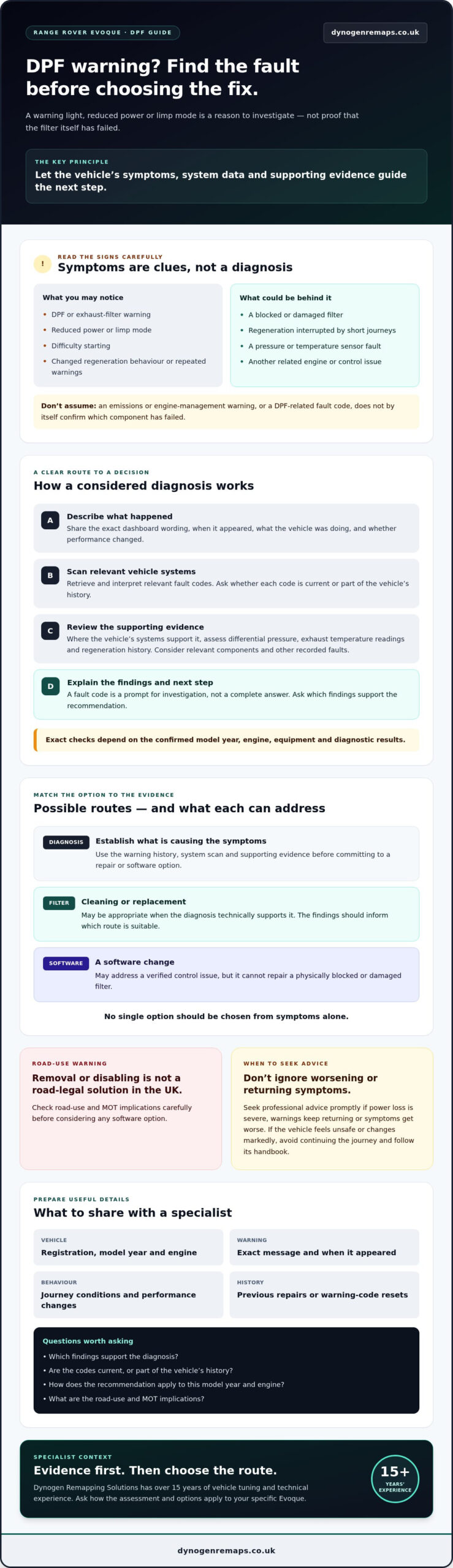
- Ask for a methodical assessment. Symptoms, relevant system scans and supporting evidence should inform the recommended next step.
- The right Range Rover Evoque DPF solution depends on the findings. Cleaning or replacement may be appropriate when technically supported.
- A software change may address a verified control issue, but it cannot repair physical filter damage. Check road-use and MOT implications carefully.
- When speaking to a specialist, share your Evoque’s model year, engine, warning messages and repair history. Ask how the options apply to your vehicle.
Range Rover Evoque DPF problems: what the warning signs can tell you
A DPF warning light, restricted performance or limp mode can disrupt everyday driving. These signs deserve attention, but they’re clues, not a diagnosis. A blocked filter is one possibility; a sensor or another engine-management fault may produce similar symptoms. A dashboard warning associated with emissions or engine management doesn’t, by itself, confirm that the DPF has failed.
The DPF captures particulate matter from the exhaust and periodically regenerates to burn off accumulated soot. For an overview of what a diesel particulate filter (DPF) is and how regeneration works, see Wikipedia. The exact warning displayed and the vehicle’s operating conditions help a technician decide what to investigate. Clearing a message alone won’t establish why it appeared.
Record the exact dashboard wording, when the warning appeared and what the vehicle was doing. Note whether the journey was short or long, whether performance changed, and whether the message returns after the car has been switched off and restarted. This history can help distinguish a recurring fault from a temporary warning and make an assessment more focused.
Which Evoque DPF symptoms should prompt a diagnosis?
Arrange an assessment if a warning persists or returns, power drops, the vehicle enters limp mode, or regeneration seems to be happening differently. These symptoms can overlap with faults in pressure or temperature sensors and related engine systems, so don’t assume the filter itself is the cause. Repeatedly clearing warnings without investigating why they return can also make the fault history harder to interpret.
- DPF or exhaust-filter warning, including any accompanying message.
- Reduced power, limp mode or difficulty starting.
- A noticeable change in regeneration behaviour or repeated warnings.
Why the model year and engine matter
Before seeking a Range Rover Evoque DPF solution, note the registration, model year, engine and exact warning shown. Evoque versions may use different equipment and diagnostic procedures, so information from another year or engine may not apply. Ask the specialist to check any engine-specific explanation against reliable service information for your vehicle rather than relying on a general online guide.
Keep details of previous repairs or warning-code resets, too. A clear history helps a specialist interpret current symptoms alongside earlier work. At this stage, the aim isn’t to choose a fix from the dashboard message alone. It’s to give the technician accurate information and establish what needs checking next.
How a specialist diagnoses a Range Rover Evoque DPF fault
A reliable diagnosis follows the evidence in sequence: confirm the reported symptoms, scan relevant vehicle systems, assess available data and physical evidence, then explain suitable next steps. A fault code identifies an issue detected by the vehicle’s system. On its own, it doesn’t prove which component caused the issue or what repair is needed.
For example, a DPF-related code may prompt checks of the filter system, but the technician should interpret it alongside the warning history and other findings. The AA’s guidance on a warning light showing that the filter’s blocked provides useful driver-focused context. Diagnosis still needs to be specific to the vehicle in front of the technician.
What should an Evoque DPF diagnostic check include?
A considered check should retrieve and interpret relevant fault codes, then review available data such as differential pressure, exhaust temperature readings and regeneration history, where the vehicle’s systems support it. The specialist may inspect relevant components and consider whether other recorded faults could be affecting DPF operation. Ask which findings support the diagnosis and whether each code is current or part of the vehicle’s history. One code or reading should not be treated as a complete answer.
Exact procedures depend on the confirmed model year, engine, equipment and diagnostic results. Your account is useful evidence too: share when warnings appeared, how the vehicle behaved and whether previous repairs or resets were carried out.
When should the owner stop driving and seek advice?
Seek professional advice promptly if power loss is severe, warnings keep returning or symptoms are getting worse. If the vehicle feels unsafe or its behaviour changes markedly, avoid continuing the journey and follow the guidance in its handbook. Don’t try to force regeneration by adopting a generic driving pattern found online. The right advice depends on the vehicle’s condition and the warning displayed.
A specialist should make clear what has been checked, what remains uncertain and why a particular next step is being recommended. If you’re considering a Range Rover Evoque DPF solution, share your vehicle details and diagnostic findings with a technical specialist before agreeing to work. Dynogen Remapping Solutions has over 15 years of vehicle tuning and technical experience. You can discuss DPF-related technical options once your symptoms and fault data have been assessed.
Compare Range Rover Evoque DPF solution options before you commit
Once the fault has been assessed, compare recommendations against the evidence, not just the dashboard symptom. A blocked filter, a sensor problem and a control issue call for different responses. A sound proposal should explain what the checks found, what the work is intended to address and whether it’s suitable for your vehicle and road use.
Repair, cleaning, or replacement: what determines the route?
The right route depends on the confirmed cause and the DPF’s condition. Cleaning may be considered if assessment shows the filter is suitable for it, but it isn’t a universal remedy. If inspection identifies physical damage or a condition that makes cleaning unsuitable, replacement may need to be considered. Ask the provider to connect the recommendation to specific findings rather than relying on the warning message alone.
| Option | Purpose | When it may be considered | Questions to ask |
|---|---|---|---|
| Diagnosis-led repair | Address an identified fault affecting DPF operation. | When checks point to a repairable cause in a related component or system. | What evidence identifies the cause, and how will the repair be verified? |
| Professional cleaning | Remove accumulated material from a filter that’s assessed as suitable. | When inspection supports cleaning and the filter’s condition allows it. | How was suitability established, and what happens if the underlying cause remains? |
| Replacement | Fit another filter where the existing unit isn’t suitable for continued use. | When inspection finds damage or another condition that rules out an appropriate repair or clean. | What condition was found, and what specification is proposed? |
| Software intervention | Address a verified control or coding issue, where technically appropriate. | Only when diagnosis identifies a software-related fault and the proposed work is suitable for road use. | What exactly will change, why is it needed, and is it road-use compliant? |
Where can DPF software intervention fit?
Software work has a limited, specific role. It may be relevant to a verified control or coding issue, but it can’t clear a physical obstruction or restore a damaged filter. Be cautious if a proposal simply suppresses a warning without explaining the fault behind it. Before agreeing, ask for a clear explanation of the work’s purpose, technical basis and suitability for UK road use.
A credible Range Rover Evoque DPF solution should distinguish between a software issue and a physical filter fault. If the explanation doesn’t connect the proposed work to the assessment, ask for clarification before committing.
Can an Evoque DPF software fix keep the vehicle road-legal?
A warning light going out doesn’t prove the fault has been repaired. Clearing a code or changing ECU software may remove a dashboard message, but that alone doesn’t show whether the DPF is functioning correctly or the cause of the warning has been addressed. A road-suitable proposal should be based on diagnosis and preserve the vehicle’s required emissions equipment.
In the UK, removing a DPF from a vehicle used on public roads is illegal. Current MOT guidance also requires the DPF to be present and intact on vehicles originally fitted with one; a missing or tampered-with filter is an automatic failure. Check the latest DVSA guidance and applicable legislation before relying on legal advice, as requirements should be confirmed against current official information.
What should you ask about DPF removal or defeat?
Don’t treat removal or emissions-system defeat as a repair for a road-going Evoque. Ask the provider to explain in writing what work is proposed, what fault it addresses and how the required emissions equipment will remain operational. If the explanation is unclear about the physical filter or the vehicle’s emissions systems, pause and seek clarification before agreeing to work.
How can you assess a software-based proposal?
Ask what fault was diagnosed and why software work is technically appropriate. Confirm whether the physical DPF and associated systems will remain in place and operate as required. Software may be relevant to a verified control or coding issue, but it can’t repair a blocked or damaged filter. Treat a promise to eliminate the warning without explaining the diagnosis as a reason to ask more questions, not as proof that the problem is solved.
A credible Range Rover Evoque DPF solution should come with a clear explanation of the findings, proposed work and road-use suitability. Ask for those points in writing, and check that the advice applies to your Evoque’s specific model and engine. If the provider can’t explain how the software change relates to the diagnosed fault, consider seeking another opinion.
Once you have the symptoms and fault information to hand, you can discuss your Evoque’s DPF symptoms with Dynogen. Dynogen Remapping Solutions offers DPF-related technical solutions and vehicle software services. Confirm the exact work proposed and its suitability for your vehicle and road use before proceeding.
Choosing a Range Rover Evoque DPF specialist and planning your next step
A capable specialist should explain how they’ll assess your Evoque, what the evidence shows and why they recommend a particular next step. Ask whether they can work with your model year, engine and relevant diagnostic systems rather than assuming advice for another Evoque applies. Dynogen Remapping Solutions has over 15 years of vehicle tuning and technical experience, and uses specialist software and equipment for its services.
Questions to ask before booking a DPF service
Before agreeing to work, ask what checks will be carried out and how the findings will guide the recommendation. Find out how the provider distinguishes a control or sensor issue from a physical filter problem. Ask for the proposed work, its purpose and its suitability for your intended road use in clear terms. A useful explanation should address your vehicle and its findings, not just promise to remove a warning.
What information to prepare for an initial discussion
Gather the registration, model year and engine details, along with the exact warning messages and a short description of how the vehicle behaves. Note when the symptoms began and include previous repairs, diagnostic scans or attempted regeneration. These details help the specialist understand the history, but they don’t establish the cause on their own. No repair or outcome should be assumed before the vehicle and available evidence are assessed.
Use this checklist to compare providers and keep the conversation focused:
- Diagnosis: Will checks be carried out before a solution is recommended, and will the findings be explained?
- Vehicle suitability: Can the provider confirm they can assess your specific Evoque model year, engine and system?
- Technical reasoning: Can they explain whether the evidence points to a control issue, a physical filter fault or another cause?
- Clear proposal: Will they state what work is proposed, what it is intended to address and whether it’s suitable for road use?
- Evidence and next steps: What information or results will help you understand the recommendation before proceeding?
The best Range Rover Evoque DPF solution is the one that follows from vehicle-specific evidence, with the work and road-use implications made clear before you commit. To discuss your vehicle’s symptoms and available information, speak to Dynogen about an Evoque DPF assessment.
Take the next step with a clear diagnosis
A DPF warning or limp mode tells you something needs investigating, not necessarily that the filter itself has failed. The right Range Rover Evoque DPF solution depends on vehicle-specific evidence, whether that points to a physical filter issue, a related fault or a verified control problem. Before agreeing to work, make sure the proposed option and its road-use implications are clearly explained.
Dynogen Remapping Solutions has over 15 years of vehicle tuning and technical experience, using specialist software and equipment across its services. Its DPF-related technical solutions may be worth discussing once your symptoms and available fault information have been assessed. Confirm that the proposed work is suitable for your Evoque and compliant for its intended road use; don’t assume a particular repair or outcome before assessment.
Prepare your model year, engine details, warning messages and repair history, then discuss your Evoque’s DPF symptoms and the appropriate next step with Dynogen. A well-informed conversation can help you make a considered decision and understand what happens next.
Frequently Asked Questions
Can a Range Rover Evoque DPF warning clear itself?
It may stop displaying temporarily, but that doesn’t prove the underlying cause has been resolved. The warning could relate to regeneration conditions, a sensor reading, the filter itself or another associated fault. Record when it appears and whether the vehicle’s performance changes. If it returns, or the Evoque enters limp mode, arrange an assessment rather than repeatedly resetting the warning and assuming the problem has gone.
What causes DPF problems in a Range Rover Evoque?
Several faults or operating conditions can cause DPF-related symptoms. Short journeys may prevent regeneration from completing, while a sensor or related engine-system fault, or a problem with the filter itself, may also be involved. The likely cause depends on the Evoque’s year, engine, fault history and diagnostic data. A warning alone can’t identify the right repair, so ask a specialist to investigate before recommending work.
Can software fix an Evoque DPF fault?
Software work may be appropriate if diagnosis identifies a relevant control or coding issue, but it can’t repair a physically blocked or damaged filter. Ask the provider to explain the confirmed fault, why software work is proposed and how the DPF and required emissions equipment will remain compliant for road use. Be cautious of promises to remove a warning without identifying its cause and explaining the technical basis for the change.
Is DPF removal legal for a Range Rover Evoque in the UK?
No. Removing a DPF from a vehicle used on UK public roads is illegal, and a diesel Evoque originally fitted with one will fail its MOT if the filter is missing or tampered with. Don’t treat removal or emissions-system defeat as a routine repair, or assume a software change makes the vehicle compliant. Check current DVSA guidance and applicable requirements, and ask the provider to explain the proposed work in writing.
Will a DPF fault put my Evoque into limp mode?
It can be associated with reduced performance or limp mode, but those symptoms don’t confirm a DPF fault. Other engine or emissions-system problems may cause similar behaviour. Record the dashboard messages and any changes in how the vehicle drives, and don’t assume that resetting the DPF warning will resolve the cause. If power loss is severe or symptoms worsen, seek qualified advice and follow the vehicle handbook.
Should I clean or replace my Range Rover Evoque’s DPF?
The right option depends on the filter’s condition and the cause of the fault. Cleaning may be considered if assessment finds the filter suitable; a damaged or unsuitable filter may need another repair route, potentially replacement. Ask what inspection findings support the recommendation and whether the underlying cause has been identified. A warning light or generic claim alone isn’t enough to establish whether cleaning or replacement is appropriate.
What information should I give a DPF specialist about my Evoque?
Share the registration, model year, engine details and exact dashboard messages. Describe when symptoms began, the conditions in which they occur and any loss of power. Include previous repairs, diagnostic scans or attempted regeneration, if known. This history helps a specialist decide which checks may be relevant, but it doesn’t replace diagnosis. Ask what work is proposed, how it addresses the identified fault and whether it’s suitable for road use.