
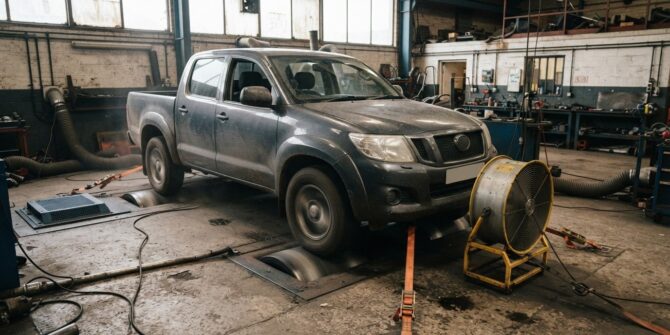
More power alone doesn’t make a 4×4 better to drive. Performance tuning for 4×4 vehicles is about shaping power and torque alongside throttle response, so the engine’s delivery feels better suited to the vehicle and how it’s used.
A 4WD rolling road allows technicians to assess the vehicle under controlled loads and speeds, gather performance data and see how power is distributed through the drivetrain. That information can help guide a custom ECU remap, with adjustments tailored to the engine rather than applied as a one-size-fits-all setting.
If you’re considering a remap for a car, van or pickup, it’s natural to want clear answers about what the process can change. This article explains how rolling-road testing and ECU calibration work, how they can affect power, torque, throttle response and fuel efficiency, and what to consider when choosing a tuning approach. The aim is a smoother, more responsive 4×4, with changes informed by the vehicle’s performance data.
Key Takeaways
- Focus on how power and torque are delivered, not just peak output, to improve control and throttle response on varied terrain.
- Rolling-road testing can reveal how a 4WD performs under different loads and how power is distributed through the drivetrain.
- A tailored ECU remap starts with an assessment of the vehicle’s engine controls and intended use, whether it’s a car, van or pickup.
- Fuel efficiency depends on calibration and how the vehicle is driven, so consider your usual journeys and workload when choosing a tuning goal.
- Explore a Stage 1 Performance Remap when sharper response and stronger performance are your priorities.
ECU remapping for improved engine power, torque and throttle response
An ECU remap adjusts engine-control settings to change how power and torque are delivered. For a 4×4, the useful result is responsive, controllable performance, not simply a larger peak figure.
Engine power and torque gains
An engine remap can alter calibration to increase power or make torque available more effectively across the rev range. The best outcome depends on the engine, its existing condition and the intended use, such as carrying a load or driving on difficult terrain. Look beyond a headline peak: consider where torque arrives and whether delivery remains smooth. A controlled increase can make acceleration feel stronger without making the vehicle awkward to drive.
Throttle response and usable torque
Throttle response is how quickly the engine reacts when you press the accelerator. Calibration can change this response, helping address a delayed or uneven feel at low speeds. Usable torque is the pulling force available in the conditions where you drive, not just a peak reached briefly at higher revs. For example, steady delivery at low engine speeds can make careful manoeuvring on a steep track easier to control.
Power, torque and drivability measurement
Power and torque figures describe different aspects of engine output, so one peak number cannot capture the whole driving experience. A technician can compare measured output before and after calibration, then assess how delivery changes across engine speeds. Drivability also depends on throttle response, smoothness and engine behaviour under load. A sharp rise in torque, for example, is less useful if it makes acceleration abrupt during low-speed manoeuvres.
Gearbox tuning can complement engine calibration by adjusting shift points, shift speed and torque limits. Earlier or later shifts change how long the engine stays in each gear, while quicker shifts can make acceleration feel more direct. Torque limits help manage the power passed through the transmission. Settings should suit both the gearbox and the engine’s revised delivery, so the two calibrations work together.
For UK road use, emissions compliance matters as much as performance. UK Government legislation states that a vehicle fails type-approval testing if it exceeds a criteria-emissions limit during any test. MOT requirements for vehicle condition and emissions also apply, so a remap should not compromise systems that control exhaust emissions.
Tell your insurer about an ECU remap or other performance modification, as changes may affect how it assesses your vehicle and cover. Vehicle tax is separate from an advertised power gain. If considering tax implications, refer to the vehicle’s recorded details and the applicable tax rules.
Changing tyre size affects effective gearing, acceleration, speedometer readings and the demands placed on the engine. Larger tyres can make the gearing taller, while smaller tyres can have the opposite effect. The transmission and intended use also influence the outcome.
More torque can put additional strain on the clutch, gearbox and drivetrain, especially if components are worn or the vehicle regularly carries heavy loads. Calibration can also affect emissions performance and manufacturer warranty terms. Consider the vehicle’s condition and intended use when deciding whether a remap is suitable.
Rolling-road dyno testing and steady-state tuning
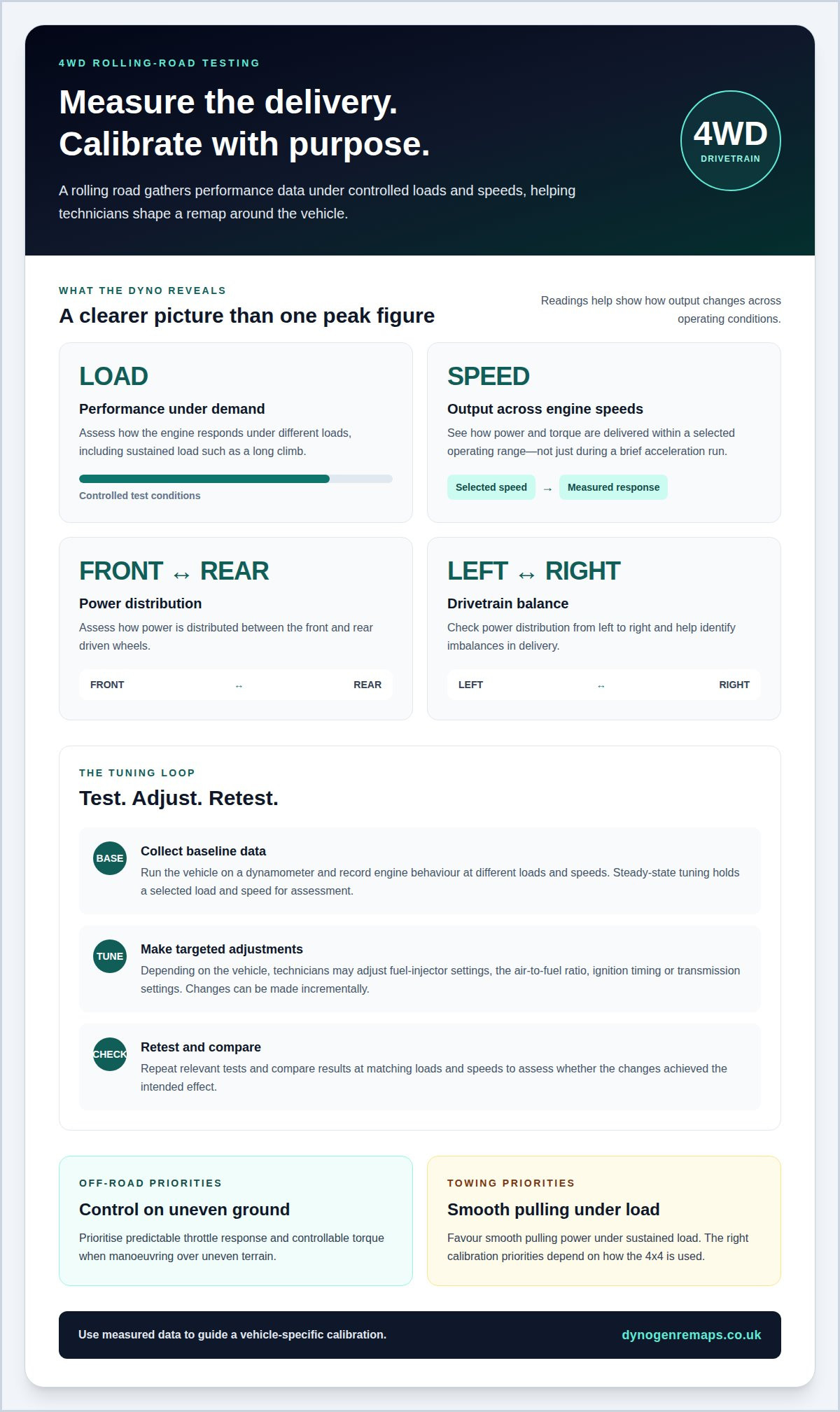
A 4WD rolling road lets technicians assess a four-wheel-drive vehicle under controlled test conditions. It provides performance data at different loads and speeds, helping guide tuning decisions.
During testing, the vehicle runs on a dynamometer, often called a dyno, while technicians collect engine data. Steady-state tuning holds the engine at a selected load and speed instead of relying only on a brief acceleration run. This can show how power and torque are delivered within a particular operating range. For example, data collected under sustained load may help show how the engine responds during a long climb.
A four-wheel-drive system needs assessment across its driven wheels. Rolling-road testing can measure power distribution from front to rear and from left to right, helping identify imbalances in delivery. Technicians can also examine behaviour at different speeds and loads, then relate those readings to the vehicle’s intended use. A pickup that regularly carries equipment, for instance, has different demands from a 4×4 mainly used for light off-road driving.
Test data can guide changes to engine and transmission settings. Depending on the vehicle, adjustments may include fuel-injector settings, the air-to-fuel ratio, ignition timing or transmission settings. Each affects how the engine produces torque and responds under load. Technicians can adjust settings incrementally, then repeat relevant tests to assess the results. Comparing the data helps distinguish a useful change from one that only alters a peak reading.
After making adjustments, technicians retest the vehicle to review its revised output and power delivery. Comparing results at matching loads and speeds shows whether the changes achieved the intended effect. Retesting also allows technicians to assess the vehicle’s behaviour and stability under test conditions, rather than relying on an unmeasured impression from the road.
Off-road upgrades prioritise predictable throttle response and controllable torque when manoeuvring over uneven ground. For drivers planning self-drive overland travel—such as the remote expeditions organised by mintadventures.com—controllable low-end delivery is indispensable. Towing-focused calibration instead favours smooth pulling power under sustained load, so the right priorities depend on how the 4×4 is used.
A considered UK tuning process starts by assessing the engine controls, then moves through baseline testing, targeted adjustments and retesting. Emissions performance must also remain in view: UK Government legislation states that a vehicle fails type-approval testing if it exceeds a criteria-emissions limit during any test. This requirement helps keep calibration decisions responsible.
If the testing points towards ECU calibration for stronger, more responsive delivery, explore the Stage 1 Performance Remap as a next step. The calibration goal should reflect the vehicle’s measured behaviour and whether it spends more time towing, travelling off-road or carrying a load.
Custom ECU remaps for cars, vans and pickups
A custom ECU remap starts with the vehicle’s existing engine controls, not a generic file chosen by body style. The initial assessment identifies which control settings may need improvement before calibration begins. A 4×4 car, a working van and a pickup can share four-wheel drive, yet differ in engine, transmission, load and everyday demands. Performance tuning for 4×4 vehicles should reflect those differences from the outset.
The intended use helps define the tuning objective. A vehicle used mainly for road journeys may benefit from smoother acceleration and more immediate response. A van carrying tools may need useful pulling power as its load changes. A pickup used for towing or rough tracks needs calibration suited to those demands. Consider how and where you drive to identify which aspects of engine behaviour matter most.
A careful process follows clear steps:
- Assess the vehicle. Review its engine-control system and existing behaviour before changing settings. This establishes a starting point for calibration.
- Define the priority. Identify whether the driver values response, pulling performance, or a balance suited to mixed use. A loaded van has different demands from an unladen one.
- Develop the calibration. Adjust relevant engine-control settings to suit the vehicle and chosen objective. Changes should work with the engine’s existing configuration.
- Review the result. Assess whether the remap delivers the intended behaviour, such as smoother acceleration in a 4×4 car or stronger-feeling response under load in a pickup.
Vehicle type alone doesn’t determine the right calibration. Two pickups can have different engines, gearboxes and working roles; one may spend its time carrying equipment, while another regularly travels without a load. Those differences affect how the engine is used. Performance tuning for 4×4 vehicles needs to account for the specific model and its real workload, rather than assuming every vehicle in a category should behave alike.
An ECU remap also involves choosing the right balance. Sharper accelerator response can make a vehicle feel more immediate, but the desired character may differ between a road-going car and a van used for steady work. For a pickup with mixed use, a measured approach can account for everyday journeys as well as heavier demands. The aim is consistent engine behaviour in the conditions that matter to you.
The vehicle’s condition and configuration provide essential context before calibration. Existing engine or transmission concerns can affect whether a change is suitable, so an assessment should separate the tuning objective from any underlying fault. Calibration can then be developed around the vehicle’s actual controls and role, rather than treating a symptom as a tuning target.
Custom calibration is most useful when the driver can describe a clear goal, such as improved response in a 4×4 car or more composed pulling performance from a working pickup. Matching that goal to the engine-control assessment gives the remap a practical purpose. It also makes the outcome easier to judge by how the vehicle behaves in its intended use, not by a headline figure alone.
Fuel efficiency
Fuel use depends on more than an ECU setting. A 4×4’s weight, load, route, tyre choice and driving style all affect the work its engine must do. An economy-focused calibration can adjust engine behaviour towards efficient operation, but its effect depends on how the vehicle is used. A lightly loaded car on steady roads presents different demands from a pickup carrying equipment across uneven ground.
Driving habits affect how much potential fuel economy you achieve. Repeated hard acceleration, high engine speeds and frequent braking use more energy than smooth, measured driving. For example, accelerating gently and anticipating traffic can help avoid unnecessary speed changes. On stop-start journeys, an efficient calibration cannot recover energy used through repeated acceleration, so route and driving conditions still matter.
Load is another key factor. Tools in a work van, a trailer behind a pickup or camping equipment in a 4×4 all add weight, increasing the effort needed to move the vehicle. A remap developed for an unladen vehicle may not reflect its usual working conditions. Calibration goals should account for the load the vehicle carries most often, rather than an occasional journey with no cargo.
The gearbox also affects fuel use. Gear selection determines engine speed under a given road load, and a vehicle staying in a lower gear may use a different amount of fuel from one travelling in a higher gear. Gearbox behaviour, engine calibration and driving conditions all play a part. For example, a van on rolling A-roads may shift differently from a pickup climbing a steep access track.
Tyres and terrain matter too. Low pressure or unsuitable tyres can increase rolling resistance, while rough tracks demand more effort than smooth tarmac. A 4×4 used for farm access, for instance, faces changing surfaces that affect both traction and fuel demand. These conditions should inform the intended calibration, rather than treating a single road journey as representative of every use.
To assess an economy-focused remap, compare the same vehicle in similar conditions before and after calibration. Keep the route, load, driving style and fuel-measurement method as consistent as possible. Records from comparable journeys are more informative than a single trip, when traffic, weather or terrain may differ. Note whether the vehicle carried a trailer or equipment, as these changes affect the comparison.
Choose the primary objective before calibration: lower fuel use during regular road driving, or practical response under the load the vehicle usually carries. These aims can influence how the engine delivers torque and how often the driver needs to change gear. A working van that spends its day laden has different priorities from a family 4×4 used mainly for commuting. Matching the calibration to that pattern gives fuel efficiency a meaningful, real-world context.
How do engine remapping and tuning affect 4×4 power, torque and fuel economy?
Engine remapping changes how the engine responds to driver demand, affecting power delivery, torque and fuel use. These outcomes are linked: a calibration that prioritises stronger acceleration may encourage more fuel use if the driver regularly uses that extra response. For a 4×4 used on mixed journeys, the useful balance depends on its typical load, route and driving pattern.
Power affects how quickly a vehicle can perform work, while torque provides the pulling force that helps it move under load. Tuning can adjust both to help a four-wheel-drive vehicle tackle challenging terrain without over-exerting or stalling. For example, a pickup climbing a rough track needs controlled pulling performance, not just a peak power figure that matters briefly during acceleration.
Throttle response changes how promptly the engine reacts to the accelerator. A more immediate response can make a vehicle feel livelier, but smooth control matters on loose ground or during precise manoeuvres. Consider a 4×4 easing over an uneven surface: predictable delivery makes it easier to adjust speed gradually than a sudden surge of power.
Fuel economy depends on how the engine is calibrated and how the vehicle is driven. A driver who uses stronger acceleration frequently may consume more fuel, while steady inputs and consistent speeds can support more economical driving. A loaded van on short, stop-start trips also has different demands from a lightly loaded 4×4 travelling on open roads.
Calibration priorities therefore involve trade-offs. A performance-led setup focuses on response and pulling power; an economy-led approach prioritises efficient engine behaviour in the vehicle’s usual operating conditions. Neither objective removes the influence of weight, terrain, tyre choice or driving style. For example, a pickup towing regularly needs a different balance from a family 4×4 used mainly for commuting.
Judge the result against the vehicle’s actual role. For a working van, assess how it responds with its usual load. For an off-road vehicle, consider whether power arrives smoothly during low-speed control. For a road-going 4×4, consider acceleration and fuel use across familiar journeys. These practical measures give meaning to changes in output, beyond a single headline figure.
A remap is most useful when its goal is clear before calibration begins. Decide whether stronger pulling performance, sharper response or fuel-conscious operation matters most, then weigh that priority against the vehicle’s regular use. A 4×4 that alternates between towing and everyday driving may need a considered compromise rather than an extreme setting.
For a tailored assessment of your vehicle’s performance goals, explore ECU remapping as a practical next step.
Dynogen Remapping Solutions: Stage 1 Performance Remap
Dynogen Remapping Solutions offers a Stage 1 Performance Remap for drivers seeking a more responsive engine and stronger performance from their 4×4. It’s a relevant next step when you’ve identified how you use the vehicle and want its engine calibration aligned with those priorities, whether that means road response, carrying a load or off-road driving.
If fuel-conscious driving is your priority, Dynogen Remapping Solutions’ Economy Remap may suit you better. The right option depends on your vehicle and the outcome you want, not simply its body style. Explain your priorities, such as sharper throttle response or efficiency on regular journeys, to establish a practical tuning goal.
For advice on the right remap for your vehicle, contact Dynogen Remapping Solutions.
Choose a tuning goal that fits your next journey
The best next step is to decide what you want your 4×4 to do better in everyday use. A clear priority helps keep performance tuning for 4×4 vehicles focused on your real needs, rather than chasing figures that don’t reflect how you drive. Consider whether your main aim is a more engaging drive, fuel-conscious operation or support with another vehicle system.
Dynogen Remapping Solutions offers a Stage 1 Performance Remap, an Economy Remap and an AdBlue Solution. Each addresses a different requirement, so the right conversation starts with your vehicle and what you want to achieve. Sharing its typical use and your priorities gives the discussion a practical starting point.
There’s no need to have every technical detail worked out before taking that step. Contact Dynogen Remapping Solutions to discuss your 4×4 and the options that suit your goals. A considered decision can help make your next drive feel more purposeful.
Frequently Asked Questions
How does 4WD Rolling Road Tuning work?
A four-wheel-drive dynamometer tests the vehicle under controlled loads and speeds. Results can show how power is shared across the drivetrain and help identify where calibration could be adjusted. For a meaningful comparison, technicians assess readings before and after changes under comparable conditions, then consider whether the revised delivery suits the vehicle’s intended use.
What are the best performance upgrades for 4×4 vehicles?
The right upgrade depends on what you want your 4×4 to do. For stronger engine performance and response, a Stage 1 Performance Remap may suit your goal; for fuel-conscious operation, consider an Economy Remap. For example, a pickup used mainly for towing and a family 4×4 driven on regular road journeys have different priorities. Choose the option that matches your vehicle’s use and the change you want to feel.
Which UK laws and MOT rules apply to 4×4 performance modifications?
A remap must not compromise systems that control exhaust emissions. Type-approval testing rejects a vehicle that exceeds a criteria-emissions limit during any test, and MOT requirements for vehicle condition and emissions still apply.