

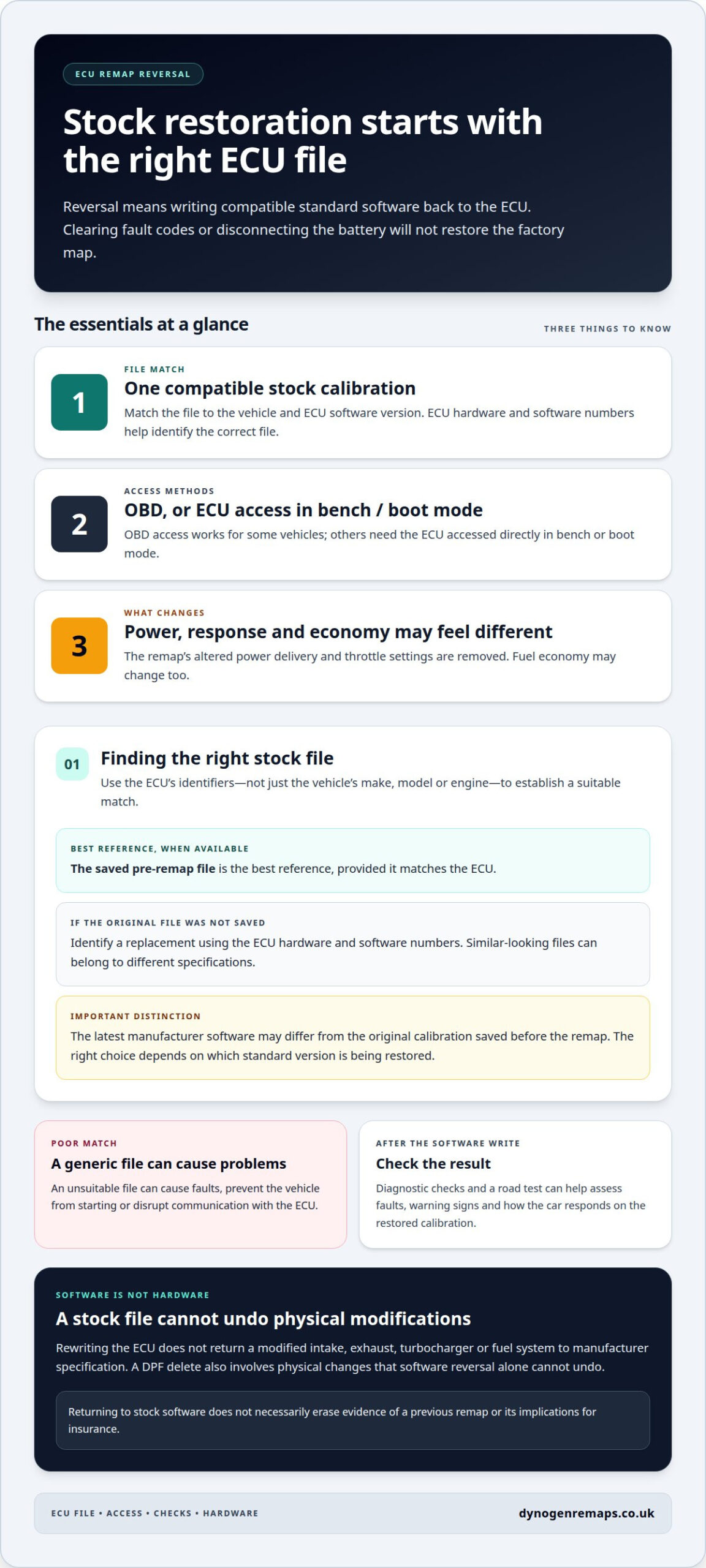
A remap is reversed by writing a compatible original ECU file back to the vehicle. Disconnecting the battery or clearing fault codes will not restore factory software. To understand how to revert a remap to stock, the key steps are identifying a file that matches the vehicle and ECU software version, then having it written correctly.
Restoring the original calibration also changes how the car drives. The sharper throttle response, increased boost and power delivery associated with a remap will be lost, and fuel economy may change. Rewriting the software alone will not return modified hardware to factory specification.
This guide explains how ECU remap reversal works, what information helps identify a suitable standard file, and what to expect afterwards. It also covers why professional work includes fault checks, and why returning to stock does not necessarily erase evidence of a previous remap or its implications for insurance.
Key Takeaways
- Returning the ECU to its original calibration removes the remap’s changes to power delivery and throttle response, while fuel economy may also change.
- A suitable stock file must match the vehicle and its ECU software version; a generic file can cause faults or prevent the vehicle from starting.
- Reversal requires rewriting the ECU software. Disconnecting the battery or clearing fault codes won’t restore the factory map.
- OBD access works for some vehicles, while others need the ECU accessed in bench or boot mode.
- Restoring software doesn’t return modified hardware to factory specification or erase the car’s remapping history, so consider insurance disclosure as well.
Changes in power, throttle response and fuel economy after reversal
Restoring the original ECU calibration removes the adjustments made by the remap. This changes how the engine responds to the accelerator, delivers boost and produces power. For example, a car that previously pulled strongly in a higher gear may feel less urgent on factory settings. That difference reflects the software change, not necessarily a new mechanical fault.
Throttle response may feel less immediate because the original calibration no longer uses the remap’s revised settings. Turbocharged vehicles may also feel different as boost delivery returns to the standard map. The change is most noticeable when a driver has grown used to remapped behaviour during everyday driving, such as overtaking or joining a motorway.
Fuel economy may change too. A remap can include fuel-efficiency adjustments, so restoring the original file removes them. That does not mean every journey will use more fuel: traffic, road type, load, driving style and engine condition all affect consumption. Compare similar routes and driving conditions before drawing conclusions from a change in the dashboard reading.
The result depends on what the remap changed. A performance calibration may have altered power delivery and throttle behaviour, while an economy-focused calibration may have aimed to improve efficiency. After reversal, the vehicle uses the standard calibration. The original map restores factory engine settings, but it cannot compensate for worn components or unrelated mechanical problems.
- Power: expect the remap’s additional power delivery to be removed.
- Throttle: accelerator response returns to the behaviour programmed into the original calibration.
- Economy: efficiency changes from the remap are removed, but actual fuel use still varies with driving conditions.
Hardware matters too. Rewriting the ECU will not return a modified intake, exhaust, turbocharger or fuel system to manufacturer specification. For example, a car with an upgraded turbo may behave differently on standard software from one with its original turbo. A DPF delete also involves physical changes that a software reversal alone cannot undo. Restoring standard software may mean the DPF needs replacement or specialist cleaning.
After the file is restored, diagnostic checks help identify faults that could affect performance or fuel consumption. A road test can then assess whether the car’s response matches the restored calibration and whether warning signs remain. If power feels inconsistent or economy changes sharply, assess those symptoms separately rather than automatically attributing them to the software overwrite.
Finding a matching stock file
Restoring an ECU remap involves writing a standard software file that matches the vehicle and its ECU version. The correct file returns the engine control unit to its intended calibration. A file that merely looks suitable can cause faults, prevent the vehicle from starting or disrupt communication with the ECU.
The best reference is the original file saved before the remap. However, remapping normally overwrites the ECU’s existing map, so that copy may no longer be in the vehicle. If the original was not saved, a standard file must be sourced using the ECU hardware and software numbers. These identifiers help distinguish files that may look similar but belong to different specifications.
The vehicle’s make, model and engine alone do not establish a match. The ECU’s own hardware and software identifiers matter because vehicles in the same range can use different control units or software versions. A specialist uses those details to identify a suitable file before writing it. Matching the file is essential to restoring the intended settings, rather than simply selecting a generic factory map.
A generic file can be unsuitable even if it is described as standard for that model. Differences in ECU version or vehicle specification can leave systems working incorrectly. In serious cases, an unsuitable write may cause faults, prevent the vehicle from starting or disrupt communication. The file should be matched to the ECU, not chosen from the registration or model name alone.
There is also a distinction between the original calibration and the latest manufacturer software. A manufacturer update released after the car was built may have changed its standard software. That newer version might suit the ECU, but it is not necessarily identical to the file saved before the remap. The right choice depends on whether the aim is to restore the saved original or install a compatible standard version.
- Original file: use the saved pre-remap file when it’s available and matches the ECU.
- Replacement file: identify it against the ECU hardware and software numbers.
- Latest standard software: treat it as potentially different from the vehicle’s original calibration.
When a vehicle has been tuned more than once, its software history can be harder to identify. Records of earlier work and available ECU details help a specialist establish which calibration is present and what file is appropriate. This is particularly important when different providers have written software at different times.
If you’re considering a calibration change, explore vehicle remapping information to understand how software choices affect a vehicle’s settings.
Reversing ECU remapping
Reversing an ECU remap means restoring standard software to the engine control unit. Understanding how to revert a remap to stock starts with identifying the calibration and access method suited to that ECU. The correct file and post-write checks matter because the ECU controls engine operation.
The reversal process
The process involves identifying suitable standard software, writing it to the ECU, and checking the vehicle’s operation. Remapping normally overwrites the original map, so the earlier file may need to be sourced and matched to the ECU. An unsuitable write can cause faults, starting problems or loss of communication, making file selection a key part of the work.
After the software is restored, diagnostic checks can reveal fault codes. A road test can assess whether the engine runs as expected in normal driving conditions. These checks help confirm the result of the write, rather than assuming that a completed programming session means every system is operating correctly.
Cost of reverting a remap
The cost in the UK depends on the work involved and is provided after a quote request. Factors include whether a suitable standard file is available, how the ECU must be accessed, and whether diagnostic checks or further work are needed.
A saved original file may simplify sourcing, while an unclear software history can require more investigation. A vehicle tuned by different providers may need closer identification before the correct calibration is selected. ECU access requirements also affect the work involved, particularly when OBD access is not suitable.
Time needed to restore the stock map
The time required depends on the ECU access method, file matching and checks after writing. Some ECUs can be read and written through the OBD port; others require bench or boot-mode access, which changes the work involved.
File identification can also affect the process. If the original software was not saved, the standard file must be matched to the ECU hardware and software numbers before restoration. Diagnostic checks and a road test add further steps. For drivers considering how to revert a remap to stock, these technical stages explain why the work varies between vehicles.
Could reverting a remap cause engine or ECU problems? Yes. An unsuitable standard file can cause engine faults, prevent the vehicle from starting or disrupt ECU communication, so correct file matching and diagnostic checks matter.
Does reverting an ECU remap restore the original warranty? No. A remap generally affects the manufacturer warranty, and returning the software to stock does not require the manufacturer to treat the vehicle as though it was never modified.
Restoring the map also does not remove hardware changes such as modifications to the intake, exhaust, turbocharger or fuel system. For example, an engine with a modified turbo may not behave like a factory-standard vehicle after its software is restored.
Keep records of the remap and reversal, including any available file details. If an insurer asks about modifications, returning to factory settings does not erase the vehicle’s remapping history or necessarily remove disclosure obligations under the policy.
Using the OBD port to return to stock
An OBD remapping service can use the vehicle’s diagnostic port to write standard software over an existing tune. The method depends on whether that ECU supports reading and writing through the port.
For an OBD-compatible ECU, the process starts by connecting suitable diagnostic equipment to the vehicle’s OBD port. The ECU is identified, and the matching original software is selected before writing begins. That file overwrites the tuning software and restores the factory calibration stored in the ECU. The vehicle’s power and driving behaviour then reflect the restored map, rather than the previous remap.
OBD access is not available for every ECU. Some units can be read but not written through the port, while others require bench or boot-mode access. In bench mode, the ECU is accessed after removal from the vehicle; boot-mode access uses a specific connection to communicate with it. These methods still involve writing the correct software, but do not rely on the OBD port alone.
A locked ECU may prevent a standard OBD write. Restoring stock settings then involves using an appropriate bench or boot-mode method to access the unit and write compatible original software. The access route depends on the ECU design and its security state, so the technician selects the method that supports that specific control unit.
After the software write, diagnostic equipment can check for fault codes and confirm communication with the ECU. A road test can assess engine operation and driving response in normal conditions. These checks are useful because a completed write alone does not establish that the vehicle is operating correctly. Any fault or communication issue needs attention before the work is considered complete.
Does returning a car to stock affect insurance or MOT requirements in the UK? Tell your insurer about both the remap and its reversal, because restoring software doesn’t erase the vehicle’s modification history. According to legislation.gov.uk, a road vehicle first used on or after 1 January 2001 that doesn’t meet its applicable emissions limits may be subject to an offence, subject to stated exceptions.
A tuning box is different from an ECU remap. It can often be removed and its original connectors reinstated without changing the ECU’s internal software. That distinction matters: restoring the ECU map will not remove a separate box, while removing a box will not rewrite remapped ECU software. Identifying which type of tuning is fitted determines the appropriate return-to-stock method.
Information needed to restore a remapped ECU to stock
Restoring a remapped ECU depends on identifying the software and hardware currently in the vehicle. The ECU hardware and software numbers help match a standard file to that specific control unit. Make, model and engine details provide useful context, but do not replace ECU identifiers when selecting the file.
A saved copy of the original calibration is valuable because it records the software installed before tuning. However, remapping normally overwrites the ECU’s original map. If that file was not saved, the replacement must be sourced and matched to the ECU hardware and software numbers. A generic file can be wrong for the vehicle’s specification.
There is a distinction between restoring the saved original and installing the latest standard manufacturer software. A later manufacturer update may differ from the file present before the remap. The intended outcome matters: returning to the earlier calibration and updating to current standard software are not necessarily the same task.
Software history adds another layer. A vehicle tuned more than once, particularly by different providers, can have a difficult-to-identify calibration history. Records of previous remapping, saved files and ECU details help establish which software is present. Without a clear history, ECU identification is central to choosing a suitable standard file.
Some modern ECUs record flash counters, programming events or diagnostic information. These records can help show that software was written, but they do not automatically identify the correct original file. A specialist combines available ECU information with the vehicle’s software history to determine which standard calibration is suitable.
Useful details to gather for the restoration process include:
- ECU identifiers: the hardware and software numbers used to match the standard file.
- Previous tuning records: details of earlier remaps or providers, especially where the vehicle has been tuned more than once.
- Saved software: any original ECU file retained from before the remap.
- Intended outcome: whether the aim is to restore the saved original or use a later standard manufacturer file.
These details help avoid treating every file labelled “stock” as interchangeable. The correct calibration must suit the ECU, and an unsuitable write can cause faults, starting issues or communication problems. Diagnostic information after the write also helps assess whether the ECU is operating correctly.
For help identifying the ECU information and appropriate restoration route, discuss ECU remap restoration.
Dynogen Remapping Solutions
Dynogen Remapping Solutions helps drivers decide on their next step when reviewing ECU software and vehicle performance. If you are considering a return to standard settings or a different calibration, the right choice depends on your priorities and the vehicle’s existing modifications.
Its Stage 1 Performance Remap and Economy Remap address different driving aims, whilst its AdBlue Solution and DPF Solution relate to emissions-system concerns. These offerings are relevant when you’re considering broader tuning or system requirements, rather than assuming a software reversal alone resolves every hardware or emissions issue.
Contact Dynogen Remapping Solutions to discuss your vehicle and the options that fit your requirements.
Make the next decision with your vehicle in mind
Before arranging calibration work, decide what you want the vehicle to do next. Returning to standard settings and choosing a different tune serve different aims, so be clear about the outcome you want. Understanding how to revert a remap to stock is only part of the decision; your vehicle’s condition and any hardware changes also shape the right approach.
Prepare a concise account of the car’s history, the changes you have noticed and how you use it day to day. This gives the discussion a practical starting point and helps focus on a solution suited to your vehicle, rather than a generic software choice.
For a considered next step, contact Dynogen Remapping Solutions to discuss your requirements. A clear plan can help you move towards the driving experience you want with confidence.
Frequently Asked Questions
Can a Remap Be Removed or Returned to Factory Settings?
Yes. A suitable standard calibration can be written to the ECU, returning its software to factory settings. This changes the engine control software, not the vehicle’s physical components. For example, an aftermarket exhaust or turbocharger remains fitted after the software change. If your goal is a fully standard vehicle, consider the relevant hardware changes separately alongside the ECU work.
Is It Possible to Reverse a Remap?
Yes. An ECU remap can be reversed by restoring compatible standard software. A tuning box is different: it can often be removed and its original connectors reinstated without rewriting the ECU software. Identifying which type of tuning the car has is a useful first step. If both a box and an ECU remap are present, each needs its own appropriate reversal.
Does Returning to Standard Remove Every Trace?
No. Restoring standard software does not necessarily erase records of earlier programming. Some modern ECUs store flash counters, programming events or diagnostic information, and diagnostic equipment may still detect evidence of a remap. Records vary by vehicle and control unit. A software change also does not undo physical modifications, so an inspection may reveal non-standard components after the ECU calibration is restored.
What about a reset?
Disconnecting the battery or resetting fault codes will not remove remapping software. These actions do not rewrite the ECU’s calibration, so the remapped settings remain. Returning to standard requires writing suitable software to the engine control unit. For example, clearing a warning light may remove a stored code, but it will not restore the original engine map or reverse the tuning changes.
How do you revert an ECU remap to the stock factory software?
A technician identifies the ECU and writes a compatible standard calibration to it. The correct access method depends on the control unit: some support reading and writing through the OBD port, while others need bench or boot-mode access. After the software change, diagnostic checks can identify fault codes or communication issues. A road test can then assess engine operation in normal driving.
Can a dealer restore a car’s original ECU map, or is a backup needed?
A backup of the pre-remap file is useful, but it is not the only route to standard software. If no original copy exists, a suitable standard file can be sourced and matched to the ECU hardware and software identifiers. A dealer may install manufacturer software, but a later update can differ from the calibration saved before tuning. The intended restoration determines which file is appropriate.
Can an ECU remap be detected after the car is returned to stock?
Yes, diagnostic equipment may still find evidence of previous programming after standard software is restored. Some ECUs retain flash counters or programming-event information. Detection depends on the vehicle’s ECU and stored records, so a successful return to stock does not prove the car has no remapping history. Keep restoration records with the vehicle’s service and maintenance documents.