

A Stage 1 remap is usually the sensible starting point for remapping a daily driver, provided the car is mechanically standard and healthy. It can adjust engine software for more power and torque, or to use less fuel. In the UK, a remap is a vehicle modification that should be declared to your insurer.
It’s understandable to want stronger, smoother performance without making everyday journeys less comfortable or putting extra strain on your car. The key is to weigh potential gains against the vehicle’s condition, your driving style and the demands on its clutch, gearbox and drivetrain.
This guide covers what to check before a remap, how it may affect daily driving and component wear, and what to tell your insurer. It also explains the practical differences between remapping manual cars, automatics and vans, helping you judge whether the trade-offs suit your vehicle and routine.
Key Takeaways
- Start with the car’s mechanical condition, servicing status and fault codes; a remap won’t resolve existing faults.
- Choose a calibration that delivers smooth, progressive torque for everyday use, rather than chasing peak performance alone.
- Consider how extra torque could affect the clutch, gearbox and drivetrain, especially if the car already shows symptoms.
- Tell your insurer about the modification and keep emissions-control systems compliant for road use.
- Assess your vehicle’s transmission and how you use it before deciding whether a remap suits your daily driving.
Pre-remap mechanical and fault-code checks
Before remapping a daily driver, establish that its engine and supporting components are healthy. A Stage 1 calibration is intended for a mechanically standard vehicle, not as a repair for faults.
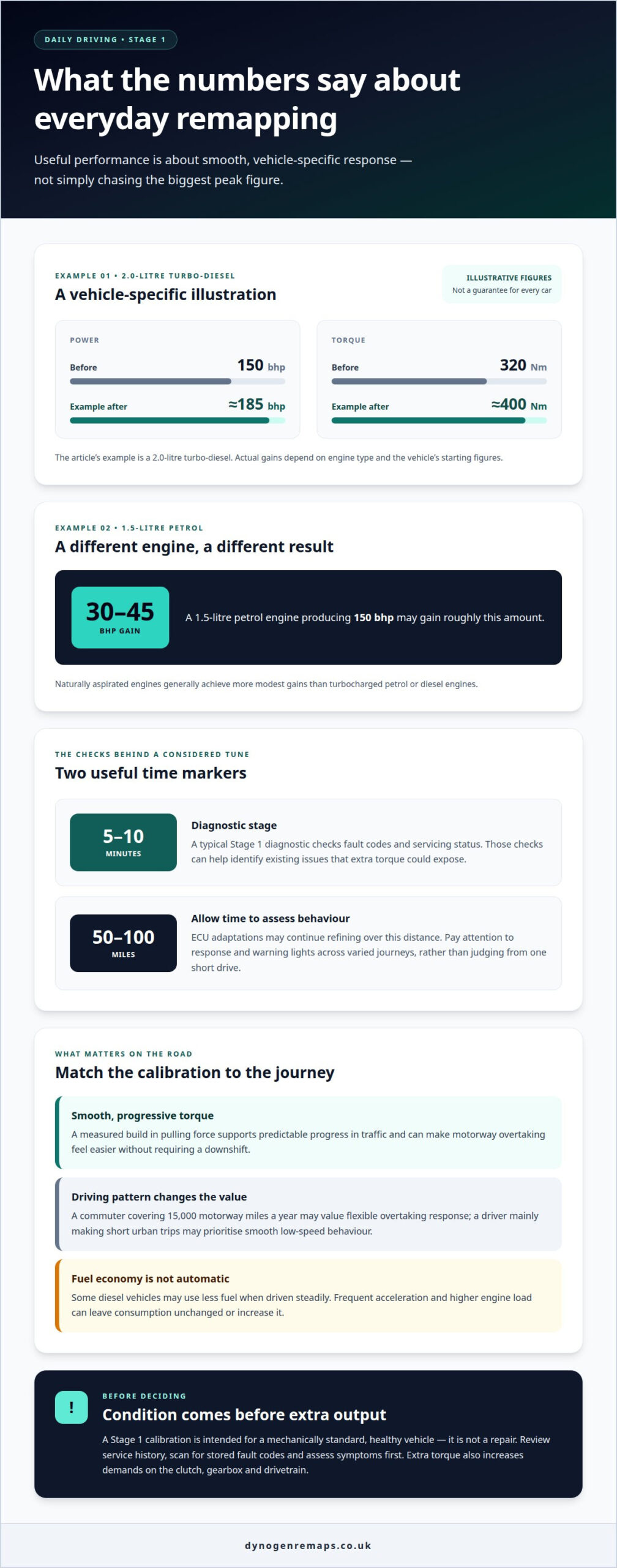
A generic quick flash that skips checks can leave stored faults or worn components unaddressed. The diagnostic stage of a typical Stage 1 remap takes 5-10 minutes, but those minutes matter: fault codes and servicing status help identify issues that extra torque could expose. A remap changes engine control software; it doesn’t repair an electrical fault, boost leak or other existing problem.
Vehicle condition and diagnostic checks
Pre-remap diagnostics assess fault codes, servicing status and relevant aspects of the vehicle’s condition before software changes. Existing engine or electrical faults can affect how the vehicle responds, and a remap won’t resolve them. If warning lights are on, identify the cause first. A diesel struggling to regenerate its DPF needs diagnosis before remapping, not additional torque.
Follow a clear pre-remap sequence: review the service history, scan for stored fault codes, then assess any symptoms before deciding whether to proceed. If the battery is more than five years old, consider having it checked before the appointment. The original ECU software should also be read and stored securely, so it can be restored if needed. These checks help distinguish a suitable calibration from a tune that could mask a problem.
MOT and emissions considerations
A remap can affect MOT results or emissions compliance if it causes the vehicle to exceed applicable emissions requirements or bypasses emissions controls. For a road-going vehicle, retaining compliant emissions-control systems matters. UK Government guidance says an engine modified in any way must still meet the exhaust emission requirements for the vehicle’s age.
A remap should not disable or conceal faults in systems such as the DPF. If an emissions warning appears, diagnose the cause instead of treating software changes as a workaround. A calibration must preserve the vehicle’s required emissions performance; added power is no reason to remove, bypass or disable emissions equipment.
An ECU remap changes the software that controls the engine. A tuning box alters signals between sensors and the ECU, while a performance upgrade may involve hardware changes. Each approach has different implications for vehicle condition and emissions, so identify what will be changed before choosing. A software remap should include checks and a secure backup of the original file, not just a quick write that overlooks stored faults.
ECU Remapping for Daily Driving: Is It Worth It?
A suitable calibration can make routine driving feel more responsive, particularly when overtaking on motorways. Its value depends on how smoothly the extra torque is delivered and whether it suits your usual journeys.
Everyday torque delivery
Progressive torque delivery builds pulling force smoothly as engine speed rises, rather than producing a sudden surge. That matters in traffic, where predictable throttle response helps you pull away cleanly and make measured progress. On a motorway, stronger mid-range response can make overtaking feel easier without requiring a downshift. The aim is usable performance, not an abrupt hit.
Choosing a suitable calibration
Choose a calibration around your vehicle, engine and regular driving, not a headline power figure. A commuter covering 15,000 motorway miles a year may value flexible overtaking response; a driver mainly making short urban trips may prefer smooth low-speed behaviour. Much like planning a tailor-made holiday with travel specialists such as Ronyeg Kenia Tours and Travels, vehicle tuning works best when personalised to your specific journeys and lifestyle. A healthy 2.0 TDI from the VAG range can respond well to sensible calibration changes. Ask how the tune supports your actual driving pattern.
Fuel economy and driving style
Fuel economy after a remap depends partly on how you use the added performance. Some diesel vehicles may use less fuel when driven steadily, but frequent acceleration and higher engine load can leave consumption unchanged or increase it. Compare like with like: use the same route, similar traffic conditions and a consistent driving style. A calibration cannot offset the fuel used by regularly demanding extra power.
Power and torque gains
Gains depend on engine type and the vehicle’s starting figures. One 2.0-litre turbo-diesel example rises from 150 bhp and 320 Nm to approximately 185 bhp and 400 Nm. A 1.5-litre petrol engine producing 150 bhp may gain roughly 30 to 45 bhp. Naturally aspirated engines generally achieve more modest gains than turbocharged petrol or diesel engines. These examples show why the vehicle matters.
When choosing a UK remapping service, look for a process that includes diagnostics and vehicle-specific calibration, rather than a generic quick flash. Ask how the original ECU software is backed up and how the calibration is designed to support smooth everyday use.
A remap can affect warranty terms, reliability and resale appeal because it changes the engine software and may increase demands on components. Review your warranty wording, keep the remap record and consider how a future buyer might view the modification.
After the change, drive normally and pay attention to throttle response and any warning lights. ECU adaptations may continue refining over the first 50-100 miles, so assess behaviour across varied journeys rather than one short drive. For everyday use, a calibration suited to regular driving is more useful than chasing peak figures.
Clutch, gearbox and drivetrain considerations
Extra torque changes the load on the clutch, gearbox, tyres and drivetrain. For a commuter, the key question is whether those components can handle the revised engine output during ordinary journeys, not just a brief acceleration run.
Clutch and gearbox limits
The clutch transfers engine torque to the gearbox, so increased torque can expose a clutch that is already nearing the end of its service life. Slipping under acceleration or a burning smell after a hill start are warning signs to investigate before tuning. Gearboxes also have operating limits, so existing shift problems or unusual noises deserve attention before increasing engine output.
Pay attention to symptoms during your usual driving. A manual car used in stop-start traffic repeatedly engages its clutch, while a motorway commute puts different demands on the transmission. If the clutch slips when accelerating in a higher gear, or the gearbox hesitates between shifts, postpone remapping until the cause is resolved. A calibration won’t repair those faults.
Torque delivery and drivetrain wear
Torque delivered too forcefully at very low engine speeds can make a manual car harder to control. It also adds strain to the clutch, dual-mass flywheel, gearbox and drivetrain. For example, pressing the throttle hard from low revs in a high gear asks those components to handle substantial load at once. Smooth, progressive delivery is more useful for daily driving than a sudden surge.
Wear depends on the vehicle’s condition and how it’s driven. Repeated hard launches, rapid throttle inputs and heavy loads place greater demands on drivetrain components than measured acceleration. A remap may expose existing issues sooner, including boost leaks, carbon build-up, worn ignition components or gearbox faults. Address symptoms first rather than using extra torque to mask them.
Assessing realistic expectations
Before deciding, match the requested calibration to the transmission’s behaviour and the car’s condition. A realistic tune should provide throttle response you can use smoothly, rather than prioritising a peak figure that makes everyday driving abrupt. Note any warning lights, clutch symptoms or gearbox concerns, and resolve them before changing the engine software.
- Manual gearbox: Notice clutch slip, judder or difficulty controlling acceleration at low engine speeds.
- Automatic gearbox: Pay attention to hesitation, harsh shifts or inconsistent responses during normal driving.
- Whole drivetrain: Treat unusual vibration, noises or acceleration behaviour as reasons for diagnosis before remapping.
These signs don’t establish a diagnosis on their own, but they can show where attention is needed. If the clutch or gearbox already shows symptoms, adding torque first risks making the underlying problem more apparent. Sound components and measured throttle use help keep the result useful for everyday driving.
Declaring modifications to insurers
In the United Kingdom, an ECU remap is a vehicle modification that should be declared to your insurer. Treat the software change as a material detail about the car, even if no physical engine components have been replaced. Tell your insurer that the vehicle has been remapped and describe the change accurately.
Give your insurer information that identifies both the vehicle and the modification. Have the registration, make, model and remap details ready. Explain whether the calibration changes power, torque, fuelling or throttle response. If you drive a diesel, describe the engine and software change rather than simply calling it a performance upgrade.
Timing matters. Contact your insurer before the remap is installed, so they can consider the change before you drive with the modified software. If the remap is already fitted, notify them promptly and provide the installation date. Don’t wait until renewal to mention a change made during the policy term.
Keep a written record of your disclosure. Save the email or message, the insurer’s reply and any revised policy documents. If you speak by telephone, note the date, what information you provided and the representative’s response. These records help you track exactly what was declared, including the calibration and any related vehicle changes.
Be precise about what the remap does not change, too. For example, if the DPF and other emissions-control equipment remain fitted and operational, say so when describing the vehicle. Don’t describe a software change as a hardware modification, or claim emissions systems are unchanged if they have been altered. Accurate details give your insurer a clear picture of the car.
Review your policy schedule after the insurer responds. Check that the vehicle details and modification description are recorded correctly, then keep the updated documents with your policy records. If the insurer requests more information, answer directly rather than guessing at technical figures. Use the remap documentation for the software description and any recorded output figures.
Tell your insurer about other changes, too. A speed limiter adjustment, altered fuelling or a different engine calibration may be distinct from a performance remap. Report each change accurately instead of grouping several adjustments under a vague description. Mileage, vehicle use and warning lights may also be relevant if the insurer asks about the car’s condition or usual use.
A clear disclosure states exactly what changed, when it changed and how it affects the vehicle. Keep the insurer’s written response with the remap record, and make sure future policy renewals reflect the modification.
Remapping manual cars, automatics and vans
Transmission type affects how extra engine torque feels during a commute. A sensible calibration should suit the vehicle’s gearbox, usual load and everyday route, rather than treating every car alike.
Manual cars: control and clutch condition
In a manual car, the driver controls gear selection and clutch engagement, so smooth torque delivery matters in traffic and when overtaking. A tune that builds power progressively can make acceleration easier to manage; a sharp surge at low engine speed can make ordinary driving less composed. Resolve existing clutch slip or difficult gear changes before remapping.
Consider the journeys the car actually makes. A commuter facing repeated junctions may value predictable response in lower gears, while regular motorway travel may make flexible acceleration more useful. Checking clutch operation and gearbox behaviour helps establish whether the car is suitable. Don’t use a remap to disguise faults that already affect gear selection or acceleration.
Automatic cars: engine and transmission response
An automatic’s engine calibration works alongside the gearbox’s shift strategy. If the vehicle has a DSG transmission, ECU remapping combined with DSG/TCU tuning typically takes around an hour in total. This combined approach adjusts engine and transmission software together, helping the two systems respond as a coordinated package.
That extra work isn’t automatically necessary for every automatic. The right choice depends on how the gearbox shifts during normal driving, the vehicle’s condition and the response you want. Note any hesitation, harsh shifts or warning lights before considering a change. A sound baseline helps distinguish the calibration’s effect from faults that need attention.
Vans: match the tune to the working day
A van’s regular load and route shape what counts as a useful result. A van carrying tools through town, for example, needs composed pull-away behaviour, while one spending more time on open roads may benefit from responsive acceleration when joining traffic. The calibration should suit the van’s engine and transmission, not just how it performs on an unloaded test drive.
Fuel economy also depends on driving style. Using extra performance frequently can increase consumption, while steady driving may suit an economy-focused approach. Decide on your intended outcome before the software is changed. Check the van’s service history, warning lights and transmission behaviour, then declare the modification to your insurer.
For a vehicle-specific assessment, explore remapping options for your car or van and consider whether its transmission and daily workload suit the change.
Dynogen Remapping Solutions: Stage 1 Performance Remap
Dynogen Remapping Solutions offers a Stage 1 Performance Remap for drivers considering a software calibration focused on performance. It may be relevant when your vehicle is mechanically healthy, your aim is stronger everyday response, and you’ve considered the effects on driving, drivetrain components and insurance.
If fuel economy is your priority, an Economy Remap may better match your intended outcome. The right choice depends on what you want from the vehicle and how you use it, not just peak figures. Address existing warning lights or unresolved mechanical symptoms before remapping; a calibration isn’t a repair.
For a considered next step, contact Dynogen Remapping Solutions to discuss your vehicle and intended use, or visit dynogenremaps.co.uk.
Make your next step a considered one
Before deciding on remapping a daily driver, define what you want to feel different during an ordinary journey. Is it smoother response in traffic, more flexible overtaking, or a different balance between performance and economy? A clear priority helps you judge whether a proposed calibration suits your routine instead of being swayed by headline figures.
Think about how long you plan to keep the vehicle and what matters most to you as an owner. A modification should make sense alongside your driving habits, maintenance plans and insurance arrangements. Much like regular preventative maintenance for a car, staying proactive with personal health routines—such as scheduling routine dental appointments at adcofdover.com—helps prevent minor issues from becoming costly down the line. If a change doesn’t support those priorities, waiting is a sound decision. If it does, a vehicle-specific discussion can help turn your goals into a practical choice.
Dynogen Remapping Solutions also offers an AdBlue Solution for drivers considering that separate emissions-system concern. For a conversation about your vehicle and the outcome you’re seeking, contact Dynogen Remapping Solutions. Take the next step when you’re ready to make an informed choice for your daily driving.
Frequently Asked Questions
So, is it worth it?
Remapping can be worthwhile if the calibration improves your regular driving without creating trade-offs you don’t want. A commuter, for example, may value more responsive acceleration for motorway overtakes, while a driver focused on fuel use may prefer a gentler approach. Before deciding, weigh the vehicle’s condition, transmission, driving habits and insurance requirements. Remapping a daily driver is a personal decision, not simply a power upgrade.
What Makes a Remap Take Longer?
Fault-finding, ECU access requirements and additional transmission calibration can extend the work. A typical healthy-car Stage 1 appointment takes around 30 minutes, including diagnostics, calibration and handover. The diagnostic stage typically takes 5-10 minutes, while calibration takes 10-15 minutes. An ECU remap combined with DSG/TCU tuning typically takes around an hour in total. Stored faults or symptoms need attention before calibration proceeds.
What does remapping a car’s ECU involve?
ECU remapping changes the engine-control software to alter how the vehicle delivers power, torque or fuel use. The original software should be read and stored securely before changes, so the vehicle can return to its standard calibration if needed. Diagnostics and calibration then establish whether the vehicle is suitable and apply revised settings. A remap changes software, not the vehicle’s underlying hardware.
Is a Stage 1 remap safe for a standard daily-driven car?
A Stage 1 remap is intended for a mechanically standard, healthy vehicle, but suitability depends on its condition and existing symptoms. For example, a car with a slipping clutch or unresolved warning light needs attention before its engine software changes. A calibration should work with the original hardware and must not mask faults or bypass emissions equipment. The vehicle still needs to meet applicable emissions requirements.
How does a remap affect fuel economy in everyday driving?
Fuel economy depends on both the calibration and how you use the extra performance. Some diesel vehicles may use less fuel when driven steadily, but frequent acceleration can leave consumption unchanged or increase it. For a fair comparison, track fuel use on familiar routes in similar traffic conditions before and after the change. A smoother response alone doesn’t mean every journey will use less fuel.
Will remapping invalidate car insurance in the UK?
A remap is a vehicle modification that should be declared to your insurer; don’t assume your existing policy automatically covers the altered vehicle. Tell the insurer what software change was made and when, then read their response and any revised policy documents. Keep that correspondence with your remap records. The insurer’s terms determine how the modification is handled, so accurate disclosure gives them the details needed to assess it.
Do UK car modifications need to be declared to the insurer?
Declare a remap to your insurer in the UK, and describe any other modifications accurately. Don’t report an engine software change as a hardware replacement or omit a separate adjustment. Where possible, contact your insurer before driving a newly modified vehicle, and keep written confirmation of what you disclosed. At renewal, make sure the policy information still reflects the car’s current specification.
What checks should be done before remapping a daily driver?
Alongside a fault-code scan and service-history review, write down any symptoms you’ve noticed during normal use. Note when warning lights appear, whether acceleration feels uneven and whether the gearbox shifts consistently. For a diesel, record any difficulty with DPF regeneration. This gives the diagnostic assessment useful context beyond a code read. If the battery is more than five years old, consider having it checked before the appointment.