
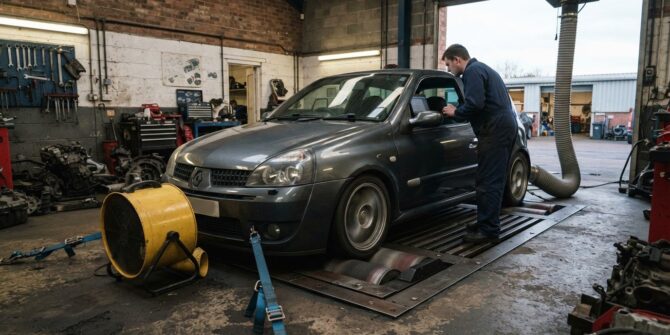
A generic remap file isn’t automatically suitable for track use: it may not account for your car’s condition, modifications or the sustained demands of a circuit. Remapping for track day performance calls for a calibration suited to the specific vehicle and its intended use. More power matters, but so does keeping the engine within sensible operating limits.
It’s understandable to want a straightforward file that sharpens response and adds performance. The key is balancing those gains with sensible protection, rather than chasing a headline power figure alone.
This article explains why generic files can fall short, how fuel delivery, ignition timing and boost influence performance, and what vehicle-specific calibration and dyno testing can contribute. It also covers supporting hardware, reliability and the different priorities of road and track use, helping you choose an appropriate tuning approach.
Key Takeaways
- A generic remap file may not reflect your car’s condition or modifications, so vehicle-specific calibration matters for sustained track use.
- Stage 1 tuning works with standard components, but the right target depends on the engine and the condition of its supporting systems.
- Fuel delivery, ignition timing and turbo boost interact; balancing them helps shape performance without focusing on peak power alone.
- Baseline data and dyno testing can help assess a calibration before the car goes on track.
- Plan for the event’s requirements as well as the tune, and understand how road use and track use can affect your ECU calibration choices.
Stage 1 software for standard components
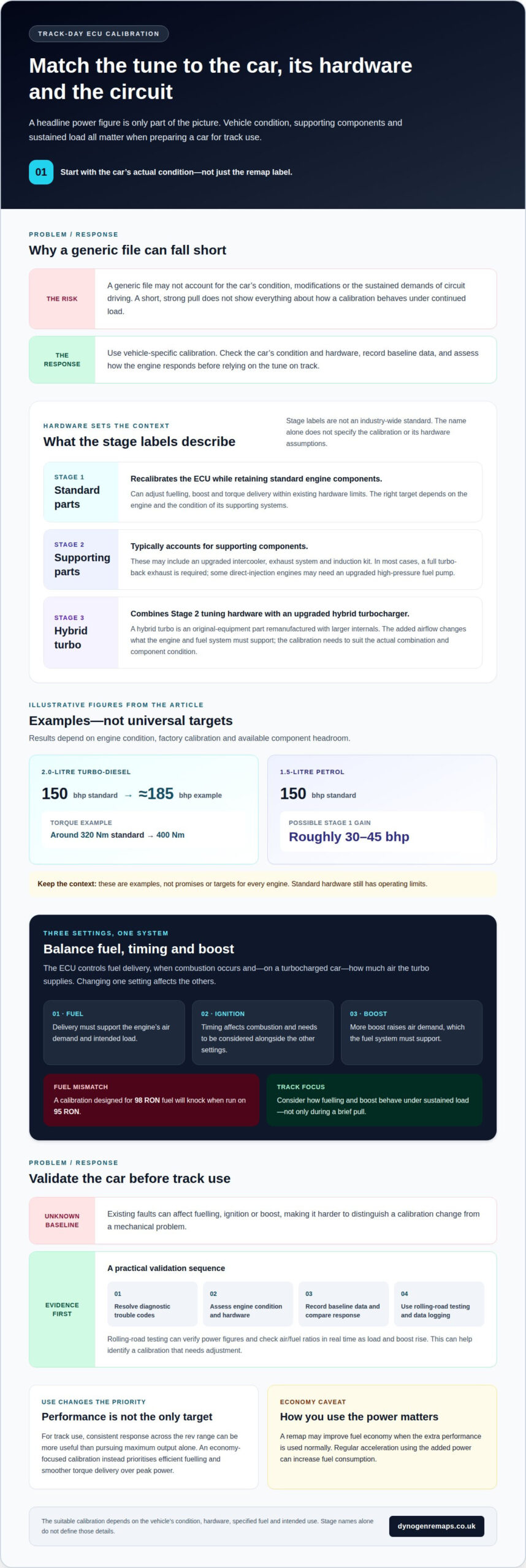
Stage 1 software recalibrates the ECU while retaining the engine’s standard components. It can adjust fuelling, boost and torque delivery within the limits of the existing hardware. For example, a typical 2.0-litre turbo-diesel producing 150 bhp as standard may reach approximately 185 bhp and 400 Nm. Its standard torque may be around 320 Nm. These are examples, not targets that apply to every engine.
A 1.5-litre petrol engine producing 150 bhp may gain roughly 30 to 45 bhp from a Stage 1 remap. The result depends on the engine’s condition, factory calibration and available component headroom. Standard hardware still has operating limits, so a suitable tune should account for more than the peak figure. For track use, consistent response across the rev range can be more useful than pursuing maximum output alone.
Stage labels aren’t an industry-wide standard. One tuner’s Stage 1 may differ from another’s, so the name alone doesn’t explain the calibration or its hardware assumptions. Stage 2 typically accounts for supporting components such as an upgraded intercooler, exhaust system and induction kit. In most cases, a full turbo-back exhaust is required for a Stage 2 setup, and some direct-injection engines may need an upgraded high-pressure fuel pump.
Stage 3 combines Stage 2 tuning hardware with an upgraded hybrid turbocharger. A hybrid turbo is an original-equipment part remanufactured with larger internals to increase airflow capacity. The added airflow changes what the engine and fuel system must support, so the calibration needs to suit the actual hardware combination. A stock engine may be used in some Stage 3 setups, subject to its limits; the label doesn’t remove the need to consider component condition.
Stage 1 can also suit drivers who want stronger performance without moving to supporting modifications. A remap may improve fuel economy when the extra performance is used normally, particularly at motorway speeds. However, regularly using the additional power can increase fuel consumption. An economy-focused calibration instead prioritises fuelling efficiency and smoother torque delivery over peak output, making its purpose different from track-focused tuning.
Choose a UK ECU specialist by looking for a vehicle-specific approach, clear explanation of the calibration and objective validation. A baseline data log, diagnostic checks and rolling-road testing give the tuner evidence to assess the car and its response. Ask how the map accounts for standard or upgraded hardware, and whether the original ECU file is saved for restoration.
Fuel delivery, ignition timing and turbo boost
Fuel delivery, ignition timing and turbo boost work together to shape an engine’s output. The ECU controls how much fuel enters the engine, when combustion occurs and, on a turbocharged car, how much air the turbo supplies. Changing one setting affects the others. A calibration needs to keep these relationships balanced under acceleration, not just produce a strong result during a brief pull.
Before remapping, resolve diagnostic trouble codes and assess the engine’s condition, including any faults affecting fuelling, ignition or boost. A fault-free baseline helps distinguish calibration changes from an existing mechanical problem. Turbocharged diesel engines can gain 25-40% in power and torque from remapping; turbocharged petrol engines typically gain 15-25% in power. Those ranges make the engine’s existing limits and supporting hardware important considerations.
More torque lower in the rev range can change how the car is driven. A driver may hold speed in a higher gear or use less throttle, potentially improving fuel economy during ordinary driving. A remapped car may achieve up to 10-15% better fuel economy at light throttle. That doesn’t mean every journey uses less fuel: frequent acceleration using the added power can increase consumption.
A calibration can prioritise peak performance, a balance of performance and economy, or fuel economy. An economy-focused map favours efficient fuelling and smoother torque delivery over peak power. For track use, the tuner needs to consider how fuel delivery and boost behave under sustained load. The right emphasis depends on the car’s intended use and hardware, not the map’s label alone.
Fuel octane also matters. A calibration designed for 98 RON fuel will knock when run on 95 RON fuel. The specified fuel must match the calibration, particularly when the engine is under load. Changes to ignition timing affect combustion, while increased boost raises the air demand the fuel system must support. Those settings should be considered together, not adjusted in isolation.
Rolling-road testing can verify power figures and check air/fuel ratios in real time. That data shows how the engine responds as load and boost rise, helping identify a calibration that needs adjustment before track use. For a considered vehicle-specific ECU calibration, the tuner can align the map’s priorities with your fuel, hardware and driving plans.
Dyno testing and vehicle-specific remaps
A vehicle-specific calibration accounts for the car’s configuration instead of relying on a generic file. Dyno testing and data logging help compare its behaviour before and after tuning.
Vehicle-Specific Calibration
A vehicle-specific calibration is an ECU map tailored to an individual car’s engine, condition and hardware. That matters because two cars of the same model can respond differently, especially if one has modified components or an existing fault.
Start by recording data on the standard map. This provides a baseline for comparison, including how the vehicle responds across the rev range. If the car has an upgraded intercooler or exhaust, those components should be considered when shaping its calibration. A generic file can’t account for these differences.
Track use also affects the calibration’s priorities. A map designed for occasional road acceleration may not suit sustained circuit running. Assess aggressive boost or ignition settings against the vehicle’s hardware and logged behaviour, rather than choosing them simply to chase a higher peak figure.
Validation and Data Logging
Dyno validation uses a rolling road to assess engine output and calibration behaviour under measured load. Data logging records vehicle information before and after a change, giving the tuner objective evidence for comparison.
Record the standard-map baseline before tuning, then make one calibration change at a time. Comparing each result helps show whether an adjustment improved the intended response or introduced an anomaly. If several settings change together, it’s harder to identify what caused the difference.
A rolling-road session after remapping can help validate the calibration and reveal anomalies before the car reaches the track. It can also check air/fuel ratios in real time and verify power figures. These readings offer more context than a peak number alone, since they let the calibration be assessed across the run.
Dyno figures describe performance under the test conditions, not every situation on circuit. Use them alongside data logs and the vehicle’s baseline to understand the result. For example, if a change improves peak output but creates an irregular response elsewhere in the run, that evidence can guide further adjustment.
For track preparation, treat calibration as a measured process: establish the baseline, adjust one setting, then validate the result with objective data. This makes it easier to distinguish a genuine improvement from a headline figure that doesn’t reflect the vehicle’s overall behaviour.
ECU calibration and track performance
ECU calibration can sharpen throttle response and improve acceleration, but power is only one part of track performance. Lap times also depend on how effectively the car turns, grips and slows. Remapping for track day performance should make engine output useful within the car’s wider capabilities.
Calibration for Track Performance
Track-focused ECU calibration adjusts engine behaviour to suit the car’s intended circuit use. It is most useful when the driver can apply the added response consistently, rather than simply chasing peak figures.
For example, progressive torque delivery can make acceleration easier to manage when exiting a corner. A sharp torque increase may be less useful if it overwhelms the tyres or makes throttle inputs harder to control. Consider the full lap: predictable delivery can help you apply power smoothly from corner exit onto a straight.
Calibration also needs to respect the vehicle’s hardware and operating limits. A remap can put extra strain on components and increase wear or mechanical risk compared with factory settings. The car’s condition and intended level of track use matter, alongside the headline power figure. Effective remapping for track day performance considers this balance, not just peak output.
Remapping and Vehicle Upgrades
ECU remapping changes engine output, while tyres, brakes and suspension affect grip, stopping and control. If the car can’t use its existing output effectively, improvements in those areas may be more valuable for lap times than added power.
Tyres, for example, influence how confidently a car corners and accelerates out of bends, while brakes support repeatable slowing into them. Suspension changes can affect how the car behaves through corners. A remap may improve acceleration on a straight, but it can’t make up for limited grip or poor braking.
Track preparation should address the whole car. Brake pads should have at least 5 mm of depth before a session, and brake fluid older than one year should be replaced before an event. These checks support braking performance, an essential part of driving consistently across a circuit.
Tyre pressures also need attention: set track-day pressures 3-5 PSI lower than normal when cold. This is a starting point for track preparation, not a substitute for considering the tyres and conditions at the circuit. A driver comparing upgrades should first identify where the car loses time, then prioritise the relevant area.
The practical takeaway is to match the change to the limitation. If cornering grip or braking is restricting progress, address that before adding engine output. If those areas are working well, a measured calibration may bring worthwhile gains through stronger acceleration and controlled throttle response.
Do UK track day organisers allow modified or remapped cars?
A remap alone doesn’t determine whether a car can attend a UK track day. Entry depends on the organiser’s event rules, so read the booking conditions and event information before travelling. Permission to participate and the car’s suitability for road use are separate considerations.
Check the rules for the specific event instead of relying on assumptions from another circuit or organiser. Look for requirements covering modified vehicles, vehicle condition, noise and documentation. If the event information doesn’t address ECU tuning, contact the organiser about your car’s modifications before booking. Describe the vehicle accurately, including its remap, rather than relying on its factory specification.
Road use has separate considerations. In the UK, engine remapping is legal provided it doesn’t interfere with emissions systems and the vehicle continues to meet road safety and environmental standards. A road car must remain safe, roadworthy and compliant with relevant emissions requirements. Removing, bypassing or disabling emissions-control systems isn’t a responsible performance upgrade, and a track-day booking doesn’t change those road-use conditions.
Insurance also needs attention. UK vehicle owners should inform their insurer about a remap or another performance modification. Keep a record of the modification and the insurer’s response with the event paperwork, so the details are clear if requested. Track-day cover and ordinary road cover are separate matters. Don’t assume a road policy includes circuit driving.
Before the event, assess the car as a complete package. Increased engine output won’t compensate for worn tyres, a brake fault or an existing diagnostic code. Resolve engine issues before tuning, and prepare the vehicle for the organiser’s stated requirements. If the car changes after booking, for example through further hardware or a revised calibration, update the relevant information rather than relying on outdated details.
Use a simple pre-event sequence: read the event terms, disclose the remap to your insurer, confirm the car meets road-use requirements, then prepare it for the circuit. Keep the original ECU file and calibration records with the vehicle’s documents, which helps establish what has changed. To discuss how ECU tuning fits your car’s intended use, talk through your vehicle’s calibration.
Dynogen Remapping Solutions: Stage 1 Performance Remap
Dynogen Remapping Solutions offers a Stage 1 Performance Remap for drivers seeking sharper engine performance while retaining standard components. It’s a relevant option when your vehicle is mechanically sound and you want to explore ECU tuning before considering supporting hardware upgrades.
For track use, the intended balance matters: stronger acceleration should go hand in hand with sensible engine protection and road-use requirements. Discuss your vehicle, modifications, fuel and driving plans so the tuning approach reflects your priorities. If lower fuel consumption matters more than peak output, an Economy Remap is designed for a different objective.
Choose a calibration based on the whole vehicle, not a headline power figure alone. Contact Dynogen Remapping Solutions to discuss your car and tuning goals.
Choose a calibration that fits your next track day
Make your next step a clear decision about what you want the car to do. For remapping for track day performance, consider how the engine’s response fits your driving style, the vehicle’s hardware and its intended road use. A measured target gives the calibration a purpose beyond chasing a peak figure.
Dynogen Remapping Solutions offers a Stage 1 Performance Remap for performance-focused tuning and an Economy Remap for drivers prioritising efficiency. Its AdBlue Solution serves a different vehicle requirement, rather than adding track performance. Selecting the right direction starts with your priorities and the car’s condition.
Bring those details into a conversation before deciding on a tune. Contact Dynogen Remapping Solutions to discuss your vehicle and performance goals. With a considered approach, you can take your next step towards a more engaging and purposeful track-day drive.
Frequently Asked Questions
Are generic remap files safe for track day use?
Not as a default choice: a generic file isn’t tailored to your car’s condition, fuel or modifications. A track car with an upgraded intercooler, for example, differs from one with standard hardware, so the same settings won’t necessarily suit both. Vehicle-specific calibration considers those differences and the engine’s operating limits. A file’s “Stage 1” or “track” label alone doesn’t establish how it will behave on your car.
Are there any disadvantages?
Yes. A remap can put extra strain on engine components, increasing wear or the risk of mechanical issues compared with factory settings. Using the added power frequently can also increase fuel consumption. A car driven hard on circuit and then used daily, for example, may have different priorities from one tuned mainly for motorway economy. The calibration target, supporting hardware and existing condition all affect the trade-offs.
Can an ECU remap be reversed?
Yes. A remap can be reversed by restoring the saved original ECU file. Keeping that file provides a route back to the factory calibration if your requirements change, such as when returning the car to standard before selling it. Reversal restores the software, not physical changes to the car, so hardware modifications need separate consideration when returning to the original setup.
How much does car remapping cost?
Car remapping costs depend on the vehicle, ECU complexity and performance or economy goals. A standard calibration and work on a heavily modified engine with a specific target involve different considerations. The price depends on the individual case and is provided after a quote request. Relevant details include the car’s configuration, existing hardware and the type of calibration required.
How accurate are the gains shown?
Dyno figures are measured results from a particular vehicle and test, not a universal prediction for every car of the same model. A rolling-road session can verify output and assess calibration under measured load. Comparison is more meaningful when the standard map has been logged first and testing conditions are consistent. Differences in vehicle condition, hardware and fuel can affect results on another car.
What does ECU remapping change for track day performance?
ECU remapping changes engine-control settings, including fuelling, ignition timing and, on turbocharged vehicles, boost. These adjustments can alter torque delivery, throttle response and acceleration. For example, stronger torque lower in the rev range can change how the car drives out of slower corners. The effect depends on the engine and hardware, so power figures alone don’t describe how the car will feel across a lap.
How much power and torque can a remap safely add to common track day cars?
There’s no single safe increase for every track car; the engine, condition and hardware set the relevant limits. As an example, a typical 2.0-litre turbo-diesel producing 150 bhp may reach approximately 185 bhp and 400 Nm after a carefully developed Stage 1 remap. A 1.5-litre petrol engine producing 150 bhp may gain roughly 30 to 45 bhp. These examples aren’t guarantees for other vehicles.
How much does a performance remap cost in the UK?
The cost of a performance remap depends on the vehicle’s ECU complexity and performance goal. A calibration for standard components differs from tuning for a heavily modified engine, where the hardware combination shapes the work involved. The price depends on the individual case and is provided after a quote request. A specific figure needs to reflect the vehicle and its intended calibration, rather than a general category alone.