
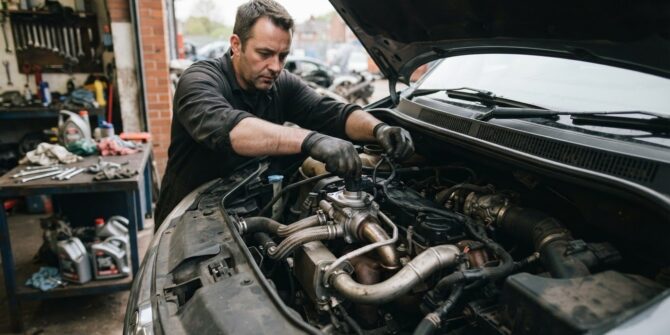
An MOT pass doesn’t make an EGR delete legal for use on UK public roads. Whether an EGR solution will pass an MOT in 2026 depends on the vehicle and the changes made: a warning light, excessive smoke or visible signs that factory-fitted emissions equipment has been removed or modified can lead to failure.
It’s understandable to focus on the MOT result, especially if a diesel has an EGR fault or warning light. But the test result and the legality of a modification are separate issues: passing an inspection does not make an emissions delete compliant for road use.
This guide explains how diesel smoke-opacity checks, warning lights and visible emissions equipment affect the MOT, and what proposed rules could mean for DPF and EGR systems. It also covers compliant repair options, from fixing a wiring or intake fault to replacing a failed valve, so you can weigh the choices before deciding what to do next.
Key Takeaways
- An MOT pass and legal road use are separate questions: an emissions modification can still create a compliance issue.
- Understand how warning lights, smoke opacity and visible changes to factory-fitted equipment can affect a diesel MOT.
- Trace an EGR fault properly, as a flow-related code can have causes beyond the valve itself.
- Explore compliant repair routes, from addressing carbon build-up or wiring faults to replacing a failed component.
- See why emissions-system changes may matter beyond test day, including when assessing warranty and resale considerations.
Proposed rules for software-based emissions deletes
An EGR delete or remap can cause an MOT failure, and passing the MOT does not make an unlawful emissions modification legal for road use. Proposed UK rules could extend enforcement beyond the test lane, so it’s important to distinguish an ECU calibration from software that disables factory-fitted emissions equipment.
Remaps and emissions-control changes
An ECU remap changes engine-control software; an emissions delete alters or disables emissions components. That distinction matters because the proposal treats a software-based delete like physically removing equipment. The UK Government consultation also proposes that vehicles continue to meet the emissions requirements that applied when they were built and first registered. A remap that hides an EGR fault may suppress a warning, but it does not restore compliant operation.
The proposal covers road vehicles first used from 1 January 2001 onwards, requiring factory emissions equipment to remain working. Its named examples include DPF removal, AdBlue (SCR) deletes, EGR manipulation and catalyst removal. Software changes are treated the same as physical removal, so changing ECU settings isn’t a compliant substitute for repairing a failed component.
The Department for Transport consultation on proposed UK DPF laws closed on 6 September 2026. At the time of writing, the proposed law was not in force. Legislation was expected in summer 2027, followed by a six-month lead-in. The proposal describes fines from £1,000 up to an unlimited amount after a magistrates’ court prosecution. Separately, Construction and Use rules prohibit using a road vehicle modified so it no longer meets its applicable emissions standards.
The proposals do not give hybrid vehicles a separate exemption from emissions-delete rules. The relevant considerations remain the vehicle’s fitted emissions components and the requirements that applied when it was built and first registered. For a petrol hybrid, the MOT emissions test measures carbon monoxide (CO), hydrocarbons (HC) and lambda values (λ); diesel testing measures smoke opacity.
Gaseous emissions checks and MOT failure
Emissions tests measure exhaust pollutants, with the UK petrol MOT recording CO, HC and lambda values. An EGR delete can lead to failure if a warning light appears, emissions exceed the applicable limits, or a tester identifies a visible modification. A poorly calibrated remap may also increase smoke or hydrocarbons, or trigger the malfunction indicator light.
There is no single MOT result that makes every remap acceptable. The vehicle’s emissions, warning status and visible components all matter. A remap that preserves emissions controls differs from software that suppresses an EGR fault. The latter may hide a fault from the ECU, but it remains an emissions delete and does not make road use lawful.
Engine management light and MOT failure
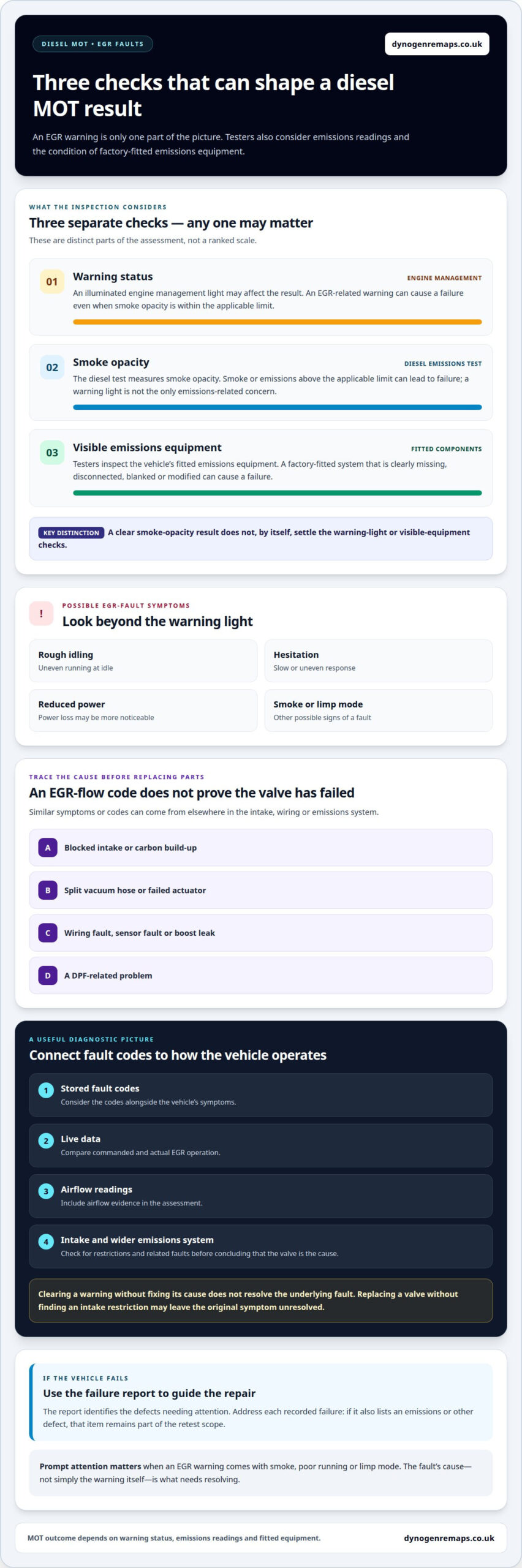
A faulty EGR valve can cause rough idling, hesitation, reduced power, smoke or limp mode. An illuminated engine management light may affect the MOT outcome, depending on the fault and inspection findings.
The MOT result is not based on exhaust readings alone. Testers check the engine-management warning status and the vehicle’s fitted emissions equipment. An EGR-related warning light can therefore cause a failure even when smoke opacity is within the applicable limit. Clearing a warning without repairing its cause does not resolve the underlying fault.
A faulty valve can cause more noticeable symptoms, particularly hesitation, power loss or limp mode. Increased smoke and fuel use are also possible. An EGR-flow code does not prove that the valve itself has failed: a blocked intake, split vacuum hose, failed actuator, wiring or sensor fault, boost leak, or DPF-related problem can produce similar symptoms.
Diagnosis should link the warning to how the vehicle actually operates. A useful assessment considers stored fault codes alongside live data, commanded and actual EGR operation, and airflow readings. The intake and wider emissions system matter too. For example, replacing a valve without identifying an intake restriction may leave the original symptom unresolved.
If the vehicle fails its MOT, the failure report identifies the defects that need attention. The risks of driving depend on the fault and the vehicle’s condition, so an EGR warning accompanied by smoke, poor running or limp mode warrants prompt attention. The warning itself is not a repair instruction: addressing its cause is what resolves the fault and prepares the vehicle for a retest.
Retest arrangements can depend on when the vehicle is returned and which defects need rechecking. That limited recheck makes it important to address each recorded failure, rather than focus solely on the EGR warning. If the report also lists an emissions or other defect, that item remains part of the retest scope.
Before treating software as a fix, separate a calibration change from an unresolved mechanical fault. A remap can’t repair a blocked intake, damaged wiring or failed actuator. For context on calibration choices, explore vehicle remapping information alongside the symptoms and fault evidence.
MOT checks for missing or modified DPF and EGR systems
Yes. The MOT assessment depends partly on the vehicle’s age and type, and on the emissions equipment fitted as standard. Testers inspect visible components against MOT requirements; a factory-fitted system that is clearly missing, disconnected, blanked or modified can cause a failure.
For a diesel, a missing factory-fitted DPF is an MOT failure. A diesel vehicle with its DPF removed has failed the test since February 2014 and cannot pass until the filter is reinstated. The tester also examines the DPF housing under MOT Inspection Manual Section 8.2.1. If its internal monolith is missing or has been bored out, that is an automatic major failure.
This visual check matters even if the dashboard shows no warning and the exhaust appears clean. A modified housing might conceal a removal from casual view, but the MOT inspection specifically covers the filter casing. A software change or low smoke reading is not proof that the original emissions components remain fitted.
Diesel emissions testing also measures smoke opacity. The tester compares the reading with the manufacturer’s plated limit, and the first acceleration must produce a smoke level at 60% or less of that limit for the vehicle to pass. Meeting that figure does not override a visible DPF defect: the visual inspection and emissions test assess different parts of the vehicle.
EGR checks focus on equipment fitted as standard. A tester can fail a vehicle if the EGR valve or associated system has clearly been removed, disconnected, blanked or modified. An EGR delete can also lead to failure if the engine-management light is illuminated or smoke exceeds the plated limit. The vehicle’s age can affect which components were fitted at the factory, but it does not make removing fitted equipment compliant.
Vehicle type affects which emissions checks apply. Diesel vehicles sold from 2009 onwards have a DPF, whilst some Euro 4 models from 2007-2008 received one voluntarily. The key is whether the relevant emissions component was fitted to that vehicle, not simply its registration year. A diagnostic scan may identify fault codes, but it cannot replace the tester’s visual inspection or smoke test.
For MOT purposes, an EGR or DPF modification is assessed by the visible system, warning status and test results. DPF removal is described as permissible only for vehicles used exclusively off-road or for motorsport, not for vehicles used on public roads. A compliant road vehicle needs its factory-fitted emissions equipment intact and operating, with faults repaired rather than hidden by software.
Compliant EGR repair options
A compliant repair keeps the vehicle’s factory-fitted EGR equipment in place and restores its operation. The right remedy depends on the fault: carbon deposits can restrict movement, while a failed actuator or damaged wiring needs a different repair. Cleaning is appropriate only when deposits are the cause and the affected components remain serviceable. Replacing parts without finding the cause can leave the original fault unresolved.
There is no single UK price for EGR cleaning or replacement. The cost depends on the case and is provided after a quote request. Key factors include whether cleaning is suitable, whether the original valve remains usable, and what diagnosis reveals. A repair estimate should reflect the work needed to restore the system, rather than treating every EGR warning as a valve replacement.
A diagnostic assessment can distinguish an EGR valve fault from related problems. An EGR-flow code may also point to a blocked intake, split vacuum hose, failed actuator, wiring issue, sensor fault, boost leak or DPF-related problem. Comparing fault codes with live data, commanded and actual EGR operation, and airflow readings helps pinpoint where the system is failing. The intake and wider emissions system also need consideration.
- Carbon build-up: clean the valve or affected passages where deposits are restricting flow and the parts remain suitable for use.
- Electrical or vacuum fault: repair damaged wiring or a split hose when it prevents the EGR system operating correctly.
- Intake restriction: address the obstruction if it is affecting airflow or causing an EGR-related fault code.
- Failed valve: replace the valve when diagnosis shows it can’t operate correctly.
- Related DPF fault: resolve the DPF issue if it contributes to the EGR symptoms.
After a repair, assess the engine warning alongside the vehicle’s operation and emissions-system behaviour. A warning that clears without its cause being fixed does not show that the EGR system is working. A visible modification or an automatic major defect can still result in MOT failure; a repair should restore standard equipment, not conceal its condition.
A visual inspection and diagnostic scan answer different questions. A scan helps identify faults and check system operation, while the MOT tester assesses visible equipment and applicable test results. An advisory on a test record is a recorded item, not proof that an EGR fault has been repaired. Keep repair details with the vehicle’s maintenance record, especially if the same warning returns.
Warranty and resale effects
An EGR or DPF change can raise ownership questions beyond the MOT result. Warranty terms, insurance disclosure, maintenance records and the vehicle’s current operation all matter. There is no single warranty outcome for every modification: review the written terms and distinguish a fault linked to altered emissions equipment from an unrelated defect. For example, an EGR-related engine concern and a failure in an unrelated component are different cases.
Before making an engine or emissions modification, owners should declare it to their insurer. Keep a written record of what changed, when it was done and which original components remain fitted. If a later claim concerns engine operation or the exhaust system, those details give the insurer a clearer account of the vehicle’s history. An MOT pass alone does not describe every modification or replace disclosure.
For resale, a complete vehicle history gives a prospective buyer clearer information than an unexplained warning light or missing service record. Keep invoices and diagnostic reports with MOT records, and note whether a fault was repaired or remains present. This helps a seller explain, for example, why an EGR warning appeared and what work followed, rather than leaving the next owner to guess at the cause.
The proposed UK emissions-equipment rules could also become relevant to future ownership decisions. The proposal would require road vehicles from 1 January 2001 onwards to keep factory emissions equipment working; legislation was expected in summer 2027, followed by a six-month lead-in. At the time of writing, that proposed law was not in force. Treat the proposal as a potential future consideration, not as a change already in effect.
When assessing a used diesel, separate three questions: are the original emissions components present, is there an active fault, and does the vehicle’s record explain previous repairs? A diagnostic report can add useful detail if an engine warning or emissions failure has occurred. Compare it with the MOT record and repair documents, rather than assuming a clean test history proves no modification was made.
For a current vehicle, clear records support better-informed decisions about repair, insurance and eventual sale. If an emissions warning appears, document the symptoms and the diagnostic findings before deciding what work is needed. To discuss the vehicle’s modification history and ownership considerations, get guidance on your vehicle’s next steps.
Dynogen Remapping Solutions
Dynogen Remapping Solutions offers vehicle tuning and emissions-system services for cars and vans. If an EGR warning or MOT concern raises questions about a software change, it’s important to distinguish a performance or economy remap from software that disables emissions equipment. A remap does not make a removed or disabled system compliant for road use.
Depending on the vehicle and the issue, the relevant offerings include a Stage 1 Performance Remap, Economy Remap, AdBlue Solution or DPF Solution. These options address different needs, so the right discussion starts with the vehicle’s symptoms, existing modifications and intended use. They are not MOT testing services, and an MOT pass cannot be promised.
For a conversation about your vehicle and its options, contact Dynogen Remapping Solutions.
Choose a road-compliant next step
If you’re asking whether an EGR solution will pass an MOT in 2026, consider the vehicle’s condition and intended use, not just a warning light. Whether an EGR solution will pass its MOT in 2026 also depends on its emissions equipment and how any changes affect that equipment. Software that masks a fault isn’t a substitute for resolving it.
Before choosing a modification, consider its effect on emissions controls, everyday operation and the vehicle’s recorded history. A discussion based on the symptoms and existing changes can help clarify which option fits your aims. Dynogen Remapping Solutions provides tuning and emissions-system services to address vehicle needs.
Take the next step with a clear account of the issue and the outcome you want. Start a conversation with Dynogen Remapping Solutions and explore your options with confidence.
Frequently Asked Questions
How do the MOT test changes 2026 affect diesel vehicles specifically?
Diesel MOT testing still centres on smoke opacity and inspection of fitted emissions equipment. A vehicle’s reading is assessed against its manufacturer’s plated limit; on the first acceleration, it must be no more than 60% of that limit to pass. NOx isn’t tested in the UK MOT. Proposed emissions-equipment rules are separate from the MOT test, and weren’t in force at the time covered in this article.
What are the UK MOT rules for EGR systems in 2026?
A tester can fail a vehicle if its standard-fitted EGR valve or related system is clearly missing, disconnected, blanked or modified. The inspection also considers warning lights and emissions-test results. Vehicle age and type affect which equipment was originally fitted, but do not make tampering with fitted equipment compliant. Separately, a UK Government proposal would require vehicles to continue meeting the emissions requirements that applied when they were built and first registered.
Can a car pass MOT with the EGR valve blanked off or removed?
A car might pass an individual MOT if the tester does not identify a defect and it meets the applicable checks, but that result does not make an EGR delete lawful for road use. A visible blanking plate, illuminated engine warning or excessive smoke can lead to failure. Passing the test is not evidence that a removed or disabled emissions-control system has been restored or complies with road-use requirements.
How do MOT testers check for EGR tampering or emissions faults?
Testers inspect visible emissions-control equipment fitted as standard and assess it against MOT requirements. For a diesel, they also measure smoke opacity against the manufacturer’s plated limit; an illuminated engine-management light can count as a separate major defect. A tester may identify obvious removal, disconnection or blanking during visual inspection. MOT checks are not the same as a full fault diagnosis, which examines system operation and related components.
What emissions limits apply to diesel and petrol cars at MOT?
Diesel cars are tested for smoke opacity against the manufacturer’s limit shown on the vehicle’s VIN plate. For the first acceleration, the reading must be 60% or less of that limit to pass. Petrol MOT emissions testing measures carbon monoxide (CO), hydrocarbons (HC) and lambda values (λ). The applicable petrol limits depend on the vehicle’s test requirements; there isn’t one universal figure for every car.
What are the legal consequences of removing or disabling an EGR system in the UK?
Using a road vehicle modified so it no longer meets its applicable emissions standards is prohibited under Construction and Use rules. The proposed emissions-equipment legislation would also treat software deletes like physical removal and set fines from £1,000 up to an unlimited amount following magistrates’ court prosecution. That proposal wasn’t in force at the time covered here, so distinguish proposed penalties from existing road-use requirements.
How can I fix an EGR fault before an MOT?
Start with diagnosis rather than assuming the EGR valve needs replacing. A flow fault can also involve a restricted intake, split vacuum hose, actuator, wiring, sensor, boost leak or DPF-related issue. Assessing fault codes, live data, airflow, and commanded versus actual EGR operation can help pinpoint the cause. The appropriate repair may involve cleaning deposits, correcting a wiring or vacuum fault, or replacing a failed valve.