
A diesel can fail its MOT even if it still runs well: a visibly missing DPF or evidence of tampering is a Major defect. Since February 2014, UK MOT tests for cars and annual tests for heavy vehicles have included a check that the filter is present. Understanding the DPF solution and MOT rules in the UK also means knowing that emissions, warning indicators and obvious defects can matter.
It’s sensible to understand the rules before a diesel MOT. This guide explains what testers inspect, how DPF removal can affect MOT results and road use, and what to do if your vehicle has a warning light, excess smoke or reduced power.
It also separates current requirements from proposed changes. The government consultation on emissions-equipment rules closed on 6 September 2026, but the proposal is not an active 2026 MOT rule. You’ll see how the Road Vehicles (Construction and Use) Regulations fit into the wider discussion, and what to understand before deciding how to address a DPF fault.
Key Takeaways
- Learn which signs, including warning lights, excess smoke and loss of power, can point to a DPF problem before the test.
- Understand why a filter that has been cut open and rewelded may attract scrutiny, and what a valid cleaning-related reason means.
- See why passing a visible-smoke test doesn’t necessarily mean a modified emissions system is suitable for road use.
- Separate the current MOT checks from proposed emissions-equipment changes, so you can tell what applies now.
- Find out how the Road Vehicles (Construction and Use) Regulations relate to emissions compliance and DPF removal.
UK MOT checks for diesel particulate filters
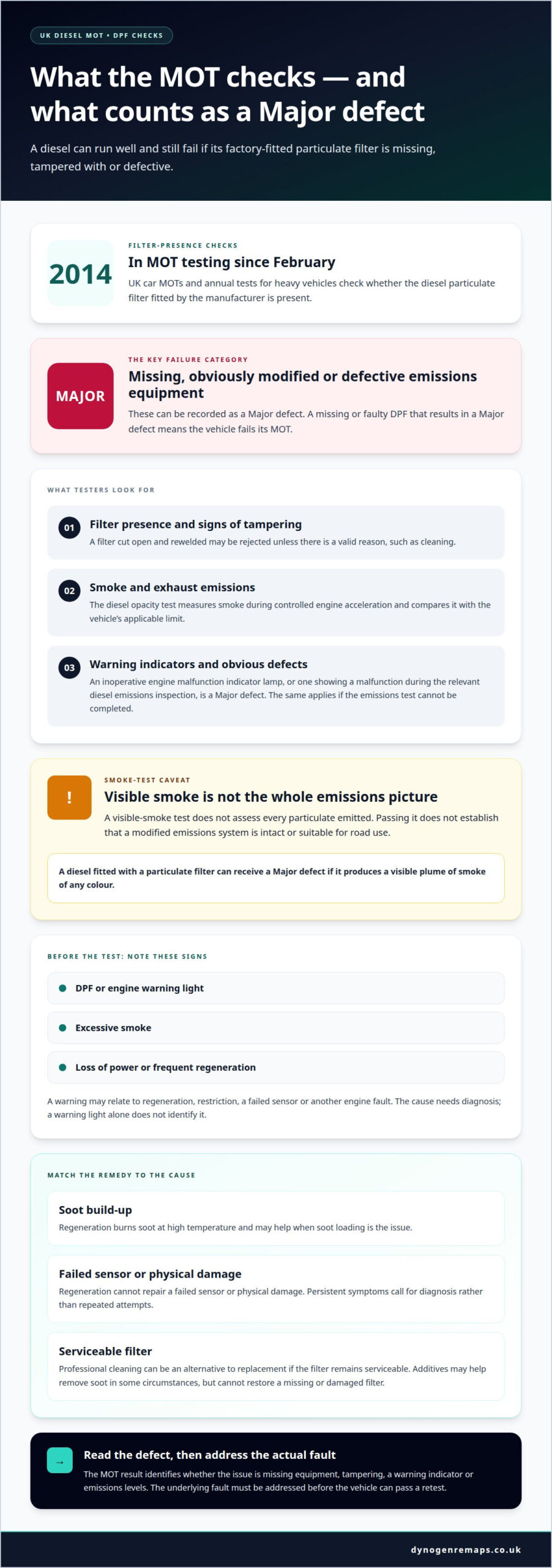
Since February 2014, UK MOT tests for cars and annual tests for heavy vehicles have checked whether a diesel particulate filter is present. Testers also assess visible smoke, emissions equipment and applicable exhaust limits.
DPF presence and tampering checks
A DPF presence check looks for the filter fitted by the manufacturer and signs of alteration. Missing, obviously modified or defective emissions equipment is a Major defect under the UK MOT inspection manual.
Testers may reject a filter that has clearly been cut open and rewelded unless the vehicle presenter can show a valid reason, such as cleaning. A visible plume of smoke of any colour or evidence of tampering can also result in a Major defect on a diesel vehicle fitted with a particulate filter.
Emissions equipment checks
An emissions check covers relevant warning indicators, obvious defects and exhaust smoke. The diesel opacity test measures smoke during controlled engine acceleration and compares it with the vehicle’s applicable limit.
An inoperative engine malfunction indicator lamp, or one showing a malfunction during the relevant diesel emissions inspection, is a Major defect. If the MOT emissions test cannot be completed, that can also result in a Major defect. A visible smoke test does not assess every particulate emitted, so passing it does not establish that the emissions system is intact.
Diesel MOT preparation
Before the MOT, look for symptoms that could affect the filter or emissions test. Check the dashboard for a DPF or engine warning light, and note excessive smoke, loss of power or frequent regeneration. A warning light may relate to regeneration, restriction, a failed sensor or another engine fault.
A blockage can develop when soot builds up faster than regeneration clears it. Regeneration burns soot at high temperature, but it cannot repair a failed sensor or physical damage. Regeneration may help if soot loading is the issue; persistent symptoms call for diagnosis rather than repeated attempts.
Professional DPF cleaning can be an alternative to replacement if the filter remains serviceable. A valid cleaning reason can also explain why a filter was cut open and rewelded. Additives may help remove soot in some circumstances, but they cannot restore a missing or damaged filter or correct every emissions fault.
UK cleaning, repair or replacement costs depend on the diagnosis, filter condition and parts required. A price is provided after a quote request.
MOT failure from DPF faults
A missing or faulty DPF that results in a Major defect means the vehicle fails its MOT. The result records the defect, and the underlying fault must be addressed before the vehicle can pass a retest.
Use the MOT result to identify whether the issue is missing equipment, tampering, a warning indicator or emissions levels. The distinction matters: regeneration may address soot, but it cannot reinstate missing equipment or resolve every fault. Repairing the actual cause is the practical route to a compliant retest.
DPF removal and road-use requirements
Removing a factory-fitted diesel particulate filter can have consequences beyond the next MOT. In the UK, deliberate DPF removal can lead to MOT failure and raise roadworthiness or legal concerns. The filter is part of the vehicle’s emissions-control system, so an engine that still runs does not make a modified exhaust compliant.
What DPF removal means
DPF removal means taking out the particulate filter fitted to the vehicle, or modifying it so it no longer performs its intended role. The change may also involve altering the engine management system, but electronic changes do not replace missing emissions equipment. Distinguish removal from cleaning or repair, which address the filter while retaining it.
At an MOT, evidence of tampering or a missing manufacturer-fitted filter can result in a Major defect. A diesel vehicle fitted with a particulate filter can also receive a Major defect if it produces a visible plume of smoke of any colour. These are test consequences; road-use concerns remain between MOTs.
Tampering, damage and exhaust leakage
Testers may identify obvious emissions-system defects, including signs that a DPF has been altered. A filter cut open and rewelded can be rejected unless the vehicle presenter can show a valid reason, such as filter cleaning. That distinction matters: documented cleaning is different from removing the filter’s function.
Damage around the filter or exhaust may also produce smoke or make the emissions test harder to complete. A warning light can indicate restriction, a need for regeneration, a failed sensor or another engine fault. Treating every warning as proof of a blocked filter risks missing the actual cause.
Road use after removal
Passing a visible-smoke test does not prove that a modified vehicle emits lawful or safe levels of particulate matter. The test checks visible smoke, not every fine particle in exhaust gases. A vehicle may therefore pass that part of an MOT while still emitting illegal and harmful levels of fine exhaust particulate.
Northern Ireland has an additional specific rule: using a vehicle modified so it no longer meets the air-pollutant emissions standards it was designed to meet is an offence under the Construction and Use regulations (Northern Ireland) 1999. Removing a DPF will almost invariably breach those requirements and make the vehicle illegal for road use.
What owners should consider
If a DPF warning light, excess smoke or reduced power appears, identify the underlying fault rather than treating removal as a remedy. A blocked filter, failed sensor and damaged emissions component each require a different response. If soot is the issue, regeneration may burn it at high temperature; it cannot restore removed equipment or repair physical damage.
For drivers, the practical distinction is clear: cleaning or repairing a fitted filter keeps the emissions equipment in place, while removal creates MOT and road-use risks. Keep records of legitimate filter cleaning, especially if the work involved opening and rewelding the casing. If the vehicle has already been modified, don’t assume an MOT pass alone settles its roadworthiness.
Proposed DPF and emissions-equipment legislation
Current MOT inspection requirements and proposed emissions legislation are separate matters. Knowing the difference helps drivers understand which rules apply now and which changes remain proposals.
The government consultation on proposed emissions-equipment rules closed on 6 September 2026. The proposal is not an active 2026 MOT rule, so it should not be treated as a new test requirement already in force.
Emissions equipment inspected during an MOT
Current MOT inspections include checks for manufacturer-fitted emissions equipment that is missing, obviously modified or obviously defective. Testers may also identify relevant warning indicators and obvious emissions-system defects.
The proposed rules would go further: they envisage factory emissions equipment remaining operational on road vehicles in Great Britain from 1 January 2001 onwards. The proposal lists DPF removal, AdBlue (SCR) delete, EGR manipulation and catalyst removal as always illegal. That proposed scope is not the same as a current MOT check.
Fines for illegal emissions-system removal
The proposal says existing Road Traffic Act offences would apply, with fines from £1,000 up to an unlimited amount after a magistrates’ court prosecution. This describes the proposal’s stated penalty framework, not a new fine introduced by an active 2026 MOT rule.
Separate stated maximums for driving with a removed DPF or EGR system are £1,000 for cars and £2,500 for vans. The figures show why vehicle owners should distinguish the MOT result from potential road-use consequences.
For the question of vehicle type and location, the core check covers cars and annual tests for heavy vehicles; the Northern Ireland rule specifically says a DPF fitted when the vehicle was built must be present. The proposed requirement covers road vehicles in Great Britain from 1 January 2001 onwards, rather than setting out a new active MOT rule for older vehicles.
There have also been proposals concerning emissions testing itself. A revised smoke test was considered from May 2018, with the stated aim of detecting particulates at half the then-current emissions levels. Bartec said the effective limit for a new MOT test might need to be up to 50 times lower than the revisions proposed at that time. These historical figures do not make that proposed test a current requirement.
If the newer proposal proceeds, legislation was expected in summer 2027, followed by a six-month lead-in. Until then, drivers should distinguish the existing inspection for missing or tampered equipment from the wider proposed rules. Northern Ireland also has a separate emissions requirement: using a modified vehicle that no longer meets its designed air-pollutant standards is an offence under the Construction and Use regulations (Northern Ireland) 1999.
UK MOT rules for diesel particulate filters
A diesel particulate filter traps solid particles in exhaust gases while allowing gaseous components to pass. The MOT combines emissions-equipment checks with an exhaust smoke test, so understanding each part helps drivers recognise what may affect the result.
DPFs have been used for more than 20 years to reduce particulate emissions and help vehicles meet European emission standards. The filter collects soot as exhaust passes through it. It then needs regular regeneration, which burns soot at a very high temperature and leaves residue behind. If regeneration is repeatedly interrupted or fails, soot can build up, affect performance and contribute to costly repairs.
Preparing a diesel car for its MOT
Before the test, look for symptoms that could point to a filter, sensor or wider engine fault. Check the dashboard for a DPF warning light or engine malfunction indicator lamp, and watch for excess smoke or loss of power. Frequent regeneration is another useful symptom to report during diagnosis.
A warning light alone does not identify the fault. It may signal a filter needing regeneration, a restriction, a failed sensor or another engine or emissions problem. Addressing the cause matters: clearing soot alone won’t correct a failed sensor or defective equipment.
Diesel opacity and smoke testing
The diesel opacity test measures exhaust smoke during controlled engine acceleration and compares the result with the vehicle’s applicable limit. It assesses visible smoke, rather than every fine particle emitted by the exhaust. A diesel vehicle can therefore pass the visible-smoke element while still emitting harmful particulate at levels the test doesn’t detect.
Excessive visible smoke can result in an MOT defect. A visible plume of any colour or evidence of DPF tampering can cause a Major defect on a diesel vehicle fitted with a particulate filter. The test is one part of the inspection, not proof that every emissions component functions correctly.
The revised MOT rules came into force on May 20. During the relevant diesel emissions inspection, an engine malfunction indicator lamp that is inoperative or indicates a malfunction is a Major defect. An MOT emissions test that cannot be completed can also result in a Major defect, so warning indicators and testability both matter.
Use symptoms to guide the next diagnostic step rather than assuming the DPF itself is always at fault. For example, a warning light combined with reduced power may indicate a restriction, but a failed sensor can also trigger a warning. Correct diagnosis distinguishes soot that may respond to regeneration from faults that require repair.
Road Vehicles (Construction and Use) Regulations
MOT and road-use requirements answer different questions: an MOT assesses a vehicle at the time of the test, while emissions rules concern whether its equipment remains compliant on the road. This explains why an MOT pass does not, by itself, settle every concern about a removed or faulty exhaust filter.
For drivers in Great Britain, the government proposal described in this article would require road vehicles from 1 January 2001 onwards to keep their factory emissions equipment working. It lists DPF removal, AdBlue (SCR) delete, EGR manipulation and catalyst removal as always illegal. However, the proposal is not an active 2026 MOT rule, so it should not be confused with the existing inspection for missing, obviously modified or defective equipment.
This difference matters in practice. An MOT failure is an outcome linked to a defect found during inspection. A road-use requirement concerns the vehicle’s emissions equipment beyond the test bay. A vehicle might pass a visible-smoke test yet still emit illegal and harmful levels of fine exhaust particulate. A pass therefore cannot prove that a tampered system meets every road-use requirement.
Northern Ireland has a specific rule already described: using a vehicle modified so it no longer complies with the air-pollutant emissions standards it was designed to meet is an offence under the Construction and Use regulations (Northern Ireland) 1999. Removing a DPF will almost invariably breach those requirements and make the vehicle illegal for road use. This is distinct from the proposed Great Britain changes.
For a faulty filter, the sensible distinction is between restoring the factory emissions system and disabling it. Regeneration burns accumulated soot at high temperature, but it cannot replace a removed DPF or correct every damaged component. A warning indicator, reduced performance or excess smoke can point to different causes, so the repair must address the actual fault rather than hide its symptoms.
The consultation on proposed emissions-equipment rules closed on 6 September 2026. If the proposal proceeds, legislation was expected in summer 2027, followed by a six-month lead-in. Until then, distinguish current MOT checks from proposed requirements, and do not assume that passing the test resolves a separate road-use concern. For a modification-related discussion, review vehicle modification options in the context of your vehicle’s emissions equipment.
Dynogen Remapping Solutions
Dynogen Remapping Solutions can help when a diesel’s DPF warning, reduced performance or emissions fault needs a technical solution. Its DPF Solution is relevant when you need support with a DPF-related issue, while an AdBlue Solution addresses a separate emissions-system concern. The right route depends on the fault; removing or disabling factory-fitted emissions equipment can create MOT and road-use problems.
Dynogen Remapping Solutions does not carry out MOT testing. If your concern is a filter fault, its DPF Solutions can help address the DPF-related issue. A warning light alone doesn’t identify the cause, and a DPF service is not a substitute for an MOT inspection or a guarantee of a pass.
For help with a DPF-related concern, contact Dynogen Remapping Solutions.
Make your next step an informed one
Use your vehicle’s symptoms and MOT findings to guide the next decision, rather than treating a warning light or failed test as the whole diagnosis. The UK’s DPF solution MOT rules make it important to distinguish an emissions-system fault from a change that removes or disables factory-fitted equipment.
Dynogen Remapping Solutions offers a Stage 1 Performance Remap, an Economy Remap and an AdBlue Solution. These are distinct services, and an MOT test remains separate. Before considering a DPF solution, understand how MOT rules in the UK apply to the vehicle’s emissions equipment and the fault identified.
Take the next step at your own pace. Contact Dynogen Remapping Solutions to discuss your vehicle and the service relevant to your needs.
Frequently Asked Questions
What Should You Do Before Your Diesel MOT?
Before the test, note any DPF or engine warning light, excess smoke, power loss or frequent regeneration. Record when each symptom occurs, such as reduced power after a cold start, and share that information during diagnosis. It can help distinguish a filter restriction from a sensor or other engine fault. Don’t assume that clearing a warning light fixes the underlying problem; the cause may still affect the inspection result.
Can a Car Pass an MOT Without a DPF?
If the car was built with a DPF, a missing filter can result in a Major defect and MOT failure. A vehicle not originally fitted with a DPF isn’t subject to that particular missing-equipment finding, but it must still meet the emissions checks that apply to it. The key distinction is the vehicle’s factory equipment, not whether a filter is visible on every diesel car.
DPF MOT Rules: Can You Remove the DPF?
Removing a factory-fitted DPF can cause MOT failure and raise roadworthiness or legal concerns, so it isn’t a sound solution to a blockage. Current MOT checks can identify missing or tampered emissions equipment. In Northern Ireland, removing a DPF will almost invariably breach vehicle emissions requirements. In Great Britain, proposed wider rules are separate from the active 2026 MOT requirements.
DPF Warning Light On Before Your MOT?
A DPF warning light means the fault needs attention before you rely on the car passing its emissions inspection. It can indicate a need for regeneration, a restriction, a failed sensor or another engine or emissions problem. Note accompanying symptoms, such as reduced power or smoke, and share them during diagnosis. The warning alone doesn’t identify the faulty component, so don’t assume it proves the filter is blocked.
Have the MOT rules around DPF deletes changed in 2026?
No proposed emissions-equipment legislation became an active 2026 MOT rule. The consultation closed on 6 September 2026, but the existing MOT inspection remains distinct from the proposed wider requirements. A tester may still identify missing or tampered equipment under current checks. For a vehicle with a DPF delete, that distinction doesn’t remove the existing risk of an MOT defect or separate road-use concerns.
Are There New DPF Laws Coming?
A government proposal would require road vehicles in Great Britain from 1 January 2001 onwards to keep factory emissions equipment working. If it proceeds, legislation was expected in summer 2027, followed by a six-month lead-in. The proposal includes DPF removal and other emissions-system tampering. These are proposed changes, not active 2026 MOT rules, so don’t confuse the consultation timetable with a rule already in force.
Can You Regenerate a DPF Before Your MOT?
Regeneration can help if soot accumulation is the problem and the vehicle can complete the process correctly. It burns soot at high temperature, but leaves residue and won’t repair a failed sensor or damaged filter. A warning light can have several causes, so regeneration isn’t a universal pre-test fix. If symptoms persist afterwards, the underlying fault needs attention rather than repeated attempts to clear the warning.
Can a Car Fail an MOT Because of Its DPF?
Yes. A car can fail if its factory-fitted DPF is missing, obviously modified or defective, or if an emissions fault results in a Major defect. Visible smoke or evidence of tampering can also cause failure. An emissions test that can’t be completed may also lead to a Major defect. The result identifies the recorded fault, helping distinguish a filter problem from another emissions-system issue.