

Most drivers mistakenly chase peak horsepower, yet it’s torque that truly defines the character of your daily drive. You’ve likely felt that frustrating hesitation when pulling away from a junction or the sluggish response of a modern turbocharged engine when you need it most. It’s a common grievance, particularly when struggling with heavy loads or navigating inclines that leave your vehicle feeling breathless and underpowered.
By opting for professional high torque tuning Lancashire motorists can finally unlock the latent potential of their engines, transforming a laboured climb into a smooth, effortless surge of power. We’re here to show you how expert ECU recalibration moves beyond generic software to provide a more responsive, punchy engine feel that prioritises real-world drivability. This technical guide explores the meticulous science of custom calibration, detailing how these precision adjustments enhance towing capability and overtaking safety whilst actually improving fuel efficiency through reduced gear changes. We’ll examine the balance between significant performance gains and the steadfast commitment to vehicle reliability that defines a truly elite tuning service.
Key Takeaways
- Distinguish between peak horsepower and usable torque to understand why rotational force is the superior metric for daily responsiveness and acceleration.
- Understand the restrictive role of factory ECU torque limiters and how professional recalibration removes these software barriers to unlock latent engine potential.
- Discover the practical advantages of high torque tuning Lancashire, particularly how it enhances overtaking safety and provides essential strength for towing heavy loads.
- Prioritise bespoke software calibrations over generic files to maintain a meticulous balance between significant performance gains and long-term mechanical reliability.
- Recognise why a comprehensive pre-tuning diagnostic health check is a mandatory requirement for any professional remap to ensure your vehicle is fit for enhancement.
The Fundamentals of High Torque Tuning: Why Torque Matters More Than BHP
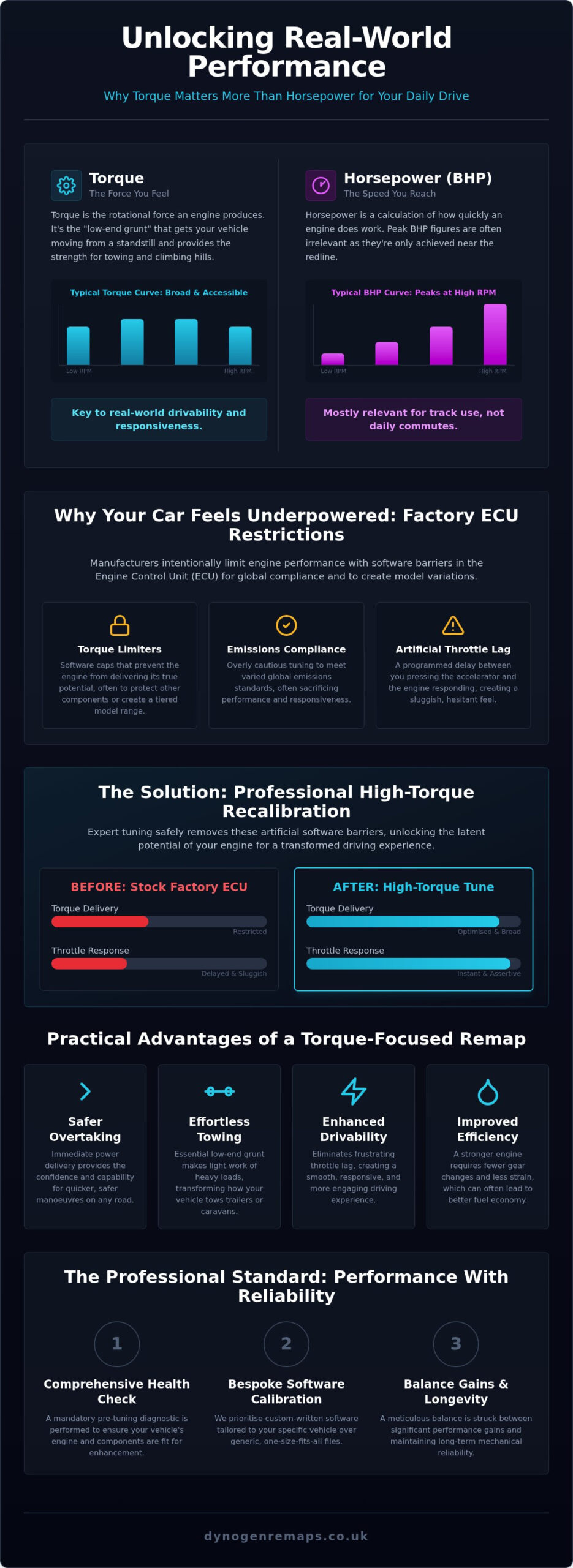
While horsepower often dominates marketing brochures, torque is the metric that actually governs your experience behind the wheel. Torque represents the rotational force produced by the engine; it’s the physical “twist” applied to the crankshaft that gets the vehicle moving from a standstill. Horsepower is merely a mathematical calculation of how quickly that work is being done at higher engine speeds. For the majority of motorists, peak power figures are largely irrelevant because they’re often only achieved near the redline, a range rarely visited during a typical daily commute.
True performance is found in the “area under the curve”. A well-calibrated engine doesn’t just hit a high peak number for a split second; it maintains a broad, flat plateau of torque across the rev range. This is where professional high torque tuning Lancashire services provide the most significant value. By recalibrating the Engine Control Unit (ECU), we can alter how boost pressure and fuel injection timing interact, particularly in modern turbocharged petrol and diesel engines. Instead of a sudden, aggressive spike in power that quickly tapers off, we create a sustained surge of energy that makes the vehicle feel significantly more capable in every gear.
The Driver’s Perspective: What Extra Torque Feels Like
The most immediate sensation of a torque-focused remap is often described as “low-end grunt”. When you’re pulling away from a junction or entering a busy roundabout, the vehicle responds with an urgency that factory software often suppresses. On the motorway, this translates to effortless progress; you’ll find the car can maintain speed on steep inclines without the gearbox constantly hunting for a lower gear. Torque is the muscularity of the engine during acceleration. It transforms the vehicle’s temperament from hesitant to assertive, providing a sense of mechanical strength that makes every manoeuvre feel safer and more controlled.
Torque and Drivability: Beyond the Numbers
Precision software optimisation does more than just increase output; it sharpens the entire relationship between your right foot and the road. Many modern vehicles suffer from artificial throttle lag, a delay designed by manufacturers to meet generic global standards rather than driver preference. Our approach to high torque tuning Lancashire addresses these delays directly, ensuring the engine reacts instantly to your inputs. This refinement leads to a much more relaxing driving experience, as you no longer need to “work” the engine hard to achieve meaningful progress. For a deeper look at how this transformation affects your daily journey, see our guide on improving car drivability with remapping.
Understanding Torque Limitation in Modern ECU Architecture
Modern vehicles are governed by the Engine Control Unit (ECU), a sophisticated “brain” that manages every facet of engine operation. While early systems relied on rudimentary chips with limited maps, today’s ECU architecture is a complex, multi-layered software environment. These systems are designed to monitor thousands of variables every second, ensuring the engine operates within a very narrow set of factory-defined parameters. This evolution has moved from simple data tables to intricate models that calculate torque demand in real-time, making the role of the calibrator more technical than ever before.
Central to this software are torque limiters. Manufacturers implement these restrictions to protect mechanical components from excessive wear and to ensure emissions compliance across various regions. The ECU continuously evaluates inputs such as exhaust gas temperatures (EGT) and boost pressure to prevent thermal stress or mechanical failure. Understanding how torque is created and managed at a physical level allows us to identify where these software limits are overly cautious. For those seeking high torque tuning Lancashire, the primary objective is to safely recalibrate these boundaries without compromising the engine’s long-term structural integrity.
The Seasoned Specialist’s View on Factory De-tuning
Manufacturers often “detune” their engines to account for variables in global markets, such as poor fuel quality or extreme climates. This means the car you drive in the UK is essentially running a compromised version of its potential to ensure it can survive in much harsher environments. By applying a custom remap, we recover the performance that was intentionally left on the table by the factory engineers. This is particularly evident in advanced systems like the B58 engine, where the factory software barely scratches the surface of what the hardware can safely achieve in a temperate climate with high-quality fuel.
Software-Based Torque Management
When delivering high torque tuning Lancashire drivers expect a balance between power and protection. Software-based management includes sophisticated “torque by gear” limitations. These are often used to protect the drivetrain, specifically the clutch and gearbox, in lower gears where mechanical stress is highest. A professional Stage 1 remap doesn’t simply remove these limiters; it adjusts them with surgical precision to ensure the power delivery remains smooth and safe throughout the entire rev range. Professional tuning is an exercise in precision calibration, not just “turning up the boost”. If you’re curious about how your specific vehicle could benefit from this level of detail, you can explore our custom remapping solutions to see the potential gains for your model.
The Practical Advantages of Torque-Focused Remapping
Professional high torque tuning Lancashire provides tangible improvements that go far beyond mere numbers on a dyno sheet. While peak horsepower might win arguments in a pub, it’s the torque delivery that dictates how safely and efficiently a vehicle performs in real-world conditions. One of the most significant advantages is the enhancement of overtaking safety. By increasing the available torque in the mid-range, a driver can execute an overtake with significantly less exposure to oncoming traffic. Reducing the time spent on the wrong side of the road is a critical safety benefit that factory software often compromises for the sake of generic global emissions cycles.
Commercial applications also see a massive benefit from this technical approach. Van drivers, who often operate vehicles at or near their maximum gross weight, find that increased low-end pulling power transforms the driving experience. Instead of the engine feeling breathless when pulling away from a standstill or navigating urban stop-start traffic, the vehicle gains a sense of effortless muscularity. This reduces driver fatigue and mechanical wear, as the engine doesn’t need to be pushed to its limits to maintain progress.
Optimising Performance for Towing
Moving a heavy weight from a standstill requires a specific type of engine response that factory calibrations frequently lack. Our approach focuses on the science of low-end torque, ensuring that motorhomes and vehicles with trailers have the necessary “grunt” to tackle steep inclines without hesitation. This isn’t just about power; it’s about thermal management. By allowing the engine to produce more torque at lower revolutions, we reduce the strain on the cooling system. The engine works less hard to achieve the same result, preventing the heat soak that often plagues vehicles under heavy load. For a more detailed breakdown of these benefits, see our specific guide on remapping for towing power.
Efficiency Gains via Torque Optimisation
Whilst increasing torque is essential for managing heavy loads, maintaining mechanical stability is equally paramount for safety. For those seeking to complement this increased power with advanced trailer sway control hitches from ProPride, Inc., click here.
There is a common misconception that performance tuning always leads to higher fuel consumption. In reality, a Stage 1 Performance Remap often results in better MPG for sensible drivers. The Engine Control Unit (ECU) is recalibrated to shift the engine’s efficiency “sweet spot” into the range where you spend most of your time driving. Because the engine produces more torque lower down the rev range, you can stay in a higher gear for longer. This reduction in downshifting, particularly on undulating motorways, directly translates to lower fuel consumption. You can explore our diesel economy tuning guide to understand how we maximise these efficiency gains without sacrificing the punchy feel of a performance map.
Identifying Professional Standards for Safe Engine Calibration
The distinction between a standard “flash” and a professional recalibration is defined by the depth of the diagnostic process. For those seeking high torque tuning Lancashire, safety must always be the primary consideration. We begin every project with a comprehensive pre-tuning diagnostic health check to ensure the vehicle’s hardware is capable of handling increased loads. This isn’t a mere formality; it’s a vital step that draws on over 15 years of industry experience to identify subtle mechanical weaknesses that a generic software installer would simply ignore. Before booking any remap, reviewing a thorough professional car tuning pre-remap checklist will help you understand exactly what mechanical conditions your vehicle must meet to achieve the best possible results.
Once the hardware is verified, the calibration process involves sophisticated data logging. We monitor real-time engine behaviour whilst the new software parameters are applied, tracking critical variables such as fuel rail pressure, turbo boost, and exhaust gas temperatures. This methodical approach ensures the engine remains within safe operating margins at all times. If the data suggests the hardware is reaching its limit, we adjust the software accordingly. This level of meticulous detail is what separates a professional specialist from a “file flasher”.
Custom vs Generic: The High-Torque Difference
Every engine has its own unique wear patterns and tolerances, which is why bespoke software is non-negotiable. Generic “off-the-shelf” files often use aggressive maps that ignore the specific torque limits of your gearbox or clutch, leading to premature failure. We take a different stance. A professional tuner prioritises the longevity of the turbocharger and injectors over raw numbers. By tailoring the torque curve to the specific health and architecture of your engine, we deliver a punchy feel that respects the mechanical boundaries of the vehicle.
The Importance of Safe Engine Tuning
Achieving a balance between power and reliability is the hallmark of elite calibration. Our software solutions are designed to work in harmony with complex emissions components like the DPF and EGR systems, ensuring that your vehicle remains efficient and road-legal. We don’t just “turn up the power”; we optimise the entire combustion cycle for a smoother, more durable result. You can learn more about our commitment to mechanical integrity in our guide to Safe engine tuning UK. To experience this level of precision for your own vehicle, contact our technical team for a custom Stage 1 Performance Remap quote.
Dynogen Remapping: Specialist Solutions for Enhanced Vehicle Performance
Dynogen Remapping Solutions represents the pinnacle of engine optimisation for drivers who demand more than generic, mass-produced software. Our commitment to technical excellence is rooted in a deep pride in workmanship, ensuring that every Stage 1 Performance Remap we deliver is a masterpiece of precision calibration. When you choose us for high torque tuning Lancashire, you’re investing in a service that balances significant performance gains with meticulous attention to detail. Unlike standard dealership software updates, which are often designed to meet the lowest common denominator of global emissions and varied fuel quality, our solutions are tailored to the specific mechanical health and architecture of your vehicle.
Our methodical approach to Stage 1 Performance Remapping involves a comprehensive diagnostic phase followed by bespoke software adjustments. We possess extensive expertise across both petrol and diesel platforms, including high-performance models that require a sophisticated understanding of complex ECU maps. This protective expert persona ensures that your vehicle receives a superior, more personalised alternative to corporate options, projecting a standard of service that is both elite in skill and humble in its dedication to your satisfaction.
A Legacy of Technical Expertise
With over 15 years of industry experience, we’ve witnessed the rapid evolution of ECU systems from simple chip-tuning to the complex, multi-layered architectures found in modern vehicles. This long-standing expertise allows us to navigate the intricacies of engine management with absolute confidence, ensuring we stay at the leading edge of tuning technology. We don’t just increase power; we solve complex mechanical problems through sophisticated software fixes. Whether it’s addressing issues with DPF, EGR, or AdBlue systems, our technical knowledge ensures that your vehicle remains efficient and reliable. Choosing a specialist who understands the historical context and advancement of these systems is the only way to guarantee a result that is both elite and safe.
Your Journey to Better Performance
Our process begins with a consultative approach, where we match the remap to your specific driving goals. We take the time to understand whether you need the muscularity required for towing or a sharper throttle response for a more engaging daily drive. During the remapping process, you can expect a thorough diagnostic health check followed by the precise application of your custom-calibrated file. After the work is complete, the transformation is immediate: a more responsive, punchy engine feel that makes every journey more rewarding. We ensure you leave with a vehicle that performs exactly as it should have from the factory, but with the added refinement that only a seasoned specialist can provide. Contact Dynogen today to unlock your engine’s true potential.
Unlocking the Latent Potential of Your Engine
Achieving a truly responsive drive requires moving beyond factory software constraints and embracing the precision of custom calibration. We’ve explored how torque serves as the fundamental force behind real-world acceleration, transforming everything from motorway overtakes to the heavy demands of towing. By prioritising the “area under the curve” rather than peak numbers, professional high torque tuning Lancashire ensures your vehicle feels punchy, capable, and refined in every gear. We’ve also detailed the necessity of methodical diagnostics and bespoke software to safeguard your engine’s long-term mechanical health.
Our commitment to technical excellence is backed by over 15 years of specialised tuning experience and a deep expertise in both performance and technical emissions solutions. We don’t believe in generic shortcuts; every vehicle receives a tailored calibration that respects its unique architecture and your specific driving goals. It’s time to stop settling for restrictive dealership software and start enjoying the smooth, muscular performance your engine was designed to deliver. Experience the Dynogen difference with a custom Stage 1 Performance Remap and rediscover the genuine pleasure of the driving experience.
Frequently Asked Questions
Will high torque tuning cause my clutch to slip?
A professionally calibrated remap will not cause a healthy clutch to slip. We meticulously adjust the delivery to ensure rotational force remains within the mechanical tolerances of your specific drivetrain. Problems usually arise from generic files that apply too much torque too early in the rev range. By utilising gear-dependent limiters, we protect your clutch whilst providing the muscularity you require for daily driving and towing.
Can any vehicle benefit from a torque-focused remap?
Most modern vehicles equipped with a turbocharger or supercharger will see transformative results from high torque tuning Lancashire. Whilst naturally aspirated engines can be refined, forced induction petrol and diesel platforms offer the greatest potential for significant gains. This process is particularly effective for heavy motorhomes, commercial vans, and performance cars where the factory software has been intentionally restricted to meet generic global market requirements.
How much extra torque can I expect from a Stage 1 remap?
You can typically expect a torque increase of 20% to 40% depending on your engine’s architecture and turbocharger capacity. Our focus remains on the “area under the curve” rather than just a single peak figure. This ensures that the extra pulling power is available across a broad range of engine speeds, making the vehicle feel punchy and responsive during real-world manoeuvres like overtaking or climbing steep hills.
Does high torque tuning affect my vehicle’s MOT emissions test?
A professional Stage 1 Performance Remap will not cause your vehicle to fail a standard MOT emissions test. We specialise in optimising the combustion cycle within the existing hardware’s capabilities, ensuring that all emissions control systems like the DPF and EGR remain fully functional. By improving engine efficiency, we often find that smoke levels and particulate output are actually reduced under normal driving conditions compared to the factory calibration.
Is it possible to revert the vehicle back to its standard factory settings?
Yes, we can revert your vehicle to its original factory settings at any time. We maintain a secure backup of your car’s unique original software file before any modifications take place. If you decide to sell the vehicle or simply wish to return it to stock, the process is a straightforward software overwrite. This ensures total peace of mind and flexibility for the vehicle owner throughout the ownership period.
Will increasing the torque reduce the life span of my engine?
Increasing torque through precision calibration does not reduce the lifespan of a well-maintained engine. We draw on over 15 years of industry experience to stay well within the safety margins of critical components like the turbocharger, injectors, and pistons. By reducing the need for high-revving gear changes and improving thermal efficiency, professional tuning can often lead to a more relaxed and durable mechanical environment for the engine.
What is the difference between high torque tuning and a simple tuning box?
A tuning box is a crude device that intercepts and “fools” sensor signals, whereas high torque tuning is a comprehensive recalibration of the ECU’s internal code. Tuning boxes often lead to erratic power delivery and can trigger safety “limp modes” because they lack the ability to manage complex variables like ignition timing and boost pressure simultaneously. Remapping provides a smooth, multi-layered solution that works in total harmony with the vehicle’s onboard computers.
How long does the professional remapping process typically take?
The professional remapping process typically takes between 1.5 and 3 hours to complete. This duration allows for a comprehensive pre-tuning diagnostic health check, the reading of the original ECU data, and the application of your custom-calibrated software. We also perform real-time data logging to verify that the engine is performing perfectly before you drive away, ensuring that every adjustment meets our elite standards for technical excellence.