
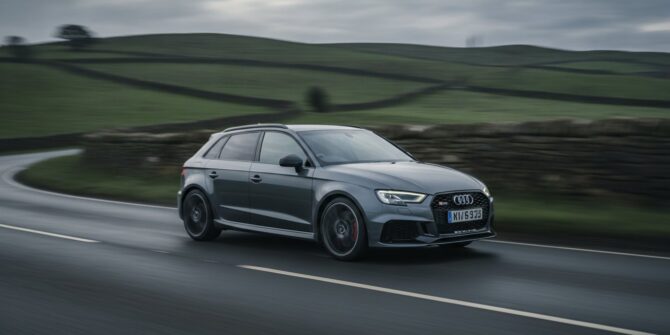
Have you ever found yourself hesitating at a busy junction, waiting for a gap that your car simply isn’t responsive enough to take? That frustrating pause when you press the accelerator isn’t a hardware limitation; it’s a result of conservative factory software. You can significantly improve your car’s drivability by remapping the ECU to eliminate these artificial flat spots and sharpen your throttle response. Most drivers accept gear hunting and turbo lag as standard characteristics of their vehicle, yet these are often just digital compromises made by manufacturers for the mass market.
At Dynogen Remapping Solutions, we understand that a car should feel intuitive and eager. This guide explains how professional ECU remapping transforms your vehicle’s on-road behaviour, replacing sluggishness with a more linear power delivery and a truly premium driving feel. We’ll compare Stage 1 performance against stock settings to show you how bespoke calibration provides the confidence you need for safe overtaking and a more refined experience every time you get behind the wheel.
Key Takeaways
- Understand why factory software often includes artificial flat spots to satisfy global regulations rather than prioritising the driver’s experience.
- Discover how optimising ‘Driver Wish’ maps creates a more intuitive connection between your right foot and the engine’s response.
- Learn how you can improve car drivability remapping your vehicle to eliminate dangerous hesitation when pulling out of busy junctions.
- Identify the specific signs that your car is suffering from restrictive stock settings, such as noticeable dead spots during mid-range acceleration.
- Recognise the reliability benefits of bespoke, custom-calibrated software developed through 15 years of specialist technical expertise.
Why Factory Engine Settings Often Compromise Drivability
When you drive a car off the forecourt, you aren’t experiencing the engine’s true potential. Manufacturers must ensure their vehicles survive in every corner of the globe, from the sub-zero temperatures of Scandinavia to the dusty, high-heat environments of the Sahara. Consequently, the Engine Control Unit (ECU) is programmed with a “safe” baseline that accounts for poor-quality fuels and irregular maintenance schedules. This generic approach prioritises mechanical survival over the refined, responsive behaviour that UK drivers expect.
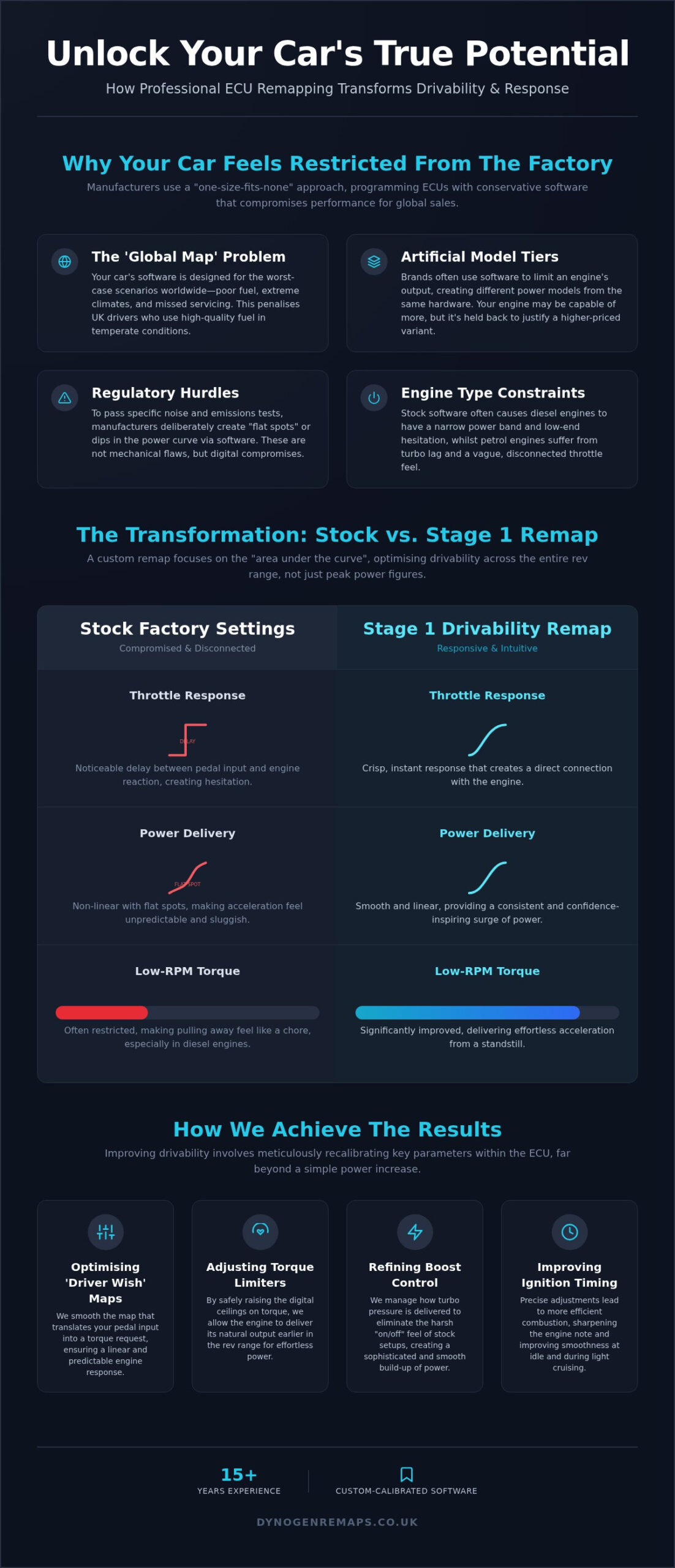
Beyond survival, manufacturers often introduce artificial flat spots in the RPM range to pass specific drive-by noise and emission tests. These software-induced dips aren’t mechanical flaws; they’re deliberate compromises designed to meet regulatory hurdles. If you want to improve car drivability remapping the ECU is the only way to iron out these inconsistencies. Many brands also use software limiters to differentiate between low and high power models. You might be driving an engine capable of significantly more, yet it’s held back by code to protect the sales of a more expensive variant. The result is a driving experience that feels muffled and disconnected from your input.
The ‘Global Map’ Problem: One Size Fits None
A vehicle sold in the United Kingdom carries the exact same software as one destined for a desert climate. This “one size fits none” strategy ignores the high-quality fuels and temperate weather conditions we enjoy locally. British drivers often find their cars feel sluggish because the factory map is overly cautious with ignition timing and boost pressure. Through professional Chip tuning, we can recalibrate these settings to suit our specific environment. This bespoke optimisation ensures the engine operates at its peak efficiency within the UK’s unique driving landscape, whether you’re navigating stop-start urban traffic or cruising on the motorway.
Diesel vs. Petrol: Different Constraints, Same Frustration
The frustrations vary depending on your fuel type, but the root cause remains the factory software. Diesel engines often suffer from low-end hesitation and a frustratingly narrow power band that makes pulling away feel like a chore. Conversely, modern downsized petrol engines frequently struggle with turbo lag and a soft throttle response that lacks precision. Factory software effectively suppresses the natural torque characteristics of these engines. By choosing to improve car drivability remapping your vehicle, you restore the linear power delivery that makes both petrol and diesel engines feel more athletic and rewarding to drive. It’s about removing those digital shackles to reveal the engine’s true character.
The Technical Pillars of Improved Drivability via ECU Remapping
True performance isn’t just about the peak figures on a dynamometer printout. While many tuners fixate on maximum horsepower, the real transformation occurs in the “area under the curve.” To effectively improve car drivability remapping must focus on how the brain of the engine interprets your physical inputs. By recalibrating the complex web of software maps within the ECU, we can replace a sluggish, unpredictable character with one that’s sharp and intuitive. This process involves a meticulous adjustment of several key parameters that dictate the vehicle’s daily behaviour.
- Optimising ‘Driver Wish’ maps: This specific table translates your accelerator pedal position into a torque request. We smooth these maps to ensure the engine’s response is linear and predictable across the entire rev range.
- Adjusting ‘Torque Request’ limiters: Manufacturers often set digital ceilings that stifle the engine’s natural output. Lifting these safely allows the engine to breathe earlier, providing that effortless surge of power from low RPMs.
- Refining turbo boost control: By managing how boost pressure is delivered, we eliminate the aggressive “on/off” sensation common in stock turbocharged cars, resulting in a more sophisticated feel.
- Improving ignition timing: Precision adjustments here lead to more efficient combustion, which not only sharpens the engine note but also improves overall smoothness during idle and light-load cruising.
Sharper Throttle Response: Removing the Digital Delay
Modern vehicles utilise ‘drive-by-wire’ technology. There’s no physical cable connecting your foot to the engine; instead, a sensor sends a signal to the ECU. Manufacturers intentionally programme “damping” into this signal to prioritise fuel economy or passenger comfort, which creates that frustrating split-second delay when you try to pull away. Our custom remapping reduces this electronic latency. The car feels lighter. It feels eager. This technical refinement removes the need to “pre-plan” your acceleration, making urban driving and lane changes far more relaxed. If you’re ready to experience this level of precision, you can explore our bespoke Stage 1 Performance Remap services to see what’s possible for your vehicle.
Torque Delivery: Smoothing the Power Curve
A “peaky” engine that only delivers power at the top of the rev range is exhausting for daily use. It requires constant gear changes and high-RPM theatrics just to maintain progress. We prioritise low-down and mid-range torque delivery. This approach makes motorway cruising and overtaking significantly safer. Instead of the car hunting for gears or feeling strained on inclines, it simply pulls with a confident, surging delivery. We create a power curve that feels endless, ensuring that the engine remains in its “sweet spot” for much longer than the factory software allows.
Stage 1 Remap vs. Stock: A Real-World Performance Comparison
Comparing a stock vehicle to one with a Stage 1 calibration reveals a transformation that goes far beyond simple speed. Most factory software is designed with a “safety buffer” that results in a dull, lethargic feel during daily commutes. You can significantly improve car drivability remapping the Electronic Control Module to remove these artificial restrictions. This technical refinement ensures that the engine’s output is aligned with your intentions, making the vehicle feel lighter and more responsive in every scenario.
The differences are most apparent during common driving manoeuvres that usually cause frustration in a standard car. Consider these real-world improvements:
- Standard driving: Moving away from junctions or roundabouts becomes an effortless action rather than an anxious wait for the engine to respond.
- Motorway cruising: You’ll notice a significantly reduced need for downshifting; the added torque allows the car to maintain speed on inclines whilst remaining in top gear.
- Overtaking: A wider window of accessible power makes B-road manoeuvres safer because you can complete the pass in less time.
- Fuel economy: Because the engine is more efficient and requires fewer gear changes to maintain momentum, many drivers see an improvement in MPG during normal use.
The ‘Area Under the Curve’ Explained
Peak power figures look impressive on a brochure, but you rarely drive at the redline. The real secret to a better driving experience lies in the “area under the curve,” which represents the total power available throughout the entire rev range. Custom software fills in the frustrating dips and flat spots found in stock power delivery, providing a consistent surge of acceleration. In practical terms, useful power is the torque available between 2,000 and 4,000 RPM. By focusing on this mid-range, we ensure the car feels muscular and ready to move without needing to thrash the engine.
Remapping and Automatic Gearboxes
Modern 8 and 9-speed automatic transmissions are marvels of engineering, but they’re often hampered by software that prioritises emissions over smoothness. This frequently leads to “gear hunting,” where the car constantly shifts up and down to find the right ratio. A Stage 1 remap provides the engine with the necessary torque to hold a gear for longer, making the transmission feel more decisive and less frantic. This synergy between engine torque and transmission shift points is particularly noticeable in DSG or ZF gearboxes, which become crisper and more intuitive. The result is a premium driving feel where the engine and gearbox work in perfect harmony rather than fighting against each other.
Beyond BHP: Signs Your Car Needs a Drivability Remap
Peak horsepower figures often dominate the conversation, but they tell only half the story. Most drivers spend their time in the mid-range of the rev counter, not at the redline. If your vehicle feels lethargic in daily traffic, it’s likely suffering from software-induced limitations. To improve car drivability remapping is essential for those who want a car that feels alert and ready. Recognising the symptoms of a restrictive factory map is the first step toward reclaiming your driving experience.
You may have noticed your car exhibits specific, frustrating behaviours that make it feel less “premium” than it should. These aren’t mechanical faults; they’re digital shackles. Look out for these common signs:
- Low-end sluggishness: The vehicle feels “heavy” or unresponsive until the turbocharger finally spools up at high RPMs, leaving you wanting more “get-up-and-go” from a standstill.
- Mid-gear dead spots: You experience a distinct pause or “flat spot” in acceleration when you’re half-way through a gear, disrupting the flow of your progress.
- Spongy throttle response: The accelerator pedal requires significant travel before the engine actually reacts, making the car feel disconnected from your foot.
- Premature power drop-off: The engine feels like it “dies off” or loses steam long before you reach the redline, forcing you to shift gears earlier than you’d like.
Identifying Flat Spots and Hesitation
Hesitation isn’t just an inconvenience; it’s a safety risk. Pulling onto a busy roundabout or merging into fast-moving traffic requires instant, predictable response. If your car pauses to “think” before moving, it puts you in a vulnerable position. Modern “Eco” modes often exacerbate this problem by dulling throttle sensitivity to chase marginal fuel savings. Our bespoke calibrations restore the natural balance between efficiency and responsiveness. We remove the artificial damping that causes this delay, ensuring your car reacts exactly when you need it to. If you’re tired of that split-second pause at every junction, it’s time to book a custom remap and experience the difference for yourself.
Remapping for Towing and Heavy Loads
For those driving motorhomes, vans, or cars pulling heavy trailers, torque is the only metric that truly matters. A narrow power band makes maintaining momentum on steep inclines a constant battle, often requiring frequent downshifting. By widening the torque band and delivering power lower in the rev range, we provide the “grunt” needed to keep moving without thrashing the engine. This technical refinement reduces mechanical strain because the engine doesn’t have to work as hard to move the same load. A remapped engine remains in its “sweet spot” for longer, providing a more relaxed and confident towing experience across the UK’s varied terrain.
This refined torque delivery is especially valuable for those planning a touring holiday; for example, if you are hiring a vehicle from Highland Roamers to explore the Scottish Highlands, you will appreciate how a responsive engine handles the region’s demanding terrain.
Dynogen’s Custom Software: Precision Calibration for the Discerning Driver
Choosing a performance upgrade requires absolute trust in the technician’s expertise. At Dynogen, we firmly reject the generic “off-the-shelf” maps that have become prevalent in the tuning industry. These standard files often ignore the specific health, mileage, and wear of your vehicle, which can lead to compromised reliability. Our 15-year legacy of technical excellence throughout the UK is built on the foundation of bespoke calibration. To improve car drivability remapping must be tailored to the individual ECU architecture of your specific car, ensuring a perfect marriage between hardware and software.
Safety remains our absolute priority during every calibration. Whilst we unlock significant performance gains, we always maintain factory safety limiters. This ensures that critical engine protections, such as exhaust gas temperature monitoring and knock sensors, remain fully active to preserve engine longevity. Our Stage 1 Performance Remap is developed specifically for UK road conditions and fuel qualities. It is an exercise in digital precision, designed for drivers who value a refined, sophisticated experience over raw, unmanaged power.
The Dynogen Difference: Custom vs. Generic
The market is currently flooded with “flash and dash” tuners using unverified, generic software. These files are often written for a “perfect” car in a controlled environment, which rarely matches the reality of a used vehicle. We begin by analysing your specific vehicle’s software version before making a single modification. This meticulous approach allows us to ensure that every adjustment to boost pressure or ignition timing is compatible and safe. Reliability is never sacrificed for a headline figure. By focusing on the unique nuances of your engine, we deliver a transformation that feels like it came from the factory, only significantly better.
What to Expect at Your Dynogen Appointment
Our process is methodical and logical, reflecting our commitment to professional standards. Every appointment begins with a comprehensive diagnostic health check to ensure your vehicle is in peak condition for software modification. We then use advanced industry equipment to install your custom-calibrated software safely. Once the installation is complete, we conduct a final test drive. This allows you to experience the sharpened throttle response and linear power delivery firsthand, ensuring total satisfaction with the result. Experience the Dynogen difference and book your custom Stage 1 remap today.
Reclaim Your Vehicle’s True Character
Modern driving shouldn’t be defined by hesitation at junctions or a sluggish throttle response. We’ve explored how factory software compromises are often the root cause of a disconnected driving experience. The decision to improve car drivability remapping the engine’s software is a technical investment in your vehicle’s refinement, providing a sophisticated solution that prioritises linear power delivery. This transformation replaces artificial flat spots with a consistent surge of torque that makes every journey more rewarding and safe.
For those who value high standards in every aspect of their lifestyle, from the performance of their vehicle to the quality of their home, finding the right environment is essential. If you are looking for premium accommodation in the North West, you can visit Nicholson Lettings to explore luxury furnished apartments in Liverpool and St Helens.
With over 15 years of expert vehicle tuning experience, we understand that every engine requires a unique approach. Our technicians use advanced diagnostic equipment to ensure your vehicle is in peak health before applying custom-calibrated software tailored specifically to your car’s needs. We don’t believe in generic flashes; we believe in precision engineering that respects the longevity of your engine. Transform your driving experience with a Dynogen Stage 1 Remap. Enquire Now. It’s time to stop settling for a car that feels held back and start enjoying the premium performance you deserve.
Frequently Asked Questions
Can remapping really improve my car’s fuel economy whilst increasing power?
Yes, a Stage 1 remap can improve fuel efficiency by increasing the engine’s torque at lower RPMs. This allows you to maintain speed with less throttle input and stay in higher gears for longer. Drivers often find they can improve car drivability remapping whilst seeing noticeable gains in MPG, particularly during steady motorway cruising where the engine operates more efficiently.
Will a drivability remap make my car less reliable or shorten its lifespan?
Reliability remains a priority when a remap is performed by a seasoned specialist. We ensure all factory safety limiters stay active to protect the engine from excessive heat or pressure. By staying within the mechanical tolerances of your specific vehicle, a custom calibration provides a safe performance boost without compromising the long-term lifespan of your engine components.
Does a Stage 1 remap affect the smoothness of my automatic gearbox?
A Stage 1 calibration has a profound impact on the behaviour of modern automatic gearboxes, such as DSG or ZF units. By increasing the available torque, the engine doesn’t need to hunt for lower gears as frequently on inclines or during overtakes. This results in a much more decisive and sophisticated shifting pattern that feels significantly more premium than stock settings.
Is remapping legal in the UK and do I need to inform my insurance provider?
ECU remapping is perfectly legal in the UK, but you must declare the modification to your insurance provider. It’s illegal to perform a remap that disables emissions control equipment like a DPF, as this would cause an MOT failure. Most insurance companies will cover a remapped car, though your premium may be adjusted to reflect the change in performance.
How long does the remapping process take at a professional centre?
The entire process usually takes between two and four hours at a professional tuning centre. This duration allows our technicians to perform a full diagnostic health check before carefully installing the bespoke software. We never rush the calibration; we take the time to ensure the new maps are perfectly integrated and conduct a final test drive to verify the results.
Can I reverse the remap if I decide to sell the car in the future?
Your car can be returned to its factory settings at any time. We keep a secure backup of your original stock software on our servers, making the reversal process straightforward. This is particularly useful if you intend to sell the car or if you’re returning a vehicle at the end of a lease agreement and want it back in its original state.
What is the difference between a ‘tuning box’ and a professional ECU remap?
A tuning box is a simple device that intercepts and alters sensor signals, whereas a professional remap is a complete optimisation of the engine’s software. Remapping is a much more sophisticated solution because it allows for precise control over ignition timing, boost pressure, and torque limiters. This ensures a safer, smoother, and more comprehensive improvement to the car’s overall performance.
What happens if my car is under warranty and I get it remapped?
Modifying your ECU will likely void the manufacturer’s warranty on the engine and drivetrain. Dealerships can often detect that the software has been altered during routine maintenance or diagnostic work. If warranty coverage is a primary concern, you should carefully review your policy or consider the risks before proceeding with any software based performance enhancement.