
With UK diesel prices hovering near a record 196p per litre, your van’s fuel consumption is likely the single largest drain on your business’s bottom line. It’s a frustrating reality for many owner-operators who find their vehicles feeling sluggish under heavy loads whilst watching their profit margins vanish at the pump. You’ve probably heard conflicting advice about “magic” additives or expensive gadgets, but the truth is that learning how to increase van MPG requires a more sophisticated, technical approach. We understand that a van isn’t just a tool; it’s an investment that needs to perform with precision and efficiency to remain competitive in today’s market.
This guide provides a professional, multi-layered strategy to transform your vehicle’s fuel economy. You’ll discover how simple maintenance habits, like managing tyre pressure and reducing aerodynamic drag, can yield immediate results. We also explore advanced technical optimisations, such as bespoke economy remapping, which refines your engine’s torque curve for better responsiveness and significantly lower fuel bills. By the end of this article, you’ll have a clear roadmap to extending your vehicle’s lifespan and achieving the smooth, cost-effective driving experience you deserve.
Key Takeaways
- Maintain a pristine air filter and utilise high-quality synthetic oils to ensure your engine operates at its ideal stoichiometric ratio, significantly reducing internal mechanical friction.
- Master the physics of momentum by employing engine braking to shut off fuel injectors during deceleration, effectively reclaiming energy that would otherwise be lost to heat.
- Learn how to increase van MPG through professional Economy Remapping, which recalibrates the ECU to optimise fuel injection timing and atomisation for a superior combustion cycle.
- Prevent substantial fuel penalties by proactively managing emissions components like the DPF and EGR valve to avoid inefficient, frequent regeneration cycles.
- Prioritise bespoke software calibrations and comprehensive pre-map health checks over generic tuning to ensure lasting vehicle reliability and peak efficiency.
The Foundation of Fuel Efficiency: Maintenance and Mechanical Health
Achieving peak performance begins with the mechanical integrity of your vehicle. Whilst many drivers focus solely on pump prices, the most effective strategy for how to increase van MPG is ensuring your engine operates without internal resistance. A clean air filter is non-negotiable for maintaining the correct stoichiometric ratio. When the air supply is restricted, the engine’s control unit often compensates by increasing fuel delivery, leading to incomplete combustion and wasted energy. By prioritising these fundamental mechanical checks, you establish a baseline of efficiency that complements more advanced energy-efficient driving techniques.
Internal engine friction represents another significant hurdle. High-quality synthetic oils are engineered to provide a superior lubricating film that remains stable under extreme thermal loads. This reduces the energy required to move internal components, directly translating to better fuel economy. Beyond the engine, overlooked components like sticking brake calipers can act as a constant, invisible drag on your momentum. Even a slight bind in the piston or slider pins forces the engine to work harder just to maintain speed. Similarly, poor wheel alignment increases rolling resistance as the tyres “scrub” against the road surface rather than gliding smoothly, causing a measurable drop in efficiency over long motorway journeys.
Tyre Pressure and Rolling Resistance
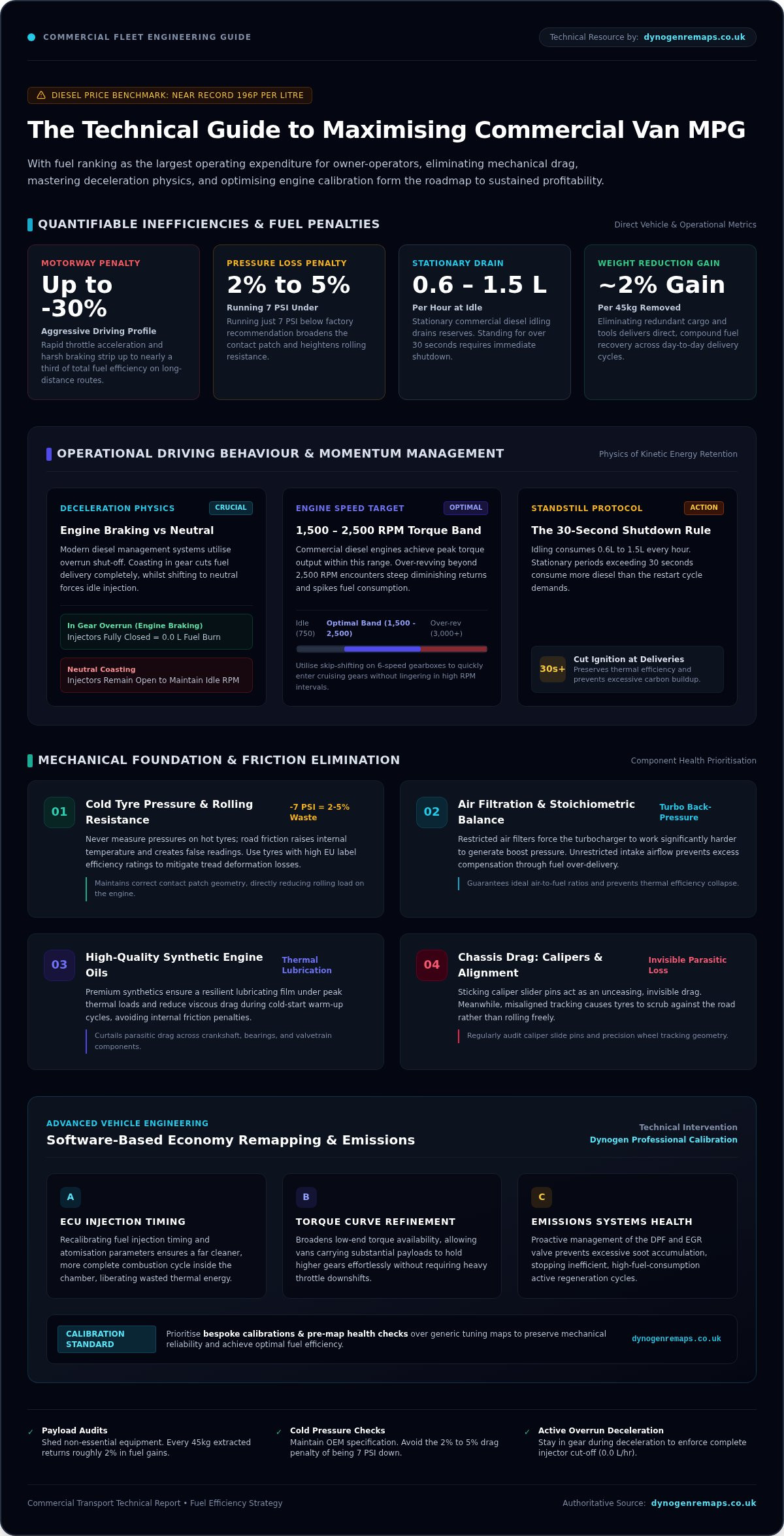
Under-inflated tyres are a primary culprit in excessive fuel burn. When a tyre lacks sufficient pressure, the contact patch expands, which significantly increases the rolling resistance the engine must overcome. Industry data confirms that running just 7 PSI below the manufacturer’s recommendation can result in a 2% to 5% fuel penalty. It is vital to check your pressures whilst the tyres are cold. Heat from driving increases internal pressure and provides a false reading. For commercial operators, selecting tyres with high fuel-efficiency ratings on the EU label further optimises performance by reducing energy loss through tread deformation.
Air Filters and Oil Quality
A restricted air filter forces the turbocharger to work harder to achieve the target boost pressure. This increases exhaust back-pressure and reduces overall thermal efficiency. Choosing the correct oil viscosity is equally critical, particularly for cold-start efficiency where thicker, older oil creates significant drag during the warm-up cycle. Regular oil changes prevent internal carbon buildup and ensure that vital engine components remain free from performance-robbing deposits.
Optimising Driving Behaviour for Maximum Van MPG
While mechanical health provides the platform, the driver’s input determines the ultimate result. Understanding how to increase van MPG requires a shift in perspective, viewing every touch of the brake pedal as a loss of energy you’ve already paid for. In the world of commercial transport, momentum is your most valuable asset. Modern diesel engines are equipped with sophisticated fuel shut-off systems that stop fuel delivery entirely during overrun. By utilising engine braking rather than shifting into neutral, you keep the injectors closed whilst slowing down, ensuring zero fuel consumption during deceleration.
Aggressive driving behaviours, such as rapid acceleration and harsh braking, can reduce fuel efficiency by up to 30% on motorways. Professional fleet fuel conservation strategies often prioritise driver training because the human element is so influential. Idling is another silent profit killer; a stationary diesel engine consumes between 0.6 and 1.5 litres of fuel per hour. If you’re stationary for more than 30 seconds, it’s more efficient to switch off. Similarly, carrying unnecessary weight is a constant penalty. Removing just 45kg of redundant tools can improve efficiency by roughly 2%, making regular cargo audits essential for the cost-conscious operator.
The Art of Smooth Acceleration
Effective driving involves finding the “sweet spot” in your engine’s torque curve, typically between 1,500 and 2,500 RPM for most modern vans. Over-revving beyond this point offers diminishing returns and spikes fuel consumption. In modern six-speed manual gearboxes, skip-shifting allows you to reach cruising speeds more efficiently by spending less time in lower, fuel-intensive gears. When climbing gradients, maintain a consistent throttle position rather than chasing a specific speed, allowing the vehicle to lose a few mph to save significant fuel.
Aerodynamics and Speed Management
Aerodynamic drag rises exponentially with speed. Driving at 70mph consumes up to 15% more fuel than driving at 60mph due to increased wind resistance. Empty roof racks or ladder carriers significantly disrupt airflow, adding between 15% and 25% to your drag coefficient at highway speeds. For those seeking the ultimate edge, an Economy Remap can further refine these gains by smoothing the torque curve, making it easier to maintain these efficient driving habits. Finally, ensure your cargo is distributed evenly to maintain a level stance, as a nose-high or tail-heavy van creates additional turbulence underneath the chassis.
The Technical Lever: Software-Based Economy Remapping
Economy remapping represents the pinnacle of modern engine optimisation, moving beyond basic mechanical adjustments to the digital core of the vehicle. This process is the technical recalibration of the Engine Control Unit (ECU) to prioritise torque delivery and fuel atomisation. Whilst factory software is written with wide tolerances to account for poor global fuel grades, bespoke software unlocks the engine’s true efficiency. By precisely adjusting fuel injection timing, we achieve a more complete combustion cycle. This ensures that every drop of diesel is converted into kinetic energy rather than wasted heat or exhaust soot. It is the most effective technical solution for those researching how to increase van MPG without compromising vehicle reliability.
Unlike generic “tuning boxes” that merely intercept and distort sensor signals, a professional remap provides a multi-dimensional adjustment of the engine’s operating parameters. These generic boxes often lead to erratic idling or increased smoke because they cannot account for the complex relationship between boost pressure and fuel rail timing. Custom software is superior because it maintains the manufacturer’s safety limits whilst smoothing out the power delivery, resulting in a vehicle that feels more refined and significantly less expensive to run.
How Economy Maps Optimise Fuel Injection
The technical process involves fine-tuning rail pressure and injection duration to create a finer fuel mist. Improved atomisation allows the flame front to travel more efficiently across the combustion chamber, extracting maximum energy from the fuel. We also focus on reducing “turbo lag” by optimising boost delivery, ensuring the engine operates in its most efficient window from lower RPMs. This cleaner burn is crucial for long-term health; as the diesel particulate filter guidance suggests, efficient combustion reduces the soot load that leads to frequent regeneration cycles. For a deeper technical dive, our guide on Diesel economy tuning UK explores these calibrations in exhaustive detail.
Balancing Torque and Gear Selection
The primary objective of an economy map is to shift the torque curve lower in the rev range. This increased low-end torque allows drivers to hold higher gears for longer amongst varying terrain, significantly reducing the frequency of fuel-intensive downshifts. When the engine isn’t struggling to maintain momentum, throttle response becomes smoother and more predictable. Exploring the broader ECU remapping benefits reveals how this technical intervention transforms a sluggish van into a responsive, efficient workhorse. This software-led approach remains the most sophisticated method for anyone asking how to increase van MPG.
Managing Emissions Systems and Speed Limiters for Efficiency
Maintaining the sophisticated emissions architecture of a modern diesel engine is a critical, yet often overlooked, component of any strategy regarding how to increase van MPG. When these systems falter, the impact on your fuel budget is immediate and severe. A primary culprit is the Diesel Particulate Filter (DPF) regeneration cycle. To clear accumulated soot, the ECU must inject additional fuel during the exhaust stroke to reach temperatures exceeding 600°C. If your van is frequently forced into these cycles due to urban driving or partial blockages, you’re essentially pumping unburnt diesel directly into the exhaust system, resulting in a significant and constant fuel penalty.
The Impact of DPF and EGR Health
Exhaust Gas Recirculation (EGR) valves are equally prone to carbonisation, which disrupts the precise air-fuel ratio required for efficient combustion. A stuck or sluggish EGR valve forces the engine to compensate with higher fuel delivery, often triggering a “limp mode” that renders the vehicle useless for commercial work. Our technical specialists provide advanced EGR Solution and DPF software calibrations to resolve these persistent faults. By implementing these software-based corrections, we can manage emissions components to restore lost MPG and prevent the engine from operating in a permanently inefficient state. Professional software recalibration ensures that the engine’s breathing remains unobstructed, allowing for a cleaner burn and better responsiveness under load.
Speed Limiters as a Fuel-Saving Strategy
Managing your vehicle’s velocity through software is a proven method for protecting your profit margins. Aerodynamic drag rises with the square of speed, which means a van travelling at 70mph consumes between 9% and 15% more fuel than one limited to 60mph. By electronically capping your maximum speed to 62mph or 68mph via the ECU, you eliminate the temptation of high-speed motorway runs that devour diesel. This software-based discipline ensures every driver in your fleet adheres to the most efficient operating parameters. These calibrations also foster a safer driving environment and can lead to reduced maintenance costs for consumables like brake pads and tyres. If you need to refine your vehicle’s current restrictions to find a better balance, you can optimise your speed limiter settings to achieve the perfect synergy between progress and economy.
The Professional Path to Increased Van MPG with Dynogen
Dynogen Remapping Solutions represents the pinnacle of technical excellence in the UK tuning industry. With over 15 years of specialised experience, we’ve witnessed the evolution of diesel technology and remain at its leading edge. For owner-operators questioning how to increase van MPG, the solution lies in moving beyond generic modifications toward precision-engineered software. Our approach is methodical; every vehicle undergoes a rigorous pre-map health check to ensure the engine, turbocharger, and emissions systems are in peak condition before any calibration occurs. This professional diligence ensures that the enhancements we provide are both safe and sustainable for the long term.
We take deep pride in our workmanship, positioning ourselves as a superior, more personalised alternative to standard dealership options. By focusing on custom calibrations rather than generic “chip” tuning, we solve complex mechanical problems whilst remaining accessible to our clients. The result is a vehicle that doesn’t just burn less fuel, but one that feels refined and aspirational to drive. This technical mastery is what allows us to deliver tangible improvements in both efficiency and engine responsiveness.
Bespoke Software vs Generic Tuning
Every engine is unique, influenced by its service history and individual wear patterns. This is why generic “flash and dash” maps are inherently risky; they apply a one-size-fits-all solution that can push components beyond their safe operating limits. We develop bespoke software for specific models, such as the Ford Transit, ensuring that every parameter is perfectly aligned with the vehicle’s actual mechanical state. By choosing our professional Van remapping for better MPG service, you avoid the instability associated with generic tuning and gain a vehicle that is smoother and vastly more efficient.
Commercial ROI and Fleet Gains
For businesses managing multiple vehicles, the return on investment for an Economy Remap is significant. When fuel costs represent over 30% of your total operating expenditure, even a modest improvement in efficiency scales dramatically across a fleet of five, ten, or fifty vans. Our Ford Transit economy remap case study demonstrates how technical optimisation translates into tangible monthly savings at the pump. The software often pays for itself within months, especially for high-mileage operators covering thousands of motorway miles. If you’re ready to protect your profit margins, contact Dynogen today for a professional efficiency consultation and discover how to increase van MPG across your entire operation.
Take Command of Your Van’s Efficiency and Performance
Achieving peak fuel efficiency requires more than just careful driving; it demands a synergy between meticulous mechanical health, driver discipline, and advanced software calibration. By prioritising routine maintenance and mastering the physics of momentum, you’ve already established the foundation for protecting your profit margins. However, the most significant technical lever remains a bespoke Economy Remap, which refines your engine’s torque delivery for a smoother, more responsive driving experience. This methodical approach ensures your vehicle operates at its absolute zenith of efficiency.
When you’re ready to master how to increase van MPG, partnering with a seasoned specialist ensures your vehicle receives the precision it deserves. At Dynogen, we bring over 15 years of technical experience and custom-calibrated software to every project, offering expert UK-wide support for owner-operators and fleets alike. This professional intervention doesn’t just lower your fuel bills; it extends your vehicle’s lifespan and enhances the overall driving experience. Take control of your operational costs today and experience the satisfaction that comes with perfection in vehicle performance.
Book Your Professional Van Economy Remap at Dynogen
Frequently Asked Questions
Can a remap really increase my van MPG significantly?
An Economy Remap can yield impressive improvements, often achieving gains of up to 10 MPG on long motorway runs. By refining the mid-range torque curve and smoothing boost response, the engine operates with much higher efficiency. This extra low-end torque allows you to shift up earlier and remain in higher gears longer, which is a fundamental strategy for anyone researching how to increase van MPG effectively.
Will increasing my van MPG through remapping affect the engine reliability?
Professional remapping actually enhances reliability by ensuring the engine operates within its designed mechanical tolerances. Unlike generic tuning boxes that distort sensor signals, a custom calibration from a seasoned specialist maintains manufacturer safety limits whilst smoothing power delivery. This precision reduces the strain on internal components during heavy loads, often extending the vehicle’s lifespan through more efficient combustion and reduced mechanical stress.
Is it legal to remap a van for better fuel economy in the UK?
Remapping for fuel economy is entirely legal in the UK, provided the vehicle remains compliant with emissions standards. Software calibrations that optimise fuel injection timing and boost pressure do not violate road regulations. However, it’s a criminal offence to remove or modify emissions control equipment like the DPF for use on public roads. Our technical services focus on legitimate software optimisation to restore and enhance efficiency.
How much can I expect to save on fuel after a professional economy remap?
Fuel savings vary based on your annual mileage and typical payload, but many operators see a return on investment within months. With UK diesel prices near record highs, a 10% to 15% improvement in efficiency translates into hundreds of pounds saved annually per vehicle. For high-mileage fleets, these gains scale dramatically, making professional software recalibration one of the most cost-effective commercial upgrades available today.
Does my driving style still matter after a van has been remapped?
Your driving behaviour remains a critical factor in achieving the best results. While the remap provides the technical potential for better efficiency by broadening the torque curve, aggressive acceleration and excessive speeding will still diminish your gains. To master how to increase van MPG, you should combine our custom software with smooth throttle inputs and early gear changes to stay within the engine’s new, more efficient sweet spot.
Can an economy remap be detected during an MOT test?
A professional economy remap is not detectable during a standard UK MOT test. The MOT focuses on safety, mechanical integrity, and tailpipe emissions levels. Since our calibrations maintain emissions compliance and don’t involve physical modifications to the exhaust system, the vehicle will pass the test as usual. The software changes are stored within the ECU and don’t appear on standard diagnostic equipment used by testers.
What happens to my insurance if I remap my van for efficiency?
You’re legally required to disclose any vehicle modifications, including software remapping, to your insurance provider. Whilst some insurers may adjust premiums, many commercial providers view economy remapping favourably as it often encourages a calmer driving style. Failing to declare the modification could void your policy in the event of a claim, so it’s vital to maintain transparency regarding your vehicle’s technical specifications.
How long does the professional remapping process take to complete?
The professional remapping process typically takes between one and two hours to complete. This timeframe includes a comprehensive pre-map health check to ensure the vehicle is fit for tuning, followed by the installation of the custom-calibrated software. Our methodical approach ensures that every parameter is meticulously verified before you get back on the road, providing an immediate and noticeable improvement in engine responsiveness and efficiency.