

Could a single software calibration be the most significant mechanical upgrade you make to your fleet this year? For many UK operators, the Ford Transit remains the undisputed backbone of daily logistics, yet the persistent sting of high fuel expenditure and the lack of low-end torque when fully laden continue to squeeze profit margins. You’ve likely felt the frustration of a van that struggles under a heavy payload, leading to valid concerns about engine longevity and your business’s carbon footprint.
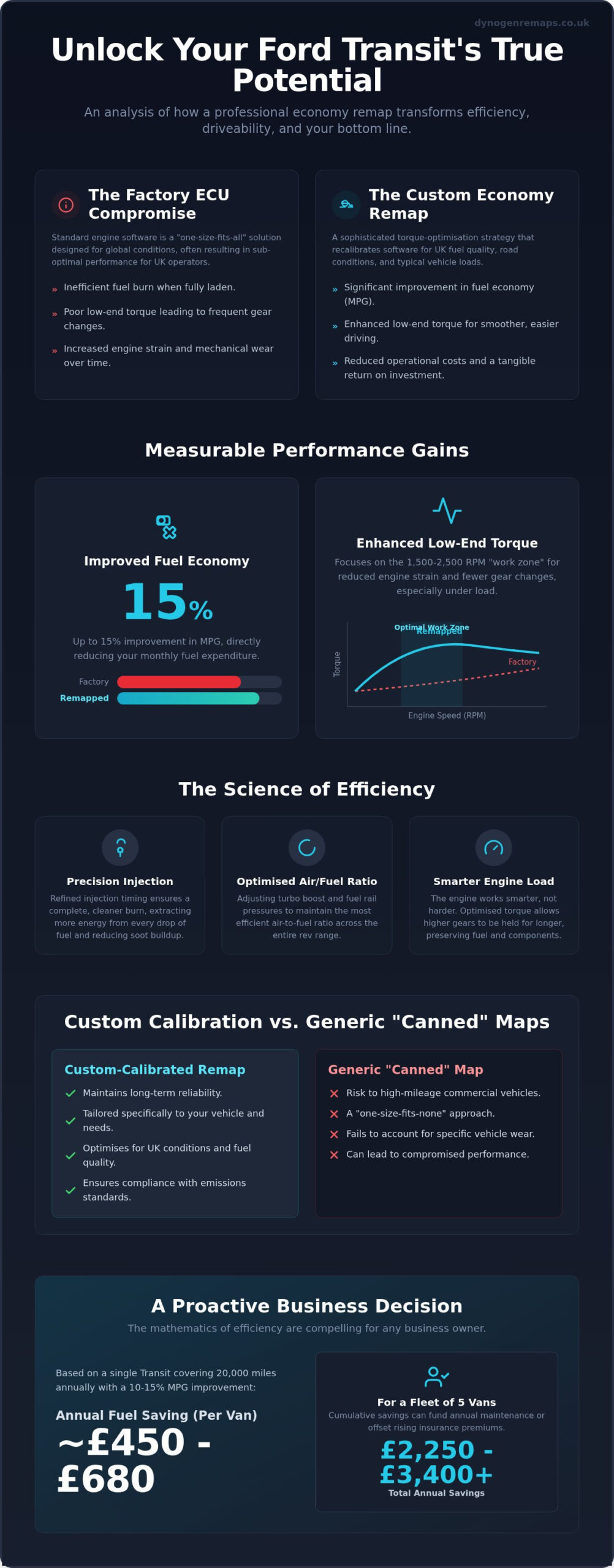
A professional Ford Transit economy remap represents a sophisticated torque-optimisation strategy that transforms how your 2.0-litre EcoBlue engine handles work. By opting for custom-calibrated software rather than generic alternatives, it’s possible to reduce fuel costs by up to 15% whilst significantly improving responsiveness. In this guide, we’ll analyse a 2026 case study on fuel efficiency and ROI. We’ll examine how precision tuning navigates the complexities of new Euro 7 regulations to deliver a smoother, more capable vehicle that protects your bottom line and ensures your van remains a competitive asset for years to come.
Key Takeaways
- Understand why standard factory maps are universal compromises and how specific UK conditions necessitate a more tailored approach to engine management.
- Learn how a professional Ford Transit economy remap optimises fuel injection and timing to deliver up to 15% improvement in MPG.
- Discover the critical role of enhanced low-end torque in reducing engine strain and improving driveability when the vehicle is fully laden with tools or cargo.
- Review real-world data from a 2.0 EcoBlue case study that demonstrates the tangible return on investment through reduced monthly fuel expenditure.
- Recognise the vital importance of custom-calibrated software over generic “canned” maps for maintaining the long-term reliability of high-mileage commercial vehicles.
The Ford Transit Fuel Challenge: Why Efficiency Matters in 2026
Operating a commercial fleet in the UK has never been more demanding. With diesel prices remaining a volatile and significant component of business overheads, every mile driven represents a direct impact on your balance sheet. The Ford Transit is widely regarded as a masterpiece of versatile engineering, yet its factory software is designed to accommodate a vast range of global variables rather than the specific needs of a UK tradesperson. This universal calibration often leads to frequent, unnecessary gear changes and inefficient fuel burn, particularly when the vehicle is laden with heavy equipment or tools.
Understanding the Factory ECU Compromise
Manufacturers are obligated to ensure their vehicles function reliably in extreme environments, from the sub-zero temperatures of Scandinavia to the intense heat and dust of the Sahara. Consequently, they detune engines to compensate for poor fuel quality and varying atmospheric pressures found worldwide. The Science Behind a Remap involves reclaiming this lost potential by refining the software to suit local conditions and high-quality UK diesel. When we apply a Ford Transit economy remap, we replace these broad, safe-bet compromises with precision-engineered parameters. This specialised approach accounts for the stricter Euro 7 standards coming into force in late 2026, ensuring your vehicle remains efficient whilst maintaining full compliance with modern emissions regulations.
The Financial Impact of 10% MPG Gains
The mathematics of efficiency are compelling for any business owner. Consider a single Transit covering 20,000 miles annually; even a conservative 10% improvement in fuel economy translates into hundreds of pounds saved every year. For a small fleet of five vans, these cumulative savings can fund an entire vehicle’s annual maintenance or significantly offset rising insurance premiums. Transitioning to a Ford Transit economy remap isn’t merely a mechanical tweak. It’s a proactive business decision that yields a measurable return on investment.
By optimising the torque curve, drivers can maintain higher gears for longer periods. This reduces the engine strain that typically occurs during stop-start urban deliveries or steep motorway climbs with a full payload. This reduction in mechanical stress, combined with tangible fuel savings, provides a level of operational reliability that generic, off-the-shelf tuning solutions simply cannot match. It’s about making the engine work smarter, not harder, to protect your margins.
The Science Behind a Ford Transit Economy Remap
Recalibrating the Engine Control Unit (ECU) involves a methodical rewrite of the software parameters that dictate how your engine breathes and consumes fuel. A Ford Transit economy remap is not a simple “power boost”; it’s a technical refinement of the combustion cycle. We focus on adjusting turbo boost levels and fuel rail pressures to ensure the air-to-fuel ratio is always at its most efficient. Global shifts in transport policy, such as the new vehicle fuel economy standards, underscore the necessity for better efficiency, yet our custom software goes beyond generic factory targets to suit your specific workload.
Torque Optimisation vs. Raw Power
Performance maps usually chase peak horsepower at high revs, but an economy-focused calibration targets the 1,500 to 2,500 RPM range. This is the critical “work zone” for the 2.0-litre EcoBlue diesel engine. By increasing low-end torque, we allow the van to maintain its momentum without the driver needing to constantly downshift. This is especially vital for automatic Transits that often suffer from “hunting” between gears when navigating inclines under load. A smoother, more robust torque curve ensures the vehicle stays in its most efficient gear for longer, which directly preserves fuel and reduces mechanical wear. You can discover how these refinements apply to your fleet by exploring our custom tuning options.
Injection Timing and Fuel Atomisation
Precision is the absolute hallmark of our recalibration process. We refine injection timing to ensure diesel is introduced at the precise millisecond required for a complete, clean burn. This process improves fuel atomisation, creating a finer mist within the cylinder that ignites more effectively. By extracting more energy from every single drop of fuel, we significantly reduce the volume of unburnt diesel that typically leads to soot and carbon buildup in the EGR and DPF systems. This technical approach doesn’t just save money at the pump; it protects the long-term health of your engine’s most expensive components. Economy remapping is essentially a sophisticated tool for maximising the thermal efficiency of the internal combustion process.
By shifting the power band lower in the rev range, we change the fundamental behaviour of the vehicle. Drivers find they no longer need to “floor it” to get a heavy van moving, as the increased torque does the heavy lifting. This reduction in aggressive throttle input is the secondary, human factor that compounds the software’s inherent efficiency gains. It is also worth noting that a poorly calibrated or generic map can trigger unwanted ECU fault responses; operators who want to stop car limp mode issues caused by software-induced performance restrictions should understand how specialist recalibration addresses the underlying ECU architecture rather than simply clearing fault codes.
Case Study: Ford Transit 2.0 EcoBlue Economy Results
To understand the tangible impact of professional software recalibration, we monitored a 2022 Ford Transit Custom equipped with the 2.0-litre EcoBlue diesel engine. This specific vehicle, originally delivering 130PS, served as a primary mobile workshop for a busy UK electrical contractor. Before our intervention, the driver reported significant frustration with a lack of responsiveness when the van was laden with heavy racking and cable drums. On frequent motorway journeys, the engine struggled to maintain 70mph on inclines without downshifting, resulting in a disappointing average of 34 MPG.
Pre-Remap vs. Post-Remap Data
Our technical team applied a bespoke Ford Transit economy remap, specifically engineered to broaden the torque curve whilst enhancing thermal efficiency. The results were immediate and measurable. By refining the ECU’s fuel and boost tables, we achieved a sophisticated performance shift that prioritised driveability under load. The data collected over a 1,000-mile trial period showed the following improvements:
- Stock Output: 130PS / 350Nm Torque
- Optimised Output: 160PS / 410Nm Torque
- Efficiency Gain: Average MPG increased from 34 to 39
The driver noted that the additional 60Nm of torque completely transformed the vehicle’s behaviour. Instead of the engine feeling strained at motorway speeds, it now pulls effortlessly from lower revs. This allows the van to hold sixth gear on gradients where it previously required a shift to fifth, directly contributing to the 14.7% improvement in fuel economy. The throttle response became more linear, eliminating the “dead” feeling often associated with factory-detuned engines.
Long-Term Reliability and DPF Health
A primary concern for commercial operators involves the reliability of engine tuning, particularly regarding the Diesel Particulate Filter (DPF). Unlike generic, high-smoke “canned” maps that can clog a DPF within weeks, our custom calibration ensures a cleaner combustion cycle. By optimising the air-to-fuel ratio, we observed that DPF regeneration cycles occurred less frequently because the engine produced less soot in the first place. We also monitored exhaust gas temperatures (EGTs) under heavy load to ensure they remained well within safe factory tolerances. This methodical approach ensures that the vehicle gains efficiency without compromising the integrity of its emissions systems or increasing the risk of mechanical failure. For a high-mileage van, this reduction in soot accumulation is vital for avoiding expensive DPF cleaning or replacement costs in the future. Operators who find their DPF issues are more persistent may also benefit from understanding the full scope of dpf delete software solutions and UK regulations before making any decisions about their emissions systems.
Maximising Your ROI: How to Get the Most from Your Remap
A Ford Transit economy remap provides the technical foundation for significant fuel savings, but achieving the maximum return on investment requires a holistic approach to vehicle operation. Software alone cannot compensate for poor maintenance or inefficient driving habits. To truly see those 15% gains reflected in your monthly accounts, you must treat the remap as part of a wider efficiency programme. The first and most critical step is ensuring the vehicle is in optimal mechanical health. We always recommend a thorough inspection of the turbocharger, fuel injectors, and air intake system before any software modification. A healthy engine responds more precisely to the refined parameters of our custom maps, ensuring every drop of diesel is converted into useful kinetic energy.
Driving for Economy with New Torque
With the additional low-end grunt provided by our calibration, drivers should adopt a “short shifting” technique to maximise results. Because peak torque is now available much lower in the rev range, there’s no longer a need to hold gears until high RPMs. Shifting up early keeps the engine in its most efficient operating window, reducing fuel burn and mechanical wear. Additionally, cruise control becomes a far more effective tool post-remap. The increased torque allows the system to maintain speed on motorway inclines without the aggressive throttle spikes typically seen in factory-calibrated vans. Avoiding aggressive acceleration whilst utilising this extra low-end grunt is the fastest way to pay back the cost of the tuning.
Maintenance for the Remapped Transit
Strict adherence to a premium service schedule is the best way to protect your investment and maintain the gains achieved through a Ford Transit economy remap. High-quality synthetic oils and fresh filters are essential for maintaining the thermal efficiency we’ve unlocked. We also advise regular checks of tyre pressures; even a slight drop in pressure increases rolling resistance and can quickly negate the MPG gains provided by the software. For more detailed advice on vehicle care and long-term efficiency, you can read our guide on Van remapping for better MPG.
Finally, accurate data is your best friend when calculating ROI. Don’t rely solely on the dashboard trip computer, which can sometimes be optimistic. Instead, use the “brim-to-brim” method: fill the tank, record the mileage, and calculate the actual fuel used over a full cycle. This transparency allows you to see the real-world impact on your overheads and proves the value of the modification. If you’re ready to transform your fleet’s performance and start saving, book your professional economy calibration today.
Why Choose Dynogen for Your Ford Transit Economy Remap?
Selecting a partner for engine recalibration requires a balance of trust and technical verification. With a 15-year history specialising in turbo diesel performance, Dynogen Remapping Solutions stands as a seasoned authority in the UK remapping industry. We’ve witnessed the evolution of Ford’s engine management systems from the early TDCI units to the sophisticated EcoBlue technology of 2026. This depth of experience allows us to provide a Ford Transit economy remap that is fundamentally superior to the generic, high-volume “canned” maps offered by many mobile tuners. We treat every vehicle as a unique mechanical entity with its own history and wear patterns, ensuring the software we install is perfectly harmonised with your van’s current condition.
The Dynogen Remapping Solutions Difference: Custom Calibration
Our technical process begins with an individual assessment of your vehicle’s ECU. We don’t believe in generic “chips” that simply fool sensors into delivering more fuel. Instead, our technicians meticulously write software specifically for your individual ECU, a process that involves extensive data logging during the tuning phase. By monitoring live parameters such as exhaust gas temperatures and injector duty cycles, we ensure that all factory safety limiters remain fully intact. This protective approach guarantees that whilst we unlock significant efficiency gains, your engine remains shielded from the stresses that lead to premature component failure. It is this commitment to precision that distinguishes a professional calibration from a standard performance patch.
Beyond MPG: A Complete Technical Solution
For fleet operators and individual tradespeople alike, a Ford Transit economy remap is often part of a broader vehicle management strategy. Our expertise extends to comprehensive technical solutions, including DPF and EGR optimisations and professional speed limiter removal. By integrating these services, we provide a streamlined powertrain that is perfectly suited for heavy-duty commercial use. Our Diesel economy tuning UK service is designed to scale, offering consistent results across multiple vehicles to ensure your entire fleet operates at peak efficiency. We provide national coverage and dedicated technical support, positioning ourselves as the elite alternative to standard dealership options.
The pursuit of mechanical perfection drives every calibration we perform. We take immense pride in the workmanship that goes into our software, knowing that the results deliver both an aspirational driving experience and a reliable business asset. If you’re ready to invest in the long-term performance of your vehicle, our expert team is available to discuss your specific requirements. Contact us today for a bespoke quote and discover how our specialized knowledge can transform your Ford Transit’s operational costs.
Secure Your Competitive Advantage Through Precision Engineering
Investing in a professional Ford Transit economy remap is more than a simple software update; it’s a strategic move to protect your business margins against rising operational costs. By shifting the torque curve and refining fuel atomisation, you transform your vehicle into a more capable, efficient asset that handles heavy loads with ease. We’ve seen how custom calibration delivers measurable ROI whilst ensuring long-term engine health and compliance with evolving emissions standards.
With over 15 years of specialist tuning experience, Dynogen provides custom software specifically calibrated for UK fuel and roads. We offer national service across the United Kingdom, ensuring every van in your fleet benefits from our technical expertise. Don’t settle for generic compromises when you can achieve mechanical excellence and significant fuel savings through our seasoned specialist approach.
Book your Ford Transit Economy Remap with Dynogen today and start reclaiming your fuel expenditure. Your journey toward a more responsive and cost-effective fleet begins with a single, expert calibration. We look forward to helping you achieve the perfect balance of performance and efficiency.
Frequently Asked Questions
How much fuel can I realistically save with a Ford Transit economy remap?
You can realistically achieve a 10-15% improvement in fuel efficiency with a professional Ford Transit economy remap. This gain depends on your specific payload, driving routes, and throttle behaviour. By shifting the torque curve lower in the rev range, the engine operates more efficiently under load, reducing the volume of diesel required for every mile covered. For a high-mileage commercial operator, these savings represent a significant reduction in monthly overheads.
Will an economy remap affect my Ford Transit warranty?
Remapping can potentially void your manufacturer’s warranty if the dealer detects the software modification during a service or repair. Whilst the changes are often subtle, modern diagnostic equipment can identify altered ECU parameters. If a warranty claim relates directly to the engine or drivetrain, Ford may refuse the claim. It’s essential to weigh the immediate fuel savings against your remaining warranty period before proceeding with any calibration.
Is remapping safe for high-mileage Ford Transit vans?
Remapping is safe for high-mileage Transits provided the vehicle is in good mechanical health. We always conduct a pre-map assessment to ensure the turbo, injectors, and clutch are functioning correctly. Our custom-calibrated software keeps all safety limiters intact, preventing excessive strain on older components. In many cases, the improved torque reduces the need for aggressive downshifting, which can actually extend the lifespan of a well-maintained, high-mileage engine.
How long does the Ford Transit remapping process take?
The entire remapping process typically takes between one and two hours to complete. This timeframe includes an initial diagnostic health check, the reading of your original ECU data, and the application of our custom-written economy software. We conclude with a final test to ensure the engine is responding perfectly to the new parameters. This efficient service is designed to minimise downtime, allowing your van to return to work the same day.
Do I need to tell my insurance company about an economy remap?
You must inform your insurance provider about any engine modification, including an economy remap. Failure to disclose the change could invalidate your policy in the event of a claim. Most insurers are familiar with remapping and many won’t significantly increase premiums for economy-focused tuning. Providing transparent information ensures your business remains fully protected whilst you benefit from the improved efficiency and torque delivered by the new software.
Can the economy remap be reversed if I sell the van?
Our economy remaps are fully reversible, allowing the vehicle to be returned to its original factory settings at any time. We always maintain a secure backup of your van’s stock ECU data. If you decide to sell the vehicle or return a leased van, we can simply flash the original software back onto the unit. This flexibility ensures the modification is never permanent, giving you total control over the vehicle’s technical state.
Will the remap cause my Ford Transit to fail its MOT emissions test?
A professional Ford Transit economy remap won’t cause your van to fail a standard MOT emissions test. Because our calibration focuses on a cleaner, more efficient combustion cycle, the engine often produces fewer pollutants than the stock map. We ensure the air-to-fuel ratio remains within safe limits, preventing the excessive soot production that leads to failure. Your vehicle will remain fully compliant with UK road legalities and emissions standards.
What is the difference between an economy remap and a Stage 1 remap?
An economy remap prioritises fuel efficiency and low-end torque, whereas a Stage 1 remap focuses on maximising overall power and performance. Whilst both involve recalibrating the ECU, the economy version targets the RPM range where commercial vans spend most of their time. This results in smoother power delivery and better MPG under load. A Stage 1 map provides a more aggressive increase in peak horsepower for drivers seeking a more spirited experience.