

Replacing perfectly functional sensors and valves won’t fix a vehicle that’s fundamentally trapped in a software-induced panic. It’s incredibly disheartening when your car suddenly loses power whilst driving, leaving you stranded with a dashboard full of warning lights and a dealership quote that feels like a ransom note. If you want to stop car limp mode issues, you must look beyond the immediate symptoms. You’ve likely experienced the cycle of clearing a fault code only for it to return miles later, or perhaps your vehicle refuses to start at all due to an arbitrary AdBlue counter. We understand the anxiety of the “parts cannon” approach, where garages swap components aimlessly at your expense.
This guide will help you identify the root causes of performance restrictions and explain how specialist software recalibration addresses the underlying ECU architecture. We’ll examine the vital distinction between a terminal mechanical failure and a persistent software glitch. You’ll discover how professional solutions like DPF and EGR recalibrations offer a sophisticated, cost-effective alternative to endless hardware replacements, ensuring your vehicle returns to its peak operational state without the premium dealership price tag.
Key Takeaways
- Understand that limp mode is a protective software state designed by the ECU to prevent engine damage, often triggered by sensor data rather than terminal mechanical failure.
- Identify the primary emissions-related triggers, including DPF and AdBlue faults, that frequently lead to restricted performance and frustrating dashboard warnings.
- Discover how to stop car limp mode issues permanently using specialist diagnostic tools and bespoke ECU software recalibration.
- Avoid the unnecessary expense of the “parts cannon” approach by opting for precise software solutions as a more reliable and cost-effective alternative to hardware replacement.
- Learn why professional recalibration from a seasoned specialist ensures long-term reliability and restores the driving experience your vehicle was designed to deliver.
Understanding Limp Home Mode: Why Your Vehicle is Restricting Power
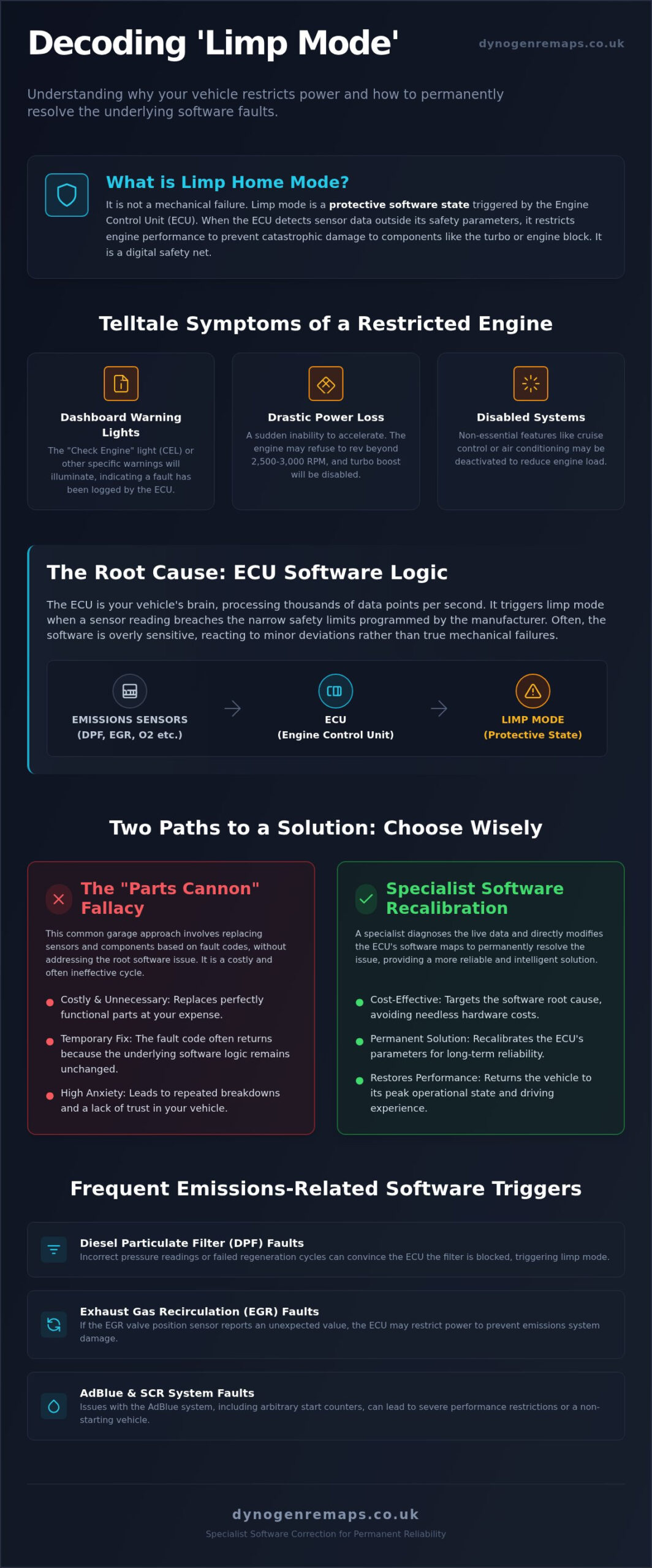
Limp home mode is essentially a digital straitjacket for your engine. It isn’t a mechanical failure in itself, but rather a protective state triggered by the Engine Control Unit (ECU). When the vehicle’s brain detects data that falls outside of pre-defined safety parameters, it immediately restricts performance to prevent catastrophic internal damage. This sophisticated logic is designed to safeguard expensive components like the turbocharger or the engine block from melting down due to incorrect fuel mixtures or excessive heat. To stop car limp mode issues, you must first decipher why the software has decided to intervene.
Modern vehicles are increasingly susceptible to these restricted states because they rely on a complex web of emissions sensors. A single faulty reading from a Diesel Particulate Filter (DPF) pressure sensor or an Exhaust Gas Recirculation (EGR) valve can be enough to force the car into a safety map. Whilst this protects the hardware, it often leads to a sluggish throttle response and a prominent Check Engine Light (CEL) on your dashboard. The ECU is essentially saying it no longer trusts the data it’s receiving, so it defaults to the safest possible operating mode.
The Immediate Symptoms of a Restricted Engine
You’ll likely notice the onset of limp mode during a moment of high demand, such as accelerating onto a motorway. The sensation is often described as hitting an invisible wall. The turbo boost disappears, and the engine refuses to rev beyond a certain point, typically around 2,500 to 3,000 RPM. Beyond the loss of torque, you might find that non-essential systems like cruise control or air conditioning suddenly deactivate. The ECU is prioritising core functions to keep the vehicle moving. This sudden loss of capability often causes significant driver anxiety, making a minor sensor glitch feel like a terminal engine failure.
Safety First: Can You Safely Drive in Limp Mode?
Driving in a restricted state is generally safe for short distances, provided you’re heading directly to a specialist centre. However, you must distinguish between a “soft” limp mode, which might clear after a restart, and a “hard” limp mode that remains constant. If the warning light is flashing or the engine is making unusual noises, stop immediately. Forcing a vehicle to perform whilst it’s in a protective state can turn a simple software correction into a genuine mechanical disaster. If you are unable to proceed safely, Instant Recovery offers professional breakdown support across London to transport your vehicle to a specialist. Always prioritise reaching a safe location where professional diagnostic equipment can analyse the live data and identify the specific fault code triggering the restriction.
If your vehicle enters a restricted state during a time-sensitive journey, such as a trip to the terminal, booking a reliable taxi Crewe to Manchester Airport ensures you make your flight while your car is recovered for professional diagnosis.
The Role of the ECU: How Software Triggers Protective States
The Engine Control Unit (ECU) acts as the central nervous system of your vehicle, constantly processing thousands of data points every second. Within its memory, the manufacturer has programmed specific “maps” that dictate exactly how the engine should behave under various load conditions. These maps establish strict boundaries for air-to-fuel ratios, boost pressure, and exhaust temperatures. When you aim to stop car limp mode issues, you’re essentially dealing with the software’s refusal to operate outside these narrow tolerances. If a sensor reading deviates from the expected value for even a few milliseconds, the ECU immediately flags a Diagnostic Trouble Code (DTC) and restricts engine output to prevent perceived damage.
As J.D. Power explains limp mode, this state is a deliberate safety feature, yet generic factory software often triggers these restrictions prematurely. Many modern vehicles are programmed with excessively sensitive thresholds that don’t account for the natural wear of components or environmental variables. This often leads to “nuisance” limp mode states where the car is mechanically sound, but the software is overly cautious. In these instances, the software logic becomes the problem rather than the solution, necessitating a more sophisticated approach to engine management.
Sensor Feedback Loops and Parameter Limits
Precision is paramount in modern engine management. The ECU relies on a constant feedback loop from sensors like the Mass Air Flow (MAF), Manifold Absolute Pressure (MAP), and Oxygen (O2) sensors. If a sensor sends a signal that is “out of bounds”, perhaps a turbocharger over-boosting by just a few PSI, the software determines the severity of the discrepancy. A minor deviation might trigger a warning light, whilst a significant outlier will instantly engage a restricted performance map. This logic ensures that the engine never operates in a condition that could lead to a terminal failure, but it can also be incredibly frustrating when the sensor itself is slightly out of calibration.
Why “Clearing the Code” is Rarely a Permanent Fix
It’s a common misconception that deleting a fault code with a handheld scanner resolves the problem. Whilst a cheap OBDII tool can “clear” the dashboard light, it cannot fix the underlying logic error or the physical condition that caused the sensor to trip. As soon as a new drive cycle begins and the ECU re-evaluates the sensor data, the fault will return. Most basic scanners lack the depth to see live data streams or fuel trim values, making them useless for diagnosing intermittent issues. If you’re tired of recurring faults, professional ECU recalibration offers a permanent path to reliability by refining the parameters within the software itself.
Common Emissions Triggers: DPF, EGR, and AdBlue Faults
Whilst mechanical failures do occur, the vast majority of modern performance restrictions are rooted in the complex emissions control systems required by current legislation. Manufacturers program the ECU with zero-tolerance logic for these components; if the system detects even a slight deviation from the expected emissions profile, it will immediately throttle the engine. To stop car limp mode issues effectively, you must understand that the vehicle isn’t necessarily broken in a traditional sense. Instead, it’s often a software-enforced response to a sensor reading that threatens the vehicle’s environmental compliance. As J.D. Power explains limp mode, these triggers are designed to protect the car and the environment, but they frequently become the primary source of owner frustration.
DPF Blockage and Failed Regeneration Cycles
The Diesel Particulate Filter (DPF) is perhaps the most frequent culprit for restricted power states. The ECU constantly monitors the pressure differential across the filter to determine how much soot has accumulated. If the vehicle is driven mostly on short urban trips, the engine never reaches the temperatures required for a natural “regeneration” cycle. When the soot levels exceed a specific percentage, the ECU triggers limp mode to prevent the filter from becoming completely terminal. In many high-mileage cases, a professional DPF solution is the only way to restore permanent reliability and bypass the cycle of endless forced regenerations.
EGR Valve Malfunctions and Carbon Accumulation
The Exhaust Gas Recirculation (EGR) valve is another critical component that frequently forces a safety state. Its job is to recirculate a portion of exhaust gases back into the combustion chamber to lower nitrogen oxide emissions. Over time, heavy carbon deposits build up on the valve, causing it to stick in either the open or closed position. You might notice a rough idle or hesitation before the ECU finally gives up and enters a restricted mode. Implementing EGR valve software adjustment can prevent these sticking points from triggering a full system shutdown, saving you from expensive hardware replacements.
AdBlue System Errors and Software Faults
The introduction of Selective Catalytic Reduction (SCR) systems has brought about the dreaded AdBlue countdown. This is the ultimate software-enforced restriction. Whether it’s a genuine pump failure or a simple sensor glitch, the ECU will often present a “non-start” warning, informing you that the vehicle will refuse to fire after a set number of miles. These systems are notoriously sensitive to temperature changes and fluid quality. For many drivers, the most effective way to stop car limp mode issues related to these sensors is through a professional AdBlue non start countdown solution, which resolves the persistent error codes that dealerships often struggle to clear permanently.
How to Resolve Limp Mode: Diagnostic Steps and Software Solutions
Resolving a restricted performance state requires a methodical, logical approach that moves beyond simple fault code deletion. To stop car limp mode issues permanently, a specialist must follow a structured diagnostic path. This process begins with identifying the specific software trigger and ends with a recalibrated ECU that understands the physical reality of the engine. It’s about data, not guesswork. By following a professional workflow, we can isolate the exact variable that’s causing the software to panic. For those who want to discover Mechnician, their advanced diagnostic software provides the depth required for complex troubleshooting across a variety of vehicle types.
The resolution process typically follows four critical steps:
- Step 1: Perform a full system diagnostic using dealer-level equipment to access manufacturer-specific sub-codes that generic tools miss.
- Step 2: Analyse live data streams to observe real-time sensor behaviour, focusing on variables like injector deviations and turbocharger vane positions.
- Step 3: Determine if the fault stems from a genuine physical component failure or an overly sensitive software calibration.
- Step 4: Apply bespoke software corrections to adjust the ECU parameters and restore full engine functionality.
Dealer-Level Diagnostics vs. Standard Garages
Most local garages rely on generic OBDII scanners that only provide surface-level information. These tools often miss the nuanced data required to identify why a vehicle keeps entering a safety state. By utilising dealer-level diagnostic platforms, we can monitor boost pressures and exhaust gas temperatures with surgical precision. This level of detail is essential for the expert vehicle tuning services required to diagnose complex ECU architecture. If you’re struggling with recurring faults, professional diagnostics are the only way to avoid the expensive “parts cannon” approach that standard garages often favour.
Calibrating Software for Permanent Reliability
Once the root cause is identified, software recalibration offers a sophisticated alternative to hardware replacement. For ageing components that are still mechanically functional but slightly out of their factory-tight tolerances, custom software can “widen” the acceptable parameters. This adjustment prevents the ECU from triggering a panic state over minor data fluctuations whilst ensuring the engine remains within safe operating limits. By remapping the ECU to bypass faulty emissions logic or sensor glitches, we provide a permanent fix that restores the driving experience. This intervention is designed to be both safe and reliable, ensuring your vehicle performs as intended without the threat of sudden power loss.
Professional Software Correction: The Dynogen Remapping Solutions Approach to Permanent Reliability
Choosing a seasoned specialist ensures that your vehicle receives a solution tailored to its exact mechanical condition rather than a generic, one-size-fits-all patch. With over 15 years of technical expertise, Dynogen Remapping Solutions focuses on bespoke recalibration that addresses the specific sensor triggers unique to your car’s ECU architecture. A Stage 1 Performance Remap does more than just unlock hidden potential; it refines the engine’s operational logic to improve overall health and responsiveness. By removing artificial software restrictions, we restore the genuine joy of driving that factory settings often stifle, providing a permanent resolution to the frustrations of restricted power.
Our methodology avoids the common pitfalls of generic “off-the-shelf” tuning files that frequently ignore the underlying causes of a safety state. We prioritise a sophisticated diagnostic process that identifies exactly why the software is intervening. This elite level of workmanship allows Dynogen Remapping Solutions to deliver a superior driving experience whilst ensuring the vehicle remains within safe mechanical tolerances. To stop car limp mode issues effectively, the software must be as precise as the hardware it controls, a standard we maintain through meticulous attention to detail and a passion for technical excellence.
Why Custom Calibration Matters for Fault Correction
Every vehicle exhibits unique wear patterns based on its mileage and service history, meaning that a standard software update is rarely sufficient to stop car limp mode issues for the long term. Precision is the cornerstone of our approach. We meticulously adjust the ECU maps to increase engine torque and power whilst simultaneously correcting the specific parameters that trigger safety states. This bespoke calibration treats the vehicle as a unique case, ensuring that all modifications are perfectly harmonised with the engine’s current physical state. Dynogen Remapping Solutions’ commitment to results means we don’t just clear codes; we re-engineer the logic that creates them.
Beyond Limp Mode: Future-Proofing Your Engine
Professional remapping serves as a proactive strategy to prevent the recurring emissions failures that plague modern diesel and petrol engines. By optimising combustion cycles and refining emissions logic, we can significantly reduce the rate of carbon accumulation in EGR valves and DPFs. This approach offers substantial long-term cost savings, as software-based modifications are a far more economical alternative to the repeated replacement of expensive hardware components. If you are tired of the “parts cannon” approach, contacting a specialist at Dynogen Remapping Solutions to discuss your vehicle’s specific software needs is the first step toward total reliability. We provide a protective, elite service that solves complex mechanical problems whilst remaining accessible to every dedicated driver.
Restore Your Vehicle’s Performance with Expert Software Recalibration
Limp mode doesn’t have to be a recurring nightmare that drains your wallet and patience. By moving beyond surface-level fault codes and addressing the core ECU logic discussed in this guide, you can reclaim the reliability and power your vehicle was designed to deliver. We’ve explored how complex emissions systems like DPFs and AdBlue sensors often trigger these protective states prematurely; a specialist software approach remains the most cost-effective path forward. To stop car limp mode issues for good, you need a solution that respects the unique mechanical state of your engine and bypasses the cycle of unnecessary parts replacement.
With over 15 years of expert tuning experience and a national UK service utilising dealer-level technology, Dynogen Remapping Solutions provides the precision required to resolve even the most stubborn performance restrictions. Don’t settle for the “parts cannon” approach or generic fixes that only mask the symptoms. Get a Professional Software Solution for Your Limp Mode Issues today and experience the difference that specialist expertise makes. Your vehicle’s peak performance is just a professional recalibration away.
Frequently Asked Questions
Can I bypass limp mode by disconnecting the battery?
Disconnecting the battery rarely provides a permanent solution to stop car limp mode issues. Whilst it might clear the ECU’s volatile memory and temporarily extinguish the warning light, the underlying fault remains stored in the permanent memory. As soon as the sensor detects the same out-of-bounds parameter during a drive cycle, the software will re-engage the restricted state. You need professional diagnostic equipment to address the root cause effectively.
Will a software fix for limp mode affect my MOT?
A professional software correction is designed to resolve persistent errors whilst maintaining the vehicle’s functional integrity. Solutions such as DPF or EGR recalibrations focus on fixing the logic errors that trigger dashboard warnings and restricted performance. It’s essential that the vehicle’s emissions hardware remains present and functional to meet UK road standards. A correctly calibrated ECU ensures the vehicle operates efficiently without the threat of a failure due to active fault codes.
Is it expensive to fix recurring limp mode issues via remapping?
Software recalibration is almost always a more cost-effective alternative to the “parts cannon” approach favoured by standard garages. Replacing expensive hardware like DPF filters or AdBlue pumps can be incredibly costly, whereas a specialist software fix targets the electronic trigger at a significantly lower price point. By choosing a permanent software solution, you avoid the recurring labour costs associated with clearing codes that inevitably return after a few miles.
Why does my car go into limp mode only when I accelerate hard?
Entering a restricted state during hard acceleration often points to a deviation fault, such as turbocharger over-boost or a drop in fuel rail pressure. When you demand maximum power, the ECU compares live sensor data against its target maps. If the turbocharger vanes stick or the fuel pump cannot maintain the required pressure, the discrepancy exceeds the safety threshold. This triggers an immediate limp state to prevent internal engine components from being overstressed under load.
Can a faulty sensor cause limp mode even if the part is actually working?
Yes, a sensor can trigger limp mode even if the mechanical component it monitors is perfectly healthy. Sensors can fail internally or suffer from wiring corrosion, sending “implausible” signals to the ECU that fall outside of acceptable parameters. The software cannot distinguish between a genuine mechanical failure and a faulty data feed, so it defaults to the safest mode. This is why dealer-level diagnostics are vital to stop car limp mode issues caused by phantom sensor errors.
How long does a professional software correction take to perform?
Most professional software corrections are completed within one to three hours. This timeframe allows our specialists to perform a full pre-diagnostic check, read the original ECU data, and apply the bespoke recalibration required for your specific vehicle. More complex ECU architectures found in the latest models may require additional time for safe data extraction and writing. We prioritise precision over speed to ensure the final calibration is perfectly harmonised with your engine.
What happens if I continue to drive my car whilst it is in limp mode?
Continuing to drive in a restricted state can lead to secondary mechanical failures that are far more serious than the original fault. Whilst the ECU limits power to protect the engine, prolonged driving in limp mode can cause issues such as fuel dilution of the engine oil or excessive soot buildup in the exhaust system. These secondary problems often prove more expensive to fix than the original software trigger. Always reach a specialist centre as soon as the restriction occurs.
Will remapping my car void my warranty if I am fixing a limp mode issue?
Remapping your vehicle generally voids the manufacturer’s warranty on the engine and drivetrain components. Dealerships utilise diagnostic tools that can detect changes to the ECU’s flash counter or software checksums. However, for vehicles already out of warranty or those facing exorbitant dealership quotes for recurring emissions faults, professional recalibration is often the most logical and reliable path to restoring the vehicle’s performance and ensuring long-term engine health.