

What if the frustratingly sluggish throttle response you feel at every junction isn’t a limitation of your engine, but merely a digital restraint imposed by the manufacturer? It’s a common misconception that factory settings represent the peak of a vehicle’s potential. By choosing a professional stage 1 remap, you’re not “overclocking” your car; you’re restoring the performance that was suppressed to meet global production compromises. If you’ve found yourself struggling with poor overtaking power or unexpectedly high fuel consumption whilst towing, you’ve likely felt the impact of these factory restrictions.
We understand the desire for a more responsive, efficient driving experience that reflects your specific needs. This guide explores how bespoke software recalibration safely unlocks latent power and torque without the need for any hardware modifications. We’ll examine the technical precision behind modern ECU tuning, the impressive BHP gains available in 2026, and the essential safety checks that distinguish a specialist service from a generic alternative. By the end, you’ll have a clear, logical path to achieving smoother power delivery and complete confidence in your vehicle’s enhanced capabilities.
Key Takeaways
- Understand how a professional stage 1 remap recalibrates your ECU to bypass factory restrictions, unlocking significant power without the need for hardware modifications.
- Learn the specific technical parameters specialists adjust to ensure your vehicle remains well within its mechanical safety margins for long-term reliability.
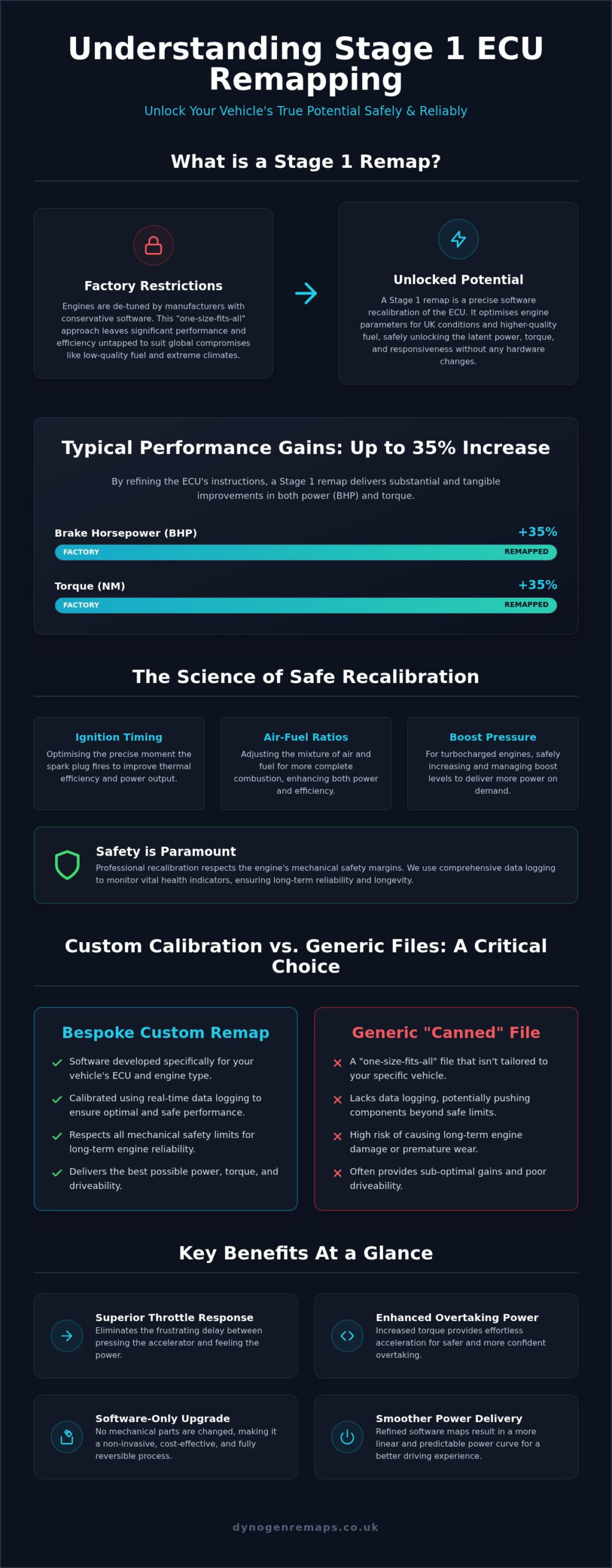
- Discover how custom software can achieve up to 35% increases in BHP and torque, resulting in smoother power delivery and superior throttle response.
- Identify the critical performance differences between bespoke, custom-calibrated software and the potential risks associated with generic “canned” tuning files.
- Gain the confidence to upgrade your vehicle’s performance by moving beyond dealership limitations toward a more personalised and efficient driving experience.
What is a Stage 1 Remap? Unlocking Your Engine’s Latent Potential
A stage 1 remap represents the most sophisticated and efficient method of enhancing a modern vehicle’s performance without replacing a single mechanical component. It is a precise software recalibration of the Engine Control Unit (ECU) that optimises the way your engine processes fuel, air, and ignition timing. Rather than adding new parts, this process focuses on refining the digital instructions that govern your engine’s behaviour, allowing it to operate at its true potential.
Manufacturers typically “de-tune” their engines at the factory to account for global variables. They must ensure a vehicle operates reliably whether it is using low-grade fuel in a developing nation or enduring the extreme humidity of a tropical climate. Consequently, the software shipped from the factory is often a conservative compromise that leaves a significant amount of power and efficiency untapped. By recalibrating these settings, we remove these artificial restrictions to suit the specific environment in which you drive.
The Role of the Engine Control Unit (ECU)
The ECU acts as the central intelligence of your vehicle, managing every combustion cycle with millisecond precision. Understanding What is Chip Tuning helps clarify how we interact with this “brain” to refine its logic. Standard factory software is designed as a “one-size-fits-all” solution, whereas our custom-calibrated approach specialises the engine’s behaviour for the specific conditions of the United Kingdom. By focusing on higher-quality fuels and our temperate climate, we can safely reclaim the performance that manufacturers intentionally suppressed for the global market.
Software vs. Hardware: Why Stage 1 is the Entry Point
Choosing a stage 1 remap is often considered the entry point into performance tuning because of its non-invasive nature. Most modern vehicles allow for recalibration via the On-Board Diagnostics (OBD) port, though some advanced ECU architectures may require bench tuning for a direct connection. This process is entirely software-based, distinguishing it from Stage 2 or Stage 3 modifications which necessitate physical hardware upgrades like uprated intercoolers, downpipes, or exhaust systems. It is a clean, efficient, and highly effective way to transform your driving experience.
This software-centric approach offers an unparalleled balance of cost-effectiveness and tangible results. Because no physical parts are changed, the modification remains discreet and, crucially, completely reversible. If you decide to sell the vehicle or return it to stock settings, the original factory map can be restored with the same level of precision used during the initial upgrade. It provides a professional, reliable foundation for any driver seeking better BHP and torque figures without committing to a full mechanical overhaul.
The Science of Recalibration: How Stage 1 Software Works
Professional engine tuning is far removed from the “black box” mystery often portrayed in generic marketing. At its core, a stage 1 remap is a methodical exercise in precision engineering, where multiple interconnected maps within the ECU are refined to work in harmony. We don’t simply “turn up the power”; we recalibrate specific parameters such as fuel rail pressure, ignition timing, and boost levels to ensure the engine operates more effectively. Ignition Timing is the precise moment the spark plug fires to initiate combustion. By optimising this single event, we can significantly improve thermal efficiency and power output.
Reliability remains our primary objective throughout this technical process. Every engine leaves the factory with a significant mechanical “overhead” designed to protect it against poor maintenance or sub-standard fuels. A specialist recalibration utilises a portion of this overhead whilst maintaining a strict safety margin to ensure long-term engine longevity. To guarantee this, we employ comprehensive data logging to monitor vital engine health indicators in real time. This includes tracking exhaust gas temperatures and knock sensors to ensure the new software operates perfectly within safe limits. If you are looking for a professional stage 1 remap, this level of diagnostic scrutiny is what separates a bespoke calibration from a generic file.
Adjusting Air-Fuel Ratios and Boost Pressure
For vehicles equipped with a turbocharger, increasing boost pressure is a highly effective way to unlock latent performance. However, air is only half of the combustion equation. We must meticulously balance the Air-Fuel Ratio (AFR) to ensure that as more oxygen enters the cylinders, a corresponding amount of fuel is delivered for a clean, complete burn. This precise synchronisation doesn’t just increase peak figures; it also helps to virtually eliminate turbo lag. The result is a much more linear and predictable power band that feels natural and urgent throughout the rev range.
Optimising Torque Limiters and Throttle Response
Modern ECUs are programmed with various torque limiters, which act as software “ceilings” to artificially restrict engine output across different gears and RPM ranges. By carefully raising these limits, we allow the engine to provide the “mid-range pull” that is so essential for safe and effortless motorway overtaking. We also refine the throttle maps to sharpen the connection between your foot and the engine’s reaction. This removes the “dead” feeling often found in factory pedals, resulting in a vehicle that feels significantly more responsive, alert, and eager to perform.
Key Benefits of a Stage 1 Remap: BHP, Torque, and Driveability
A professional stage 1 remap delivers a transformative impact that extends far beyond simple peak power figures. For turbocharged petrol and diesel engines, owners can typically expect BHP and torque increases ranging from 20% to 35% depending on the specific platform. These aren’t just vanity metrics; they represent a fundamental shift in how the vehicle interacts with the road. Whilst a petrol sports car gains a more aggressive and rewarding top-end, a diesel van or motorhome benefits from a massive surge in low-down pulling power, making heavy loads feel significantly lighter during transit.
Commercial vehicle operators and motorhome enthusiasts often report the most practical advantages from this upgrade. Towing a heavy trailer or navigating steep inclines frequently leads to constant downshifting and high engine stress in factory-standard vehicles. A Stage 1 recalibration provides the necessary torque to hold higher gears for longer, reducing mechanical strain and providing the driver with the confidence that the power is there when needed. This additional “shove” makes overtaking slower-moving traffic a much safer and more decisive manoeuvre, especially when the vehicle is fully laden.
Tangible Performance Gains: Beyond the Numbers
A stock power curve often feels “strangled” at high RPMs or hesitant during initial acceleration due to the factory compromises discussed earlier. By contrast, a remapped power curve is smoother, more progressive, and far more intuitive. While BHP often gets the headlines, torque is the metric that dictates your daily driving experience. It’s the force that allows for effortless progress in stop-start traffic and reduces the need for constant gear changes. This refinement creates a truly “favourite” driving experience where the car feels alert and eager, rather than a machine you have to work hard to motivate.
Improved Fuel Economy and Efficiency
It may seem counterintuitive that increasing power can improve efficiency, but the logic is rooted in engine load and thermal efficiency. Because a stage 1 remap increases torque across the entire rev range, the vehicle requires less throttle input to maintain a specific speed. Drivers can shift into higher gears earlier and stay there longer, keeping the engine in its most efficient operating window. This is particularly beneficial for diesel engines, which often see the most significant efficiency gains after a professional recalibration.
For high-mileage fleet operators or long-distance commuters prioritising running costs, we also offer an Economy Remap variant. This specific calibration focuses on maximising MPG and thermal efficiency rather than chasing outright performance. By optimising fuel injection timing and boost characteristics, we can achieve a noticeable reduction in fuel consumption whilst still providing a more responsive drive. This business-like approach to tuning ensures that your vehicle isn’t just faster, but also more cost-effective to operate over thousands of miles.
Is a Stage 1 Remap Safe? Reliability and Mechanical Limits
The fear that a performance upgrade will “blow” an engine is a common anxiety amongst many vehicle owners. In reality, a professionally developed stage 1 remap operates strictly within the mechanical tolerances established by the original manufacturer. Engineers design modern power units with a substantial buffer to ensure reliability in extreme global conditions. By accessing a portion of this “overhead,” we can unlock significant power whilst ensuring the engine’s internal components remain under no more stress than they were designed to handle.
A healthy vehicle is the essential foundation for any performance modification. We always recommend that owners ensure their vehicle is up to date with routine maintenance, specifically high-quality oil changes and fresh spark plugs for petrol models. A remap isn’t a solution for underlying mechanical issues; it’s an enhancement for a well-maintained machine. If your car or van is in peak condition, the software recalibration will feel seamless and reliable.
Component Longevity and Wear
Managing Exhaust Gas Temperatures (EGT) is a critical priority for any seasoned specialist. Excessive heat is the primary enemy of turbochargers; therefore, our software ensures that fuel and boost delivery never push temperatures beyond safe limits. We also account for the drivetrain, ensuring the clutch and gearbox can comfortably manage the increased torque load. Drivetrain wear is rarely an issue with a bespoke calibration. The primary cause of component failure is almost exclusively “cheap” generic maps that ignore these vital safety limiters. To ensure your vehicle’s longevity, you should always book your professional stage 1 remap with experts who prioritise data-driven safety.
Insurance, Warranty, and MOT Compliance
Transparency is vital when modifying any road vehicle in the United Kingdom. You must declare a stage 1 remap to your insurance provider, as it’s considered a material modification. While most insurers are comfortable with software upgrades, failure to disclose it could invalidate your policy. Regarding the MOT, a software-only remap doesn’t involve removing emissions hardware like DPFs or catalytic converters. Consequently, your vehicle will continue to meet the required emissions standards during its annual inspection. Be aware that while the process is reversible, manufacturers can often detect software changes, which may affect your engine warranty if the car is still young.
The Dynogen Advantage: Custom Software vs Generic Tuning
Choosing a stage 1 remap is a significant decision for any vehicle owner, and the quality of the software calibration is the single most important factor. At Dynogen Remapping Solutions, we bring over 15 years of technical experience to every vehicle we service. This long-standing expertise allows us to distinguish between mediocre “canned” maps and truly professional recalibrations. Generic tuning files, often found in cheap handheld devices or provided by inexperienced “mobile” tuners, are designed as a one-size-fits-all solution. These files rarely account for the specific health or unique wear patterns of your engine, frequently leading to poor running, excessive smoke, or even mechanical failure.
Our process is rooted in a methodical, business-like approach to vehicle mechanics. We begin every session with a comprehensive diagnostic health check using specialist equipment designed for advanced ECU architecture. This ensures that your car or van is in peak condition before any software changes occur. Once we are satisfied with the vehicle’s health, we apply a custom-calibrated solution that respects factory sensor limits. This meticulous attention to detail ensures we avoid the “limp mode” issues that often plague lower-quality tuning services. We take immense pride in our workmanship, viewing every recalibration as a pursuit of mechanical perfection.
Bespoke Calibration for Your Specific Vehicle
No two engines are identical, even if they share the same assembly line. Factors such as mileage, previous service history, and even the way the vehicle was “broken in” can lead to slight variations in how an engine responds to tuning. A bespoke stage 1 remap from Dynogen accounts for these nuances. By tailoring the software to your specific vehicle, we ensure that the power delivery is not just stronger, but also smoother and more reliable. We prioritise the end-user’s experience, ensuring that the modification feels like a factory-fitted enhancement rather than an aftermarket compromise.
Getting Started: Preparing for Your Remap
To achieve the best possible results from your performance upgrade, we recommend a few simple preparatory steps. For petrol vehicles, using high-quality 99 octane fuel is essential for maximising the benefits of the new timing maps. Ensure your vehicle has a documented service history and that your tyres are in good condition, as the increased torque will put more demand on your vehicle’s traction. If you are ready to transform your driving experience, the first step is a professional consultation to discuss your specific goals.
Unlock your vehicle’s potential with a professional Stage 1 remap from Dynogen and experience the difference that 15 years of specialist expertise can make to your car, van, or motorhome.
Elevate Your Driving Experience with Precision Engineering
A professional stage 1 remap represents more than just a power increase; it is the strategic restoration of your vehicle’s true capability. By removing the conservative factory restrictions discussed throughout this guide, you can enjoy a more responsive, efficient, and rewarding drive. We have established that the success of this modification relies on custom-calibrated software and the expertise of a specialist who understands the mechanical limits of your specific engine. With our 15+ years of specialist tuning expertise, we ensure that every recalibration prioritises longevity alongside performance.
Every service we provide includes advanced diagnostic pre-checks to guarantee your vehicle is in peak condition before any software changes occur. This methodical approach eliminates the risks associated with generic tuning and provides you with the confidence that your engine is operating at its absolute best. Whether you are seeking better overtaking power for motorway commutes or improved efficiency whilst towing, a bespoke recalibration is the definitive solution. Request a custom Stage 1 remap quote for your vehicle and discover the latent potential waiting to be unlocked. Your car is capable of so much more; it’s time to experience it.
Frequently Asked Questions
Will a Stage 1 remap void my car insurance?
You must declare a stage 1 remap to your insurance provider as it’s considered a material modification to the vehicle’s factory specification. Failure to do so can invalidate your policy entirely, leaving you unprotected in the event of a claim. Most UK insurers will accept the modification, though they may apply a small premium adjustment to reflect the increased performance and value.
How much extra BHP can I expect from a Stage 1 remap?
Typical gains for turbocharged petrol or diesel engines range between 20% and 35% of the original power output. For a standard 150bhp engine, this often results in a final figure of approximately 185 to 200bhp. Naturally aspirated engines generally see more modest increases of 5% to 10% because they lack the forced induction needed for larger software-based gains.
Can a remap be detected by a main dealer during a service?
Main dealers can detect software alterations if they perform a deep diagnostic scan or check the ECU flash counter. While a technician might not notice the change during a standard oil change, modern manufacturer systems are increasingly sophisticated. They’re designed to flag non-factory software during warranty claims or major diagnostic investigations.
Is it possible to reverse a Stage 1 remap back to factory settings?
Reversing the modification is a straightforward process that we can perform at any time. We always store a secure copy of your original factory software, allowing the vehicle to be restored to its stock settings whenever required. This is a popular option for owners who intend to sell their vehicle or return a car at the end of a lease agreement.
Do I need to upgrade my brakes or suspension for a Stage 1 remap?
Physical hardware upgrades like uprated brakes or suspension aren’t required because a stage 1 remap is designed to operate within the mechanical overhead of your factory components. The power increase stays within the safety margins established by the original engineers. You should, however, ensure your existing tyres and brakes are in good condition to handle the improved responsiveness.
How long does the remapping process take to complete?
The entire process typically takes between 90 minutes and 3 hours to complete correctly. This duration allows our specialists to perform a comprehensive pre-tuning diagnostic check, apply the bespoke software recalibration, and conduct a final performance evaluation. We follow this methodical rhythm to ensure the results meet our high standards for precision and reliability.
For drivers in the North East who value this methodical approach but require the convenience of a mobile service, Naked Frog Vehicle Tuning provides professional engine remapping that brings this high level of technical expertise directly to your door.
Will a Stage 1 remap make my car fail its MOT emissions test?
Your vehicle will pass its MOT emissions test as long as the physical emissions hardware remains intact. A professional recalibration focuses on improving engine efficiency and doesn’t involve the removal of the DPF, EGR, or catalytic converter. Provided the engine is well-maintained, it will comfortably meet the required UK smoke and gas standards during its annual inspection.
What is the difference between a tuning box and a professional remap?
A tuning box is an external device that “tricks” sensor signals, whereas a professional remap is a complete logic recalibration within the ECU. Remapping is the superior solution because it allows the engine’s “brain” to maintain full control over safety limiters and hundreds of interconnected parameters. This leads to much smoother power delivery and superior long-term engine health compared to signal manipulation.