

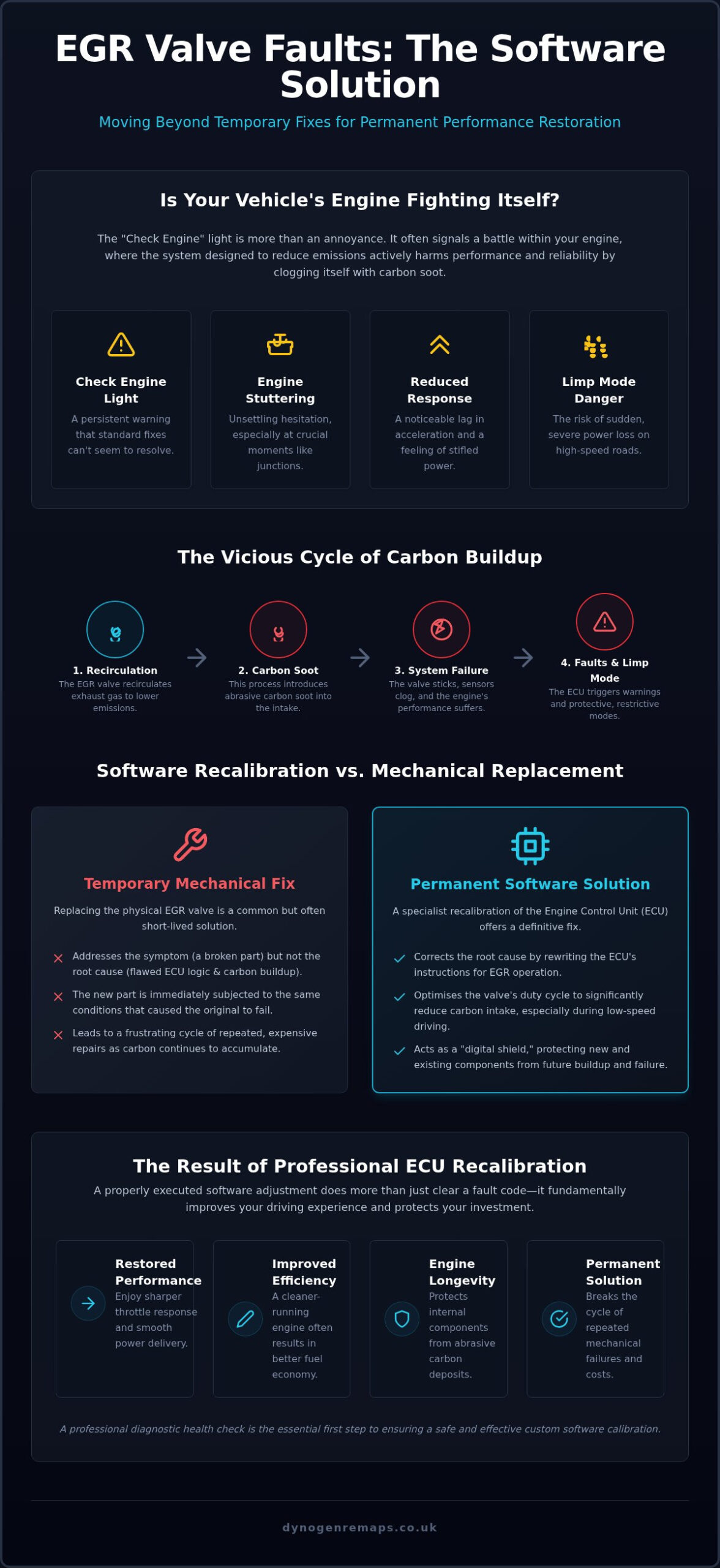
What if the persistent “Check Engine” light on your dashboard isn’t a sign that your hardware has failed, but rather a signal that your vehicle’s brain is fighting a losing battle against carbon soot? It’s incredibly frustrating to face expensive quotes for a component that often feels like it’s designed to stifle your engine’s potential. You likely recognise the irritation of reduced throttle response or that unsettling engine stuttering whilst you’re trying to navigate a busy junction. Nobody wants to drive in constant fear of their vehicle entering limp mode during a high-speed motorway journey.
Discover how a professional EGR valve software adjustment can resolve these persistent faults by recalibrating the engine control unit to operate with renewed precision. This specialist approach doesn’t just clear a dashboard code; it restores your vehicle’s performance and prevents the aggressive carbon buildup that leads to recurring mechanical failure. We shall explore the critical differences between a temporary mechanical fix and a permanent ECU adjustment to help you achieve the smooth power delivery and improved fuel efficiency your vehicle was engineered to provide.
Key Takeaways
- Understand how a professional EGR valve software adjustment moves beyond simple code clearing to address the root cause of carbon-related engine faults.
- Compare the long-term reliability of software-based recalibration against the cycle of expensive and often temporary mechanical part replacements.
- Learn to identify the early warning signs of emissions failure before your vehicle defaults to a restrictive and inconvenient limp mode.
- Discover why a professional diagnostic health check is the essential first step to ensuring a safe and effective custom software calibration.
- Gain insight into how precision ECU modifications restore throttle response and improve fuel efficiency whilst protecting your engine’s longevity.
What is an EGR Valve and Why Does it Require Software Adjustment?
Most drivers view the EGR system as a purely environmental component, yet its impact on engine health is profound. The Exhaust Gas Recirculation (EGR) system was developed to lower combustion temperatures by reintroducing spent exhaust gases into the intake manifold. This reduces the formation of nitrogen oxides (NOx), a key pollutant. Whilst effective for emissions, the mechanical reality is that modern diesel and petrol engines are forced to “breathe” their own waste, leading to a steady accumulation of carbon soot within the heart of the engine.
The Role of Recirculation in Modern Engines
The process involves a sophisticated valve that diverts a precisely measured portion of exhaust gas back into the combustion chamber. By diluting the oxygen-rich intake air with inert exhaust, the combustion temperature drops, which successfully curbs NOx production. This process is beneficial for the environment, but it’s fundamentally detrimental to engine cleanliness. Recirculating these gases introduces abrasive particulate matter into the intake system, which eventually coats the manifold, valves, and sensors in a thick, sticky layer of carbon.
Common Failure Points of the Mechanical System
Failure usually begins with the valve itself. Carbon buildup often causes the internal mechanism to stick in either an open or closed position. If it sticks open, your vehicle will suffer from a rough idle and poor performance. If it remains closed, you’ll face a persistent “Check Engine” light. This creates a “snowball effect” where soot clogs the manifold and sensitive pressure sensors, eventually triggering a restrictive limp mode. Older vacuum-operated valves were simpler, but today’s units are sophisticated, ECU-controlled electronic components. In fact, electronic EGR valves account for over 65% of new installations in 2026, reflecting the industry’s shift toward digital precision. These modern actuators frequently suffer from internal electrical faults or position sensor failures that a simple cleaning cannot resolve.
This is where an EGR valve software adjustment becomes essential. Traditional repairs usually involve swapping the physical valve, but this rarely addresses the underlying logic within the Engine Control Unit (ECU). Professional software recalibration allows the ECU to manage the system more effectively. It serves as the missing link in a permanent repair strategy that restores engine reliability and protects your vehicle from the cycle of repeated mechanical failures.
The Science of EGR Valve Software Adjustment
Accessing the Engine Control Unit (ECU) requires sophisticated interfaces that allow a specialist to read and modify the binary data governing your engine’s behaviour. This is where a professional EGR valve software adjustment takes place. Unlike a standard diagnostic tool that merely clears a fault code, deep software recalibration involves rewriting the specific instructions that tell the valve when to open and close. This precise modification ensures that the engine’s “brain” no longer relies on flawed logic that leads to mechanical failure, providing a permanent resolution rather than a temporary patch.
ECU Mapping and Parameter Control
The ECU operates using complex three-dimensional “maps” that dictate the valve’s position based on real-time engine load and RPM. By carefully adjusting these parameters, a technician can instruct the valve to remain closed during cycles where carbon production is at its peak, such as during low-speed urban idling. This process requires an expert understanding of the basics of EGRs to ensure the new data remains within safe operational limits. The result is a system where the ECU remains satisfied with sensor feedback whilst the mechanical components are shielded from unnecessary stress.
Preventing Carbon Buildup via Software
Most soot accumulation occurs when the engine is under light load, as the system is traditionally most active during these periods. By optimising the duty cycle through custom software, we significantly reduce the volume of particulate matter entering the intake manifold. Professional software adjustment acts as a digital shield, preventing carbon deposits from ever forming on sensitive internal components. This proactive approach preserves the health of the turbocharger and maintains the integrity of the manifold, which is far more effective than waiting for a total mechanical breakdown. For those seeking a comprehensive approach to engine health, a custom EGR Solution offers a reliable path to long-term performance.
Often, these software modifications are part of a wider strategy to enhance vehicle reliability. We frequently integrate EGR adjustments with DPF or AdBlue management software to create a unified engine profile. By synchronising these changes, we eliminate the conflicting signals that generic files often produce. This holistic method ensures that every component works in harmony, resulting in smoother power delivery and a vehicle that is no longer plagued by persistent emissions-related fault codes.
Software Modification vs. Mechanical Replacement: A Comparison
Facing a faulty EGR system often leads to a fork in the road: do you replace the hardware or recalibrate the software? Dealerships typically push for the former, yet fitting a new valve without addressing the underlying software logic often results in a recurring cycle of failure. A professional EGR valve software adjustment offers a superior alternative by resolving the systemic issues that cause these components to fail in the first place. This approach treats the software as the primary control mechanism, ensuring that the mechanical parts are no longer subjected to the conditions that lead to their demise.
The Limitations of Physical Part Replacement
Mechanical components are frequently victims of their operating environment. In stop-start urban driving conditions, it’s common for brand new valves to fail within 20,000 miles due to rapid carbon accumulation. Relying on physical replacement ignores the root cause of the soot buildup within the intake manifold. The hidden costs of this cycle are substantial, including repeated labour charges, diagnostic fees, and the persistent threat of the vehicle entering limp mode at an inconvenient moment. Software modification addresses the fundamental behaviour of the system, ensuring the engine remains clean and reliable over the long term.
Drivability and Efficiency Gains
Beyond simple reliability, the practical benefits of software recalibration are immediately apparent behind the wheel. A faulty or clogged system often saps engine torque and power, leaving the vehicle feeling sluggish and unresponsive during acceleration. By optimising the intake cycle, we restore the engine’s natural breathing capacity and responsiveness. This process is closely linked to Diesel Economy Tuning UK, where a clean intake allows for more efficient combustion and improved fuel economy. Drivers typically report a sharper throttle response and a significantly smoother power delivery across the entire rev range.
Choosing a specialised technical solution is critical for maintaining vehicle health. Whilst “cheap” generic files are available, they often lack the precision required to keep the ECU’s complex monitoring systems satisfied. Our custom-calibrated software ensures that every adjustment is tailored to your specific vehicle, providing a permanent fix that respects the intricate balance of modern engine management. This professional approach transforms the driving experience from one of constant anxiety over warning lights to one of absolute confidence in your vehicle’s performance. Drivers who want to understand the full scope of what precision calibration can achieve should explore expert vehicle tuning services that go beyond emissions management to unlock genuine performance and reliability gains.
Signs Your Vehicle Needs an EGR Software Adjustment
Recognising the early symptoms of a failing emissions system allows you to intervene before a minor annoyance transforms into a total mechanical breakdown. Whilst many drivers assume that a “Check Engine” light is the first indicator, your vehicle often exhibits subtle performance shifts long before a fault code is logged. Identifying these behaviours early is the most effective way to determine if an EGR valve software adjustment is the necessary corrective measure for your engine’s longevity.
Early Warning Symptoms
One of the most immediate signs of a struggling system is a noticeable drop in fuel efficiency. When the valve fails to regulate gas flow correctly, the ECU compensates by adjusting fuel mixtures, which inevitably leads to increased consumption and a lower MPG. You might also experience rough idling, particularly when waiting at traffic lights or during a cold start. This often manifests as a “hunting” sensation, where the engine RPM fluctuates slightly as the system struggles to maintain a stable combustion environment. Other common physical signs include:
- Hesitation or “flat spots” during light, steady-state acceleration.
- A distinct stuttering sensation whilst maintaining a constant speed.
- Increased smoke from the exhaust during gear changes.
Critical Faults and Limp Mode
When the software detects that the mechanical components are no longer responding within their calibrated parameters, it will trigger the dreaded “Engine Management” or flashing “Glow Plug” light. At this stage, the ECU often initiates its ultimate protective strategy: limp mode. This restrictive state severely limits engine power and RPM to prevent catastrophic damage, but it’s an incredibly stressful experience if it occurs whilst you’re on a busy motorway. It’s a protective measure, but it’s also a clear signal that the system has reached its limit.
Distinguishing between an EGR fault and a DPF blockage is essential for an accurate repair. EGR issues typically cause hesitation at specific throttle positions, whereas DPF problems usually result in a more consistent, heavy loss of power across the entire rev range. Ignoring these signs can lead to secondary failures, as a faulty valve will quickly saturate the DPF with excess soot and put unnecessary strain on the turbocharger. If your vehicle is showing these symptoms, a professional EGR Solution is the most reliable way to restore drivability and protect your engine from further harm. A precise EGR valve software adjustment ensures the ECU remains in total control, removing the threat of sudden power loss and restoring the smooth, responsive driving experience you expect.
Professional EGR Solutions: The Dynogen Approach
Dynogen takes a meticulously engineered approach to emissions management, prioritising long-term engine health over the superficial fixes offered by standard dealerships. We don’t believe in generic “off-the-shelf” files that often trigger more problems than they solve. Instead, our professional EGR valve software adjustment is a bespoke process, tailored specifically to the unique software architecture of your vehicle’s ECU. This level of precision ensures that the modification is seamless, reliable, and entirely compatible with your engine’s protective monitoring systems.
Expertise in Emissions Software
Precision is the cornerstone of our service. By employing advanced diagnostic tools, we pinpoint the exact nature of any software fault before any modifications take place. This thoroughness is supported by over 15 years of technical remapping experience, allowing us to navigate the complexities of modern engine management with absolute confidence. We avoid the pitfalls of low-quality, generic tuning files that can lead to erratic engine behaviour or secondary sensor failures. Our commitment to high-standard coding ensures a safe engine tuning UK experience that protects your investment whilst delivering the reliability you require. We treat every car and van with the same level of specialist care, ensuring that our software adjustments provide a permanent resolution to persistent emissions-related faults.
Next Steps for Your Vehicle
The process begins with a comprehensive diagnostic health check. We refuse to apply a software fix to a vehicle with underlying mechanical issues, as this would compromise the final result. Once we’ve confirmed your engine is healthy, we extract the original ECU data and apply a custom-calibrated EGR valve software adjustment. This is also the ideal opportunity to integrate an Stage 1 remap, which combines your EGR Solution with a significant boost in torque and power for the ultimate driving experience. Our national service covers the entire UK, providing a professional alternative to expensive part-swapping for both private car owners and commercial van operators.
What can you expect from the Dynogen process? It’s a methodical journey from the initial data read to the final, rigorous road test. We ensure that every parameter is checked and verified before returning the keys. If you’re tired of persistent warning lights and the constant threat of limp mode, it’s time to choose a technical solution that actually works. Get in touch with us today for a professional consultation on your vehicle’s emissions system. Our experts are ready to restore your vehicle’s efficiency, reliability, and performance through advanced software recalibration.
Secure Your Engine’s Future with Precision Calibration
Maintaining a reliable vehicle requires moving beyond the cycle of temporary mechanical repairs and expensive part-swapping. A professional EGR valve software adjustment provides the definitive solution to the flawed ECU logic that causes persistent carbon buildup and those frustrating encounters with limp mode. By opting for a technical recalibration, you’re protecting your engine’s long-term health whilst restoring the sharp throttle response and fuel efficiency that modern driving demands.
Dynogen delivers this elite level of service across the UK, drawing on over 15 years of specialist remapping expertise. We provide custom software calibrated specifically for your vehicle’s ECU, ensuring a safe and permanent result for cars, vans, and commercial fleets alike. Our commitment to technical excellence means you can drive with absolute confidence, free from the anxiety of recurring emissions faults. Book your professional EGR software solution with Dynogen today and experience the pursuit of perfection in vehicle performance. It’s time to reclaim your engine’s true potential.
Frequently Asked Questions
Is an EGR valve software adjustment legal for road use in the UK?
In the UK, it is an offence to use a vehicle on a public road if it has been modified to no longer comply with the air pollutant emissions standards it was originally certified to meet. We provide our specialised software modifications primarily for off-road, competition, or export use. It is the vehicle owner’s responsibility to ensure their car remains compliant with all current road traffic and environmental regulations.
Can a software adjustment fix a valve that is already physically broken?
Software cannot repair a physically snapped or seized internal component, but it can recalibrate how the ECU interacts with the system. If a valve is stuck in the closed position, a professional EGR valve software adjustment can often resolve the fault codes and limp mode without needing hardware replacement. However, if the valve is stuck open, mechanical intervention is required first to prevent ongoing performance issues.
Will an EGR software fix cause my DPF to block up faster?
No, a professional software modification typically has the opposite effect on your vehicle’s exhaust system. By reducing the volume of recirculated exhaust gas, the engine produces less particulate matter during the combustion process. This results in a cleaner exhaust stream and fewer soot deposits entering the Diesel Particulate Filter. Consequently, your DPF may actually experience longer intervals between regeneration cycles and an extended overall service life.
How long does the EGR software adjustment process take to complete?
Most professional software adjustments are completed within one to two hours at our facility. This timeframe includes a comprehensive initial diagnostic health check to ensure your vehicle is in a suitable condition for recalibration. Once we’ve verified the engine’s health, we perform the software read, apply the custom calibration, and conclude with a rigorous road test to confirm that all parameters are functioning perfectly for the driver.
Will I notice a difference in my fuel economy after the adjustment?
Yes, drivers typically report a noticeable improvement in fuel economy after a successful EGR valve software adjustment. By ensuring the engine is breathing fresh, oxygen-rich air rather than inert exhaust gases, combustion efficiency is significantly enhanced. This cleaner burn allows the vehicle to produce the same level of power whilst consuming less fuel, particularly during steady-state cruising and light-load driving conditions on the motorway.
Can this software fix be reversed if I decide to sell the vehicle?
Yes, the software recalibration is entirely reversible and can be returned to factory settings at any time. We maintain a secure backup of your vehicle’s original factory ECU file for this exact purpose. If you decide to sell the vehicle or wish to return it to its stock configuration, the process is straightforward and restores the original emissions parameters exactly as they were before the adjustment was performed.
Does an EGR adjustment work on both petrol and diesel engines?
Yes, software solutions are available for both petrol and diesel powerplants. Whilst EGR issues are more commonly associated with diesel engines due to higher soot production, modern direct-injection petrol engines also utilise these systems and suffer from similar carbon accumulation. Our technical expertise allows us to apply precise software recalibrations to a vast range of makes and models, ensuring reliable results regardless of the fuel type being used.
What happens if I ignore my EGR warning light and keep driving?
Ignoring an emissions-related warning light is a high-risk strategy that often leads to secondary mechanical failures. A faulty system will eventually trigger a restrictive limp mode, significantly reducing your vehicle’s power and safety on the road. Prolonged use with an active fault causes rapid soot accumulation in the DPF and intake manifold, potentially leading to thousands of pounds in avoidable repair costs for turbochargers and sensitive engine sensors.