

The persistent ‘engine start not possible’ warning on your Mercedes dashboard isn’t a mechanical death sentence; it is frequently a software logic failure that no amount of expensive hardware replacement can truly cure. You have likely experienced the mounting anxiety of a non-start countdown or the frustration of replacing a NOx sensor only for the same amber warning light to return weeks later. It feels as though you are trapped in a cycle of dealership visits that prioritise the ‘parts cannon’ approach over a genuine resolution.
We understand that you expect your vehicle to perform with the precision and reliability synonymous with the marque. This guide will demonstrate how a professional Mercedes AdBlue software fix provides the definitive solution you require, moving beyond temporary patches to address the root cause within the engine control unit. We will examine the limitations of standard dealership updates, the technical reality behind sensor failures, and how sophisticated software recalibration ensures your vehicle remains on the road without the threat of a looming countdown. By the end of this article, you will have the technical clarity needed to choose a permanent, specialist solution that restores your peace of mind whilst driving.
Key Takeaways
- Understand why the ‘engine start not possible’ countdown occurs and how it relates to the complex logic within the Selective Catalytic Reduction system.
- Discover why a professional Mercedes AdBlue software fix provides a more reliable result than the repetitive hardware replacements often suggested by dealerships.
- Learn how recent manufacturer software updates tighten sensor tolerances, which frequently triggers false faults on components that are otherwise functional.
- Identify the critical technical standards to look for when choosing a specialist to ensure your vehicle receives a bespoke and high-quality recalibration.
- Explore how advanced coding manages your emissions hardware to eliminate dashboard warnings and restore long-term driving confidence.
The Mercedes AdBlue Non-Start Countdown Explained
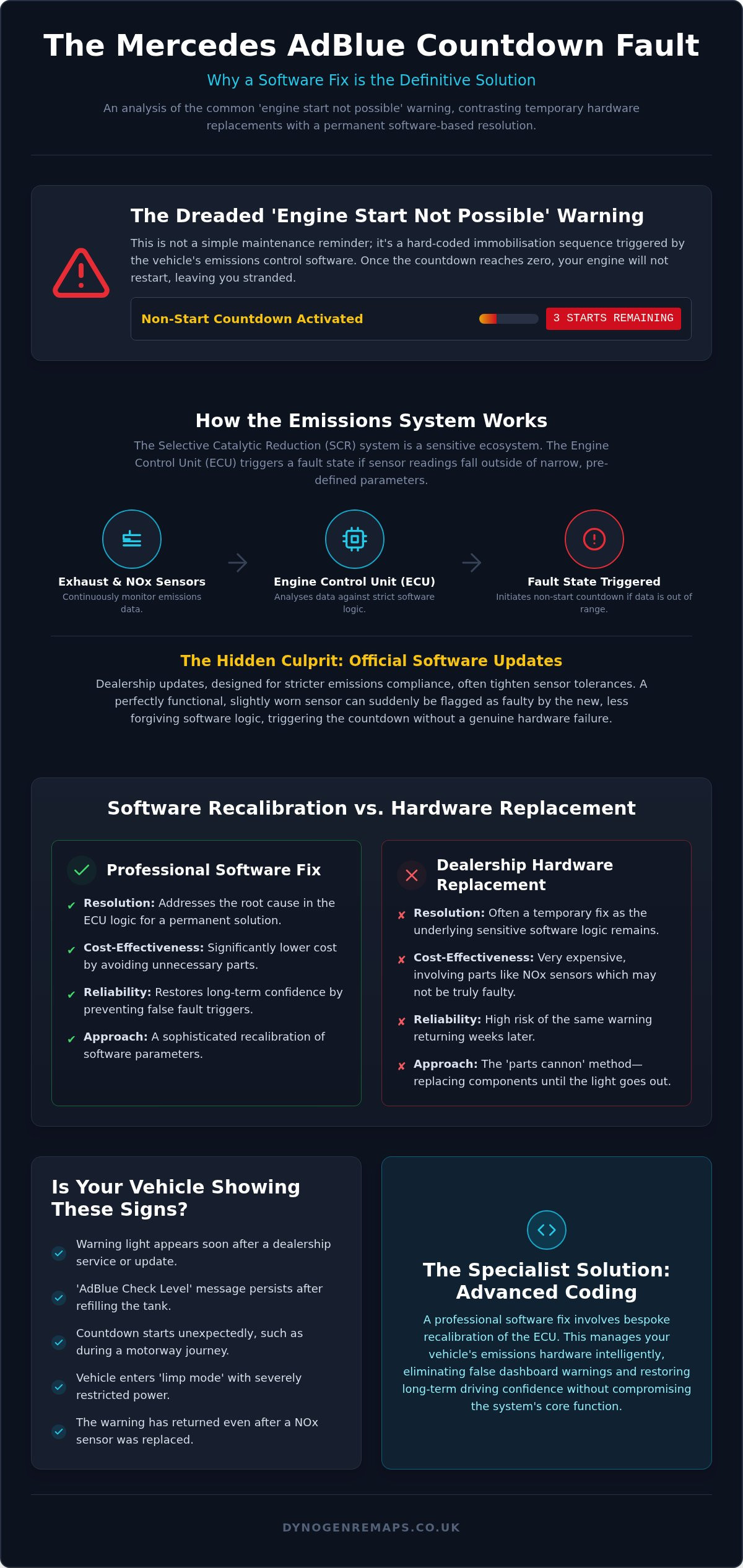
The ‘Engine Start Not Possible’ message is arguably the most dreaded notification a Mercedes owner can face. It’s more than a mere maintenance reminder; it’s a hard-coded security measure that will eventually render your vehicle immobile. This warning signifies that the vehicle’s onboard diagnostics have detected a critical failure within the emissions control system. Unlike a standard service light, this countdown is a legal requirement designed to ensure the car doesn’t operate whilst exceeding its permitted emissions levels. If the counter reaches zero, the engine will not restart once switched off, leaving you stranded regardless of your location or the time of day.
Mercedes diesel engines utilise Selective Catalytic Reduction (SCR) technology to meet stringent Euro 6 standards. This process relies on Diesel Exhaust Fluid (DEF), commonly known as AdBlue, which is injected into the exhaust stream. The fluid reacts with a catalyst to break down harmful nitrogen oxides (NOx) into harmless nitrogen and water vapour. The system operates on a methodical countdown logic, typically beginning with a warning indicating a specific mileage or a set number of remaining engine starts. Simply adding more fluid rarely resolves the issue if the fault is rooted in the software logic. Whilst many assume it’s a simple volume problem, the ECU often requires a professional Mercedes AdBlue software fix to reset internal fault counters and clear the persistent non-start state.
The Role of the SCR System in Emissions Control
The SCR system is a complex ecosystem of hardware and software. High-precision sensors, including NOx sensors and temperature probes, constantly feed data back to the Engine Control Unit (ECU) to monitor efficiency. When these sensors report values outside of a narrow, pre-defined range, the software triggers a protective state. This often leads to an immobilisation countdown even if the hardware is physically intact, as the software prioritises emissions compliance over vehicle availability. It’s a sophisticated but sensitive arrangement where even a minor software glitch can result in a total vehicle lockout.
Symptoms of a Failing AdBlue Software Logic
Detecting a software-based fault requires an understanding of specific vehicle behaviours. You might notice persistent ‘AdBlue Check Level’ messages that refuse to clear even after a complete refill of the reservoir. Often, the countdown appears suddenly during a steady motorway cruise, where the system’s monitoring is most active. In some instances, the vehicle may also enter a restricted ‘limp mode,’ where power is severely limited to reduce emissions output. Applying a Mercedes AdBlue software fix is the only way to address these logic-based failures and restore the vehicle’s reliability without the need for endless hardware replacements.
Why Official Software Updates Often Trigger AdBlue Warnings
It’s a scenario we see frequently: a customer takes their Mercedes in for a routine service or a “voluntary emissions update” and within days, the AdBlue warning light illuminates. Dealership staff often dismiss these occurrences as pure coincidence, yet the technical reality suggests a much stronger correlation. These updates are designed to ensure strict compliance with Euro 6 emissions regulations, but they often achieve this by significantly tightening the operational parameters of the existing hardware. For a vehicle that has already covered several thousand miles, these “tighter” tolerances can be catastrophic for the perceived health of the system.
When new, more stringent software is loaded onto an older Engine Control Unit (ECU), it often lacks the flexibility to account for the natural wear of sensors and pumps. A NOx sensor that was functioning perfectly within previous tolerances might suddenly be flagged as defective because its readings now fall a fraction outside the new, narrower window. This leads to the dreaded “non-start” countdown, creating immediate stress for the owner. In these cases, a specialised Mercedes AdBlue software fix is often the only way to restore the balance between hardware capability and software logic without resorting to unnecessary component replacement.
Increased Sensitivity in Post-Update ECU Logic
Modern ECU updates frequently implement a “zero-tolerance” approach to sensor drift. As components age, their response times and accuracy naturally shift; while the hardware remains physically sound, the updated software interprets this drift as a critical failure. This creates a “cascade effect” where a single minor deviation triggers multiple secondary faults, making it nearly impossible for standard diagnostic tools to find a specific hardware culprit. The result is a dashboard full of errors that don’t reflect the actual mechanical state of the vehicle.
The Cost of Dealership Misdiagnosis
Without a specialist software-first perspective, dealerships often resort to the “parts cannon” approach. They replace the NOx sensors, then the AdBlue pump, and finally the entire SCR tank, often costing the owner thousands of pounds without ever addressing the underlying software conflict. Diagnostic fees alone can reach significant sums whilst the vehicle remains unreliable. Choosing a professional Mercedes AdBlue software fix allows for a more surgical recalibration of the system, ensuring the software works in harmony with your vehicle’s current hardware state. This methodical approach avoids the financial drain of replacing functional parts and provides a definitive resolution to the fault.
Software Recalibration vs. Hardware Replacement: Cost and Reliability
Choosing between a physical component replacement and a professional Mercedes AdBlue software fix is a decision that impacts both your bank balance and your vehicle’s long-term dependability. Many owners find themselves caught in a cycle of replacing expensive sensors only for the same dashboard warnings to reappear a few months later. This happens because the new hardware is often subject to the same overly sensitive software logic that caused the initial failure. A software-based solution addresses the root cause by recalibrating how the Engine Control Unit (ECU) interprets data from the Selective Catalytic Reduction system.
The technical reliability of custom-calibrated software is exceptional when performed by a seasoned specialist. By refining the parameters within the ECU, we can eliminate persistent error codes that would otherwise lead to a non-start condition. This approach does not just mask the problem; it provides a logical resolution that prevents future limp mode events. You gain the peace of mind that comes from knowing your vehicle won’t suddenly restrict power or refuse to start during a critical journey.
The Financial Reality of AdBlue Repairs
Hardware repairs for Mercedes SCR systems are notoriously expensive. Industry data indicates that a new AdBlue tank replacement typically costs between £1,200 and £2,000, whilst a pair of new NOx sensors can reach over £1,000 when including fitting. In extreme cases, premium vehicle owners have seen quotes exceeding £2,100 for a full sensor refresh. These costs are often recurring because the hardware remains vulnerable to the same environmental and logical triggers. A one-time software fix offers far greater value by providing a definitive resolution without the need for a “parts cannon” approach. For those looking to understand the broader capabilities of ECU modifications, our Performance Software: Buyer’s Guide to ECU Remapping provides further technical context on how these solutions are implemented.
Ensuring Long-Term Vehicle Reliability
Software recalibration stabilises the ECU’s emissions monitoring logic by ensuring it operates within realistic, sustainable tolerances. This is particularly beneficial for high-mileage drivers who need their vehicles to remain functional under varied driving conditions without the constant threat of a software-induced breakdown. The result is a more predictable driving experience and a significant reduction in maintenance-related stress. A professional software recalibration definitively corrects the non-start logic by permanently adjusting the ECU’s fault-trigger thresholds to prevent immobilisation.
Selecting a Reputable Technical Solution Provider in the UK
Finding a specialist who understands the intricate architecture of a Mercedes SCR system is as critical as the solution itself. Whilst many owners are led to believe that only a main dealer can resolve emissions faults, the reality is that specialised independent experts often possess a deeper understanding of the software logic involved. A professional provider does not merely clear fault codes; they perform a comprehensive diagnostic evaluation to ensure the underlying cause is addressed. This level of service requires a significant investment in high-end diagnostic interfaces and genuine, licensed recalibration tools that can safely communicate with your vehicle’s Engine Control Unit (ECU).
You must be cautious of “cheap” mobile tuners who offer remarkably low prices for an AdBlue service. These operators frequently rely on generic, one-size-fits-all files or “cracked” software that can cause irreversible damage to sensitive Bosch or Delphi ECUs. A genuine Mercedes AdBlue software fix requires a bespoke approach where the original firmware is read, meticulously modified, and then verified. Choosing a provider with a physical premises and a reputation for technical excellence ensures that your vehicle is in safe hands. If you are looking for a definitive resolution to your emissions faults, you can book a specialist AdBlue solution with our technical team today.
Questions to Ask Your Software Specialist
Before committing to a service, you should verify the specialist’s methodology. Ask if they provide a bespoke recalibration tailored specifically to your vehicle’s software version rather than a generic template. It is also vital to confirm their experience with the specific ECU generation in your Mercedes, as the coding requirements for an older E-Class differ significantly from a modern GLE. For more information on identifying high-quality services, see our guide on Safe Engine Tuning UK: Expert Myth-Busting.
The Importance of Technical Experience
Technical expertise is built over years of hands-on problem-solving. With over 15 years of industry experience, we have witnessed the evolution of Mercedes emissions technology from its inception to the current, highly complex iterations. This longevity allows us to distinguish between a simple sensor drift and a deep-seated logic conflict within the SCR architecture. Professional technical coding involves a surgical adjustment of the ECU’s internal maps, whereas basic “file-flashing” often misses critical sub-routines that can lead to the return of the non-start countdown. Ensuring your provider understands these nuances is the only way to guarantee a permanent, reliable result.
Professional Mercedes AdBlue Software Fixes from Dynogen
Dynogen Remapping Solutions specialises in resolving the complex software-logic failures that haunt modern SCR systems. We don’t believe in the “parts cannon” approach favoured by many dealerships; instead, we utilise over 15 years of technical expertise to provide a sophisticated Mercedes AdBlue software fix that targets the root cause within the ECU. Our methodology ensures that emissions-related hardware components are managed precisely through advanced coding, restoring the seamless driving experience you expect from your vehicle. We approach every vehicle with a blend of professional confidence and a genuine passion for technical excellence.
Our process begins with a comprehensive diagnostic evaluation using elite-level equipment to identify the specific logic conflict. Once we understand the failure profile, our seasoned specialists perform a bespoke software recalibration. This surgical adjustment ensures the software works in harmony with the vehicle’s current hardware state, effectively eliminating the persistent dashboard warnings that traditional garages struggle to clear. We take immense pride in our workmanship, ensuring every modification meets our standard of perfection. This methodical approach guides you from the initial consultation to a final result that guarantees long-term reliability.
A Comprehensive Solution for AdBlue Faults
We provide a definitive resolution that clears persistent dashboard error codes and resets the critical non-start countdown. By addressing the software logic directly, we improve vehicle reliability and prevent the engine from entering a restrictive limp mode. Dynogen positions itself as the superior, personalised alternative to standard corporate options, offering a level of elite skill that focuses on the end-user’s satisfaction. Our software-based modifications are designed to be permanent, giving you total peace of mind whilst driving and ensuring your vehicle remains a pleasure to own.
Next Steps for Your Mercedes
It’s vital to address these faults before the ‘Engine Start Not Possible’ countdown reaches zero. Enquiring about a technical software solution is a straightforward process that starts with a consultation to determine the best path for your specific Mercedes model. Beyond resolving emissions faults, professional software modifications can enhance your overall driving experience in several ways. For drivers who also want to explore the acoustic and performance character of their vehicle, our professional guide to pop and bang map Wigan exhaust overrun calibration demonstrates how precision ECU software can transform your vehicle’s character without compromising reliability. You can learn more about the broader advantages of our specialist services by reading about the Top 5 ECU Remapping Benefits. Don’t wait for a total immobilisation; restore your vehicle’s reliability and driving pleasure today.
Restore Your Mercedes to Peak Performance
The “engine start not possible” countdown doesn’t have to signal the end of your vehicle’s reliability or the start of an endless cycle of expensive hardware replacements. By choosing a professional Mercedes AdBlue software fix, you address the underlying logic failures that standard dealership updates often exacerbate. We have demonstrated that sophisticated recalibration offers a more sustainable and cost-effective resolution than the repetitive “parts cannon” approach, provided it is executed by a specialist with the correct technical pedigree.
At Dynogen, we leverage over 15 years of technical remapping expertise and utilise advanced diagnostic and software calibration equipment to resolve even the most persistent SCR faults. As specialists in Mercedes SCR and ECU architecture, we take immense pride in delivering results that restore your driving confidence and eliminate dashboard warnings permanently. Don’t allow a software glitch to compromise your driving experience any longer. Enquire about our professional Mercedes AdBlue software solutions today and reclaim the reliability your vehicle was designed to deliver.
Frequently Asked Questions
Is the Mercedes AdBlue software fix a permanent solution?
A professional Mercedes AdBlue software fix is a permanent modification to the Engine Control Unit’s logic. Unlike a temporary fault code reset that only masks the issue, this recalibration adjusts the specific parameters that trigger the immobilisation countdown. By refining how the ECU interprets data from the SCR system, we ensure the ‘engine start not possible’ warning does not return. This provides long-term peace of mind without the need for repetitive hardware replacements.
Can I still drive my car if the AdBlue non-start countdown has begun?
You can continue to drive whilst the countdown is active, but you must reach a specialist before the counter reaches zero. Once the remaining mileage or number of starts is exhausted, the vehicle’s security logic will prevent the engine from restarting. This immobilisation is a hard-coded legal requirement designed to enforce emissions compliance. Addressing the fault early prevents the significant inconvenience and cost of a recovery vehicle to a technical centre.
Will a software fix for AdBlue affect my vehicle’s performance or fuel economy?
A professional software recalibration won’t negatively impact your vehicle’s performance or fuel economy. The modification focuses exclusively on the SCR monitoring logic within the ECU and doesn’t alter the primary fuel maps or turbocharger parameters. In fact, many owners report that their vehicle feels more responsive once the restrictive limp mode is removed. This ensures your Mercedes continues to perform with the precision and efficiency you expect from the brand.
Why does my Mercedes say AdBlue is low when the tank is full?
This discrepancy usually indicates a software logic error or a sensor that has drifted out of its calibrated range. The ECU receives data from the level sensor but interprets it incorrectly due to overly tight software tolerances introduced during manufacturer updates. Even with a full reservoir, the system triggers a low-level warning. A Mercedes AdBlue software fix recalibrates these internal thresholds, ensuring the dashboard accurately reflects the physical fluid levels within the SCR tank.
How much does a professional Mercedes AdBlue software fix cost compared to a dealership repair?
Professional software solutions are significantly more cost-effective than the hardware-heavy approach taken by dealerships. Industry data shows that replacing a NOx sensor can exceed £1,000, whilst a full AdBlue tank replacement often costs between £1,200 and £2,000. A software recalibration avoids these mounting expenses by providing a definitive logic-based resolution. This one-time investment eliminates the ‘parts-throwing’ cycle where functional components are replaced unnecessarily, offering a superior alternative to standard corporate repair routes.
Can a software fix resolve the Mercedes limp mode caused by AdBlue faults?
Yes, expert software recalibration is the most effective way to clear a limp mode state triggered by emissions faults. When the ECU detects a perceived failure in the SCR system, it restricts engine power to reduce NOx output. Our technical solution adjusts the internal mapping to remove these restriction flags. This restores full power and responsiveness to your vehicle, ensuring you are no longer restricted by software-induced performance caps or dashboard warning lights.
Is it safe to recalibrate the emissions software on my Mercedes-Benz?
Recalibrating your emissions software is entirely safe when conducted by a seasoned specialist using advanced, licensed diagnostic equipment. We use sophisticated coding techniques that respect the engine’s inherent safety limits and structural integrity. Unlike generic mobile tuners who use ‘cracked’ software, our bespoke approach ensures that the ECU remains stable and reliable. This precision-focused modification provides a permanent fix for SCR faults whilst maintaining the high standard of vehicle performance you expect.
Do I need to bring my vehicle to a specific centre for the AdBlue fix?
It is essential to visit a specialist technical centre equipped with the latest Mercedes-specific diagnostic and coding hardware. Complex ECU architectures, such as those found in modern Mercedes-Benz models, require a stable environment and high-speed data interfaces to ensure a safe recalibration. Mobile operators often lack the sophisticated tools needed to handle these deep-level software modifications correctly. Bringing your vehicle to a dedicated facility guarantees a professional, controlled process and a reliable final result.