

Your modern petrol engine is essentially a restricted masterpiece, held back by conservative factory software designed for the lowest common denominator of fuel quality and global climate. It’s frustrating when your vehicle feels hesitant during a crucial overtake or suffers from a sluggish throttle response that disconnects you from the tarmac. You’ve likely felt that there’s more power waiting to be unleashed, yet the fear of a generic, “one-size-fits-all” map causing internal damage often keeps drivers from making the leap. A professional petrol engine performance remap solves this by replacing factory compromises with precision-engineered calibration.
You’ll discover how custom-written software transforms your vehicle’s power delivery and overall dynamics whilst maintaining long-term reliability. This guide provides a comprehensive look at the transition from standard to superior performance, detailing the significant gains in BHP and torque you can expect. We’ll also explain the diagnostic rigour required to ensure your engine’s longevity remains the top priority during every stage of the tuning process. By the end of this article, you’ll understand how to achieve a sharper, more engaging driving experience that feels tailored specifically to your car’s unique mechanical health.
Key Takeaways
- Understand the ‘factory compromise’ and how professional software optimisation reclaims the performance potential suppressed by global manufacturing restrictions.
- Explore the mechanical differences between tuning turbocharged and naturally aspirated engines to ensure your expectations match your vehicle’s specific hardware.
- Learn why refined torque delivery and a smooth power curve are far more significant for a superior driving experience than chasing headline BHP figures.
- Recognise the critical safety advantages of a professional petrol engine performance remap over unverified, generic files that can jeopardise engine longevity.
- Discover how custom-calibrated solutions provide a sophisticated and reliable alternative to standard dealership software without compromising mechanical integrity.
What is a Petrol Engine Performance Remap?
A petrol engine performance remap is a sophisticated software-based optimisation of the Engine Control Unit (ECU) designed to enhance power delivery and efficiency. Rather than replacing physical components, this process involves recalibrating the digital instructions that dictate how your engine breathes, burns fuel, and reacts to your right foot. By rewriting these parameters, we can eliminate the artificial restrictions imposed during the manufacturing process, resulting in a vehicle that feels significantly more urgent and capable.
The technology used to achieve these results has evolved remarkably over the last two decades. In the early days of tuning, performance gains required physical ‘chips’ to be unsoldered and replaced on the circuit board. Today, we utilise advanced OBDII and bench-tuning software solutions to interface directly with the ECU. This modern approach allows for a level of precision and safety that was previously impossible, enabling us to fine-tune specific tables without invasive hardware changes.
It’s vital to distinguish a professional remap from basic ‘tuning boxes’ often found online. These external modules typically function by intercepting sensor signals and tricking the ECU into providing more boost or fuel, which can lead to erratic power delivery and long-term reliability issues. A professional petrol engine performance remap provides a holistic calibration where every map is adjusted in harmony, ensuring the vehicle remains balanced and reliable under all driving conditions.
The Role of the Engine Control Unit (ECU)
The ECU acts as the sophisticated brain of your vehicle, constantly managing the intricate relationship between fuel injection, air intake, and spark timing. It relies on complex data tables, known as ‘maps’, to dictate engine behaviour under different loads and environmental conditions. Professional equipment allows us to access these maps safely, ensuring that the new performance data is written to the ECU’s memory with absolute precision and integrity.
Why Petrol Engines are ‘Restricted’ from the Factory
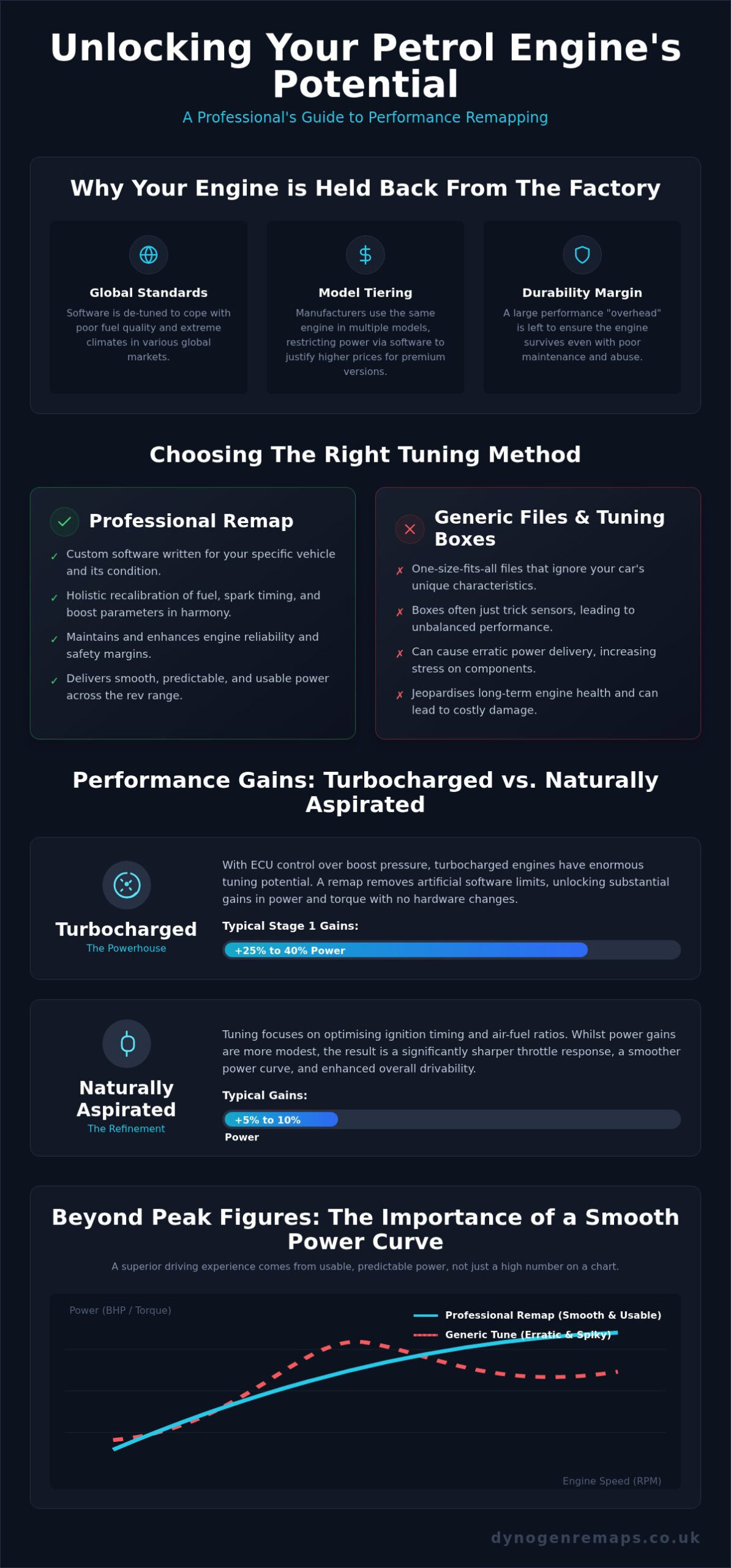
Manufacturers are forced to build vehicles that can survive in every corner of the globe, which means they must account for poor maintenance habits and low-grade fuel found in less regulated territories. Furthermore, many brands use the same physical engine across multiple models, using software to artificially limit power on cheaper variants to justify a higher price for ‘premium’ versions. Factory overhead is the safety margin left by engineers to ensure a vehicle survives the worst possible conditions across the globe. By reclaiming this overhead, we can safely unlock the power that was intentionally suppressed on the production line.
Turbocharged vs Naturally Aspirated: The Mechanics of Petrol Tuning
The mechanical architecture of your vehicle dictates exactly how a petrol engine performance remap will manifest on the road. While the fundamental principles of combustion remain the same, the methods used to extract power vary significantly between forced induction and naturally aspirated setups. Understanding these nuances is essential for any owner looking to invest in a professional calibration that respects the engine’s physical limits.
Turbocharged petrol engines represent the pinnacle of remapping potential. Because the ECU directly manages the turbocharger’s boost pressure, we can precisely dictate how much air enters the cylinders. Modern powerplants, such as the BMW B58 or the Volkswagen Group’s EA888, are engineered with substantial factory overhead, allowing for incredible Stage 1 gains without changing a single bolt. These engines are essentially software-restricted from the factory, and a bespoke remap simply removes those digital shackles.
Unlocking the Potential of Turbo-Petrol Engines
Achieving a reliable power increase in a turbo-petrol vehicle involves more than just increasing boost levels. We focus on sophisticated wastegate control to ensure that boost pressure is delivered smoothly rather than in a sudden, drivetrain-stressing spike. By optimising the relationship between air-fuel ratios and ignition timing, we create a more efficient combustion cycle. This methodical approach allows the engine to produce more power whilst keeping exhaust gas temperatures within safe operational limits, ensuring your turbocharger remains healthy for the long term.
Refining Naturally Aspirated Performance
Refining naturally aspirated (NA) performance via a petrol engine performance remap requires a different level of finesse. Without the ability to force more air into the engine, we look for efficiency gains within the existing mechanical constraints. We achieve this by refining fuel maps and advancing ignition timing to suit higher-quality fuels. A critical component of this process is the optimisation of variable valve timing (VVT). By adjusting when the intake and exhaust valves open and close, we can significantly improve the engine’s volumetric efficiency.
The results of NA tuning are often transformative for the driver’s experience, even if the peak numbers appear more modest on paper:
- Sharper throttle response: The engine reacts instantly to driver input, eliminating the “laggy” feel of factory software.
- Elimination of flat spots: We provide a smooth, linear power delivery throughout the entire rev range.
- Enhanced low-end torque: This makes the car feel significantly more agile and responsive in daily traffic.
Whilst the peak BHP gains for NA engines are typically lower than their turbocharged siblings, the improvement in drivability is often what owners value most. If you’re curious about the specific benefits for your model, you can view our performance database to see what our custom software can achieve for your vehicle.
Measuring Success: BHP, Torque, and Drivability
While many enthusiasts focus on the “headline” figure, the success of a petrol engine performance remap is truly measured by how the vehicle behaves under real-world conditions. A peak BHP figure only tells you what the engine is doing at its absolute limit, usually near the redline. In contrast, torque gains are the true key to effortless overtaking and improved in-gear acceleration. We prioritise a balanced calibration that enhances the entire rev range, transforming a car from merely functional to genuinely inspiring. It’s the difference between a car that looks fast on a spec sheet and one that feels fast on the road.
The ‘Area Under the Curve’ Explained
A common misconception in the tuning world is that a higher peak number always equals a faster car. However, a 20 BHP gain spread across the whole rev range is far superior to a 40 BHP peak spike that only appears for a few hundred RPM. This is because the “area under the curve” represents the actual work the engine is doing throughout a gear. By adjusting the complex torque limiters within modern ECUs, we can provide a linear power curve that feels consistent and predictable. Improve car drivability remapping is the primary goal of professional tuning. This ensures that the vehicle pulls strongly from low RPM all the way to the redline without any erratic surges or sudden drop-offs in power.
Throttle Mapping and Driver Connection
Modern fly-by-wire throttle systems often introduce a frustrating “dead” zone, where the car fails to react instantly to your input. A precision petrol engine performance remap eliminates this lag, creating a direct connection between the driver and the engine. If you want to understand exactly how software recalibration can improve throttle response remap calibrations achieve, the process centres on removing the electronic filters that create these artificial dead zones. We typically favour a linear throttle map, which ensures that 50% pedal input results in 50% of the available power, rather than the twitchy, aggressive mapping found in some generic files. This refinement is especially noticeable in automatic or DSG-equipped vehicles, where optimised software leads to more intuitive downshifts and more effective engine braking. The result is a car that feels more intuitive, responsive, and ultimately more rewarding to drive through a series of bends.
The integrity of your engine depends entirely on the quality of the software controlling it. While a petrol engine performance remap offers significant rewards, using generic, unverified “eBay maps” or files from low-cost “slave” tools can be a costly mistake. These one-size-fits-all files often bypass critical safety parameters to achieve headline-grabbing numbers. In contrast, a professional calibration respects the mechanical limits of your specific vehicle, ensuring that every increase in power is matched by a commitment to longevity.
Maintaining safe Exhaust Gas Temperatures (EGTs) is a cornerstone of professional tuning. If a map is too aggressive, EGTs can skyrocket, leading to catastrophic turbocharger failure or melted pistons. We utilise sophisticated logging equipment to monitor these variables in real-time. This level of Safe engine tuning UK ensures that your vehicle remains within its engineered thermal limits. Before any software is uploaded, we perform a comprehensive diagnostic health check. This ensures your injectors, fuel pump, and ignition system are in peak condition; remapping an engine with underlying faults is a recipe for disaster.
Staying Within Mechanical Tolerances
Professional tuners understand that components like the clutch, turbocharger, and fuel injectors have specific operational ceilings. We carefully manage torque delivery to prevent clutch slip and ensure the turbocharger doesn’t exceed its maximum rated RPM. A vital part of this protection is the ECU’s knock sensors. These sensors detect “pinking” or pre-detonation caused by poor fuel or excessive timing. Our custom-calibrated software retains and refines these safety nets. Unlike “bedroom” tuners who might disable these protections for a higher dyno reading, we prioritise a conservative, reliable map that delivers performance without compromise.
ECU Architecture and Modern Security
Modern petrol engines, particularly those produced after 2020, often feature “Anti-Tune” software designed to prevent unauthorised access. Bypassing these protections requires specialised knowledge and elite-level equipment. While older cars can be tuned via the OBDII port, newer models often require “bench” remapping, where the ECU is safely interfaced with directly. This professional approach ensures that the ECU’s internal security remains intact and that main dealer diagnostic tools can still communicate with the car effectively. If you want to ensure your vehicle receives this level of technical care, book your professional performance remap today.
The Dynogen Process: Custom Performance for Your Petrol Engine
Dynogen brings over 15 years of technical expertise to every petrol engine performance remap we perform. We don’t believe in the “one-size-fits-all” approach that often dominates the lower end of the market. Instead, we focus on a methodical, diagnostic-led process that respects the unique mechanical health of your vehicle. This commitment to workmanship ensures that the results we deliver are both aspirational and entirely reliable, providing a superior alternative to standard dealership software.
The ECU remapping benefits go far beyond just top-end speed. While the increase in BHP is rewarding, the improvement in smoothness during your daily commute is often the most significant change for our clients. By refining the engine’s thermal efficiency and combustion timing, we reduce hesitation and provide a more predictable, effortless power delivery. This makes navigating urban traffic far less taxing and ensures your car feels revitalised in every driving scenario.
Custom Calibration vs. Generic Tuning
Even two vehicles with the same engine code will have subtle differences in wear, sensor tolerances, and historical maintenance. A generic “tuning file” cannot account for these variables. We also tailor our software to complement any existing hardware upgrades you’ve installed, such as performance air intakes or free-flowing exhaust systems. Having a seasoned specialist verify the installation means we can fine-tune parameters to suit your specific driving goals. This provides a level of precision that automated DIY devices or generic files simply cannot match.
Booking Your Remap and Next Steps
On the day of your appointment, our process follows a logical and thorough diagnostic path. We begin with a comprehensive health check to confirm your engine is fit for tuning. We then perform a full read of the original factory software before our experts begin the custom calibration process. Once the new performance software is installed, we conduct a comprehensive test drive to ensure every parameter is performing perfectly.
To maintain these results, we recommend the following post-remap care:
- Fuel Quality: Use high-quality Super Unleaded fuel to take full advantage of the advanced ignition timing.
- Maintenance: Adhere to strict oil change intervals to ensure the turbocharger and internal components remain protected.
- Monitoring: Pay attention to the vehicle’s behaviour and report any changes to your specialist immediately.
If you’re ready to transform your vehicle and unlock its true potential, you can enquire about your Stage 1 performance upgrade today. Our team is ready to provide the elite-level service your petrol engine deserves.
Experience the Full Potential of Your Petrol Engine
Investing in a petrol engine performance remap is about more than just increasing top-end speed; it’s about refining the mechanical soul of your vehicle. You’ve seen how custom software optimisation removes factory restrictions whilst respecting the engine’s physical limits. Whether you’re seeking the massive gains of a turbocharged setup or the sharpened response of a naturally aspirated engine, the focus must always remain on quality calibration over generic shortcuts. By prioritising drivability and smooth torque delivery, you transform your car into a more intuitive and capable machine.
Dynogen provides a superior alternative to standard dealership software through our 15+ years of vehicle tuning expertise. We use advanced software for precision calibration and always begin our process with a comprehensive pre-tuning vehicle health check to ensure absolute reliability. It’s time to stop settling for a compromised driving experience. You can unlock your engine’s true potential with a custom petrol remap from Dynogen and rediscover the joy of every journey. Your car has so much more to give; let’s help it reach its peak performance safely.
Frequently Asked Questions
Will a petrol engine performance remap damage my car’s engine?
A professional petrol engine performance remap won’t damage a healthy engine because it stays within the manufacturer’s mechanical tolerances. We use sophisticated software to monitor exhaust gas temperatures and boost levels, ensuring the engine remains reliable. However, applying a map to an engine with underlying faults like worn injectors can cause issues. That’s why our process always begins with a comprehensive health check to confirm your vehicle is fit for the upgrade.
How much extra BHP can I expect from a Stage 1 petrol remap?
The gains depend heavily on your engine’s architecture. Turbocharged petrol engines typically see the most significant improvements, often gaining between 20% and 40% more power through software alone. Naturally aspirated engines usually see more modest peak BHP increases, often around 5% to 10%. Regardless of the headline figure, the real benefit lies in the sharpened throttle response and smoother power delivery across the entire rev range for a more engaging drive.
Do I need to use premium fuel after my car has been remapped?
We strongly recommend using high-quality Super Unleaded fuel following a performance calibration. Professional maps are often written to take advantage of the higher octane rating, which allows for more advanced ignition timing without the risk of knocking. Whilst your car will still run on standard 95 octane fuel, you won’t experience the full power and torque gains we’ve unlocked. Using premium fuel ensures the engine runs more efficiently and maintains peak performance.
Will a performance remap void my vehicle’s manufacturer warranty?
A remap can potentially void the powertrain section of your manufacturer warranty if a failure is directly attributed to the software modification. Most dealerships won’t look for a remap during routine maintenance, but they may investigate if you make a major engine-related claim. It’s always best to assume that any ECU modification carries this risk, which is why many owners choose to wait until the factory warranty period has expired before seeking an upgrade.
Can a petrol engine remap be detected by a main dealer during a service?
Modern diagnostic equipment used by main dealers can detect a petrol engine performance remap if they specifically check the ECU’s flash counter or checksums. During a standard service or oil change, technicians rarely perform these deep checks. However, if the vehicle is connected to the manufacturer’s central server for a software update or a warranty investigation, the modification is likely to be flagged. We prioritise maintaining factory-level communication protocols to minimise visibility.
What is the difference between a remap and a tuning chip box?
A remap is a sophisticated software recalibration within the ECU itself, managing hundreds of parameters in harmony. In contrast, a tuning box is an external module that tricks engine sensors into providing more fuel or boost. Whilst boxes are easily removable, they often provide erratic power delivery and can bypass essential safety nets. A custom remap provides a far more refined and reliable solution because it works with the engine’s internal logic rather than against it.
How long does the petrol remapping process take to complete?
A professional Stage 1 remap typically takes between one and three hours to complete. This duration allows us to perform a thorough pre-tuning diagnostic check, read the original factory file, and apply the custom calibration. We also include a comprehensive test drive to ensure the vehicle is performing exactly as expected. Some newer models with complex security may require a little longer if the ECU needs to be accessed directly on the bench for a safe installation.
Can I return my car to its original factory settings if I sell it?
Yes, a professional ECU remap is entirely reversible. We always save a secure backup of your vehicle’s original factory software before making any modifications. If you decide to sell the car or return it to a leasing company, we can simply flash the original map back onto the ECU. This process restores the car to its exact stock parameters, ensuring it meets the requirements for a standard sale or return without any lasting software changes.