

The biggest advertised gain isn’t necessarily the best remap for your Audi A4 TDI. An Audi A4 TDI performance remap should be judged by how well it suits your specific car, not by a headline figure that may relate to a different engine, ECU or transmission.
If you’re unsure whether a remap is right for your car, that’s sensible: its age, mechanical condition and intended use all matter. Before comparing claims, gather the details that identify your car, then ask how the proposed calibration has been matched to them.
This guide explains what a Stage 1 remap can involve, how to assess performance claims and what to check before booking. It also covers the questions to ask about the car’s condition, drivability, insurance and emissions compliance, so you can make a more informed decision.
Dynogen Remapping Solutions has more than 15 years of vehicle tuning experience. Rather than assuming every A4 will respond in the same way, start by discussing your car’s specification, condition and your expectations with a specialist.
Key Takeaways
- Find your A4’s exact engine, ECU and transmission details before comparing remap claims.
- Judge an Audi A4 TDI performance remap by vehicle-specific evidence, not headline gains alone.
- Review the car’s condition and service history, and explain how you intend to use it.
- Ask a specialist how compatibility is checked and what any quoted figures are based on.
- Speak to your insurer before modifying the car, then consider the response alongside your ownership plans.
Audi A4 TDI performance remap: what the upgrade is intended to change
An ECU remap recalibrates the engine-management software that controls how the engine operates. It isn’t a mechanical rebuild and doesn’t add or replace engine components. Depending on the car and calibration, changes to software settings may alter power delivery and torque. The aim is to change how the engine responds, but the outcome depends on the vehicle’s exact specification and condition.
Remapping is also often described as Chip tuning, a term for modifying engine-control software to change vehicle behaviour. A Stage 1 remap is generally a software-only approach for a vehicle with standard hardware. That description doesn’t mean every A4 TDI is suitable. The engine and ECU must be checked, and a tuner should confirm what is appropriate for your particular car before recommending a calibration.
Which Audi A4 TDI details matter before considering a remap?
Gather the model year, generation, engine code, transmission and current mileage. The TDI badge alone doesn’t identify the engine or ECU, and a registration year isn’t enough to confirm compatibility. Check your vehicle documents and service history, then provide the details to a specialist. Ask them to verify the engine and ECU information against the car itself before discussing a specific calibration.
What changes might a driver notice after calibration?
Some drivers may notice a different throttle response or stronger mid-range delivery. What you notice depends on the car, the calibration and how you drive. These impressions are not the same as measured results. If a tuner quotes power or torque figures, ask whether they relate to your exact variant, ECU and transmission, and how they were obtained. A claim for one A4 shouldn’t automatically be treated as an estimate for another.
Assess an Audi A4 TDI performance remap on its suitability and the information behind the calibration, not a headline gain alone. For broader context on software-only tuning, read a guide to Stage 1 remapping, then discuss your vehicle details and intended use with an experienced specialist. Dynogen Remapping Solutions offers a Stage 1 Performance Remap; any potential outcome should be considered against your car’s specification and condition.
How an Audi A4 TDI remap works, and why results vary
A specialist should start by checking the car’s identifying information and ECU details, then establish whether a compatible calibration is available. The ECU, or engine control unit, manages engine operation using calibrated settings. In a turbo-diesel, these controls relate to how the engine responds to the turbocharger and how torque is delivered. A software calibration changes control settings; it doesn’t upgrade hardware or correct a mechanical fault.
Identical badges don’t guarantee identical results: the engine, ECU, transmission and condition all matter. A4 TDI specifications and software versions can differ. A quoted figure is useful only if the tuner can explain which variant it applies to and how it was measured. Don’t assume one gain applies to every car.
How the ECU calibration relates to the TDI engine
The ECU coordinates engine functions, including fuel delivery and, where applicable, turbocharger control. A calibration may change how the engine responds within its operating parameters, but the appropriate approach depends on the ECU version and the rest of the vehicle. The transmission matters too, because it affects how engine torque is put to the road. Ask a tuner to confirm compatibility for your car rather than infer it from the TDI badge.
Why condition and calibration quality affect the outcome
Existing faults or wear can affect whether a remap is sensible. Tell the specialist about warning lights, known mechanical concerns and service history. Diagnostic checks can help identify issues that need attention before a software change, but a remap isn’t a repair. If there’s an unresolved fault, ask whether it should be investigated first and how the proposed calibration takes the car’s condition and use into account.
For a fuller discussion of reliability considerations, consult the existing guide to safe engine remapping and reliability. Keep legal guidance in context too: GOV.UK’s vehicle modification guidance covers structurally modified vehicles, not ECU remaps specifically, so don’t treat it as remap-specific advice. Check with the relevant authorities if you’re unsure whether your particular modification affects registration requirements.
Before proceeding, ask what vehicle information will be checked, how compatibility is confirmed and what evidence supports any quoted outcome. Dynogen Remapping Solutions has more than 15 years of vehicle tuning experience and uses advanced software and equipment for remapping. You can discuss your Audi A4 TDI and ask whether it is suitable for a Stage 1 Performance Remap.
How to compare Audi A4 TDI remap claims before choosing a tuner
Compare the process behind a quote, not just its headline figures. A useful assessment should take account of your car’s engine code, ECU and transmission, and explain the basis for any stated power or torque outcome. If a claim relates to a different A4 TDI variant, it isn’t a reliable estimate for yours.
| What to compare | Questions to ask | What a clear answer should cover |
|---|---|---|
| Vehicle-specific evidence | Do the quoted figures match my engine code, ECU and transmission? | The precise variant and the basis for its estimated results. |
| Diagnostics | What checks are made before calibration? | How faults or warning lights are identified and handled. |
| Process transparency | What does the calibration change, and what are its limitations? | A straightforward explanation of the proposed software approach. |
| Aftercare | What documentation and follow-up support are available? | What happens after the work, including whether restoration options exist. |
Questions to ask about gains, testing and the calibration
Ask how power and torque figures were obtained, and whether the tuner can provide supporting evidence for your specific vehicle. Find out whether the figures are measured or estimated, and what conditions they refer to. Be cautious of guaranteed gains or promises of identical results across different variants. A useful explanation should set out what the calibration is intended to change without implying that every car will respond in the same way.
For wider comparison criteria, read the existing buyer’s guide to performance software alongside this checklist. Use it to consider how clearly a provider explains its process, the evidence behind its claims and the limitations of the proposed work.
What professional process and support should a buyer expect?
Before booking, ask what vehicle information and diagnostic checks the specialist needs, and how a detected fault might affect the decision to proceed. Clarify what documentation you’ll receive, what follow-up support is available and whether the original software can be restored if needed. Don’t assume these are included; ask the provider to explain its process.
A well-matched Audi A4 TDI performance remap starts with accurate vehicle details and realistic expectations. Once you’ve compared the evidence and questions above, you can discuss your Audi A4 TDI with Dynogen and ask whether its Stage 1 Performance Remap is suitable for your car.
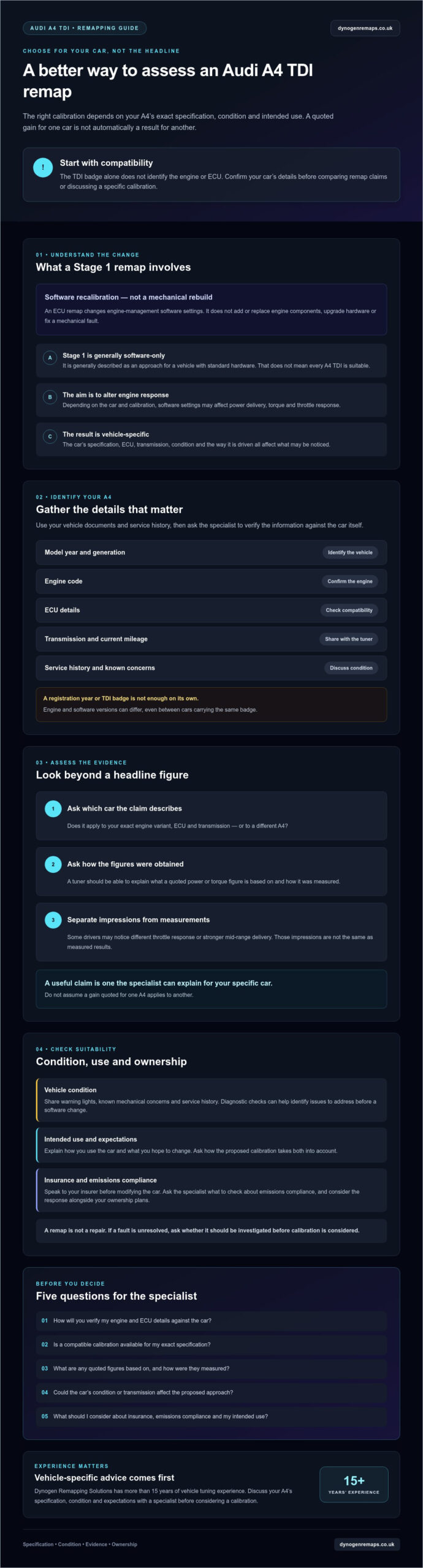
Audi A4 TDI remap checklist: insurance, condition, and ownership
Work through a clear sequence before deciding whether an Audi A4 TDI performance remap suits your car. Confirm the exact variant, review its condition, discuss compatibility and the proposed work with a specialist, then check your insurance. Finally, consider the answers alongside how you use and intend to keep the car. This gives you a more useful basis for deciding than a generic performance claim.
- Identify the variant: Note the model year, generation, engine code, ECU and transmission. Check the vehicle documents and ask a specialist to confirm compatibility.
- Review condition: Look through the service history and note warning lights, diagnostic faults or known mechanical concerns.
- Ask the tuner: Confirm what work is proposed, what checks are carried out and what limitations apply to your specific car.
- Check insurance: Contact your insurer before any modification and ask what it requires you to disclose. Keep a record of the advice and any policy changes.
- Decide: Proceed only if the car’s condition, compatibility, insurer response and proposed scope make sense for you.
Is the car a suitable candidate for a performance remap?
Service records can help you understand how the car has been maintained, while diagnostic checks may highlight issues that need attention. Share warning lights, faults or mechanical concerns with the specialist before discussing calibration. An unresolved problem should be investigated, not treated as something a software change will fix. Don’t assume age or mileage alone decides suitability. Ask for an assessment based on the car’s actual condition and specification.
What to confirm before and after booking
Before agreeing to the work, ask the specialist to confirm the compatible vehicle details, the exact scope of the calibration and any stated limitations. Make sure you understand that the discussion concerns software changes, and ask directly whether factory emissions equipment will remain in place. If you’re unsure about current MOT or emissions requirements, verify the latest official UK guidance rather than relying on assumptions.
Speak to your insurer before the modification, confirm its current notification requirements and retain relevant paperwork, including details of the work and any insurer correspondence. For a useful comparison of driving behaviour, read the existing guide to Stage 1 remapping versus standard driving before deciding which changes matter in everyday use.
After reviewing the car, insurance and proposed work, you can ask Dynogen about a Stage 1 Performance Remap and whether it is suitable for your Audi A4 TDI.
Choosing a specialist for your Audi A4 TDI performance remap
A sound decision comes from matching the calibration to the car, not chasing the largest advertised gain. Confirm compatibility, review the vehicle’s condition, compare the evidence behind any claims and understand the proposed process before booking. A Stage 1 Performance Remap may be worth discussing, but its suitability and outcome need to be considered for your particular Audi.
Why vehicle-specific assessment matters more than headline figures
Model year, engine code, ECU version, transmission and mechanical condition all inform whether a calibration is suitable. Give a specialist accurate details and expect clear answers about compatibility, checks and limitations. Treat broad promises with caution if they don’t explain which variant they relate to or how the figures were established. Any model-specific power or torque figures should be checked against a reliable source for the exact vehicle before they’re published or relied upon.
Look for a documented, understandable process rather than confident-sounding claims alone. A specialist should be able to explain what information they need, how the car’s condition affects the assessment and what the proposed software work covers. If an answer is unclear, ask for clarification before agreeing to proceed.
Next steps for an informed remap discussion
Prepare the registration details, engine information, current mileage and service history. Include any warning lights, symptoms or known faults, and tell the specialist about existing modifications. Describe what you want to change in everyday driving, such as throttle response or mid-range delivery. Specific expectations make it easier to discuss whether the proposed approach fits your needs, without assuming a particular result.
Dynogen Remapping Solutions has more than 15 years of vehicle-tuning experience and uses advanced software and equipment for remapping. Its Stage 1 Performance Remap is an option to explore, not a promise of a particular gain. Bring your vehicle information and intended driving use to the discussion, and ask whether your exact A4 TDI can be supported.
For a vehicle-specific conversation, discuss a Stage 1 Performance Remap with Dynogen. A careful assessment of the car and a clear explanation of the process are useful foundations for deciding whether to proceed.
Make your next remapping decision with confidence
A suitable Audi A4 TDI performance remap starts with the details of your exact car, not a headline gain from another variant. Confirm the engine, ECU and transmission, consider the vehicle’s condition, and ask what evidence supports any quoted figures. Before proceeding, check your insurer’s requirements and make sure you understand the proposed calibration and its limitations.
Dynogen Remapping Solutions brings more than 15 years of tuning experience and uses advanced software and equipment for vehicle remapping. Its Stage 1 Performance Remap is an option to discuss, with suitability assessed against your Audi’s specification and intended use rather than assumed in advance.
Ready to explore the next step? Discuss your Audi A4 TDI remap with Dynogen and share your vehicle details and driving priorities. A clear conversation can help you decide whether a remap is right for your car.
Frequently Asked Questions
Can every Audi A4 TDI have a performance remap?
Not every Audi A4 TDI is automatically suitable for a performance remap. Suitability depends on its model year, engine code, ECU, transmission and current condition. The TDI badge alone doesn’t confirm which ECU is fitted or whether a compatible calibration is available. Give a specialist your vehicle details and service history, and disclose warning lights or known faults. Unresolved issues may make remapping inappropriate until they’ve been investigated, so confirm compatibility before booking.
How much power can an Audi A4 TDI remap add?
There isn’t one reliable power-gain figure for every Audi A4 TDI. An Audi A4 TDI performance remap can produce different outcomes according to engine and ECU specification, vehicle condition, calibration and how results are measured. Ask for figures that match your exact variant, whether they’re measured or estimated, and what evidence and test conditions support them. Treat broad advertised gains as claims to check, not guaranteed results for your car.
Is a Stage 1 remap safe for an Audi A4 TDI?
A Stage 1 remap’s suitability depends on the car’s condition, ECU compatibility and the calibration. Ask what diagnostic checks are carried out and discuss warning lights, existing faults and mechanical concerns before work begins. If an issue is unresolved, have it investigated rather than expecting software to correct it. A professional assessment can help inform your decision, but no remap can remove existing wear or guarantee reliability.
Will an Audi A4 TDI remap affect fuel economy?
Fuel economy after a remap depends on the calibration, driving style, route, vehicle condition and how you use any additional performance. There’s no reliable MPG improvement to promise across all A4 TDIs. Ask whether the proposed work is intended to prioritise performance or economy, and how any claimed efficiency change was measured. Your everyday driving and journey conditions matter, so treat claims as estimates rather than assured savings.
Do I need to tell my insurer about an Audi A4 TDI remap?
Contact your insurer before modifying the car and check its policy requirements for declaring changes. Insurers and policies can differ, so don’t rely on another driver’s experience or assume every provider treats a remap in the same way. Ask what information they need and keep relevant remapping documentation and insurer correspondence with your vehicle records. If you’re uncertain, get clarification from your insurer before booking the work.
Can an Audi A4 TDI remap affect its MOT or emissions compliance?
The effect depends on the work carried out and the vehicle’s condition. A performance remap should not be presented as requiring emissions-equipment deletion. Ask the specialist to explain exactly what the calibration involves and whether factory equipment remains in place. MOT and emissions guidance can change, so check current official UK information before proceeding. If the proposed work raises questions about compliance, seek advice from a qualified specialist first.
What should I check before booking an Audi A4 TDI performance remap?
Confirm the car’s model year, engine code, ECU and transmission, then review its service history, warning lights and known faults. Ask what diagnostic checks take place, whether your exact variant is compatible, how quoted results were established and what aftercare is available. Check your insurer’s requirements before agreeing to the work. Compare how clearly each specialist answers these questions rather than choosing solely on a headline power claim.