
The biggest claimed torque gain may be the wrong target for your Mitsubishi L200. A Mitsubishi L200 torque increase should suit your exact engine, the vehicle’s condition and the work it does, whether you carry loads or tow. Figures vary between engine versions and tuning methods, so a headline number alone won’t tell you how the pick-up will feel or what extra demand may fall on its transmission.
It’s understandable to want stronger pulling power and sharper response, but more torque is only useful when the calibration preserves predictable, composed drivability. This guide compares an ECU remap with an external tuning module, explains how to assess advertised gains against your L200’s engine and condition, and sets out practical checks to make before tuning. You’ll also learn how Dynogen Remapping Solutions’ Stage 1 Performance Remap can be considered in light of your intended use, rather than treated as a promise of one fixed result. Dynogen draws on more than 15 years of vehicle-tuning experience and takes a vehicle-specific approach to performance calibration, with the aim of making any improvement work for the way you drive.
Key Takeaways
- Learn why model year, engine variant and ECU software can change what a Mitsubishi L200 torque increase means in practice.
- See how an ECU remap differs from an external tuning module, and which factors matter when weighing the options.
- Understand why torque claims alone can’t establish whether a tune is suitable for your vehicle.
- Use your L200’s workload, from towing to everyday driving, to clarify what you want improved.
- Discover how Dynogen’s Stage 1 Performance Remap uses vehicle-specific assessment, advanced equipment and more than 15 years of tuning experience.
Mitsubishi L200 torque increase: why the right result depends on your model
Torque is the engine’s rotational force: the twisting effort that helps turn the wheels. In an L200, it contributes to pulling away, accelerating and maintaining speed under load. A useful Mitsubishi L200 torque increase isn’t simply the largest number in a tuning advert. It’s a change in response that suits the specific vehicle and the work you need it to do.
Model year, engine variant and ECU software all influence what a calibration can do. The vehicle’s condition matters too. An engine with maintenance issues or worn components shouldn’t be judged by the same expectations as a well-maintained example. The Mitsubishi L200 model history helps explain why identifying the exact generation matters: the L200 has been sold under different names in various markets, including Triton.
What does more torque feel like in an L200?
A change in torque delivery may make the engine feel more responsive at lower revs or make acceleration feel stronger. This can be useful when pulling away with a load, towing or joining faster-moving traffic. The result depends on the vehicle and calibration, so don’t assume a particular sensation from a quoted figure alone.
Gearing, the weight carried or towed, terrain and driving style all shape how torque feels on the road. A pick-up used for steady work may benefit more from smooth, controllable pulling response than a sharp surge or the biggest quoted Nm figure. For everyday driving, predictable acceleration and comfortable gear changes may be better measures of success.
Why L200 engine versions need separate assessment
Engine labels aren’t interchangeable. A 2.5 DI-D and a 2.2 DiD are different applications, and the engine identity, ECU software and vehicle condition affect whether a published tuning figure is relevant. Check the model year and engine code against the example, rather than relying on “L200” alone.
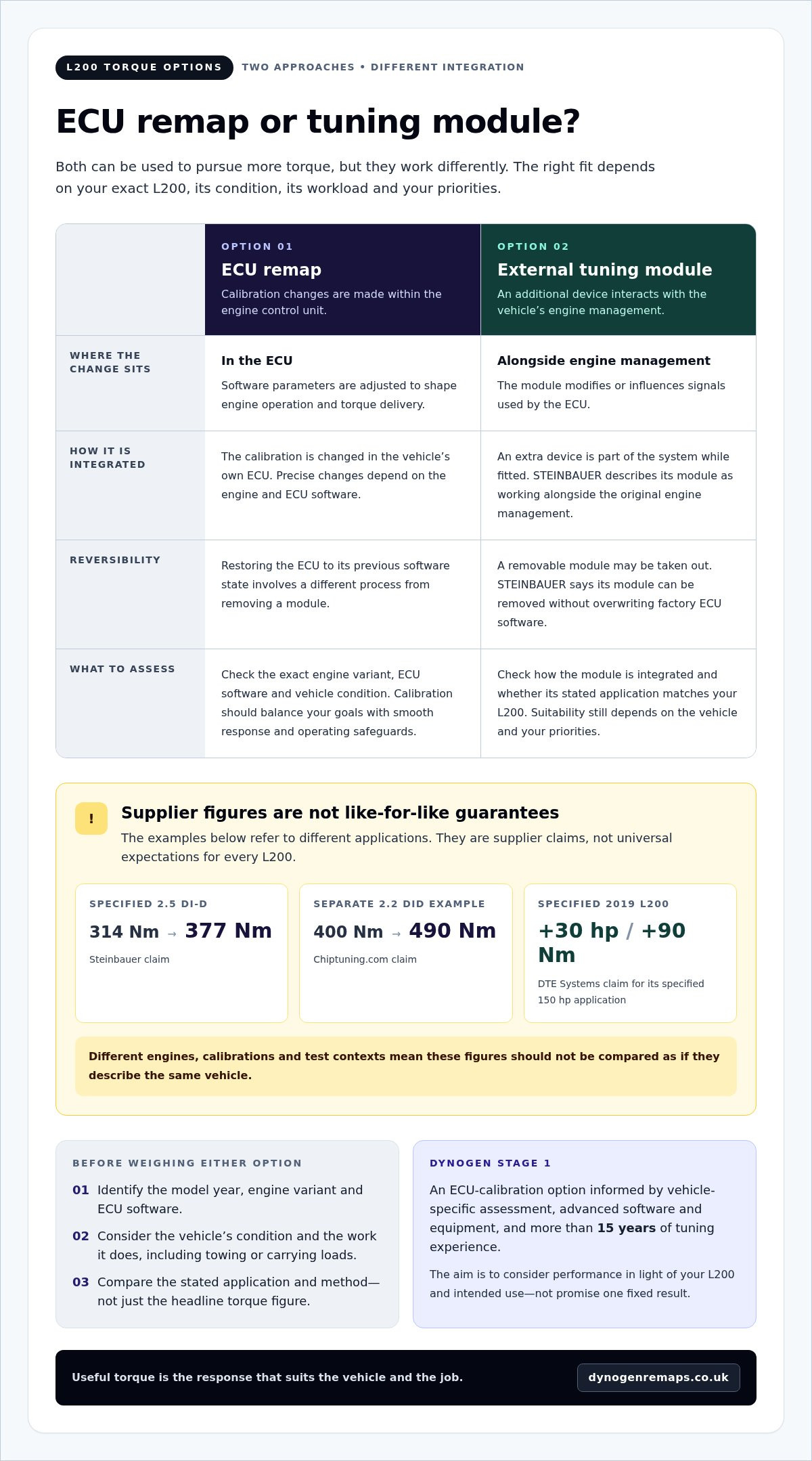
For instance, Steinbauer claims a change from 314 Nm to 377 Nm for a specified 2.5 DI-D application. Chiptuning.com gives a separate 2.2 DiD example, claiming a change from 400 Nm to 490 Nm. These are supplier claims for distinct applications, not a like-for-like comparison or a prediction for every vehicle. The test context and method matter too. Figures from one engine or calibration shouldn’t be transferred to another.
A considered assessment therefore starts with the actual vehicle, not a headline result. Establish its engine variant and software, then relate its condition and workload to the response you want. That gives you a more meaningful basis for discussing a remap. A quoted maximum can’t show whether the outcome will suit your L200.
ECU remap or tuning module: compare ways to increase Mitsubishi L200 torque
Both an ECU remap and an external tuning module can be used to pursue a Mitsubishi L200 torque increase, but they work differently. A remap revises calibration within the engine control unit (ECU); a module is an additional device that interacts with engine management. Neither method is automatically right for every L200. The engine variant, vehicle condition, intended use and your preferred approach all matter.
How an ECU remap changes torque delivery
An ECU remap adjusts software parameters that influence engine operation, with the aim of shaping performance and torque delivery. Effective calibration balances your goals with smooth response and the vehicle’s operating safeguards. The precise changes depend on the particular engine and ECU software, so a quoted result for one L200 shouldn’t be treated as a guaranteed outcome for another. The Stage 1 remapping guide explains the wider process. Sound calibration draws on established automotive engineering standards, rather than chasing a headline figure in isolation.
How an external tuning module differs
A tuning module is fitted into the vehicle’s engine-management system and modifies or influences signals used by the ECU. STEINBAUER describes its module as working alongside the original engine management and as removable, without overwriting factory ECU software. DTE Systems also advertises a module for a 2019 L200, claiming an increase of 30 hp and 90 Nm for its specified 150 hp application. These are supplier claims for particular setups, not independently established results or universal expectations.
With a remap, calibration changes are made in the ECU itself. With a module, an additional device remains part of the system while fitted. A removable module may be taken out, whereas restoring an ECU to its previous software state involves a different process. The practical distinctions include how the solution is integrated, how it can be reversed and how its calibration relates to the exact vehicle. There’s no universal winner: suitability depends on the L200 and your priorities.
Compare like with like. Check that an advertised result identifies the engine variant and vehicle context, and distinguish a supplier’s stated gain from an independently verified test or a promise for your pick-up. Dynogen’s Stage 1 Performance Remap is an ECU-calibration option informed by vehicle-specific assessment, more than 15 years of tuning experience, and advanced software and equipment. For more information about this approach, visit Dynogen’s ECU remapping service.
Do L200 torque gains affect reliability? Separate useful results from bold claims
A torque increase doesn’t, by itself, prove a tune is either safe or unsafe. Suitability depends on the L200’s condition, how it’s calibrated and how it’s driven. A measured, responsive delivery for everyday use or towing is a different goal from chasing a dramatic peak figure or demanding strong acceleration at low revs in a high gear.
Extra pulling force can place more demand on the engine and the components that transmit power. That doesn’t mean a remap will cause a fault, but it makes the vehicle’s starting condition and intended workload important parts of the decision. For a deeper explanation, read Dynogen’s guide to safe engine remapping and torque.
What can influence reliability after a torque increase?
Assessment should take account of the engine’s condition, servicing history, cooling system and any existing warning signs or faults. The clutch, gearbox and wider drivetrain matter too, particularly if the L200 regularly carries heavy loads or tows. General guidance can outline these considerations, but it can’t diagnose a particular vehicle or predict how long its components will last.
Driving behaviour counts as well. Applying heavy throttle at very low revs, especially under load, creates a different demand from using smooth acceleration and selecting a suitable gear. The goal should be usable response, not aggressive delivery that makes the vehicle harder to drive smoothly. A vehicle-specific calibration should take your intended use into account rather than treating every L200 as if it has the same workload.
How to read advertised torque figures responsibly
Before comparing claims, establish the exact engine variant and model year, then identify the standard output used as the baseline. Check whether the figure refers to peak torque and whether the supplier explains the testing method and conditions. Without that context, two headline numbers may not represent a like-for-like comparison.
Published figures relate to the vehicle and application stated. They shouldn’t be transferred to another engine version or treated as a universal expectation for a Mitsubishi L200 torque increase. A large claimed gain doesn’t establish how a particular vehicle will drive or whether its existing components are in suitable condition. Supplier advertising describes a claim; it isn’t automatically independent verification.
Dynogen’s Stage 1 Performance Remap is considered ECU calibration, not a promise of a fixed torque figure. With more than 15 years of vehicle-tuning experience and advanced software and equipment, Dynogen focuses on the individual vehicle and the driver’s requirements. The intended balance of response, workload and condition is central to judging a potential result.
How to decide whether an L200 torque increase suits your workload
Start with the job you want the L200 to do better, not a target torque figure. Work through four checks: identify the exact vehicle, define the driving need, assess its condition, then compare the tuning approach. This helps distinguish a suitable calibration from a headline gain that may not address your everyday requirements.
Match the torque goal to how you use the L200
Be specific about where you want to notice a difference. Is it pulling away with a load, responding more confidently while towing, accelerating for an overtake or feeling more composed in ordinary driving? These aims aren’t identical. Towing and loaded work place different demands on a pick-up from general road use, so describe the normal workload, not just the maximum task.
A clear use case gives calibration a practical focus: smooth, controllable response may matter more than a peak number. For broader guidance on load-related considerations, read this guide to remapping for towing and pulling.
Assess the vehicle before choosing a calibration
Establish the model year and engine variant, then consider the service history and how the vehicle is currently running. Existing warning lights, unresolved faults or signs of poor maintenance are reasons to address the vehicle’s condition before pursuing a performance change. A remap adjusts engine management; it doesn’t repair worn, damaged or poorly maintained components.
Include the drivetrain in your thinking, especially if the L200 regularly works under load. A calibration decision should reflect the condition of the vehicle as a whole, not just what the engine might produce. General guidance can help you organise these checks, but it can’t diagnose a specific pick-up.
Finally, compare an ECU remap with an external module against your identified vehicle and priorities. Consider how each approach fits the application, how it interacts with engine management and whether its claimed outcome relates to the same engine and context. If towing is the main reason for a Mitsubishi L200 torque increase, prioritise usable pulling response and predictable drivability over the largest advertised Nm figure.
Dynogen’s Stage 1 Performance Remap offers a considered ECU-calibration route, informed by vehicle-specific assessment, more than 15 years of tuning experience, and advanced software and equipment. Explore Dynogen Stage 1 Performance Remapping to learn more about a calibration aligned with your L200 and its workload.
Dynogen Stage 1 remapping for a Mitsubishi L200: informed next steps
For owners considering a Mitsubishi L200 torque increase, Dynogen’s Stage 1 Performance Remap provides an ECU-calibration route focused on the vehicle and its intended use. The aim isn’t to promise one headline figure, but to consider how torque delivery could support the way you drive, whether that means everyday road use, carrying loads or towing.
Dynogen draws on more than 15 years of vehicle-tuning experience and uses advanced software and equipment to enhance engine power and torque. The starting point is the specific L200: its model year, engine variant, ECU software and current condition all inform what calibration may be suitable. A result quoted for another vehicle shouldn’t be treated as a prediction for yours.
What to expect from a considered remapping process
A considered approach takes account of the vehicle, its operating condition and your performance goals. Be clear about the response you want, such as more composed acceleration when loaded or improved everyday drivability. Calibration goals should balance torque delivery with smooth behaviour and the vehicle’s safeguards. Any potential outcome depends on the individual L200; don’t assume a particular gain, fuel saving or change in reliability.
This distinction matters. Calibration can alter engine operation, but it can’t make an unsuitable vehicle suitable for extra demands or repair existing mechanical wear. The vehicle’s workload and condition belong at the centre of the decision.
Ownership checks before and after tuning
Before making a modification, inform your insurer and check your policy’s requirements. If the L200 is subject to a finance agreement, review its terms before proceeding. Keep up with appropriate maintenance and pay attention to changes in how the vehicle runs after tuning. A remap doesn’t prevent mechanical wear, so investigate new warning lights or unusual behaviour rather than treating them as an expected effect.
Also check current UK MOT and emissions guidance for modified vehicles before proceeding. Requirements can depend on the vehicle and the modification, so don’t rely on general tuning claims as a substitute for up-to-date official information.
A suitable Stage 1 remap begins with a clear understanding of your L200 and what you need from it, not with a guaranteed torque promise. Discuss your vehicle, its condition and your performance goals with Dynogen Remapping Solutions.
Choose torque that works for your L200
A worthwhile Mitsubishi L200 torque increase starts with the exact engine variant, its condition and the job you need it to do. Published gains are specific to the vehicles stated, so don’t treat a headline Nm figure as a promise for your pick-up. Whether you’re comparing an ECU remap with an external module or aiming for better response when towing, focus on a smooth, usable result that suits your workload.
Dynogen’s Stage 1 Performance Remap is its primary service, supported by more than 15 years of vehicle-tuning experience and advanced software and equipment. Calibration is considered in the context of the individual vehicle and its performance goals, rather than as a guaranteed figure. Good maintenance and attention to the vehicle’s condition remain essential before and after tuning.
Ready to explore a considered remap for your L200? Discuss a Stage 1 remap for your Mitsubishi L200 with Dynogen. Start with your vehicle details, current condition and priorities to work towards a pick-up that feels better suited to the way you drive.
Frequently Asked Questions
Can a Mitsubishi L200 torque increase improve towing response?
Yes, a suitable calibration may make an L200 feel more responsive when pulling away or accelerating with a trailer, but it can’t guarantee easier towing in every situation. Engine variant and condition, trailer and payload weight, gradients, gearing and driving style all influence the result. Consider a Mitsubishi L200 torque increase in relation to the loads you actually tow and the vehicle’s condition, rather than judging suitability by a headline gain alone.
Is an ECU remap or tuning box better for increasing Mitsubishi L200 torque?
Neither is automatically better for every L200. An ECU remap changes the engine control unit’s calibration, while a tuning box is an additional device that interacts with engine management. The best fit depends on your exact engine variant, vehicle condition and priorities, including your preferred calibration approach and how you use the pick-up. Compare claims for the same application and focus on smooth, usable response rather than the biggest advertised figure.
How much torque can a Mitsubishi L200 remap add?
There’s no single gain that applies to every L200. The potential Mitsubishi L200 torque increase depends on model year, engine and ECU variant, vehicle condition and the calibration used. Treat published figures as specific to the vehicle and test context they describe, not as universal expectations. Before comparing claims, check the stated engine, baseline output and whether the supplier explains how the result was measured.
Will increasing torque affect my Mitsubishi L200’s reliability?
Added torque alone doesn’t prove a tune is safe or unsafe. Suitability depends on the engine’s condition, maintenance history, calibration and how the vehicle is driven, including whether it regularly carries loads or tows. The clutch, gearbox and drivetrain are relevant too. Address existing faults before pursuing performance changes, and maintain the vehicle appropriately afterwards. General guidance can’t guarantee the condition or service life of a particular L200’s components.
Can every Mitsubishi L200 engine be remapped in the same way?
No. L200 engines and ECU software differ, so a calibration suitable for one variant shouldn’t be assumed to apply to another. Model year, exact engine identity and the vehicle’s current condition all need to inform the assessment. Identify those details before comparing advertised figures or discussing tuning goals. Vehicle-specific assessment helps determine whether an approach is appropriate, but it doesn’t mean every L200 will produce the same result.
Do I need to tell my insurer about a Mitsubishi L200 remap?
Tell your insurer about the remap and check your policy’s requirements before making the modification. Ask how your insurer records changes to engine performance and whether it needs particular information about the calibration. Policy terms can differ, so don’t assume a modification is automatically covered or that the same conditions apply to every driver. Keep any relevant tuning documentation with your vehicle records.
Will a torque increase improve fuel economy in my Mitsubishi L200?
Not necessarily. Fuel consumption depends on how the L200 is calibrated and driven, as well as load, terrain, journey type and towing demands. A change in response may affect driving habits, which can influence real-world use. Don’t treat a torque increase as a guaranteed fuel-saving measure or rely on a supplier’s claim as a promise for your vehicle. Judge any economy outcome over comparable journeys and conditions.