

A headline quote can look attractive and still be wrong for your vehicle. The speed limiter removal cost UK drivers are quoted depends on more than the requested change: the vehicle, its ECU and the type of limiter all matter. Online prices can be hard to compare when they don’t explain what work or checks are included.
A useful quote starts with the vehicle and its intended use, not a headline price. This guide explains which details can affect your quote and what to ask providers before authorising work. You’ll also learn why the method, diagnostics and post-service checks matter when comparing offers.
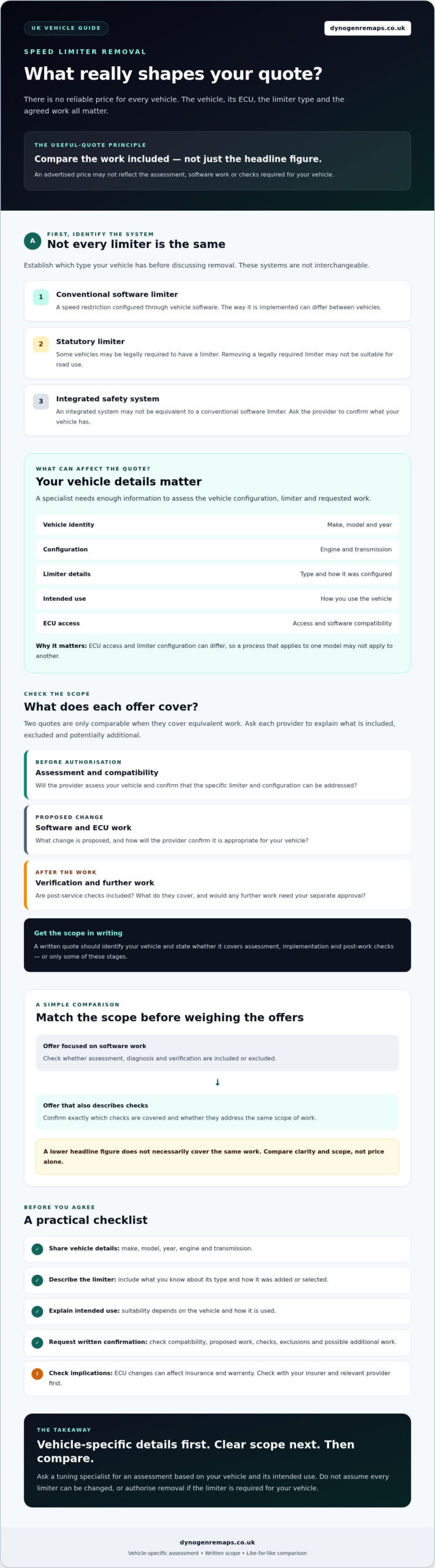
First, establish whether your vehicle has a conventional software limiter, a statutory limiter or an integrated safety system. These aren’t interchangeable, and removing a legally required limiter may not be suitable for road use. ECU changes can also have insurance and warranty implications, so check with your insurer and relevant provider first. With your make, model, year and limiter details to hand, you can ask a tuning specialist such as Dynogen for a vehicle-specific assessment, then compare the scope of each quote with greater confidence.
Key Takeaways
- The speed limiter removal cost UK drivers are quoted can depend on vehicle-specific factors, so an advertised figure may not reflect the work required for your vehicle.
- Ask providers to confirm compatibility and set out the proposed work, checks and exclusions in writing before you authorise the service.
- Compare quotes against the same scope of work, rather than choosing solely on the lowest figure.
- Check what type of limiter your vehicle has and whether removing it is suitable for its category and intended use.
- Prepare your vehicle details and intended use before requesting a tailored assessment from a tuning specialist such as Dynogen.
Why does speed limiter removal cost vary between UK vehicles?
Speed limiter removal generally involves changing vehicle software so a particular speed restriction no longer operates as configured. The process depends on how that restriction is implemented, so an advertised figure is only a starting point, not a reliable quote for every vehicle. For a general overview of what a speed limiter is and the different types, see Wikipedia.
There isn’t one reliable price for every vehicle. A precise quote needs to account for the vehicle and the requested work. Treat figures without clear details about compatibility and scope with caution, and ask the provider to assess your vehicle before agreeing to anything.
Which vehicle details can affect a speed limiter removal quote?
Start with the vehicle’s make, model and year, then provide its engine and transmission details. These help a specialist identify the vehicle configuration and assess whether the relevant software can be accessed. ECU access and the way a limiter is configured can differ between vehicles, so a process that applies to one model may not apply to another.
Describe the limiter as accurately as possible, including how you believe it was added or selected and how the vehicle is used. Don’t assume every limiter can be changed. Ask the provider to confirm whether the specific system can be addressed. A specialist such as Dynogen can assess the details you supply, but compatibility and the work required should be confirmed for your vehicle.
Why can two speed limiter removal quotes differ?
Two figures are only comparable if they cover equivalent work. One provider might quote for a software change alone, whilst another may include diagnosis or checks after the change. Don’t assume these details are covered by a short service description. Ask each provider to confirm exactly what is included, what is excluded and whether any additional work could be needed.
- Diagnosis: Is the vehicle assessed before work is authorised?
- Software work: What change is proposed, and how will the provider confirm it suits the vehicle?
- Verification: Are post-service checks included, and what do they cover?
Vehicle configuration and the agreed work determine whether two quotes are genuinely comparable. Get the answers in writing, then weigh the scope and clarity of each offer rather than choosing on the headline figure alone. For a useful quote, share your vehicle details and intended use before asking a provider to assess the job.
What should a speed limiter removal service include?
A clear service begins with an enquiry, not an assumption that every vehicle can be handled in the same way. Provide the vehicle’s make, model, year, engine and transmission details, explain how it’s used, and describe the limiter as accurately as possible. The provider should confirm whether the specific limiter and vehicle configuration can be addressed before setting out the proposed work.
That sequence helps turn an initial price enquiry into a useful, vehicle-specific quote. It also gives you the chance to check whether the requested change is appropriate for the vehicle’s use. For example, some vehicles may be legally required to have a speed limiter. Check current government guidance and don’t authorise removal if the limiter is required for your vehicle.
What to ask about diagnostics and software work
Ask how the provider will identify the limiter type and establish software compatibility. Then request a plain description of the proposed ECU work before giving approval. A clear explanation should state what the provider intends to change, without suggesting the process is identical for every vehicle.
Diagnostic checks and appropriate verification after the work can help establish whether the vehicle’s software has been handled as intended. Their exact nature may vary, so don’t assume they’re included. Ask which checks are covered and whether any further work would need your separate approval. To understand why software quality matters, read this guide to professional performance software.
How to check the scope before agreeing
Ask for a written quote that identifies your vehicle and describes the agreed work. It should make clear whether the price covers assessment, implementation and post-work checks, or only some of those stages. A low headline figure may not include the same scope as another provider’s quote, so compare like for like.
- Compatibility: Has the provider confirmed that the requested limiter can be addressed on your vehicle?
- Work included: Is diagnosis, software modification and verification specified?
- Exclusions: Are additional checks or work outside the quote clearly identified?
- Support terms: Is any warranty or future support explicitly stated, or is it not included?
Don’t infer a warranty, guarantee or ongoing support from the service name. Ask for any relevant terms in writing before authorising the work. A careful comparison of the speed limiter removal cost UK providers quote should consider the written scope as well as the figure itself. If you’re preparing an enquiry, you can ask Dynogen about a vehicle-specific assessment, with no assumption of compatibility until it’s confirmed.
How do you compare speed limiter removal quotes in the UK?
Compare the detail behind each quote, not just the headline figure. A clear offer should relate to your exact vehicle and limiter, describe the proposed work and identify what is not included. If one provider has confirmed compatibility and another hasn’t, their figures aren’t yet like for like.
Use this checklist to compare replies side by side:
| What to compare | What to look for |
|---|---|
| Vehicle compatibility | Does the response identify your vehicle and confirm the provider has assessed its specific limiter? |
| Stated work | Is the proposed software work described clearly, rather than labelled only as “removal”? |
| Checks | Does the provider explain what checks are included before or after the work? |
| Exclusions | Are possible extra work or charges identified, and would you need to approve them first? |
| Written confirmation | Are the vehicle, agreed service and scope recorded in the quote? |
Which questions should you ask each provider?
Ask whether compatibility has been confirmed for the exact vehicle and limiter, what the quote includes and excludes, and which items would need separate approval. Then ask how the provider checks that the agreed software work has been completed appropriately. A knowledgeable specialist should be able to explain the proposed approach in terms you can understand, without promising a process that may not suit your vehicle.
Provider experience can be useful context, but it shouldn’t replace a clear technical explanation. Look for a reasoned answer about your vehicle and the work proposed, rather than relying on a general experience claim alone. For broader questions about software work, read these safe engine remapping considerations.
How can you spot an incomplete or unclear quote?
Pause if the quote doesn’t name your vehicle, leaves compatibility unconfirmed, describes the work vaguely or contains unexplained exclusions. Ask for those points to be clarified in writing before authorising anything. If the answer changes the proposed scope, request an updated quote so you’re comparing the same job across providers.
A useful quote identifies the vehicle, the proposed work and any exclusions. GOV.UK guidance on UK rules on vehicle modifications concerns structurally modified vehicles, so don’t assume it settles requirements for an ECU software change. Check relevant guidance for your situation and ask your insurer about declaring modifications. This careful comparison makes the speed limiter removal cost UK providers quote easier to assess on scope, clarity and technical reasoning, not price alone.
Is speed limiter removal legal and suitable for your UK vehicle?
There isn’t one answer for every vehicle. Whether speed limiter removal is lawful and suitable depends on the vehicle category, how it’s used and whether the limiter is required by regulation. A driver-selected setting or non-statutory fleet restriction is not automatically the same as a legally required limiter. Identify which system your vehicle has before seeking a quote or authorising a change.
This distinction matters as much as the speed limiter removal cost UK providers quote. A software change that may be possible on one vehicle could be inappropriate or unlawful on another. If the limiter is required for your vehicle’s road use, don’t remove or disable it in a way that leaves the vehicle non-compliant.
When might a speed limiter be legally required?
Requirements can vary by vehicle category and use. For example, goods vehicles above certain weight thresholds may be subject to statutory speed-limiter requirements, whilst a separate software restriction on another vehicle may not have the same legal status. These examples aren’t a substitute for checking the rules that apply to your exact vehicle.
Before proceeding, check current guidance from the relevant UK authorities, including DVSA and DVLA, and confirm the position for your vehicle class and intended use. Treat an owner-selected or adjustable speed setting, a fleet-configured restriction and a legally mandated limiter as distinct until a knowledgeable provider confirms what’s fitted. If there’s any doubt, pause the work and seek authoritative advice.
Could removal affect insurance, testing or vehicle operation?
Contact your insurer before changing vehicle software. Explain the proposed modification and ask for written confirmation of how it affects your cover. Don’t assume that a change is immaterial simply because it involves software rather than a physical component. For a company or fleet vehicle, also obtain approval from the vehicle owner or operator and check any relevant contractual or operational requirements.
Testing requirements depend on the vehicle and the rules that apply to it. Ask an appropriate testing provider or consult current official guidance about how a software modification could affect the relevant test. An MOT outcome can’t be guaranteed in advance, and an MOT pass alone shouldn’t be treated as proof that the modification is lawful for every use.
Also consider whether the change could affect other vehicle systems or settings. Ask the tuning specialist to identify the limiter type, confirm whether the requested work is suitable, and explain any uncertainties before you authorise it. A responsible assessment should not present removal of a legally required limiter as suitable for non-compliant road use.
Share your vehicle category, intended use and limiter details with Dynogen Remapping Solutions to request a vehicle-specific assessment. Confirm compatibility and compliance before agreeing to any work.
How to request a vehicle-specific quote from Dynogen
A useful enquiry gives the specialist enough information to assess the vehicle and understand why you’re considering the change. Dynogen Remapping Solutions offers speed limiter removal, but suitability depends on the specific vehicle and limiter. Contacting a specialist is a way to request an assessment, not confirmation that every make, model or limiter can be modified.
Preparing the details below can make the discussion more focused and help you understand what any quote covers. It also gives you a chance to raise legal, insurance or operator requirements before software work is considered.
What information should you have ready?
Share the details in this order, providing what you know and flagging anything you’re unsure about:
- Vehicle identity: make, model and year.
- Configuration: engine and transmission details, if known.
- Limiter information: how the speed restriction behaves and whether you know if it’s factory-fitted, fleet-configured or another type. Don’t guess if you’re uncertain.
- Intended use: explain whether the vehicle is privately or commercially operated, and who owns or manages it.
- Available diagnostic information: share relevant codes or reports if you already have them, but don’t treat these as proof of compatibility.
More detail can help a specialist ask the right follow-up questions. It can’t, by itself, confirm that the limiter can be addressed or that removal is suitable for the vehicle’s use.
What should happen before you approve the work?
Ask Dynogen to confirm whether the vehicle and limiter are suitable for the requested service, then request a written scope describing the proposed work, checks and exclusions. If any part of the quote is unclear, ask for clarification before authorising it. Don’t assume that a price covers diagnostics, post-work verification, a warranty or future support unless those terms are explicitly stated.
Resolve compliance questions first. Check whether the limiter is legally required for your vehicle and intended use, speak to your insurer about the planned modification, and obtain approval from the vehicle owner or fleet operator where relevant. If those answers are uncertain, pause the enquiry rather than treating a technical assessment as legal or insurance confirmation.
Once you have the vehicle details and questions ready, contact Dynogen about speed limiter removal to discuss a vehicle-specific assessment. Ask about the speed limiter removal cost UK for your particular vehicle only after its configuration, intended use and proposed scope have been considered.
Make your next step a vehicle-specific assessment
The right speed limiter removal cost UK quote depends on your vehicle, its limiter and the work proposed, so a headline figure alone won’t tell you whether two offers are comparable. Share the vehicle’s details and intended use, then ask for compatibility, checks, exclusions and the agreed scope to be confirmed in writing.
Before authorising a software change, make sure it’s suitable for your vehicle and intended use. Check applicable requirements, speak to your insurer and get approval from the vehicle owner or operator where needed. These checks help you make a considered decision, not just choose a quote.
Dynogen Remapping Solutions uses advanced software and equipment to enhance engine power and torque, and has over 15 years of vehicle tuning experience. For a tailored discussion without assuming compatibility or a fixed price, contact Dynogen to discuss your vehicle and request an assessment. With the right information in hand, you can take the next step with greater confidence.
Frequently Asked Questions
How much does speed limiter removal cost in the UK?
There’s no single reliable price for every vehicle, so the speed limiter removal cost UK drivers are quoted needs to be based on their vehicle and the work involved. Make, model, year, ECU access and limiter type can all affect the assessment. Ask for a written quote that names your vehicle and explains what is included, such as any diagnosis or post-work checks. Don’t treat an unexplained advertised figure as a confirmed quote.
Can a speed limiter be removed from any car or van?
No, compatibility can’t be assumed for every car or van. Vehicles differ in ECU software, access methods and the way a speed restriction is configured. A traditional software limiter is also not necessarily the same system as a driver-selected setting or an integrated safety feature. Give a tuning specialist your make, model, year, engine, transmission and known limiter details, then ask them to confirm whether the specific system can be addressed.
Is it legal to remove a speed limiter in the UK?
It depends on the vehicle category, its use and the type of limiter. A restriction that is adjustable or fleet-configured may have a different status from one required by regulation. Goods vehicles subject to statutory limiter requirements must not have that limiter removed for non-compliant road use. Don’t assume a factory-fitted or software-based system is automatically exempt. Check current DVSA and DVLA guidance, and confirm the requirements for your particular vehicle before authorising work.
Will removing a speed limiter affect my insurance or MOT?
It may affect insurance, so tell your insurer about the planned software modification and ask for confirmation of its effect on your cover before proceeding. MOT outcomes depend on the requirements that apply to the vehicle and its condition; a pass shouldn’t be treated as proof that a modification is lawful for every use. Check current MOT guidance and ask the relevant testing provider if you’re unsure. For a fleet vehicle, confirm approval with its owner or operator too.
What information do I need to get a speed limiter removal quote?
Have the vehicle’s make, model, year, engine and transmission details ready. Describe how it’s used, whether privately or commercially, and share what you know about the limiter, such as how it behaves or whether it was configured for a fleet. You can also provide relevant diagnostic information if available, but it doesn’t guarantee compatibility. Ask the provider to confirm suitability and put the proposed work, checks and exclusions in writing.
How long does speed limiter removal take?
There’s no confirmed standard duration for every vehicle. The time required can depend on the vehicle’s software, how the ECU is accessed, the limiter configuration and what assessment or verification the provider includes. Ask for an estimate after the specialist has reviewed your vehicle details, and check whether it allows for any additional work that might need separate approval. Don’t rely on a generic time estimate as a promise for your particular vehicle.
Can a vehicle’s original speed limiter be restored?
It may be possible, but restoration depends on the vehicle, the original software and the work performed. Ask the provider before authorising removal whether the original settings can be retained or restored, and what that would involve. Get the answer in writing rather than assuming the change is reversible. If a fleet operator or insurer has requirements about the vehicle’s software, confirm these before any modification, and make sure restoration would still meet applicable rules.