
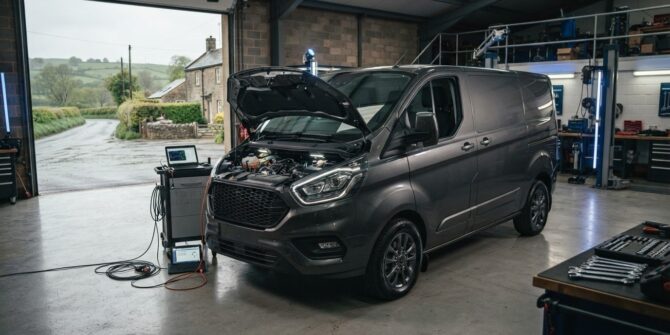
The same Transporter badge doesn’t mean the same remap. A VW Transporter T6 remap should account for your van’s engine, model year, ECU and day-to-day work, not just a headline power figure.
If you want stronger mid-range response or easier pulling under load, it’s natural to ask what a Stage 1 remap could change. The result depends on your van’s specification and condition, so figures quoted for another T6 are examples, not guarantees. A calibration suited to a lightly loaded camper may not be right for a van that works hard every day.
This guide explains which vehicle details matter, what changes to performance and drivability to consider, and how reliability, emissions and insurance fit into the decision. Dynogen brings over 15 years of vehicle tuning experience to Stage 1 remapping for cars and vans, with attention to each vehicle’s requirements. Read on to understand how to approach a T6 remap with realistic expectations.
Key Takeaways
- A VW Transporter T6 remap changes engine-management software. Identify your van’s engine code, output and ECU rather than relying on its badge alone.
- Consider how you use the van. Changes to power delivery, torque and throttle response may feel different under load, but aren’t guaranteed.
- A diagnostic assessment helps establish whether your van’s condition and configuration are suitable before calibration is considered.
- Factor in wear, existing faults, emissions responsibilities and insurance when weighing up a remap.
- Dynogen’s Stage 1 remapping is backed by over 15 years of vehicle tuning experience and advanced software and equipment.
VW Transporter T6 remap: why engine and ECU details matter
A remap changes the software that controls how the engine operates. The engine control unit (ECU) manages functions such as fuelling and boost, and a calibration adjusts its instructions to suit the vehicle’s setup. It’s a software change, not a mechanical engine upgrade, so it doesn’t add or replace components.
That distinction matters because “T6” identifies a generation, not one universal engine specification. Vans can differ in engine, factory power output, gearbox and ECU configuration. A quoted result for one 2.0 TDI variant doesn’t show what another T6 will achieve.
What does a Stage 1 remap mean on a Transporter T6?
Stage 1 generally describes a software-focused tuning approach for a vehicle without supporting hardware modifications. It isn’t a standardised output figure or a promise that every van will reach the same result. The available scope depends on the engine, its existing calibration and the vehicle’s condition.
Two Transporters with the same badge may have different starting outputs or software. A considered calibration takes account of the individual vehicle rather than applying one headline number across the range. Dynogen’s Stage 1 performance remapping for cars and vans is shaped around each vehicle’s requirements, using specialist experience and advanced software and equipment.
Why do T6 and T6.1 details affect remap suitability?
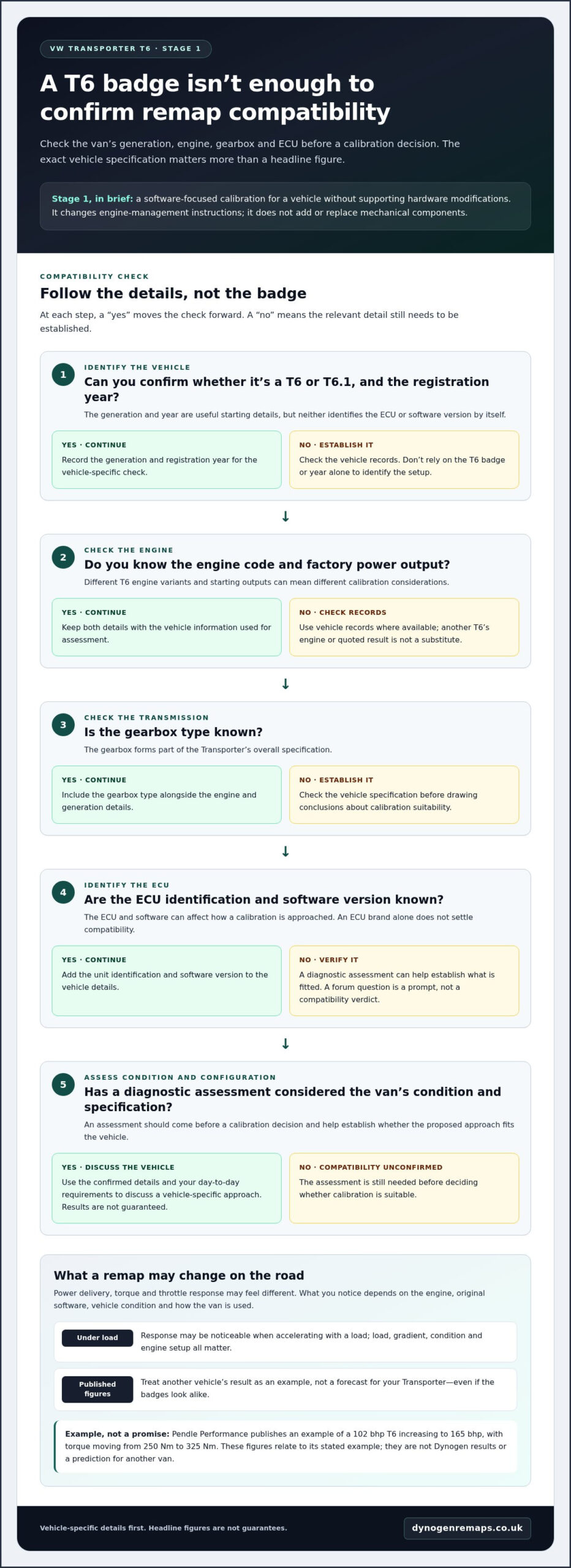
T6 and T6.1 are distinct model generations, but the badge or registration year alone doesn’t identify the ECU or software version. Before considering a VW Transporter T6 remap, gather the registration year, engine code, factory output and gearbox type. ECU identification and software version can also affect how a calibration is approached.
A question raised by an owner of a 2022 T6.1 with a Bosch ECU on the T6 Forum illustrates why the ECU brand alone doesn’t settle compatibility. The exact ECU identification and software need to be considered alongside the engine and vehicle details. A forum question is a useful prompt, not a compatibility verdict for every T6.1.
Use this checklist to prepare accurate information about your van:
- Generation and registration year: establish whether it’s a T6 or T6.1.
- Engine: note the engine code and factory power output, using vehicle records where available.
- Gearbox: identify the transmission, which forms part of the vehicle’s overall specification.
- ECU: record the unit identification and software version if available.
A diagnostic assessment should come before a calibration decision. It helps establish what’s fitted and whether the van’s specification supports the proposed approach. With those details in hand, the discussion can focus on your particular Transporter rather than assumptions based on its badge, year or another owner’s figures.
What can a VW Transporter T6 remap change on the road?
A Stage 1 calibration may alter how the engine delivers power, torque and throttle response. What a driver notices depends on the van’s engine, original software, condition and everyday use. You may feel a stronger response when accelerating under load, but that isn’t guaranteed, and a remap won’t make every Transporter behave alike.
How might torque delivery affect everyday van driving?
Torque is the engine’s rotational force. How it’s delivered can affect how readily a van accelerates, particularly when carrying a load or climbing a gradient. You might notice a difference on an uphill pull or when building speed to overtake, but these are situations to consider, not promised benefits. The result also depends on the vehicle’s setup, load and condition.
Why do published T6 remap figures vary?
Figures vary because engine variants, original power outputs, ECU software and vehicle condition vary. A published result describes a particular vehicle and calibration. It can’t predict what another Transporter will achieve, even if the badges look similar. Treat examples as illustrations, not a forecast for your van.
For instance, Pendle Performance publishes an example of a 102 bhp T6 increasing to 165 bhp, with torque moving from 250 Nm to 325 Nm. Those figures relate to its stated example. They aren’t Dynogen results, a typical promise for every 102 bhp model or a reliable prediction for a different van.
| Potential driving change | What can influence it |
|---|---|
| Different power delivery | Engine variant, starting output and calibration |
| Altered torque response | Engine and software, plus vehicle condition |
| Changed throttle response | Calibration and how the van is driven |
| Response under load | Load, gradient, vehicle condition and engine setup |
Use published figures as context, then focus on a vehicle-specific assessment. Your engine variant, existing output, ECU software and condition all matter when considering a realistic calibration. A useful discussion starts with what you want the van to do in daily use, not a headline power number.
SAE International develops standards for the automotive sector, offering a wider technical reference point through its SAE International Standards. This doesn’t certify a particular remap or confirm its results, which still depend on the vehicle and calibration.
If you’re considering a calibration for your van, explore Dynogen’s Stage 1 remapping for vans and discuss your vehicle’s engine and driving requirements.
How to assess T6 remap compatibility and calibration quality
A sound compatibility assessment starts with the van, not a power figure advertised for a similar-looking Transporter. Before considering a VW Transporter T6 remap, gather the vehicle details and explain how you use it. A camper used mainly for leisure has different demands from a van that regularly carries tools or equipment, so the intended use should inform the discussion.
Which vehicle details help establish remap compatibility?
Start with the registration document and service records, which can help identify the vehicle and its history. Note whether it’s a T6 or T6.1, the registration year, engine code, factory output and gearbox. The engine code may appear in service documentation or vehicle data. A diagnostic readout can help identify ECU details and software. A badge alone isn’t precise enough.
Use this checklist when preparing the information:
- Model generation and registration: record the registration and establish whether it’s a T6 or T6.1.
- Engine and output: note the engine code and original power specification from the available records.
- ECU identification: include the unit and software details retrieved during diagnosis.
- Gearbox and use: state the transmission and describe typical loads, journeys and driving conditions.
Exact compatibility depends on a vehicle-specific technical assessment. Registration details help identify the van, but they don’t necessarily establish its current ECU software or condition. A diagnostic assessment can clarify what’s fitted before a decision is made about whether a particular calibration is appropriate.
What distinguishes a considered calibration from a headline claim?
A considered calibration takes account of engine-management changes as a whole. Areas such as fuelling, boost and ignition or injection timing can interact, so pursuing a peak figure alone may not reflect how the van drives across its normal operating range. The vehicle’s condition and working load also matter when deciding on an appropriate approach.
Quoted gains are meaningful only when tied to the specific vehicle, its starting specification and the calibration tested. A number from another T6 can provide context, but it isn’t a prediction for yours. Check what vehicle and starting setup a published figure describes, then compare it with your own van’s details rather than assuming the same result applies.
Before calibration is considered, a diagnostic assessment should help identify relevant faults or concerns that could affect suitability. This matters especially for a working van: existing issues shouldn’t be mistaken for a tuning problem, and a remap shouldn’t be treated as a repair. Dynogen’s specialist team brings over 15 years of vehicle tuning experience and uses advanced software and equipment to support vehicle-specific Stage 1 remapping.
Is a VW Transporter T6 remap safe, legal and suitable for your use?
A remap can’t guarantee freedom from wear, faults or future repair bills. Suitability depends on the van’s condition, maintenance, calibration and the demands placed on it. A sharper response may appeal if your Transporter regularly carries a working load, but weigh that against the vehicle’s individual condition and use.
What can affect reliability after a remap?
Existing mechanical or emissions-related faults, overdue maintenance and general wear can all affect how a van responds. A remap can’t repair a failing component or make a neglected vehicle healthy. Address faults before considering calibration. Increased performance can also mean components work differently, so don’t assume a remap will preserve the engine’s lifespan or prevent wear.
Be realistic about your workload. A van used for frequent heavy carrying or demanding journeys may face different operating demands from one used occasionally for lighter trips. Suitability should account for those patterns, not just the desired power figure. A considered approach starts with the vehicle’s condition and requirements, then weighs potential driving changes against its intended use.
What should owners consider for insurance and roadworthiness?
In the UK, tell your motor insurer about an ECU remap and follow its instructions. Disclose the modification accurately and ask how it affects your policy before proceeding. Failing to notify your insurer can put cover at risk, so don’t assume a software change is too minor to declare.
Emissions equipment and roadworthiness matter too. A performance remap should not be confused with removing or disabling emissions-control systems. Before making changes, check current UK government and DVSA guidance on vehicle modifications, emissions and roadworthiness, and ensure the van remains compliant with the requirements that apply to it. MOT outcomes can depend on the vehicle and modification, so don’t rely on general claims instead of current official guidance.
Keep the decision practical. Consider the van’s service history, known faults, usual load and the driving change you want. If there are unresolved concerns, deal with them first rather than treating a remap as a fix. Dynogen’s Stage 1 remapping is supported by over 15 years of vehicle tuning experience, with advanced software and equipment used for work on cars and vans.
For a considered discussion of your van’s requirements and Stage 1 performance remapping, explore Dynogen’s remapping service.
Choosing Dynogen for your VW Transporter T6 remap
A suitable remap starts with understanding the van, not applying a headline figure to every Transporter. Dynogen provides Stage 1 performance remapping for cars and vans, backed by over 15 years of vehicle tuning experience. Its specialist team uses advanced software and equipment, with the calibration considered in relation to the vehicle and its driving requirements.
That vehicle-specific focus matters across the T6 range. Engine, ECU, software and condition can all affect suitability, while a van’s regular workload helps define what a useful change might look like. Whether you want more responsive delivery in everyday driving or want to discuss how the van behaves under load, clear information helps keep expectations realistic.
What happens when you explore a T6 remap with Dynogen?
The discussion begins with your Transporter’s details and how you use it. Share its registration year, engine information and gearbox, along with any current issues and the journeys or loads it handles. These details help frame an assessment of suitability before a remap is considered. Your goals matter too. Prioritising everyday response, for example, is more useful than focusing only on peak power.
Dynogen’s Stage 1 service involves the professional installation of custom-calibrated software. The software approach is considered for the individual vehicle, rather than treated as a universal setting for every T6. No particular gain can be assumed in advance. The aim is to discuss a suitable calibration in light of the van’s specification, condition and intended use.
How should you prepare before taking the next step?
A few details make it easier to have a focused conversation. Gather what you know and be clear about what you want to improve. If the van has an unresolved fault or a recent change in behaviour, mention it rather than treating remapping as a fix. A calibration cannot repair a mechanical problem.
- Vehicle details: note the registration year, T6 or T6.1 generation, engine code and original output if known.
- Transmission: identify whether the van has a manual or automatic gearbox.
- Condition: share current issues and relevant maintenance information.
- Typical use: describe regular loads, journey types and driving conditions.
- Your priorities: explain whether you’re most interested in response, loaded driving or general drivability.
With that information ready, share the vehicle details, assess suitability, discuss your goals and decide whether to proceed. This keeps the focus on a considered Stage 1 remap, rather than a number taken from a different van. To take the next step, explore Dynogen’s remapping service and discuss a VW Transporter T6 remap shaped around your vehicle and its requirements.
Take the next step towards a better-suited drive
The right decision starts with a clear picture of what you want from your van, not an assumption that more power is automatically better. Think about the moments you’d most like to improve, such as response in everyday traffic or how the Transporter feels during its usual work. Then weigh those priorities against its condition, specification and the way you rely on it.
With that perspective, a VW Transporter T6 remap becomes a considered choice rather than a leap based on someone else’s figures. A focused discussion about your vehicle and its use can help establish whether Stage 1 remapping aligns with your expectations, while keeping the outcome realistic and specific to your van.
Dynogen’s specialist team brings extensive tuning experience and advanced software and equipment to its work on cars and vans. If you’re ready to explore a vehicle-specific approach, explore Dynogen’s Stage 1 remapping service. Take the next step with a clearer idea of what you want your Transporter to deliver.
Frequently Asked Questions
Can a VW Transporter T6.1 with a Bosch ECU be remapped?
The Bosch name alone can’t confirm whether a specific T6.1 can be remapped. ECU hardware, software version and vehicle specification all matter, and support can vary between configurations. A vehicle-specific diagnostic assessment can identify the ECU and provide a sound basis for understanding whether a suitable calibration can be applied. Don’t rely on another owner’s experience or the model year alone.
How much power can a VW Transporter T6 remap add?
There’s no single power increase that applies to every T6. Published results relate to particular engines and vehicles. For example, DC Remapping UK reported a T6 2.0 TDI 140 increasing from 143 bhp to 183 bhp, with torque rising from 364 Nm to 425 Nm. That is one provider’s example, not a typical or guaranteed result. Your van’s original output and condition affect what’s realistic.
Is a Stage 1 remap safe for a VW Transporter T6?
A Stage 1 remap can’t guarantee that a T6 will remain free from wear or faults. Before considering one, pay attention to warning lights, unusual smoke, poor starting or changes in engine behaviour, as these may need investigating first. Keep up with the vehicle’s maintenance and don’t treat software calibration as a repair. Suitability depends on the van’s condition, intended workload and the calibration chosen.
Will remapping my VW Transporter T6 affect my insurance?
You should tell your motor insurer about an ECU remap and follow its instructions. Disclose the modification before the work and provide accurate details, then check how it affects your policy. Don’t assume a modification is too small to disclose or that another driver’s insurance experience applies to yours.
Does a VW Transporter T6 remap improve fuel economy?
It may, but improved economy isn’t guaranteed, particularly with a performance-focused calibration. Fuel use depends on driving style, journey type, traffic, load and vehicle condition. A heavier right foot after remapping can offset any potential efficiency change. If reducing fuel consumption is your main aim, make that clear when discussing the calibration. Assess real-world use over comparable journeys rather than relying on a quoted percentage.
Do I need to modify hardware for a Stage 1 Transporter T6 remap?
A Stage 1 remap is generally a software-led approach and doesn’t normally require performance hardware upgrades. That doesn’t mean every van is identical or that existing modifications are irrelevant. Tell the specialist about changes to the engine or related components, including parts that may affect how the vehicle operates. The van’s specification and condition should inform whether the proposed software approach is suitable.
What information do I need before remapping my VW Transporter T6?
Gather the registration year, engine code or engine details, original power output if known, gearbox type and any available ECU information. Note current warning lights or faults, recent changes in how the van drives and any hardware modifications. Also describe its usual journeys and loads. This information makes the suitability discussion more specific and keeps expectations grounded in your vehicle, rather than a similar-looking Transporter.