
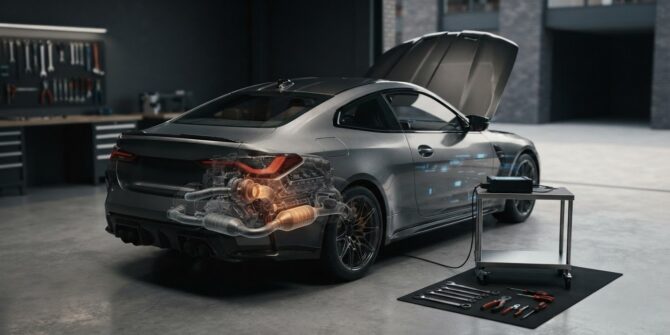
A crackle map can be bad for your engine if it’s poorly calibrated or unsuitable for your vehicle. If you’re asking, “is a crackle map bad for your engine?”, the answer depends on how the software changes fuelling and ignition, and how your engine and exhaust system respond.
Pops and bangs may sound like a harmless exhaust effect, but they come from changing how fuel burns. Poor calibration can raise exhaust temperatures and damage components such as exhaust valves, the turbocharger or catalytic converter. The effects vary by vehicle, so understanding the setup matters.
This guide explains how crackle-map software works, which components may be affected and what signs could point to trouble. It also covers what to weigh before choosing a remap, so you can make an informed decision about the sound you want and the mechanical risks involved.
Key Takeaways
- Learn how changes to fuelling and ignition create crackles, and why exhaust hardware matters as much as the software.
- Understand how poor calibration can expose engine components to excess heat and mechanical stress.
- See why unburnt fuel can put exhaust valves, silencers, turbochargers and catalytic converters at risk.
- Explore how crackle-map settings can affect fuel use and emissions, and what factors influence the outcome.
- Compare a crackle map with a Stage 1 Performance Remap to identify which approach better suits your driving priorities.
ECU software and hardware modifications
A crackle map changes ECU instructions to create exhaust pops when you lift off the accelerator. The sound depends on the calibration and the condition of the engine and exhaust hardware.
How crackle maps work
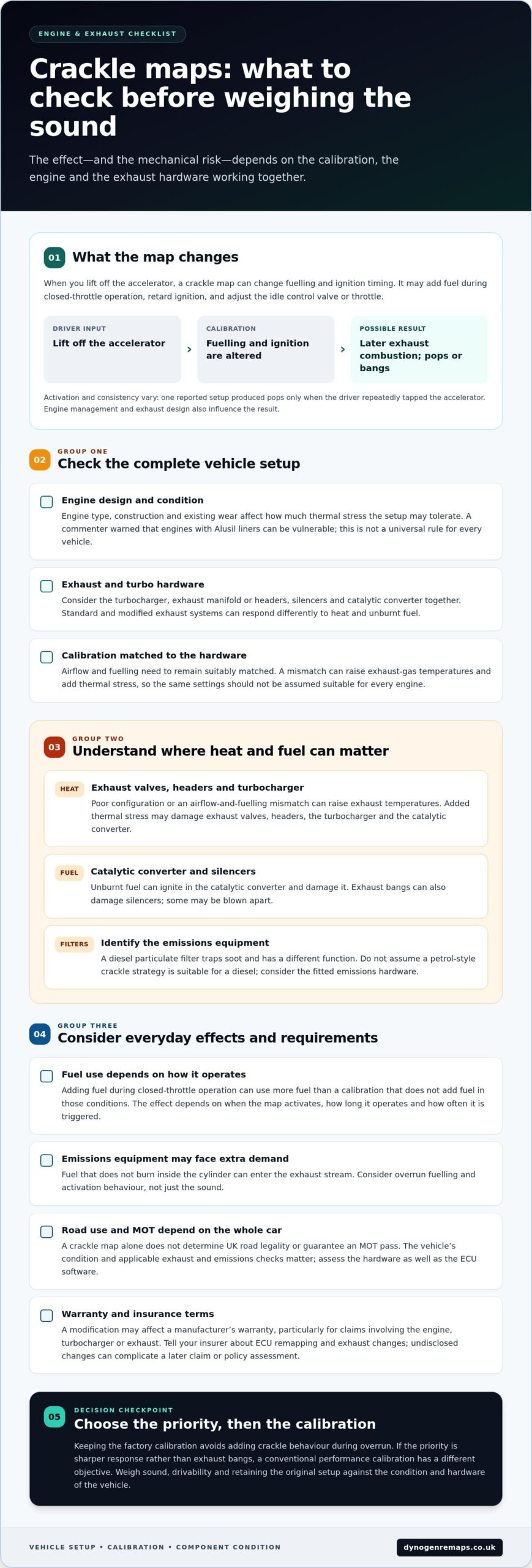
A crackle map changes fuelling and ignition timing when you lift off the accelerator. The calibration may add fuel during closed-throttle operation, retard ignition and adjust the idle control valve or throttle. This encourages combustion later in the exhaust, producing crackles or bangs rather than simply changing the sound at the tailpipe.
Consider when the effect activates and how consistently it behaves. One reported setup produced pops only when the driver repeatedly tapped the accelerator. This illustrates why calibration behaviour matters: driver inputs, engine management and exhaust design all influence the result.
Software changes work alongside physical components, not in isolation. A standard catalytic converter, modified exhaust and turbocharged system can each respond differently to heat and unburnt fuel. Unburnt fuel and exhaust bangs can damage silencers, and some silencers may be blown apart. Poor calibration can also damage exhaust valves, headers, the turbocharger and catalytic converter.
Airflow and fuelling need to remain suitably matched when a crackle map is active. A mismatch can raise exhaust-gas temperatures, increasing thermal stress on exhaust components. The calibration should account for the vehicle’s existing hardware and operating behaviour, rather than applying the same settings to every engine.
Road legality and MOT considerations
A crackle map alone doesn’t determine whether a UK road car is legal to use. The key issue is whether the modified vehicle continues to meet applicable road-use requirements, including those for emissions and noise. Assess the complete setup, including the exhaust and emissions equipment, rather than judging legality by sound alone.
A car with a crackle map can pass an MOT, but the map doesn’t guarantee a pass. The outcome depends on the vehicle’s condition and the checks that apply, including those for its exhaust and emissions systems. Modified exhaust or emissions components can affect these checks, so consider the hardware as well as the ECU software.
Warranty and insurance implications
A crackle map may affect a manufacturer’s warranty, particularly if a claim relates to the engine, turbocharger or exhaust system. Warranty terms determine how a modification is treated, so review them before changing ECU software. Keep a record of the original calibration and the work completed to document the vehicle’s modification history.
Tell your insurer about ECU remapping and exhaust changes, and keep its response with your policy documents. An undisclosed modification can complicate a later claim or policy assessment. Give accurate details of the software and hardware changes, rather than assuming a change is irrelevant because the car still drives normally.
Remapping and engine damage
If you’re asking, “is a crackle map bad for your engine?”, the answer depends on the engine’s design, condition and calibration. Assess your car’s existing hardware and intended use before weighing the audible effect against potential mechanical stress.
Engine and exhaust setup suitability
Some engines and exhaust setups are more vulnerable than others. A commenter warned that crackle maps can damage engines with Alusil liners, making engine construction a key consideration. In a Focus ST tuning discussion, an owner recalled advice not to push the engine over 300-310 because of liner-damage risk. That figure applies to the recalled advice, not every vehicle.
Consider the complete setup: engine type, turbocharger, exhaust manifold, silencer and catalytic converter. A standard exhaust may respond differently from a modified system, while existing wear can reduce an engine’s tolerance for added thermal stress. Assess these parts together rather than treating one setting as suitable for every car.
Effects on exhaust valves and filters
Exhaust valves and headers experience repeated heat cycles as they release gases from the cylinders. A poorly configured crackle map can damage exhaust valves, headers, the turbocharger and catalytic converter. A mismatch between airflow and fuelling can also raise exhaust-gas temperatures, adding thermal stress to these components.
Unburnt fuel can ignite in the catalytic converter and damage it. A diesel particulate filter has a different function, trapping soot in the exhaust, so don’t assume a petrol-style crackle strategy is suitable for a diesel. Identify the fitted emissions hardware and consider how the calibration may affect it.
Fuel consumption and emissions
Adding fuel during closed-throttle operation can use more fuel than a calibration that doesn’t add fuel in those conditions. The effect depends on when the map activates, how long it operates and how often you trigger it. For example, repeated accelerator taps can produce pops on some setups.
Fuel that doesn’t burn inside the cylinder can enter the exhaust. This can increase unburnt fuel in the exhaust stream and place additional demands on emissions-control components. Assess the overrun fuelling and activation behaviour, not just the sound.
Safer alternatives to crackle maps
Keeping the factory calibration avoids adding crackle behaviour during overrun. If your priority is sharper response rather than exhaust bangs, a conventional performance calibration has a different objective. Decide whether sound, drivability or retaining the original setup matters most before choosing a remap.
Start by identifying the engine and exhaust components, then define the outcome you want. If you’re seeking a sportier feel without deliberate pops, prioritise throttle response instead. That’s more useful than choosing settings based only on sound.
The question “is a crackle map bad for your engine?” is best considered alongside your car’s hardware and goals. To explore an alternative focused on performance, review performance remapping options.
What is a crackle map and how does it work?
A crackle map is an ECU calibration that changes how an engine behaves when you lift off the accelerator. Rather than simply ending combustion as the throttle closes, the software can alter fuelling and ignition timing to create exhaust pops. The effect comes from engine control, not a sound file or speaker.
What changes in the ECU?
During closed-throttle operation, the ECU can add fuel and retard ignition timing. This approach often includes opening the idle control valve or throttle, helping fuel ignite later in the exhaust. These adjustments change where and when combustion occurs, producing crackles as exhaust gases pass through the system.
The exact strategy depends on the vehicle’s ECU and calibration. You might hear crackles when lifting off after accelerating, rather than during steady cruising. Some setups produce pops only after repeated accelerator taps, showing how activation conditions affect the result. The map’s behaviour matters as much as the sound it creates.
What happens during overrun?
Overrun is the period after you release the accelerator while the engine is still turning. A conventional calibration controls fuelling in this situation; a crackle strategy changes that behaviour to encourage combustion later in the exhaust path. The ECU coordinates fuel delivery, ignition timing and airflow, so changing one setting can influence the others.
Think of the process as a sequence: you lift off, the ECU applies its overrun settings, and the exhaust produces audible pops. The sound then travels through components such as the exhaust manifold, catalytic converter and silencer. These parts shape the sound and experience the heat and pressure associated with the changed combustion.
Why do crackle maps sound different?
Two cars can produce different results because their engine management, exhaust layout and calibration differ. A standard silencer can soften the sound, while a modified exhaust can make it more prominent. Your input matters too: a map triggered by repeated accelerator taps behaves differently from one that activates whenever the throttle closes.
To understand a particular setup, note when the crackles occur, how long they continue and whether they depend on accelerator input. These observations help distinguish activation behaviour from the exhaust’s acoustic character. They also show that a crackle map is a set of ECU instructions, not one universal setting.
In short, a crackle map uses changes to fuelling, ignition and airflow during overrun to create exhaust pops. Its sound and operation depend on the ECU calibration and vehicle hardware, so the same approach won’t behave identically in every car.
Professionals at Dynogen Remapping Solutions note that adding fuel during closed-throttle operation, retarding ignition and opening the idle control valve or throttle allows fuel to ignite later in the exhaust. These actions describe coordinated ECU changes, not a sound effect on its own. They shift where combustion occurs after the driver releases the accelerator. This is one account of the strategy, not a universal calibration recipe.
How do crackle maps affect exhaust valves, catalytic converters and DPFs?
A crackle map changes combustion behaviour, so its effects can extend beyond the engine. Exhaust valves, the catalytic converter, silencer and any diesel particulate filter are all part of the system to consider.
Exhaust valves and the turbocharger
Exhaust valves open to release hot combustion gases from the cylinders. A poorly configured crackle map can expose them to damaging heat, along with exhaust headers and the turbocharger. The risk relates to how the calibration changes combustion and exhaust-gas temperatures, not simply to how loud the crackles sound.
Airflow and fuelling need to work together. If they become mismatched during crackle-map operation, exhaust-gas temperatures can rise. A calibration should stop producing crackles if temperatures climb too high. This cut-off helps avoid continuing the effect under conditions that put extra thermal stress on exhaust valves or turbocharger components.
Catalytic converters and silencers
A catalytic converter treats exhaust gases, but unburnt fuel entering it can ignite and damage its internal structure. This damage can reduce its effectiveness and may lead to further exhaust problems. The catalytic converter is therefore a key component to consider before changing overrun fuelling.
Exhaust bangs can also harm silencers. Unburnt fuel and repeated bangs may damage a silencer, and some silencers can be blown apart. A modified exhaust doesn’t remove this risk: both its construction and the crackle map’s behaviour affect how pressure and heat reach the system.
Watch for a new rattle, reduced performance or a change in exhaust noise after a remap. These signs don’t identify a failed component on their own, but they may indicate that the silencer or catalytic converter needs attention. Don’t treat louder crackles as proof that the system is working correctly.
Diesel particulate filters
A diesel particulate filter, or DPF, traps soot in the exhaust. DPFs have been mandatory for vehicles since about 2009 to help meet Euro 4, 5 and 6 emissions requirements. Their presence makes the vehicle’s emissions hardware an essential consideration, rather than an optional exhaust detail.
Assess the DPF separately from the catalytic converter: each has a distinct function in the exhaust system. A crackle calibration that changes fuelling or exhaust temperatures can affect downstream components, so the map must suit the vehicle and its hardware. Don’t assume a setting designed for a different engine or exhaust is appropriate for a DPF-equipped car.
Before applying a crackle map, identify the exhaust valves, turbocharger, catalytic converter, silencer and DPF fitted to the vehicle. Then consider how the calibration controls fuelling and exhaust-gas temperature. Assessing each component is more useful than judging suitability by sound alone.
work safely on another vehicle. A commenter reported engine damage in some Mazda MPS cars after owners installed WOT boxes for pops and bangs, and also raised catalytic-converter damage and bore wash as risks. The report is a reminder to consider the whole setup, not just the sound. Take reported risks seriously and seek a vehicle-specific assessment before changing the calibration or exhaust hardware.
Do crackle maps increase fuel consumption or emissions?
A crackle map can increase fuel use because its overrun strategy may add fuel after you lift off. The effect depends on how often the map activates, how long it stays active and how you drive. A short, occasional burst differs from repeated activation on regular journeys.
How extra fuelling affects consumption
In a standard overrun strategy, the ECU manages fuelling when you release the accelerator. A crackle calibration can instead introduce fuel during closed-throttle operation to create exhaust pops. That fuel still comes from the tank, even though you aren’t asking for acceleration at that moment.
The effect on a whole journey’s fuel consumption depends on the map’s settings and activation conditions. A driver who frequently lifts and reapplies the accelerator may trigger the effect more often than someone cruising steadily. The engine, calibration and route also shape the result, so one driving impression won’t isolate the map’s contribution.
For a useful comparison, record fuel use before and after the change using similar routes and driving habits. Include the same kinds of journeys, such as regular commutes, and note how often crackles occur. This gives a more meaningful comparison than using unrelated trips with different traffic or driving styles.
How emissions can change
Fuel added during overrun may not burn completely inside the cylinder. Some can reach the exhaust as unburnt fuel, where it may ignite and increase heat around components such as the catalytic converter. A mismatch between airflow and fuelling can also raise exhaust-gas temperatures during crackle-map operation.
Emissions depend on the engine’s combustion and the condition of the exhaust system. A catalytic converter is designed to treat exhaust gases, but unburnt fuel can damage it. If its performance deteriorates, the vehicle’s emissions-control system may no longer work as intended. The sound of pops alone doesn’t show whether the system is functioning properly.
Keep the distinction clear: fuel consumption concerns how much fuel the engine uses, while emissions concern what leaves the exhaust. A calibration can affect both through added overrun fuelling, but the extent depends on its settings and use. Neither can be judged by exhaust volume alone.
What to observe after a remap
Track fuel use consistently and pay attention to when the crackles occur. Also note changes in exhaust behaviour, such as a new rattle or persistent smell of unburnt fuel. These observations don’t diagnose a fault, but they can help identify changes that merit attention, especially around the catalytic converter.
If you’re considering this setup, review crackle-map options with fuel use and emissions behaviour in mind, not sound alone.
Dynogen Remapping Solutions: Stage 1 Performance Remap
Dynogen Remapping Solutions offers a Stage 1 Performance Remap for drivers considering ECU tuning without making exhaust crackles the main objective. It provides a different direction from a crackle map: the focus is performance remapping rather than creating pops on overrun. If you’re weighing sound against how you want your car to drive, consider which outcome matters most before choosing a calibration.
For drivers focused on fuel efficiency, an Economy Remap may be more relevant. The right option depends on your vehicle and priorities, so be clear about your goals when discussing a remap. Contact Dynogen Remapping Solutions to talk through the Stage 1 Performance Remap and your tuning objectives.
Choose a calibration that suits your next drive
Whether a crackle map is bad for your engine depends on the calibration and the vehicle it’s applied to. Before choosing one, decide what you want from your car: a distinctive exhaust note, stronger performance or a focus on economy. That priority gives your tuning decision a clear direction.
Dynogen Remapping Solutions offers a Stage 1 Performance Remap for performance-focused drivers, an Economy Remap for those prioritising efficiency, and an AdBlue Solution for relevant vehicle needs. Each option addresses a different goal, so the best next step is to discuss what matters most for your vehicle and driving.
Contact Dynogen Remapping Solutions to talk through your remapping options and decide how to move forward. A considered choice can help you pursue the driving experience you want with greater confidence.
Frequently Asked Questions
Can a crackle map damage an engine or turbo?
Yes. A poorly configured crackle map can damage an engine or turbocharger, especially if its settings create excessive thermal stress. If you notice a warning light, misfire or loss of power after a remap, record when it happens, such as during overrun or acceleration. That detail can help a technician identify whether the change is linked to the calibration or another fault.