

The right choice in bench tuning vs OBD remapping depends on how your vehicle’s ECU can be accessed, not just on the performance goal. OBD remapping reads and writes the ECU through the vehicle’s diagnostic port. Bench tuning involves removing the ECU and connecting to it directly. If security features or limited OBD access prevent programming through the port, bench access may be needed.
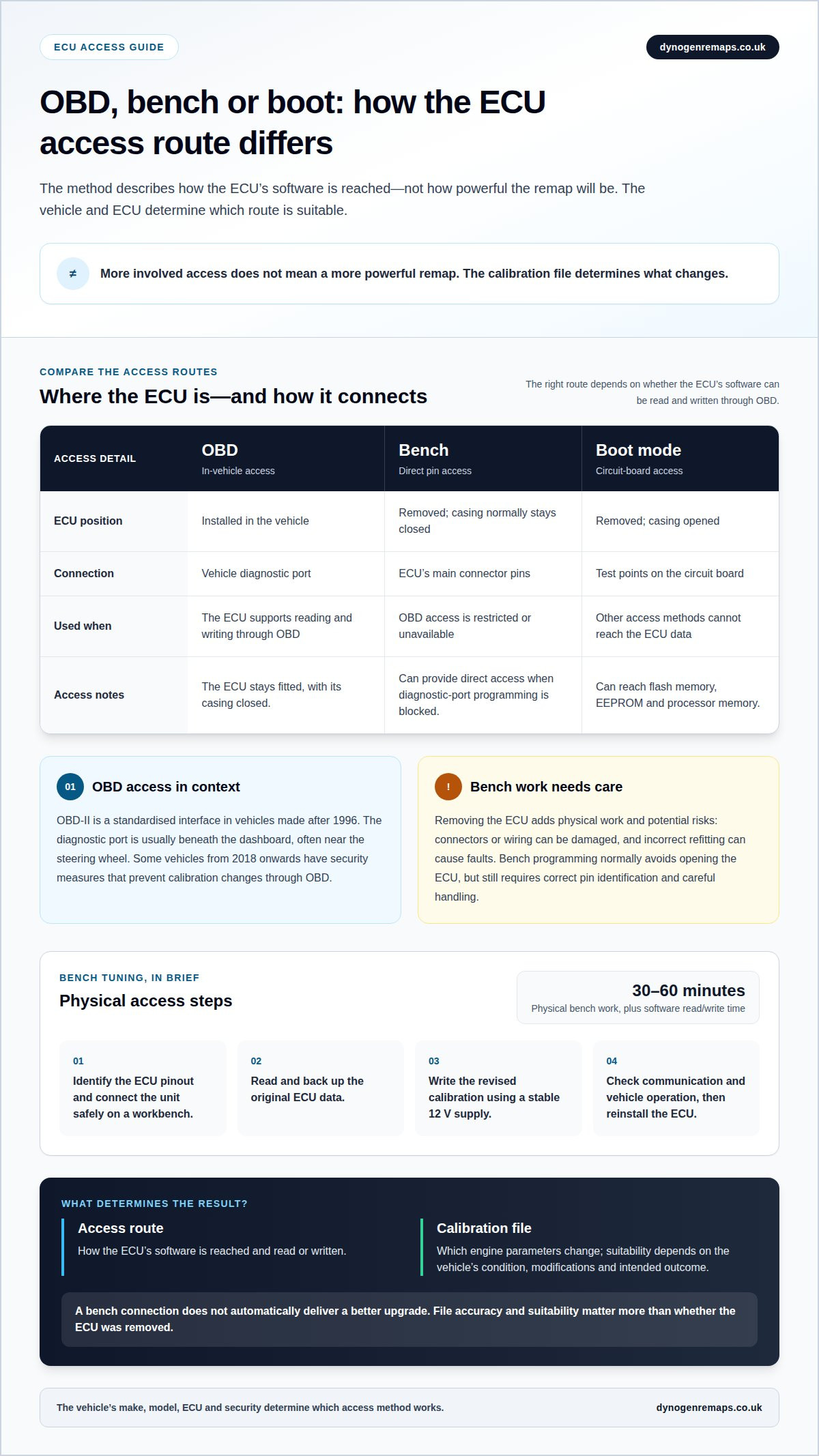
A more involved access method doesn’t mean a more powerful remap. The method describes how the ECU’s software is reached, not the calibration itself. The map’s quality and suitability determine the result.
This guide explains how each method works, how ECU security affects the choice, and what the access route means for performance or fuel-efficiency goals. It also compares OBD, bench and boot access, and explains when each is appropriate.
Key Takeaways
- Use OBD access when the ECU can be read and written through the diagnostic port; it leaves the ECU installed in the vehicle.
- Bench access involves removing the ECU and connecting through its pins, making it an option when OBD access is restricted or unavailable.
- Choose the access method based on the vehicle’s ECU and security, not the remap goal alone.
- Focus on a map tailored to the vehicle’s condition and modifications, as the access method doesn’t determine the calibration.
- Define whether you prioritise performance, fuel efficiency or both before deciding which remap approach suits your vehicle.
How OBD remapping accesses the ECU through the vehicle’s diagnostic port
OBD remapping uses a specialist programming device connected to the vehicle’s On-Board Diagnostics port. The port is usually beneath the dashboard, often near the steering wheel. A standardised OBD-II interface appears in vehicles made after 1996. Through it, a specialist reads the ECU’s existing software, applies a modified calibration and writes the revised data back.
The ECU stays in the vehicle, with its casing closed. A suitable programming tool communicates with the control unit through the vehicle’s wiring, so there’s no need to remove it or access its circuits directly. Before writing software, a professional can save the original ECU file, allowing the standard calibration to be restored. Stable vehicle voltage is also important during programming, as an interruption can disrupt the write.
Some vehicle manufacturers use anti-tuning protection or security gateways to restrict calibration changes through the diagnostic port. Some vehicles from 2018 onwards have security measures that prevent OBD access for calibration changes. In these cases, a tuner may need direct bench access to reach data that the OBD route cannot read or write. The vehicle’s make, model and specific ECU determine which access method works.
Bench tuning involves removing the ECU and connecting to its main connector pins on a tuning bench. The casing normally stays closed. Boot mode goes further: a specialist opens the ECU and connects to points on its circuit board. This can provide access to flash memory, EEPROM and processor memory when OBD or standard bench connections can’t reach protected data.
| Access method | ECU position | How it connects | Typical reason |
|---|---|---|---|
| OBD | Installed in vehicle | Diagnostic port | ECU supports read and write through OBD |
| Bench | Removed, casing closed | Main connector pins | OBD access is restricted or unavailable |
| Boot mode | Removed, casing opened | Circuit-board test points | Other access methods cannot reach ECU data |
Bench access can also help recover an ECU after a failed write, corrupted software or loss of OBD communication. The choice in bench tuning vs OBD remapping therefore depends on access to the ECU, not simply on the map you want.
A remap may affect manufacturer warranty cover and insurance terms. Disclose the modification to your insurer and review the relevant conditions. MOT results depend on the vehicle’s tested condition and emissions, not on the programming method alone.
Does the access method change the remap?
Bench tuning changes how the ECU is accessed, not what the finished calibration is designed to do. The access route determines how software is read and written; the modified file determines which engine parameters change. For example, an ECU accessed on a bench can receive the same type of performance-focused calibration as one programmed through OBD, if the ECU and file support that work.
Bench tuning involves removing the ECU from the vehicle and connecting its harness pins to specialist equipment. A technician identifies the ECU pinout, powers the unit safely on a workbench and reads its existing data. The casing normally stays closed, and connecting directly to the main pins doesn’t require soldering. This is less invasive than opening the ECU, but involves more physical work than programming it in the vehicle.
Once the original file is read and backed up, the calibration is modified for the vehicle and its intended use. The specialist then writes the revised data through the bench connection, checks communication and reinstalls the ECU. A stable 12 V supply is essential during programming. Physical bench work typically takes 30-60 minutes, plus the time needed to read and write the software.
Removing an ECU adds practical steps and potential risks. Access may be awkward, connectors or wiring can be damaged during removal, and incorrect refitting can cause faults. Opening the casing is a separate operation, usually associated with boot-mode work; poor resealing can compromise waterproof protection. Bench programming normally avoids opening the ECU, but still requires correct pin identification and careful handling.
Bench and OBD programming follow the same core process: assess the ECU’s condition, preserve its original data, apply the appropriate modified calibration, then confirm the write and check vehicle operation. The physical access steps are what differ.
- Identify the vehicle and ECU, then select a supported access route.
- Read and save the original ECU software.
- Modify the calibration to suit the vehicle’s condition, existing modifications and intended outcome.
- Write the file through the OBD connection or bench pins, then check operation.
A bench connection doesn’t automatically deliver a better upgrade. A poorly calibrated file can cause harsh delivery, smoke or fault codes, whatever the access method. The file’s accuracy and suitability matter more than whether the ECU was removed.
If you’re weighing a performance-focused change, explore vehicle remapping options alongside the access method. The right route is the one that safely supports the ECU and the calibration goal.
Choosing a tuning method based on vehicle and ECU security
The correct method depends on the vehicle’s make and model, the ECU’s security level, and whether its software can be read and written through OBD. OBD tuning is the primary method for most passenger cars built between 2000 and 2020, but that range doesn’t guarantee access for every ECU. Some vehicles from 2018 onwards have security measures that block calibration changes through the diagnostic port.
Which cars and ECUs need bench tuning rather than OBD remapping? Bench access may be needed when a security gateway blocks OBD programming, the ECU isn’t supported through OBD protocols, or the vehicle can’t be driven. It can also help with recovery after a failed write or corrupted ECU software.
The manufacturer’s protection determines whether a direct connection is necessary. A specialist first identifies the ECU and checks whether the required reading and programming operations are supported through OBD. If the port allows a complete read and write, OBD avoids removing the ECU. If protected data remains inaccessible, bench access can reach areas restricted through the vehicle’s diagnostic connection.
When choosing a UK remapping specialist, look for a clear, vehicle-specific explanation of the programming process. A professional should explain how the ECU will be accessed, whether its original file will be saved, how stable programming voltage is maintained, and how the calibration suits the vehicle and its modifications. They should also set realistic expectations about gains and show familiarity with the vehicle and ECU type.
- OBD: A suitable method when the ECU supports reading and writing through its diagnostic port.
- Bench: Appropriate when OBD access is blocked, unsupported or unavailable, including some recovery work.
- Boot mode: A more direct route used when OBD and standard bench connections cannot achieve access.
Time and labour vary with the access route. OBD programming is generally quicker because it involves fewer physical steps. Bench work takes longer because the ECU must be removed, identified, connected and refitted; it also requires specialist equipment and careful handling. The extra work reflects access complexity, not a higher performance stage or a different remap goal.
For example, a vehicle with an OBD-accessible ECU can usually be programmed through its diagnostic port, while a model with a security gateway may need bench programming. The ECU, not simply the vehicle’s age or desired upgrade, determines the method. Start with the supported access route and move to bench work only if security or communication limits prevent the required read or write.
OBD remapping through the diagnostic port
OBD tuning uses the vehicle’s diagnostic socket to communicate with its engine control unit. In the UK, the socket is usually beneath the steering wheel or dashboard, within reach of a diagnostic tool. Many cars built since the late 1990s use a standard 16-pin connector. The OBD-II interface is standardised in vehicles made after 1996, although the ECU’s supported functions still vary by model.
The diagnostic socket is designed for vehicle diagnostics and servicing, but compatible programming equipment can also read and write ECU software. A specialist connects the tool, identifies the ECU and establishes communication before starting a calibration session. This confirms whether the vehicle supports the required operation through the port. If the ECU blocks writing or can’t communicate, bench or boot access may be needed.
A typical OBD session involves reading the existing software, saving the original file, applying the modified calibration and writing it back to the ECU. The original file provides a route back to standard software. Reading and writing are separate stages: a successful read alone doesn’t mean the revised data has been installed. OBD tuning typically takes 15-40 minutes per vehicle, including reading, file application and writing.
- Connect a compatible programming device to the vehicle’s OBD port.
- Identify the ECU and read its current software.
- Save the original file before applying a suitable modified calibration.
- Write the revised software, then check that the ECU communicates correctly.
Electrical stability is important during writing. A battery stabiliser is recommended to prevent vehicle battery voltage dropping below 12 volts. Professional programming tools and battery stabilisation help maintain stable power while the ECU receives new data. This matters because interrupted communication during a write can leave the control unit unable to operate correctly.
OBD access can suit a Stage 1 calibration when the ECU supports programming through its diagnostic port. The method leaves the ECU installed and its casing unopened. It is generally quicker than bench tuning because it avoids physical removal and reconnection. However, the port cannot necessarily expose every protected ECU area, so access depends on the vehicle and ECU protocol.
Bench access uses the ECU’s connector pins after removal, while boot mode requires opening the casing and connecting to circuit-board points. These routes address access limitations, not different remap goals. For an OBD-compatible vehicle, the diagnostic port allows software to be read and written without removing the ECU. If programming is blocked, the access method must change.
ECU remap performance and fuel-efficiency aims
An ECU remap changes software in the engine control unit, or ECU, to adjust how the engine operates. Tuners can modify parameters such as fuel delivery, ignition timing and boost pressure. The goal might be stronger response, greater fuel efficiency or a considered balance between the two. OBD, bench and boot mode describe ways to access the control unit, not the outcome the file is designed to achieve.
For a performance-focused calibration, changes to boost pressure and fuel delivery can influence how the engine responds under load. The map must account for the vehicle’s condition and existing modifications. For example, a turbocharged vehicle with altered hardware needs a calibration suited to those parts rather than a generic file. More aggressive settings alone don’t make a sound upgrade; how the changes work together matters. For enthusiasts who appreciate peak automotive capability and wish to experience high-calibre machinery first-hand, curated driving getaways such as those featured at supercarholidays.com provide a chance to get behind the wheel of exotic supercars in stunning destinations.
An economy-focused calibration aims to support efficient engine operation in the vehicle’s usual driving conditions. Fuel consumption also depends on factors beyond ECU software, including driving style, load and route. A map can’t ensure lower fuel use on every journey. Drivers who frequently carry heavy loads or travel in stop-start traffic may get different results from those covering steady motorway journeys.
Before programming, a specialist considers the vehicle’s condition, its modifications and the driver’s priorities. The written calibration should suit the engine and control unit, rather than being chosen simply because it promises a particular outcome. The diagnostic connection or circuit board is only the access point; neither determines the map’s quality.
- Performance priority: Focus calibration on engine response and the vehicle’s intended use.
- Efficiency priority: Consider typical routes, load and driving behaviour alongside the ECU settings.
- Mixed aim: Balance response and efficiency around the vehicle’s condition and modifications.
Onboard diagnostics can identify faults, but they don’t replace a suitable calibration or an assessment of the vehicle’s mechanical condition. A poorly calibrated file can cause smoke, drivability problems, harsh delivery or fault codes, whether programming used OBD or a bench. Excessive stress on the engine, turbocharger or transmission can also contribute to premature wear or failure. Careful calibration matters more than choosing the most involved tuning method.
Set the intended outcome first, then match the calibration to the vehicle. If stronger response is the priority, explore a Stage 1 Performance Remap suited to that goal.
Dynogen Remapping Solutions
Dynogen Remapping Solutions helps drivers connect their ECU remapping goals with a suitable service. The choice between OBD and bench access depends on the vehicle’s ECU, its security and the programming route it supports. The intended result matters too: a Stage 1 Performance Remap is performance-focused, whilst an Economy Remap is for drivers prioritising fuel efficiency. AdBlue and DPF Solutions address different vehicle-system needs.
Start with your vehicle and the outcome you want. That gives you a clear basis for discussing the right remapping option, without assuming one access method suits every ECU. For guidance on your vehicle and remapping goals, contact Dynogen Remapping Solutions.
Choose the outcome before the method
A decision about bench tuning vs OBD remapping is most useful when it starts with the driving change you want, not a preferred piece of equipment. Consider how you use the vehicle, what feels lacking in its current behaviour, and whether your priority is sharper response or greater efficiency. A clear goal gives the calibration discussion direction.
Bring that goal together with your vehicle’s details and any existing modifications. This makes the discussion specific to your engine and intended use, rather than centred on a generic promise. The access route is part of the technical process; the aim is a considered result that suits your car.
Dynogen Remapping Solutions can help you explore the right direction for your vehicle. Contact Dynogen Remapping Solutions to discuss your requirements and take an informed next step.
Frequently Asked Questions
What is ECU tuning?
ECU tuning adjusts the software that controls engine operation. A calibration can alter settings such as fuel delivery, ignition timing and turbo boost to suit a specific aim. One driver might prioritise stronger throttle response, while another seeks an economy-focused setup. The result depends on the calibration, engine condition and vehicle modifications, so tuning isn’t simply about choosing the most aggressive settings.
Does the method change how strong the tune is?
No. The access method determines how the ECU’s software is read and written, not how strong the calibration is. A performance-focused file can be installed using OBD or bench access if the vehicle’s ECU supports that route. For example, a security restriction may require bench access, but it doesn’t automatically call for a more aggressive map. Calibration quality and suitability matter more than the connection method.
So which one does my car need?
Your car needs the method supported by its specific ECU and security setup. If the control unit can be read and programmed through its diagnostic port, OBD access is suitable. If the ECU blocks that operation, lacks OBD support or needs recovery after a failed write, bench access may be required. The vehicle’s make and model help identify the ECU, but its protocols determine the workable route.
What is an ECU remap?
An ECU remap changes the software calibration stored in the engine control unit. Revised settings can target performance, fuel efficiency or drivability, depending on the vehicle and intended use. It isn’t a physical engine upgrade: the work changes control instructions, such as how fuel or boost is managed. A suitable calibration accounts for the vehicle’s condition and existing modifications.
What is OBD remapping and how does it work?
OBD remapping programmes the ECU through the vehicle’s diagnostic connection. When the ECU supports programming through the port, a compatible tool communicates with the control unit, reads its software and writes a modified file. For example, a vehicle may allow diagnostic fault reading but restrict calibration writing. That’s why diagnostic communication alone doesn’t prove that a remap can be completed through OBD.
Bench tuning vs OBD remapping: what are the key differences?
In bench tuning vs OBD remapping, the key difference is how the ECU is connected. OBD programming uses the vehicle’s diagnostic socket, while bench programming uses the ECU after removal and connection to specialist equipment. A driver with an OBD-compatible ECU can avoid removal; a restricted ECU may need bench access. Neither method automatically produces a stronger tune, because the calibration file determines the intended changes.
How much does bench tuning or OBD remapping cost in the UK?
The price depends on the vehicle and the work required; request a quote for the specific case. Factors include ECU type, access complexity, vehicle condition and calibration goals. Bench work can require additional removal, connection and refitting steps compared with an OBD session. These differences affect the work involved, but there’s no universal price: the cost depends on the vehicle and programming required.
How long does bench tuning take compared with OBD remapping?
OBD programming typically takes 15-40 minutes for reading, file application and writing. Bench work adds ECU removal, pin identification, connection and refitting, so its overall duration depends on access and ECU response. Physical bench work can take 30-60 minutes, with reading and writing time added. More complex bench or boot-mode jobs can take several hours to complete correctly.