
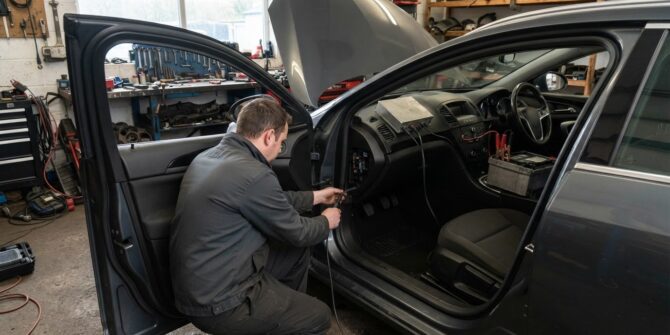
The software write is only part of the appointment. For a typical Stage 1, the answer to how long an ECU remap takes is usually one to three hours, including diagnostics, software updates and a final test drive. A straightforward job may be quicker, but the vehicle and the checks involved shape the total time.
An ECU remap is software-focused, but the appointment includes more than changing the map. ECU access, vehicle condition and the checks required can all affect how long the work takes. Allow time for the full process rather than just the software write.
This guide explains what a typical Stage 1 appointment involves and why the programming itself doesn’t determine the whole schedule. You’ll learn how vehicle access, condition and final testing can add time, so you can plan your appointment with a clearer idea of what to expect.
Key Takeaways
- A typical Stage 1 remap usually takes one to three hours, with diagnostics and testing included in the appointment.
- ECU access, the vehicle’s condition and the programming method can all affect how long the work takes.
- A diagnostic fault may need attention before remapping can proceed, adding time to the process.
- ECU programming needs a stable power supply, and post-remap checks help assess how the vehicle responds.
- Find out what to expect from Dynogen Remapping Solutions’ Stage 1 Performance Remap and how vehicle-specific factors shape the appointment.
Typical duration for a Stage 1 ECU remap
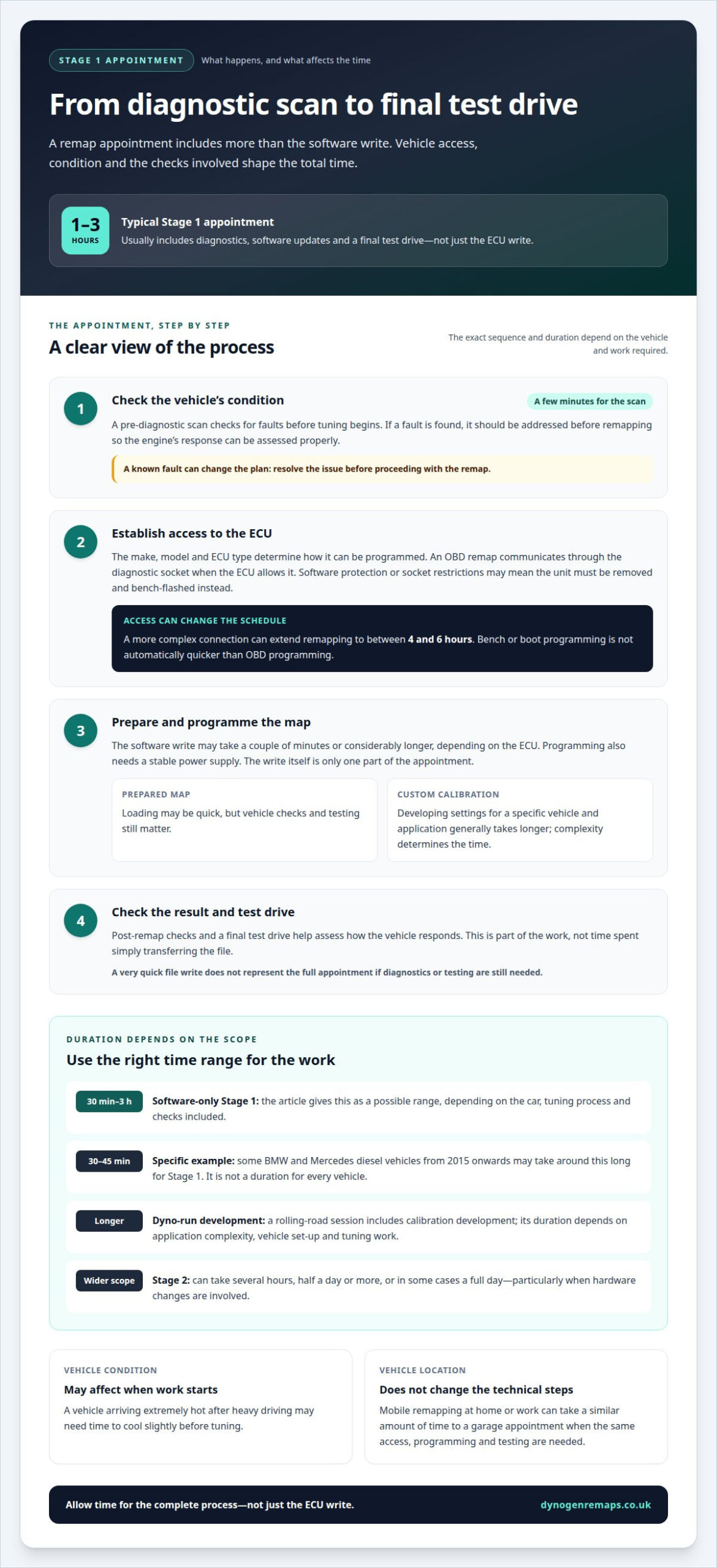
A typical Stage 1 appointment can take from around 30 minutes to three hours, depending on the vehicle and work involved. The total can include diagnostics, software updates and a final test drive, not just the ECU write.
Standard car remap and installation time
A standard car remap usually takes one to three hours, while installing a vehicle remap commonly takes one to two hours, including checks and post-remap testing. These ranges help drivers plan their day, but they describe different scopes of work. A software-only Stage 1 may take 30 minutes to three hours; the time depends on the car, tuning process and checks included.
Some BMW and Mercedes diesel vehicles from 2015 onwards may take around 30-45 minutes for a Stage 1 remap. That shorter example doesn’t define the duration for every engine or ECU. Access, the programming method and the time needed for checks all affect the appointment. A standard Stage 1 remap usually doesn’t require the car for a whole day.
So, how long does an ECU remap take in practice? There isn’t one fixed duration: the ECU, vehicle condition and work involved determine the appointment length. Preparation and checks are part of the process, so the full visit can take longer than the ECU write alone.
UK drivers must tell their insurer about an engine remap. Failing to do so could invalidate the policy and affect claims. A manufacturer may also void a vehicle warranty after remapping. A remapped engine must still meet its age-related exhaust emission requirements at MOT, according to the UK Government.
Dyno-run remap duration
A dyno-run remap uses a rolling road to assess and develop the engine calibration under controlled conditions. There’s no single fixed duration: development time depends on the application’s complexity, vehicle setup and tuning work required. A dyno appointment may therefore take longer than a straightforward software-only installation.
That distinction matters when planning time away from the car. A rolling-road session includes development work beyond loading a prepared map, and the application’s complexity affects the schedule. Consider the full tuning work, not just the time taken to transfer the file.
A remap completed in 10 minutes flat, whatever the vehicle, may be a reason to question how thorough the process is. If diagnostics or testing are rushed or skipped, faults and the vehicle’s response may not be properly assessed. Time spent checking the engine and confirming the result is part of the work, not unnecessary delay.
What can make a remap take longer?
The ECU, vehicle condition and tuning required can all affect appointment length. Writing the software may take a couple of minutes or considerably longer, depending on the ECU. That’s only one part of the process: preparation, access and checks also determine when the vehicle is ready.
Custom calibration generally takes longer than applying a prepared generic map because it involves developing settings for a specific vehicle and application. There’s no fixed duration for custom work; complexity determines the time needed. Even when a prepared file loads quickly, vehicle checks and testing still matter.
Stage 2 work also takes longer than a standard Stage 1 remap, particularly when hardware changes are involved. Depending on the vehicle and setup, this work can take several hours, half a day or more, or, in some cases, a full day. The extra time reflects the wider scope, not simply a longer software upload.
Vehicle condition can change the plan before tuning begins. If a diagnostic health check finds a fault, repair it before remapping. Continuing with a known problem can make it harder to assess the engine’s response to the new calibration, so resolving the fault comes first.
Temperature can also affect when tuning starts. If a vehicle arrives extremely hot after heavy driving, it may need time to cool slightly. This applies at a tuning centre or during mobile remapping: the vehicle needs suitable conditions for the work to proceed correctly.
ECU access can add time. Some ECUs have software protection or can’t be programmed through the diagnostic socket. In those cases, the unit may need to be removed and bench-flashed, adding steps beyond connecting a tool inside the vehicle. The make, model and ECU type determine the programming method.
Finally, the work may take longer if the tuning application needs development on a rolling road. Rolling-road development time varies with its complexity, while a Stage 3 project involving a turbo or major hardware changes often takes a full day or longer. These examples show why a quick file write doesn’t, by itself, indicate the full appointment duration.
How ECU access and vehicle condition affect appointment time
A pre-diagnostic scan takes a few minutes, but access to the control unit can affect the rest of the appointment. The time from start to finish depends on the ECU, the vehicle’s condition and the programming method required.
A mobile ECU remap can take a similar amount of time to a garage appointment when the same access, programming and testing steps are needed. Mobile remapping can take place at the owner’s home or workplace, but the location doesn’t determine the technical work. The vehicle still needs diagnostic checks and suitable access to its control unit.
An OBD remap uses the vehicle’s diagnostic socket to communicate with the ECU. It’s a direct route when the control unit accepts programming through that connection. Some ECUs have software protection or cannot be programmed through the socket, so the ECU must be removed and bench-flashed. This extra access work takes longer than socket programming. A more complex connection can extend remapping to between 4 and 6 hours.
Bench or boot programming isn’t automatically quicker than an OBD remap. The ECU type determines whether it can be accessed through the diagnostic socket or needs another method. Removal, bench access and reinstallation add steps, so the file-writing time alone doesn’t show how long the appointment will take.
Faults can affect the schedule too. If the diagnostic health check finds a fault, repair it before remapping proceeds. The scan takes a few minutes, but an issue changes the next step: tuning pauses until the vehicle is in suitable condition. Programming a faulty vehicle can make it harder to distinguish an existing problem from its response to the new calibration.
Software updates may be part of a remapping appointment alongside diagnostics and programming. Their effect on the schedule depends on the vehicle and work required, so there’s no fixed duration for every update. Keeping the vehicle’s supply voltage steady during programming also helps prevent an interrupted ECU write, which could disrupt the process.
For an economy-focused calibration, the same access considerations apply as for performance tuning. ECU protection, diagnostic-socket access and any faults found during scanning determine the practical route. The process is clear: scan the vehicle, establish ECU access, address faults, programme the map and complete the relevant checks. Each step helps ensure the remap is carried out correctly.
Uploading the new map and testing the car
An ECU remap involves diagnostic checks, calibration, programming and post-remap testing. A pre-diagnostic scan takes a few minutes; writing the file can take a couple of minutes or considerably longer, depending on the ECU. Testing time varies with the vehicle and checks required, so the full process has no single fixed duration.
Before programming, the technician identifies the ECU and selects the appropriate calibration for the vehicle. A generic file and a vehicle-specific calibration aren’t interchangeable descriptions of the whole process: the ECU and the work being completed determine the programming method. A standard Stage 1 remap is software-focused, but preparation and testing remain part of the appointment.
The vehicle’s supply voltage needs to remain steady during programming. A suitable battery support supply helps maintain stability while the ECU receives its new calibration. If voltage drops, the write can abort and the programming process may need further attention before the vehicle is ready. That’s why the file transfer shouldn’t be rushed.
After programming, the technician checks that the write has completed and assesses the vehicle’s response. A post-remap test drive can show how the engine behaves in normal driving conditions. Drivers may notice sharper throttle response and smoother acceleration, but a short road test assesses operation rather than proving every possible outcome.
A quick file upload doesn’t necessarily mean a quick, complete appointment. The ECU may accept the map in a short time, but diagnostic preparation, stable power and road testing add time. Comparing appointments by write time alone leaves out checks that help establish whether the vehicle is operating as intended.
The first drive also provides useful feedback on drivability. The technician can assess whether throttle response and acceleration feel consistent, rather than relying only on the programming tool’s completion message. If something needs attention, further checks may be required before the vehicle is ready, extending the visit beyond the file write.
For a typical Stage 1, the full appointment may sit within the usual one-to-three-hour range, but individual stages vary. ECU type affects the write; the vehicle’s response shapes the checks and test drive. A careful sequence, from diagnostic scan through to road testing, gives a more useful measure of the work than upload speed alone.
Circumstances that can extend remapping time
Some appointments take longer because the work involves more than loading a prepared file. ECU access, vehicle condition and hardware modifications can each add steps. For example, a protected control unit may need bench-flashing rather than programming through the diagnostic socket, changing the work required before tuning can begin.
Hardware changes are a key factor. Stage 2 tuning can take several hours, and work involving hardware may take half a day or more. In some cases, a Stage 2 remap takes a full day, depending on the vehicle and setup. Stage 3 work involving a turbo or major modifications often takes a full day or longer.
These longer projects differ from a standard software-only appointment because calibration work must account for the application’s complexity. Rolling-road development time varies with that complexity too. A vehicle with modified hardware may therefore need a different plan from a standard Stage 1 vehicle, even if both arrive for the same booking.
Vehicle condition can change the sequence too. If a diagnostic check finds a fault, repair it before remapping proceeds. The appointment shouldn’t move straight from scanning to writing a map if an unresolved issue affects how the engine runs. Resolving the fault becomes part of preparing the vehicle.
Temperature may also affect when work starts. If a vehicle arrives extremely hot after heavy driving, it may need to cool slightly before tuning. This applies at a workshop or during a mobile appointment: the vehicle needs suitable conditions regardless of location.
Writing the ECU can take a couple of minutes or considerably longer, depending on the unit. If the write is interrupted, programming may need further attention before the vehicle is ready. Maintaining a steady supply voltage helps avoid an aborted write, but ECU design still affects the time required.
Sharing details about the vehicle’s setup can help prepare for the appointment. Existing faults, ECU access issues and modifications provide useful context before work starts. This doesn’t replace diagnostic checks, but it helps identify whether the job is straightforward or may need additional access or development.
For a modified vehicle or an ECU requiring bench access, allow for the extra work involved rather than treating the file write as the whole appointment. Discuss your remapping requirements to find the right starting point for your vehicle and its setup.
Dynogen Remapping Solutions
Dynogen Remapping Solutions can help you choose a suitable remapping service and understand which vehicle-specific factors may shape the appointment. For a performance-focused calibration, its Stage 1 Performance Remap is relevant; an Economy Remap is another option for drivers prioritising efficiency. ECU access, vehicle condition and the checks required all influence the time involved, so the file write alone doesn’t tell the whole story.
When discussing your requirements, share your vehicle details and what you want from the remap. That helps focus on the appropriate work and factors that could affect the appointment. Dynogen Remapping Solutions also offers AdBlue Solution and DPF Solution services.
Contact Dynogen Remapping Solutions to discuss your vehicle and remapping requirements.
Plan your next step with confidence
Knowing how long an ECU remap takes helps you plan, but the next step is matching the work to your vehicle and driving priorities. Start with your vehicle details, its current condition and the outcome you want. This gives the appointment the right context.
Dynogen Remapping Solutions offers a Stage 1 Performance Remap and an Economy Remap, alongside AdBlue Solution work. These options address different needs, so clarity about your priorities helps focus the conversation. The vehicle’s ECU access and any diagnostic findings also help shape what the work involves.
If you’re considering a remap, or want to understand which option suits your vehicle, contact Dynogen Remapping Solutions to discuss your requirements. A considered conversation is a practical starting point for making an informed decision about your vehicle.
Frequently Asked Questions
Can You Wait While Your Car Is Being Remapped?
You can wait nearby, but you don’t need to stay in the car during the work. The vehicle remains stationary while the technician accesses and programmes the ECU, then completes the relevant checks. If you’re planning your day around the appointment, allow time for the full visit, including checks and any vehicle-specific access requirements.
After the remap: does it need running in?
No running-in period is needed after a Stage 1 remap because it changes the ECU calibration, not the engine hardware. You can use the vehicle normally once the work and checks are complete. Fuelling and torque delivery may settle over a few days of ordinary driving, so judge how the car feels over normal journeys rather than expecting every response to be identical immediately.
Can I drive straight away after a remap?
Yes, you can drive once programming and post-remap checks are complete. The first drive is a useful opportunity to notice changes such as sharper throttle response or smoother acceleration. Drive normally and pay attention to how the vehicle behaves in familiar conditions. You don’t need to leave it parked for a set period before setting off.
Does the Vehicle Need to Cool Down First?
Not usually, but a vehicle arriving extremely hot after heavy driving may need to cool slightly before tuning starts. The relevant factor is the car’s temperature, not a fixed waiting period. A car driven hard just before its booking may need a pause, while one arriving after ordinary driving may be ready for checks. Cooling time depends on its condition on arrival.
Engine remapping: what is remapping a car?
Remapping a car means changing the software calibration within its engine control unit (ECU). The ECU manages how the engine operates, and revised settings can alter its response. Unlike replacing engine parts, a software remap changes calibration rather than hardware. The work depends on the vehicle and intended result, such as stronger performance response or improved fuel efficiency.
How Long Should You Leave the Car After Remapping?
You don’t need to leave the car unused after the remap and its checks are complete. Drive normally and notice how it behaves on familiar journeys. Fuelling and torque delivery can take a few days of normal driving to settle, so the first trip isn’t the only opportunity to assess the vehicle’s response.
How long does a typical ECU remap take in the UK?
A typical UK car remap takes one to three hours, including diagnostics, software updates and a final test drive. Some straightforward Stage 1 jobs take less time, while ECU access or additional checks can extend the appointment. The overall visit is a better guide than the time spent writing the file, because preparation and testing are also part of the process.
What factors affect how long an ECU remap takes?
Appointment length depends on the ECU’s programming method, vehicle condition and work required. A unit that can’t be programmed through the diagnostic socket may need removal and bench-flashing. Repair faults identified during the health check before remapping. Bespoke development or hardware modifications also add work, while a vehicle arriving extremely hot may need time to cool before tuning begins.