

With the average price of diesel reaching 183.7p per litre in August 2026, a fleet of ten vans covering standard annual mileages can see thousands of pounds in potential profit simply evaporate through the exhaust pipe. You’re likely all too familiar with the relentless pressure of rising operational costs and the sheer frustration of seeing your vehicles sidelined by recurring DPF or AdBlue faults. It’s a constant battle to maintain a competitive edge whilst managing the wear and tear that comes with heavy payloads and inconsistent driver behaviour.
This article demonstrates how professional fleet van tuning North West services provide more than just a simple performance boost; they offer a strategic recalibration of your assets to slash annual fuel spend, enhance driver safety, and maximise vehicle longevity. By moving away from generic tuning boxes and towards bespoke ECU software, you can transform your fleet into a more efficient, reliable, and responsive operation. We will explore the technical nuances of Stage 1 and Economy remapping, the benefits of speed limiter removal, and how expert emissions calibrations can prevent the failures that lead to expensive downtime.
Key Takeaways
- Understand how professional fleet van tuning North West services utilise bespoke ECU recalibration to perfectly balance engine torque with long-term mechanical reliability.
- Learn the technical mechanics of economy remapping and how targeting the engine’s torque curve allows your vehicles to operate more efficiently at lower RPMs.
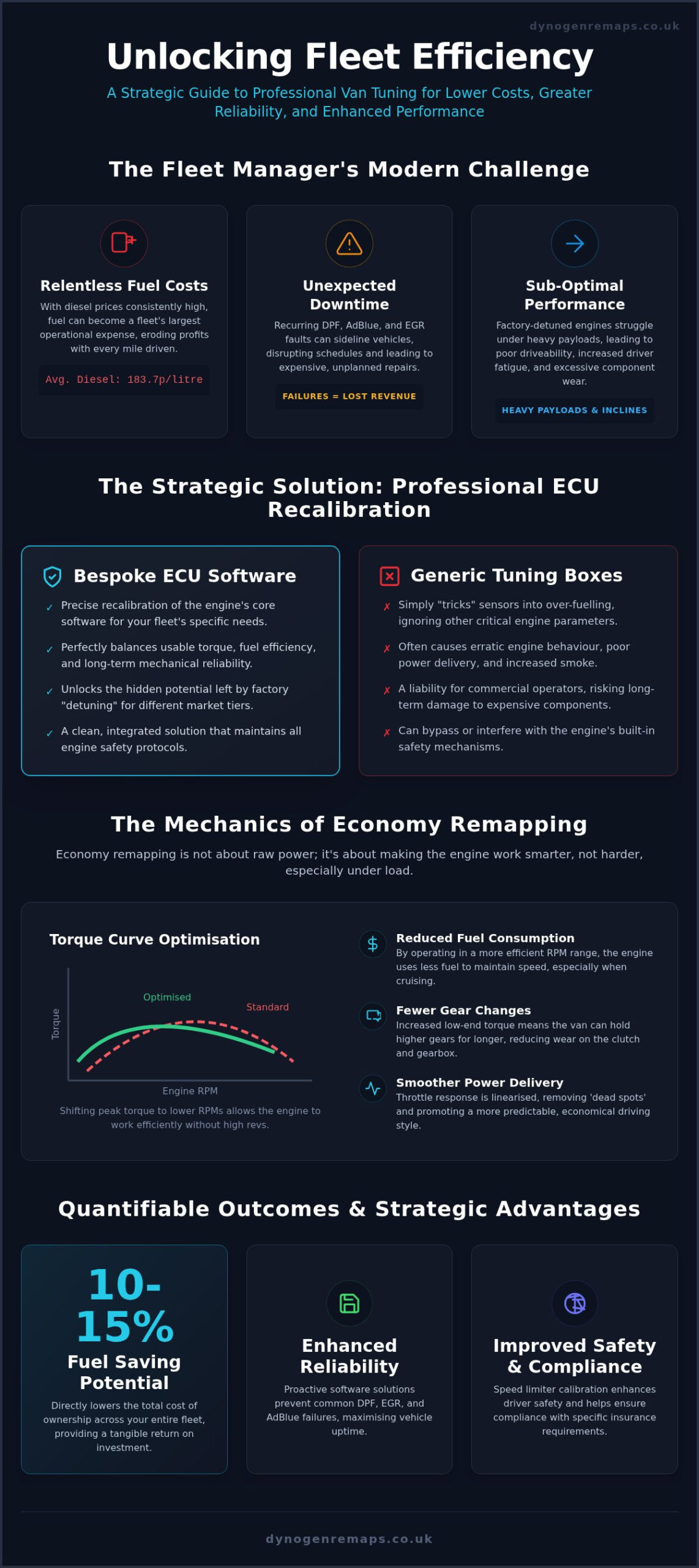
- Discover the potential for a 10-15% reduction in fuel consumption and how these savings significantly lower the total cost of ownership across your entire fleet.
- Explore software-based solutions for DPF, EGR, and AdBlue systems that proactively prevent common emissions-related failures and expensive vehicle downtime.
- Identify the strategic advantages of speed limiter calibration for enhancing driver safety and ensuring fleet compliance with various insurance requirements.
Optimising Fleet Performance with Professional Fleet Van Tuning in the North West
Professional fleet van tuning North West involves the precise recalibration of a vehicle’s Engine Control Unit (ECU) to meet specific commercial requirements. Whilst a private owner might pursue maximum speed, a fleet manager requires a sophisticated balance between usable torque, fuel efficiency, and long-term mechanical reliability. Many modern vans leave the factory “detuned” by the manufacturer. This is often done to create different power tiers for marketing or tax purposes, meaning two vans with identical hardware might have vastly different outputs. Dynogen acts as a seasoned specialist, using over 15 years of technical expertise to remove these artificial limitations through bespoke software. We unlock the hidden efficiency that factory settings often leave on the table.
The Role of ECU Software in Modern Fleet Management
The ECU functions as the digital brain of the vehicle, constantly managing critical parameters such as fuel injection timing, ignition cycles, and turbo boost pressure. Modern engine tuning has evolved significantly from the days of soldering physical chips into a circuit board. Today, we utilise advanced software interfaces to rewrite the internal logic of the engine directly. A custom map is essential for commercial operations because it accounts for the specific wear patterns and duty cycles of your vehicles. Generic tuning boxes that merely “trick” sensors into delivering more fuel are a liability for any commercial operator. These devices often cause erratic engine behaviour and long-term damage. A professional remap provides a clean, integrated solution that maintains the integrity of the engine’s safety protocols whilst delivering smoother power delivery.
Performance vs. Economy: Identifying Your Fleet’s Primary Goal
Choosing between a Stage 1 Performance Remap and a dedicated Economy Remap for your fleet van tuning North West project depends entirely on your operational profile. For fleets operating heavily laden vehicles, the “sweet spot” often lies in increasing low-end torque. This allows the van to maintain speed on inclines or during overtakes without the driver needing to drop a gear. Fewer gear changes directly translate to reduced clutch wear and lower fuel consumption across the year. Models like the Ford Transit or Volkswagen Transporter see significant improvements in driveability when the torque curve is smoothed out. By aligning the software with the vehicle’s typical payload, we ensure the engine operates within its most efficient window at all times. This strategic approach ensures your fleet remains productive whilst keeping maintenance costs under control.
Economy Remapping: The Mechanics of Achieving Better MPG
Economy remapping targets the engine’s torque curve to extract maximum work from every drop of fuel. By recalibrating fuel injection timing and turbo boost delivery, we ensure the engine operates at its peak thermal efficiency during typical commercial driving cycles. This process often involves throttle response linearisation. This technical modification removes the dead spots or aggressive surges often found in factory pedal maps, promoting a smoother and more economical driving style. For a deeper look at specific vehicle benefits, our Van Remapping for Better MPG guide offers comprehensive model-specific data.
Torque Optimisation for Heavy Payloads
Increasing low-end torque is the cornerstone of effective fleet van tuning North West. When a van is fully loaded, the engine often struggles to maintain momentum in higher gears, forcing the driver to downshift frequently. This constant gear hunting is a primary driver of high fuel consumption. By shifting the torque delivery lower down the RPM range, vehicles can remain in fifth or sixth gear for longer, even when navigating the rolling terrain common in UK logistics. This steady-state cruising significantly reduces the load on the drivetrain. It’s a strategic move that also limits wear on the clutch and gearbox, extending the service life of these expensive components. Smooth power delivery ensures that the engine isn’t being over-worked, which is essential for maintaining a healthy fleet over high annual mileages.
Custom Calibration for Real-World Commercial Driving
Generic tuning files often ignore the physical realities of commercial use, such as the increased aerodynamic drag of high-roof bodies or the constant weight of internal racking and tools. Our process involves per-vehicle software tuning that respects the specific duty cycle of your fleet. This level of precision is vital as the industry adapts to the UK government’s van emission regulations, which place greater emphasis on real-world efficiency. We don’t just apply a template; we calibrate for the road. With over 15 years of experience, we understand how to balance these parameters without compromising the vehicle’s safety protocols. You can find more about our methodology in our Diesel Economy Tuning UK pillar. If you want to see how these technical adjustments translate to your specific models, exploring our Economy Remap options is the first step toward a more profitable fleet.
Calculating the ROI: Fuel Savings and Total Cost of Ownership
Investing in professional fleet van tuning North West shifts the focus from a simple modification to a strategic asset optimisation. When you analyse the financial impact of a 10-15% fuel saving across a fleet, the numbers become impossible to ignore. For an operator with 10 vans, the savings are substantial; for those managing 50 or 100 vehicles, the cumulative effect can redefine annual profit margins. Beyond the pump, optimised engine behaviour reduces the frequency of emissions-related faults, which are often the most expensive and time-consuming repairs for modern diesel fleets. By refining how the engine handles combustion and exhaust gas recirculation, we can significantly extend the operational life of each vehicle. This delays the need for expensive fleet replacement cycles, keeping your capital where it belongs. A professionally calibrated fleet remap often pays for itself within the first six months of fuel savings alone.
The ROI of a Ford Transit Economy Remap
As the UK’s most popular commercial vehicle, the Ford Transit represents a major portion of our workload. Our Ford Transit Economy Remap Case Study provides hard data on the MPG gains achievable through precise software calibration. We pay particular attention to the 2.0 EcoBlue engines found in newer models. These units are highly sophisticated but often restricted by factory settings that don’t account for the heavy payloads or high-mileage demands of British logistics. By adjusting the fuel injection maps and turbo pressure specifically for this engine architecture, we achieve a smoother power delivery that naturally encourages more efficient driving. This isn’t just about peak power; it’s about making the van easier to drive under load, which reduces the strain on every mechanical component.
Reducing Fleet Downtime with Software Reliability
Every hour a van spends in “limp mode” is an hour of lost revenue and broken promises to your customers. Vehicle downtime is a silent profit killer that many managers accept as an inevitability of modern diesel ownership. However, fleet van tuning North West provides a proactive maintenance strategy. Software-based emissions corrections target the root causes of roadside breakdowns, such as DPF clogging or AdBlue system errors. Instead of waiting for a fault to occur, we calibrate the ECU to manage these systems more effectively. This reduces the likelihood of emergency repairs and keeps your team on the road, where they are most productive. Professional remapping turns a reactive repair cycle into a controlled, high-performance operation.
Technical Solutions for Fleet Reliability: DPF, EGR, and Speed Limiters
Professional fleet van tuning North West serves as a critical safeguard against the most common causes of commercial vehicle downtime. Modern diesel engines are equipped with complex emissions hardware that, whilst well-intentioned, often becomes a primary source of operational failure. Our technical interventions focus on the digital management of these systems to ensure your vehicles remain on the road rather than in the workshop. By addressing software-driven faults at the source, we provide a level of reliability that standard dealership updates simply cannot match. It’s essential to recognise that these specific software adjustments for emissions components are designed for off-road applications or very specific legal use cases, ensuring your business remains transparent and compliant.
Managing Emissions Systems via Software
The EGR (Exhaust Gas Recirculation) valve is a frequent point of failure, often succumbing to heavy carbon buildup that eventually chokes the engine. Our EGR Solution involves recalibrating the software to prevent this accumulation, which effectively eliminates the risk of related engine damage and expensive replacement costs. Similarly, our DPF Solution addresses the software logic that triggers “limp mode” when a filter becomes restricted. Instead of facing thousands of pounds in hardware replacement, we can often correct the fault through the ECU. Perhaps most importantly for modern fleet managers, our AdBlue Solution resolves the dreaded “non-start countdown”. This software-controlled lockout can ground a vehicle entirely, but our expertise allows us to recalibrate the system to prevent these disruptive countdowns from halting your operations.
Speed Limiter Removal and Rev Limitation
Calibrating speed and rev limiters is a strategic decision that impacts both safety and engine longevity. Whilst some operational requirements necessitate Speed Limiter Removal to allow for greater flexibility, many fleet managers opt for standardised speed caps across their entire inventory. This approach is highly regarded by insurance providers and directly promotes safer driver behaviour. Rev limiters are also particularly effective at preventing drivers from over-stressing the engine through aggressive acceleration. This simple software adjustment reduces wear on the turbocharger, clutch, and braking system, significantly lowering your long-term maintenance overheads. By enforcing a disciplined driving profile through the ECU, you protect your capital investment and ensure a more predictable service life for every van. If you’re ready to secure your fleet’s reliability, exploring our specialist technical solutions is the best way to start.
Why Dynogen is the Specialist Choice for UK Fleet Van Tuning
With over 15 years of industry-leading experience, Dynogen has established itself as the premier provider of fleet van tuning North West. We’ve witnessed the evolution of automotive technology firsthand, from the early days of basic fuel maps to the highly sophisticated, interconnected ECU architectures of today. This historical perspective allows us to navigate modern mechanical complexities with a level of professional confidence that generic “tuning box” providers simply cannot match. We treat every vehicle as a unique commercial asset. Our reputation is built on a steadfast commitment to delivering measurable results for businesses across the UK, ensuring that every remap is a strategic investment in both efficiency and long-term mechanical longevity.
Expert Vehicle Tuning Services: The Dynogen Process
Our methodical approach begins with a comprehensive diagnostic health check. We don’t just overwrite software; we verify that the vehicle’s hardware, including critical sensors and turbocharger components, is in peak condition to handle the recalibration. This ensures that every Stage 1 or Economy Remap is built on a solid foundation of mechanical health. Once the health check is complete, we use advanced interface equipment to read the existing ECU data safely. Our specialists then create a custom-calibrated file tailored to your specific fleet requirements, rather than using generic, one-size-fits-all templates. This bespoke software is written back to the vehicle and followed by a rigorous final verification phase. We address common concerns about reliability in our Safe Engine Tuning UK guide, which provides expert insights into how we maintain factory-level safety protocols whilst enhancing performance.
A Partner in Your Fleet’s Success
Choosing Dynogen means securing a long-term technical partner dedicated to your operational success. We understand that fleet managers need more than just a one-off service; they require ongoing technical advice to help navigate the changing landscape of vehicle emissions and efficiency standards. Our booking process is designed for maximum convenience, allowing for minimal disruption to your daily business operations. We pride ourselves on being accessible and competitive, positioning our elite technical skills as a superior alternative to standard corporate or dealership options. Whether you’re managing a small local team or a national logistics operation, we provide the meticulous attention to detail your business deserves. Contact Dynogen today to discuss your fleet requirements and request a bespoke quote.
Securing the Future of Your Fleet with Strategic Calibration
Professional fleet van tuning North West represents more than a simple efficiency upgrade; it is a fundamental shift towards a more resilient and profitable business model. By prioritising bespoke ECU recalibration over generic alternatives, you secure a tangible return on investment through significant fuel savings and reduced mechanical wear. We have explored how targeting the torque curve and resolving emissions software faults proactively prevents the downtime that often erodes commercial margins. With over 15 years of technical remapping expertise, Dynogen provides the specialised knowledge required to protect your assets whilst maximising their output.
Every vehicle in your fleet holds untapped potential for greater efficiency and reliability. Our commitment to custom-calibrated software and specialist DPF and AdBlue solutions ensures that your operations remain smooth, compliant, and cost-effective. It’s time to move beyond standard factory restrictions and embrace a technical standard that matches your professional ambitions. Optimise your fleet today with Dynogen’s expert remapping services and experience the pursuit of perfection in vehicle performance. We look forward to helping you transform your operational costs into a strategic advantage.
Frequently Asked Questions
How much fuel can I realistically save with fleet van tuning?
Fleet managers typically achieve fuel savings of between 10% and 15% through professional fleet van tuning. This improvement is achieved by recalibrating the engine’s torque curve to allow for more efficient operation at lower RPMs. Whilst individual results vary based on vehicle load and driver behaviour, the cumulative impact across a large inventory often results in thousands of pounds saved annually. It’s a strategic software adjustment that targets the specific duty cycle of your commercial vehicles.
Will remapping my fleet vans void the manufacturer’s warranty?
Remapping can potentially affect a manufacturer’s warranty if the modification is detected during a service or repair. Whilst we use sophisticated equipment to ensure our software remains as discreet as possible, most manufacturers officially discourage third-party ECU modifications. We recommend that fleet managers check their specific warranty terms before proceeding. However, many operators find that the significant fuel savings and reduced downtime far outweigh the theoretical risks associated with dealership-level restrictions.
Is remapping safe for high-mileage diesel vans?
Remapping is safe for high-mileage diesel vans provided the vehicle undergoes a thorough diagnostic health check first. Our process ensures that critical components like the turbocharger and fuel injectors are in good working order before we apply any software changes. For older vehicles, an Economy Remap can actually improve longevity by smoothing out power delivery and reducing the strain on the drivetrain during heavy-load scenarios common in logistics.
How long does the remapping process take per vehicle?
The remapping process generally takes between one and two hours per vehicle to complete safely. This timeframe includes the initial diagnostic scan, the reading of the original ECU data, the application of the custom-calibrated software, and a final verification test. We understand that vehicle downtime is a critical concern for businesses. Therefore, we organise our workflow to ensure minimal disruption to your daily operations whilst maintaining our high standards of technical precision.
Can you remove speed limiters on all van makes and models?
We can provide Speed Limiter Removal for the vast majority of modern van makes and models currently on the UK market. Whether you’re operating a Ford Transit, Mercedes Sprinter, or Volkswagen Crafter, our software tools allow us to adjust or remove these restrictions based on your specific operational requirements. Conversely, we can also install standardised speed caps across your fleet to promote safer driving habits and potentially lower your insurance premiums.
What happens if I am not happy with the results of the remap?
If you aren’t completely satisfied with the results, we can revert your vehicle’s software back to its original factory settings. We take great pride in our workmanship and aim for total customer satisfaction through our bespoke calibration process. If the performance or economy gains don’t meet your expectations, we’ll work closely with you to adjust the software parameters until the desired balance of efficiency and responsiveness is achieved.
Do you offer mobile fleet remapping services across the North West?
Yes, we provide mobile fleet van tuning North West services to ensure maximum convenience for our commercial clients. Our specialists can visit your business premises or a central depot to perform the remapping on multiple vehicles in a single session. This mobile capability eliminates the need for you to coordinate vehicle logistics or lose time transporting vans to a workshop, keeping your team productive and focused on their core tasks.
Can remapping help with recurring DPF and AdBlue warning lights?
Remapping is an exceptionally effective way to resolve recurring DPF and AdBlue warning lights that often plague modern diesel fleets. Our specialist DPF Solution and AdBlue Solution target the software logic responsible for triggering “limp mode” or non-start countdowns. By recalibrating how the ECU manages these emissions systems, we can prevent these faults from occurring in the first place, significantly reducing your emergency repair costs and unscheduled vehicle downtime.