
You have spent the last hour cruising the motorway at high revs, hoping to trigger a regeneration, yet the DPF warning light on dashboard remains stubbornly illuminated. It’s a sinking feeling that often precedes a dreaded loss of power and a dealership quote for a replacement filter that can easily exceed £1,000. We recognise the immense frustration of a vehicle stuck in limp mode, particularly when you’ve followed every recommendation to keep the system clear. You shouldn’t be forced into a cycle of expensive, temporary fixes that fail to address the underlying software management issues.
This article reveals the precise reasons why your filter is failing and how professional software solutions provide a definitive fix for persistent exhaust errors. We’ll move beyond basic mechanical cleaning to explore how custom-calibrated coding can restore your engine’s original responsiveness and long-term reliability. You’ll discover exactly how we apply fifteen years of technical expertise to clear your dashboard and eliminate the threat of future blockages, ensuring your driving experience remains as smooth and efficient as intended. By understanding the intersection of mechanical hardware and sophisticated software, you can finally reclaim your vehicle’s performance without the constant fear of another breakdown.
Key Takeaways
- Identify the critical distinctions between amber and red alerts to understand when your vehicle requires immediate professional intervention.
- Discover why a DPF warning light on dashboard often persists despite motorway driving due to underlying mechanical faults or sensor errors.
- Evaluate the limitations of temporary chemical cleaning against the long-term reliability of a bespoke software-based DPF Solution.
- Learn how custom-calibrated ECU coding can permanently resolve restrictive limp mode issues and restore your engine’s original power.
- Understand the specific diagnostic error codes that signal a critical blockage and why standard scanners often fail to provide a definitive fix.
Understanding the DPF Warning Light on Your Dashboard
The appearance of a DPF warning light on dashboard displays is rarely a welcome sight, yet it serves as a critical communication channel between your engine’s management system and the driver. Essentially, the Diesel Particulate Filter (DPF) is a sophisticated soot-trapping component integrated into the exhaust stream, designed to prevent harmful particulate matter from entering the atmosphere. The DPF is a mandatory emissions component that requires specific thermal conditions to function. When these conditions aren’t met, the Engine Control Unit (ECU) triggers a visual alert to prevent permanent hardware damage. Professional diagnostics are vital here; the light doesn’t always signal a full filter, but rather a system that can no longer manage its own cleaning cycle.
If the soot loading exceeds a safe threshold, the ECU will often initiate “limp home” mode. This is a protective state where the computer restricts engine power, limits RPM, and sometimes disables certain comfort features like cruise control. It’s a safeguard designed to reduce exhaust gas temperatures and pressures, preventing the filter from melting or cracking under extreme restriction. Whilst frustrating, this mode is your vehicle’s way of telling you that the emissions circuit requires immediate expert attention before a minor blockage becomes a catastrophic failure.
The Different Stages of DPF Warnings
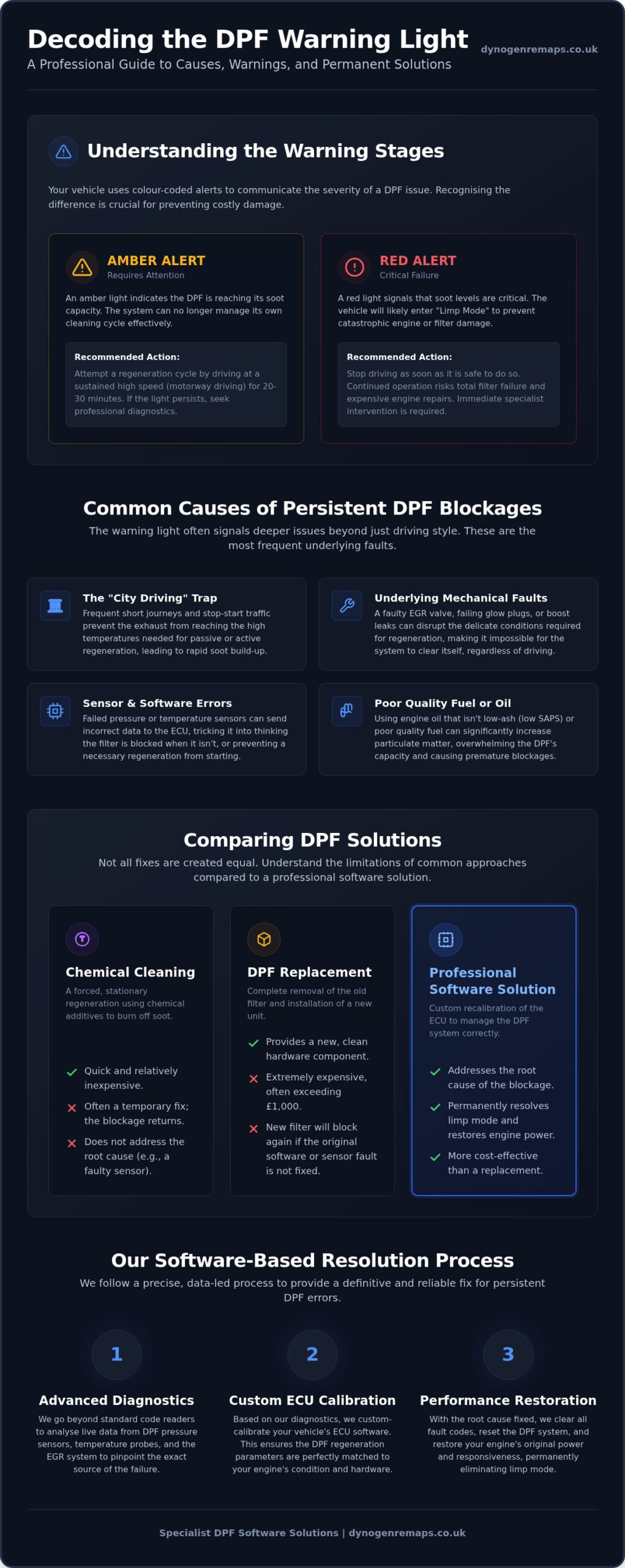
Drivers must recognise that not all alerts carry the same weight. An amber light typically indicates that the filter is reaching its capacity and requires a dedicated regeneration cycle, usually achieved through a sustained high-speed drive. Conversely, a red light signifies that soot levels have reached a critical state, and continued driving could lead to total engine failure. If you see a flashing light or the general engine management icon alongside the DPF symbol, it often indicates a secondary fault within the emissions circuit. These software-related errors, such as a failed pressure sensor, can often mimic a physical blockage, making addressing a DPF warning light on dashboard clusters a task for a specialist rather than a general mechanic.
Why Modern Diesel Engines Rely on DPF Health
The integration of these filters is central to meeting stringent Euro 6 emissions standards, which dictate near-zero particulate output. To manage this, the ECU constantly monitors pressure differentials across the filter; if the pressure before the filter is significantly higher than after, the system knows a restriction is present. Maintaining this balance is vital for performance. There is a direct link between DPF health and Diesel economy tuning UK specialists often highlight. A clean, efficient filter reduces backpressure, allowing the turbocharger to work more effectively and ensuring the engine operates at its peak efficiency. When the DPF is compromised, fuel economy suffers as the engine struggles to breathe against the restriction.
Common Causes of Persistent DPF Blockages
While many believe the DPF warning light on dashboard symbols are purely a result of driving style, the reality is often more complex. The “City Driving” trap is a well-documented catalyst for filter failure. Frequent, stop-start urban commutes prevent the exhaust gas from reaching the high temperatures required to incinerate soot naturally. However, mechanical integrity plays an equally critical role. A faulty Exhaust Gas Recirculation (EGR) valve or compromised glow plugs can halt the regeneration process entirely, regardless of how fast you drive. Additionally, the use of poor-quality fuel or the incorrect grade of engine oil significantly accelerates soot accumulation, overwhelming the filter’s capacity.
Short Journeys and Incomplete Regeneration
Understanding how your vehicle manages soot is essential for maintaining performance. Passive regeneration occurs naturally during high-load driving, whilst active regeneration is a software-controlled process where the ECU injects extra fuel to artificially raise temperatures. If you frequently stop the engine mid-cycle, you risk aborted regenerations that lead to severe blockages. This Beginner’s Guide to DPFs explains the fundamental mechanics behind these cycles. Crucially, a simple “20-minute motorway run” often fails to clear a deep-seated blockage once the soot has hardened. These failed cycles also cause diesel to leak into the sump, leading to oil dilution that can be disastrous for engine bearings.
Mechanical Faults That Mimic DPF Failure
In many cases, the hardware is actually clear, but faulty electronics trigger a false alarm. Differential pressure sensors are the most frequent culprits; if they provide inaccurate data, the ECU will assume a blockage and trigger a DPF warning light on dashboard alert. Similarly, a leaking turbocharger can introduce oil into the exhaust stream, which “poisons” the DPF substrate and creates a sticky residue that standard regeneration cannot burn off. Excessive carbon build-up in the EGR valve also leads to soot-heavy combustion, creating a cycle of constant restriction. If you are experiencing recurring issues despite frequent long drives, our expert DPF Solution can identify whether the fault is physical or digital, providing a permanent fix that dealerships often overlook. By addressing the root software or sensor cause, we restore your vehicle to its peak operating standard.
Comparing Solutions: Cleaning vs. Replacement vs. Software
When the DPF warning light on dashboard clusters begins to glow, most drivers face a difficult decision between three primary paths. Chemical cleaning provides a temporary reduction in soot levels but fails to address the non-combustible ash that naturally accumulates over time. Whilst it might temporarily extinguish the alert, it’s often a short-term reprieve that ignores the underlying cause of the blockage. The traditional dealership route involves a total DPF replacement, which frequently costs upwards of £1,000 for a new OEM filter. For high-mileage diesel owners, this is rarely a sustainable strategy. Professional software solutions offer a more sophisticated alternative by recalibrating how the ECU interacts with the emissions hardware, ensuring long-term reliability without the recurring costs of physical components.
Professional DPF Solutions focus on the digital logic governing the exhaust system. By using advanced software coding to adjust the ECU’s parameters, we can eliminate the software-induced limp mode that plagues so many modern diesels. This method is particularly effective for those who have already tried physical cleaning only to find the light returning within weeks. It addresses the root cause: the software’s inability to manage the hardware’s current state. Amongst veteran drivers and fleet operators, this software-first approach is increasingly recognised as the only way to ensure a vehicle remains on the road rather than in the workshop.
The Limitations of Forced Regeneration and Cleaning
Forced regeneration is a process where a garage uses diagnostic tools to command the vehicle to run at high temperatures whilst stationary. This puts immense thermal stress on the engine and turbocharger, often shortening the lifespan of critical components. Off-the-shelf additives are similarly limited; they may lower the combustion temperature of soot, but they cannot remove a deep-seated blockage or clear out ash. Cleaning is essentially a sticking plaster for a deeper software or mechanical fault. Without addressing the sensor errors or coding issues that caused the initial soot build-up, the DPF warning light on dashboard displays will inevitably return.
Professional DPF Software Solutions for Reliability
Specialist software coding resolves persistent dashboard errors and limp mode by providing a permanent fix that physical cleaning cannot match. We often integrate this DPF management with a Stage 1 remap, which enhances engine responsiveness whilst optimising the emissions circuit. This dual approach ensures the vehicle remains reliable for high-performance or heavy-duty use, providing a level of precision that generic, off-the-shelf files simply cannot provide. By choosing a custom-calibrated DPF Solution, you invest in the long-term health of your vehicle’s engine and ensure it operates with the smoothness and efficiency intended by the manufacturer.
Dealing with Limp Mode and ECU Error Codes
The sudden activation of a DPF warning light on dashboard displays is often accompanied by specific diagnostic trouble codes (DTCs) that reside deep within the ECU’s memory. Codes such as P242F, indicating critical ash accumulation, or P2452, relating to pressure sensor circuit malfunctions, are the most frequent triggers. Whilst a standard OBDII scanner might allow you to view these errors, it often fails to clear permanent emissions faults. This is because the ECU’s logic is designed to maintain a “hard lock” on certain safety-critical errors until it receives a specific handshake or sees a physical change in pressure data. Simply erasing a code without addressing the software logic is a dangerous shortcut; it leaves the vehicle vulnerable to immediate power loss the moment the system re-evaluates its sensors. At Dynogen, we utilise dealer-level diagnostic equipment to pinpoint the exact failure point, ensuring we aren’t just treating a symptom but solving the architectural flaw.
What to Do When Your Car Enters Limp Mode
If your car enters limp mode on a motorway, safety must be your absolute priority. The sudden loss of acceleration can be jarring, so you should move to the hard shoulder or a safe refuge area as soon as it’s practical. Never ignore a red DPF light, even if the vehicle seems to drive normally at low speeds. A severely restricted filter causes massive backpressure and extreme heat. This doesn’t just kill your fuel economy; it risks total turbocharger failure or, in extreme cases, an engine bay fire. Ignoring the warning signs turns a manageable software correction into a mechanical catastrophe. Once the car is in a safe position, seeking a specialist diagnostic check is the only way to prevent permanent hardware damage. If the vehicle is no longer safe to drive, using a specialist service such as Bernabe Towing & Recovery ensures it is transported correctly to a workshop for repair.
Dealership technicians are typically trained to follow a rigid “replace” protocol, which often results in a recommendation for a new filter costing thousands. In contrast, specialists like Dynogen are trained to “solve” the logic problem. There is a fundamental difference between generic fault finding and the deep ECU architecture analysis we perform. By using custom software calibration, we can prevent the car from re-entering limp mode repeatedly. This bespoke approach ensures the emissions system works in harmony with the engine’s current state. If you are tired of recurring dashboard errors, our professional DPF Solution provides the definitive answer that standard garages cannot offer. We focus on restoring the driving experience through technical excellence rather than just swapping expensive parts.
How Dynogen Resolves Persistent DPF Issues via Software
The Dynogen approach to resolving a DPF warning light on dashboard alert is methodical and rooted in deep technical analysis. We begin with professional diagnostic labour using dealer-level equipment to verify that the fault is indeed software-related or sensor-based. Once the root cause is identified, we apply custom software coding to the ECU. Unlike generic, low-quality software “patches” that often provide a temporary fix, our solutions involve bespoke file calibration. This ensures the engine’s management system is perfectly aligned with the vehicle’s hardware state. By addressing the logic errors directly, we provide a definitive fix that restores engine efficiency and prevents the recurrence of limp mode.
One of the most significant ECU remapping benefits is the complete restoration of throttle response and drivability. When a filter is restricted, the ECU often retards timing and limits boost to protect the system. Our DPF Solution recalibrates these parameters, allowing the vehicle to breathe freely again. This is a vital technical fix for vehicles used in demanding environments, such as heavy towing or long-distance haulage, where reliability is paramount. We focus on the long-term health of the vehicle, ensuring that every software modification remains within safe operating limits whilst delivering peak performance.
The Dynogen Technical Advantage
Our team brings 15 years of experience in managing complex engine control unit software to every vehicle we service. This longevity in the industry allows us to act as a Seasoned Specialist, identifying nuances in coding that standard garages frequently miss. We pride ourselves on workmanship that prioritises precision over speed, ensuring that every software modification is safe and effective. By choosing a specialist solution, you eliminate the dashboard anxiety that comes with recurring warning lights, replacing it with the confidence of a professionally tuned machine. Our commitment to technical excellence means your vehicle leaves our centre in a superior state to when it arrived.
Combining DPF Solutions with Performance Tuning
Many of our clients choose to increase engine torque and power whilst we are resolving their emissions faults. There is a natural synergy between a healthy exhaust flow and a custom Stage 1 map; once the software restriction is removed, the engine can safely handle higher performance parameters. This combination not only clears the DPF warning light on dashboard cluster but also transforms the vehicle’s power delivery. It’s a comprehensive upgrade that addresses both reliability and enjoyment. If your vehicle is currently restricted by emissions errors or lacklustre performance, it is time to seek a specialist opinion. Book a diagnostic consultation with the Dynogen team today to clear your dashboard for good and rediscover your vehicle’s true potential.
Restore Your Engine’s Performance and Reliability
Addressing a persistent DPF warning light on dashboard requires more than just a high-speed drive or a temporary chemical clean. We’ve explored how complex software logic and sensor inaccuracies often underpin these alerts, making a bespoke DPF Solution the most effective path to long-term reliability. By choosing advanced software-based emissions fault correction, you avoid the exorbitant costs of dealership hardware replacements whilst ensuring your engine operates with peak efficiency.
Our team brings over 15 years of technical tuning expertise to every vehicle, utilising specialist diagnostics for all major UK vehicle makes to identify the exact failure point. We don’t just clear codes. We recalibrate the ECU’s architecture to eliminate the threat of limp mode for good. This precision-engineered approach restores your throttle response and provides the peace of mind that only comes from expert workmanship and a deep pride in results.
Resolve your DPF dashboard errors today with Dynogen Remapping Solutions and reclaim the smooth, powerful driving experience your vehicle was designed to deliver. It’s time to stop managing symptoms and start solving the problem with a permanent, professional fix.
Frequently Asked Questions
Can I drive with the DPF warning light on?
Driving with an amber DPF light is generally safe for a short duration, provided you intend to perform a regeneration cycle immediately. However, if the light turns red or begins to flash, you must stop as soon as it is safe to do so. Ignoring these alerts frequently leads to the vehicle entering limp mode, which significantly restricts engine power. Continued use with a blocked filter risks severe engine damage and expensive turbocharger failure due to excessive exhaust backpressure.
How long does a DPF regeneration take whilst driving?
A complete active regeneration cycle typically requires between 15 and 30 minutes of uninterrupted driving. To initiate this process, the engine must reach a specific operating temperature, usually achieved by maintaining a steady speed of at least 40mph. It’s important to keep the engine speed above 2,000 RPM during this time to ensure the exhaust gases are hot enough to burn off the trapped soot. Frequent short trips prevent this cycle from completing, leading to persistent blockages.
What is the difference between a DPF clean and a DPF software solution?
A DPF clean is a physical intervention that uses high-pressure chemicals or thermal processes to remove accumulated soot and ash. Whilst this can be effective, it’s often a temporary sticking plaster for a deeper issue. A professional DPF Solution involves recalibrating the ECU’s internal coding to manage how the vehicle handles emissions data. This digital approach resolves the root cause of persistent dashboard errors and limp mode, providing a far more reliable and permanent technical fix.
Will a DPF software fix affect my MOT?
Current UK MOT regulations state that a diesel particulate filter must be present and show no signs of tampering to pass the inspection. Any physical removal of the filter substrate will result in a major failure and potential legal fines. Our software-based solutions focus on correcting the ECU’s internal logic and resolving persistent dashboard errors. We always recommend that clients maintain their vehicle’s emissions integrity to ensure full compliance with the latest 2026 inspection standards.
Why does my DPF light keep coming back after being cleared?
When a DPF warning light on dashboard displays returns quickly, it’s a clear sign that the underlying cause of the soot build-up hasn’t been addressed. Simple code clearing only removes the notification, not the fault. Issues such as a sticking EGR valve, faulty glow plugs, or sensor malfunctions will continue to overwhelm the filter. A specialist diagnostic session is required to identify these mechanical or software failures, ensuring a permanent fix rather than a temporary reset.
Can a faulty sensor cause a DPF light even if the filter is clean?
A faulty differential pressure sensor is a very common cause of a false DPF warning light on dashboard alert. These sensors are responsible for measuring the pressure drop across the filter to estimate soot levels. If the sensor fails or provides inaccurate data, the ECU will assume the filter is blocked, even if it is physically clear. This often triggers an unnecessary limp mode, demonstrating why expert software diagnostics are vital before considering expensive hardware replacements or cleans.
How much does it cost to fix a DPF warning light issue?
The cost of resolving a DPF issue varies depending on the specific nature of the fault. Initial diagnostic checks to identify the root cause typically follow standard industry rates, whilst specialist software solution fees depend on the complexity of your vehicle’s ECU. These professional services represent a significant saving compared to dealership replacements, which often cost between £1,000 and £3,500. Choosing a software-based fix ensures you aren’t paying for recurring temporary cleans that fail to solve the underlying problem.
What is the best way to prevent DPF blockages in the future?
The most effective way to prevent future blockages is a combination of regular long-distance driving and the use of high-quality, low-SAPS engine oils. Specialists such as San Juan Auto Smog recommend regular synthetic oil changes as a key part of maintaining an efficient emissions system. Aim for a weekly motorway journey of at least 30 minutes to allow the system to perform a natural regeneration cycle. Additionally, ensuring your engine is correctly tuned and that components like the EGR valve are clean will reduce soot production. For many, a custom DPF Solution provides the final layer of long-term reliability.