

Your vehicle’s diesel particulate filter is far more than a simple exhaust component; it is the heart of a sophisticated emissions ecosystem that, when failing, signals a deeper software or mechanical imbalance. If you have encountered a sudden loss of throttle response or the frustrating onset of limp mode, you are likely witnessing the primary symptoms of a blocked DPF. We recognise the anxiety that follows a glowing dashboard warning, especially when faced with the prospect of exorbitant dealership repair costs and confusing technical jargon regarding regeneration cycles.
We believe that every driver deserves absolute certainty in their vehicle’s performance and efficiency. This guide will help you identify the eight critical warning signs of a clogging filter whilst providing the technical clarity needed to address the root cause of the fault. A specialist software calibration offers a definitive resolution to these emissions errors, restoring the engine’s natural smoothness and responsiveness. We shall move through the diagnostic process methodically, ensuring you understand exactly why these faults occur and how to achieve a permanent fix in 2026.
Key Takeaways
- Recognise the primary indicators of filter failure, such as the amber dashboard warning and a sudden loss of throttle response, which are key symptoms of a blocked DPF.
- Understand how driving habits and oil specifications influence soot accumulation, allowing you to prevent premature clogging before it necessitates a costly repair.
- Learn why a professional software calibration offers a more definitive and reliable resolution than the temporary relief provided by forced regenerations.
- Identify the long-term mechanical risks of operating in limp mode, including the danger of engine oil dilution and excessive exhaust back-pressure.
- Discover how resolving emissions faults through a specialist DPF Solution can restore your vehicle’s efficiency and overall driving experience.
Understanding the Diesel Particulate Filter (DPF) and the Blockage Cycle
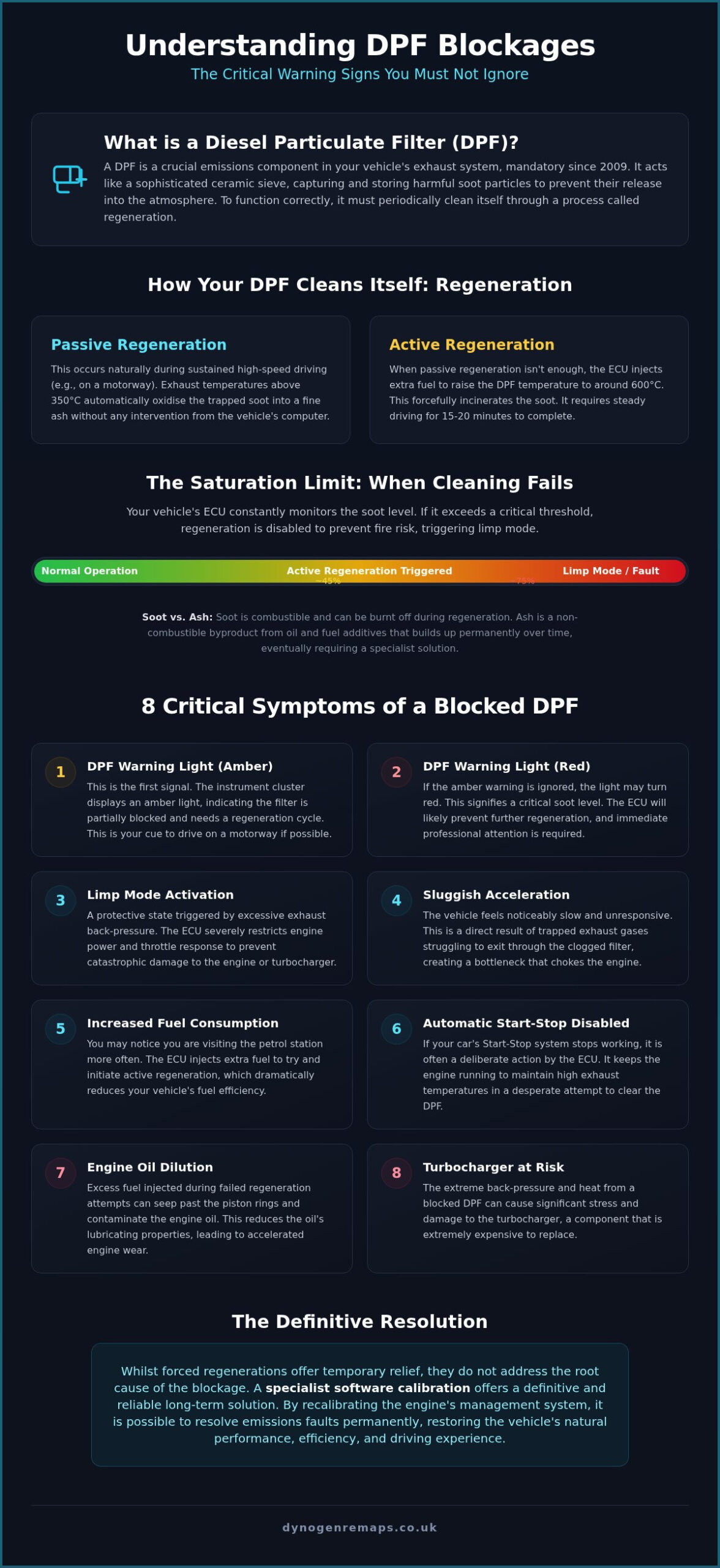
The Diesel Particulate Filter (DPF) is a precision-engineered component integrated into your exhaust system to capture and store soot. Since the implementation of Euro 5 emissions standards in 2009, these filters have been mandatory for diesel vehicles across the UK to reduce the volume of harmful particulate matter released into the atmosphere. A DPF operates as a sophisticated ceramic sieve, trapping microscopic carbon particles whilst allowing treated gases to pass through. It is a highly effective system, but it relies entirely on a delicate thermal balance to remain functional.
Whilst the filter is designed to store soot, it has a finite physical capacity. To prevent the unit from becoming a permanent restriction, the vehicle must periodically undergo a self-cleaning process. When this cycle is interrupted or fails due to mechanical faults, the “soot trap” effectively becomes a “soot plug,” causing significant back-pressure in the engine. Recognising the early symptoms of a blocked DPF is vital to preventing complete hardware failure and protecting your turbocharger from excessive heat soak.
Passive vs Active Regeneration: How Your Car Fights Blockages
Passive regeneration is the most efficient cleaning method and occurs naturally during sustained motorway driving. When the exhaust reaches a consistent “light-off” temperature, typically above 350°C, the trapped soot oxidises and turns into a fine ash without any electronic intervention. It is the cleanest way for your vehicle to maintain its emissions hardware.
Active regeneration is a more assertive software-driven process. If the Engine Control Unit (ECU) detects that the soot load has reached a specific threshold, usually around 45%, it will inject additional fuel into the cylinders during the exhaust stroke. This raises the internal filter temperature to approximately 600°C to incinerate the blockage. For this to succeed, the vehicle usually requires a minimum amount of fuel in the tank and a steady engine speed for roughly 15 to 20 minutes.
The Saturation Limit: When Cleaning is No Longer Possible
Your vehicle monitors soot accumulation through differential pressure sensors that compare the pressure before and after the filter. Once the soot load exceeds a critical safety threshold, often 75% or higher, the ECU will typically disable further regeneration attempts to prevent a potential fire risk. At this stage, the symptoms of a blocked DPF become undeniable as the car enters a restricted performance mode.
It is also essential to distinguish between soot and ash. Soot is combustible and can be cleared through heat; ash is the non-combustible byproduct of engine oil and fuel additives. Over time, ash accumulates permanently within the ceramic core. No amount of driving or forced regeneration can remove ash, making professional software-based DPF Solutions a more reliable long-term alternative to repeated, unsuccessful manual cleanings.
8 Critical Symptoms of a Blocked DPF You Should Not Ignore
Identifying the symptoms of a blocked DPF early is the definitive way to avoid catastrophic engine failure. When the filter becomes saturated, the instrument cluster typically displays an amber warning light, signalling that the system requires a regeneration cycle. If this warning is ignored, the light often turns red, indicating that the soot load has reached a critical level where the ECU can no longer safely manage the self-cleaning process. At this stage, the vehicle is often one step away from a total hardware shutdown.
A noticeable increase in fuel consumption and the sudden failure of your automatic Start-Stop system are also major indicators. The ECU logic here is highly specific; the vehicle disables the Start-Stop function to keep the engine running and maintain exhaust temperatures, whilst simultaneously over-fuelling the cylinders to attempt an active regeneration. If your car refuses to turn off at traffic lights, it is frequently a sign that the filter is desperately trying to clear itself. This persistent over-fuelling not only wastes diesel but can also lead to oil dilution, further endangering engine internals.
Performance and Drivability Warning Signs
Acceleration becomes noticeably sluggish as the trapped exhaust gases struggle to escape the ceramic core. You might find your vehicle suddenly entering Limp Mode, which is a protective software state triggered by excessive back-pressure within the exhaust system. In this state, the engine is typically restricted to a ceiling of 2,500 to 3,000 RPM to prevent the turbocharger from sustaining heat damage. This loss of throttle response makes overtaking difficult and suggests that the internal restriction has become severe. Professional diagnostics can confirm if a DPF Solution is the most effective way to restore this lost performance and eliminate the software restrictions.
Physical and Sensory Indicators of a Clogged Filter
Sensory signs provide immediate evidence of a failing system. An acrid diesel smell inside the cabin often indicates that exhaust gases are backing up and leaking through seals or gaskets due to high pressure. You may also observe excessive black smoke during acceleration, which is a clear sign of poor combustion caused by the lack of airflow through the pipe. Technical specialists are adept at explaining what DPF clogging is and how these physical signs relate to the internal saturation of the filter. Some drivers even report an unusual hissing sound from the engine bay as air attempts to force its way through the soot-clogged passages. If your vehicle exhibits these signs, the soot trap has likely reached its physical limit, and immediate technical intervention is required.
Why Your DPF is Blocked: Identifying the Root Technical Causes
The underlying causes of a saturated filter extend far beyond simple driving habits. Whilst frequent short journeys are a primary culprit, they only represent one facet of a complex mechanical failure. For the exhaust to reach the necessary “light-off” temperature for passive cleaning, the engine must operate under load for a sustained period. Without this heat, carbon particles simply accumulate until the symptoms of a blocked DPF become unavoidable. Professional diagnostics often reveal that the vehicle has been struggling to complete a cycle for hundreds of miles before the dashboard light finally illuminates.
Maintenance oversights often accelerate this decline. Using an incorrect engine oil that does not meet “Low SAPS” (Sulphated Ash, Phosphorus, and Sulphur) specifications leads to rapid, irreversible ash accumulation. Similarly, neglected glow plugs or a restricted air filter can disrupt the combustion process, resulting in excessive soot production that the DPF cannot handle. The differential pressure sensor also plays a critical role; if this sensor fails or provides inaccurate data, the ECU may never trigger a necessary regeneration, allowing the filter to clog completely whilst the software remains oblivious to the restriction.
The EGR Connection: How a Faulty Valve Kills Your DPF
A sticking Exhaust Gas Recirculation (EGR) valve is a silent DPF killer. By recirculating too much exhaust gas back into the combustion chamber to lower NOx emissions, a faulty valve significantly increases the volume of soot produced during every combustion stroke. This creates a vicious cycle where carbon buildup amongst various emissions components leads to total system failure. Integrating EGR valve software adjustments alongside a DPF solution is often the only way to break this cycle and ensure long-term engine health. Without addressing the EGR, any DPF repair is likely to be temporary.
Turbocharger Issues and Oil Leaks
Turbocharger Issues and Oil Leaks
Turbocharger health is inextricably linked to the state of your exhaust. If the turbo seals begin to fail, engine oil can leak directly into the exhaust stream, effectively “poisoning” the ceramic DPF substrate. This oil contamination creates a dense, sticky residue that no amount of heat can incinerate. Conversely, the high back-pressure generated by a blocked filter can cause premature wear on the turbocharger bearings by preventing the turbine from spinning freely. Addressing the symptoms of a blocked DPF without first rectifying an underlying oil leak is a wasted effort, as the filter will simply fail again within weeks. Precision diagnostics are essential to determine whether the DPF is the victim or the cause of your vehicle’s performance issues. For readers seeking comprehensive automotive support, My Auto Shop provides a trusted platform to find professional mechanics for such complex repairs.
Ignoring the early symptoms of a blocked DPF is a gamble that rarely pays off. When the filter reaches a state of total saturation, the resulting back-pressure forces exhaust gases back toward the turbocharger and engine valves, leading to catastrophic internal damage. In extreme cases, the intense heat generated during desperate, repeated regeneration attempts can even pose a genuine fire risk. Whilst many drivers hope that a spirited motorway drive will clear the restriction, this is often impossible once the ECU has locked the system into a permanent protective state. Professional software management, as discussed in our guide to Safe Engine Tuning UK, is the most effective way to prevent these hardware failures before they occur.
The financial burden of negligence is equally severe. A full DPF replacement at a main dealership can cost several thousand pounds, often making the repair unviable for older vehicles. Beyond the hardware itself, the labour involved in diagnostic testing and sensor replacement quickly accumulates. Choosing a specialist software resolution early is a far more strategic investment than waiting for the vehicle to become completely immobilised.
UK MOT Regulations and Legal Requirements in 2026
The legal landscape regarding emissions has tightened significantly. Modern MOT testing now involves a rigorous “Visual Inspection” to ensure the DPF canister is present and untampered, followed by a “Particulate Number” (PN) test. This electronic probe is incredibly sensitive; it detects microscopic levels of particulate matter that older smoke tests would miss. If you have “gutted” your filter or used a poor-quality bypass, your vehicle will face an immediate failure. It’s essential to remember that tampering with emissions equipment on road-going vehicles remains illegal and can result in substantial fines. We always advise drivers to seek professional software-based DPF Solutions that maintain compliance whilst resolving the underlying fault.
Engine Oil Dilution: The Silent Killer
One of the most dangerous results of a failing filter is oil dilution. When the ECU attempts an active regeneration, it injects excess diesel into the cylinders. If the cycle fails repeatedly, this unburnt fuel leaks past the piston rings and enters the oil sump. This thins the engine oil, destroying its lubricating properties and potentially leading to “engine runaway,” where the engine begins to consume its own sump oil as fuel. A “Service Required” light often accompanies the symptoms of a blocked DPF for this very reason; the car knows its oil is contaminated. If you’ve noticed your oil level rising, you must act immediately. Contact our specialist team today to book a professional diagnostic assessment and protect your engine from total failure.
Technical Software Solutions for Persistent DPF Issues
Many drivers mistakenly believe that a forced regeneration is the ultimate cure for exhaust restrictions. In reality, this process is often a temporary sticking plaster that fails to address the fundamental reason why the soot accumulated in the first place. If the underlying cause, such as a faulty differential pressure sensor or an imbalanced air-to-fuel ratio, remains uncorrected, the symptoms of a blocked DPF will inevitably return within a few hundred miles. A professional DPF Solution offers a far more robust alternative by addressing the software logic that governs these emissions cycles.
We frequently recommend combining these emissions fixes with a Stage 1 Performance Remap to fundamentally optimise engine efficiency. This dual approach doesn’t just clear the dashboard errors; it enhances the entire driving experience by improving thermal management and reducing the baseline soot production of the engine. By recalibrating the ECU to operate with greater precision, we ensure that the vehicle remains responsive and efficient, preventing the cycle of clogging from restarting.
Diagnostic-Led Software Calibration
Our process begins with a comprehensive interrogation of the Engine Control Unit (ECU) to identify the true culprit behind the failure. We don’t simply clear fault codes; we interpret live data to distinguish between physical hardware saturation and sensor misreporting. With over 15 years of technical expertise, our specialists develop custom software calibrations that manage emissions components with far greater precision than generic, off-the-shelf maps. This methodical approach ensures that the resolution is permanent and perfectly aligned with your vehicle’s mechanical state.
Restoring Drivability and Peace of Mind
A successful software intervention removes the vehicle from the restrictive confines of permanent Limp Mode, instantly restoring the throttle response and power delivery you expect. Beyond simply extinguishing the warning light, you will notice a significant improvement in fuel economy as the ECU stops wasting diesel on futile, high-temperature cleaning attempts. The engine regains its natural smoothness and responsiveness, allowing you to enjoy the driving experience without the constant fear of a breakdown. If you are tired of recurring dashboard errors and performance restrictions, enquire about a professional DPF Solution today to secure a definitive fix for your vehicle.
Restoring Peak Performance and Long-Term Reliability
Recognising the symptoms of a blocked DPF early is the definitive way to safeguard your vehicle’s engine and turbocharger from irreversible thermal damage. These warning signs are often cries for help from a sophisticated emissions system that requires more than a temporary forced regeneration or a spirited motorway drive. By addressing the root cause through precision diagnostics and advanced software calibration, you can eliminate persistent limp mode errors whilst ensuring your vehicle remains fully compliant with 2026 MOT particulate standards. This methodical approach doesn’t just clear dashboard lights; it restores the natural smoothness and efficiency of your diesel engine.
With over 15 years of technical expertise, our seasoned specialists provide specialised ECU software solutions that offer a superior alternative to costly dealership repairs. We provide national UK coverage to ensure every driver has access to elite-level tuning and professional emissions management. Get a Professional DPF Diagnostic and Solution from Dynogen today to reclaim your vehicle’s throttle response and efficiency. We are dedicated to ensuring your driving experience is as precise and responsive as the day your car left the factory.
Frequently Asked Questions
Can I drive my car with the DPF light on?
You should only drive with the DPF light on if you are immediately heading to a motorway or dual carriageway to perform a regeneration cycle. Continuing to drive in urban stop-start traffic whilst the light is illuminated will rapidly lead to total saturation. Once the light turns red or the vehicle enters limp mode, you must stop driving to prevent permanent turbocharger damage. Recognising these symptoms of a blocked DPF early is essential for avoiding catastrophic engine failure.
How much does it cost to fix a blocked DPF in the UK?
The cost to resolve a blocked filter varies significantly based on whether you choose a temporary cleaning or a permanent software resolution. Professional DPF cleaning typically costs several hundred pounds, whereas a full OEM replacement at a main dealership can reach into the thousands. Many drivers find that a specialist DPF Solution is a more cost-effective long-term investment, as it addresses the software logic that causes recurring blockages and performance issues.
Will a blocked DPF cause my car to fail its MOT?
Yes, a blocked or tampered filter will result in an immediate MOT failure under 2026 regulations. Modern testing includes a sensitive Particulate Number (PN) test that detects microscopic emissions leaks that older smoke tests would miss. Additionally, if the DPF warning light is illuminated on the dashboard during the test, the vehicle will be issued a major fault. It’s vital to ensure your emissions system is fully functional before presenting it for inspection.
Can a Stage 1 remap help with DPF issues?
A Stage 1 Performance Remap can significantly improve DPF health by optimising the engine’s air-to-fuel ratio and reducing baseline soot production. By recalibrating the ECU for greater efficiency, the engine runs cleaner and produces fewer particulates during every combustion stroke. When combined with a dedicated software solution, this enhancement ensures that the vehicle remains responsive whilst preventing the soot accumulation that leads to the common symptoms of a blocked DPF.
How long does a DPF regeneration take whilst driving?
A successful active regeneration typically takes between 15 and 20 minutes of sustained driving at speeds over 40mph. The engine must maintain a consistent RPM, usually above 2,000, to ensure the exhaust reaches the light-off temperature required to incinerate trapped soot. If you interrupt this cycle by switching off the engine, the soot remains in the filter, eventually leading to a complete blockage that requires professional technical intervention to resolve.
What is the difference between soot and ash in a DPF?
Soot is the combustible carbon byproduct of diesel combustion that can be burnt off during a regeneration cycle. Ash, however, is a non-combustible residue created by engine oil additives and metallic wear particles. Whilst soot can be cleared with heat, ash accumulates permanently within the ceramic core over time. Once ash levels reach approximately 70% to 80% capacity, the filter will require a specialist solution as standard cleaning methods become ineffective.
Why does my car keep going into Limp Mode even after a DPF clean?
Recurring limp mode often indicates that the underlying cause of the blockage, such as a faulty differential pressure sensor or a sticking EGR valve, was not addressed during the cleaning process. If the sensors continue to send incorrect data to the ECU, the vehicle will remain in a protective state regardless of the filter’s physical cleanliness. A professional diagnostic assessment is required to identify whether the fault lies within the software or the hardware components.
Is it better to clean or replace a blocked DPF?
Cleaning is often a temporary sticking plaster that fails to address the root software or mechanical issues causing the soot buildup. Whilst replacement with an OEM unit is effective, it is also the most expensive option. If the cost of repair is no longer viable, you might decide to sell the vehicle; for instance, you can check out Rapid Car Removal to get immediate cash for an unwanted car. For many drivers, a specialist DPF Solution provides a more reliable and definitive fix, managing the emissions hardware via advanced software calibration and restoring performance whilst eliminating the frustration of recurring dashboard errors.