

A main dealer’s standard response to a blocked diesel particulate filter is often a four-figure quote for a total replacement, yet this is frequently an unnecessary expense that ignores the root cause of the failure. It’s incredibly frustrating when your vehicle’s performance is stifled by limp mode or the looming threat of an MOT failure, especially when you’re told the only solution is to spend thousands of pounds. You shouldn’t have to choose between a massive repair bill and a car that refuses to accelerate. This specialist guide explores viable, cost-effective alternatives to DPF replacement that restore your engine’s efficiency and responsiveness without the dealership price tag.
We understand that maintaining a high-performance diesel engine requires precision and technical expertise. By moving beyond the “replace rather than repair” mentality, you can achieve a more permanent solution for your vehicle. We’ll examine the technical distinctions between professional cleaning and sophisticated software-based DPF solutions, providing you with a clear path to restored vehicle performance. You’ll discover how advanced ECU recalibration and specialist diagnostics can resolve underlying issues, ensuring your car runs smoother and more reliably whilst protecting your bank balance from unnecessary dealer markups.
Key Takeaways
- Understand why main dealer replacement is often a “nuclear option” and how advanced diagnostics can identify more affordable repair paths.
- Explore professional alternatives to DPF replacement, including chemical cleaning and software-based recalibration, to resolve persistent fault codes.
- Learn how ECU-based DPF solutions address the root cause of limp mode more effectively than temporary hardware flushes.
- Discover the critical role of Low SAPS engine oils and high-quality fuel in preventing future soot accumulation and filter blockages.
- Gain technical insight into how combining specialist cleaning with performance tuning can restore your vehicle’s efficiency and driving dynamics.
Understanding the DPF Dilemma: Why Replacement is the Nuclear Option
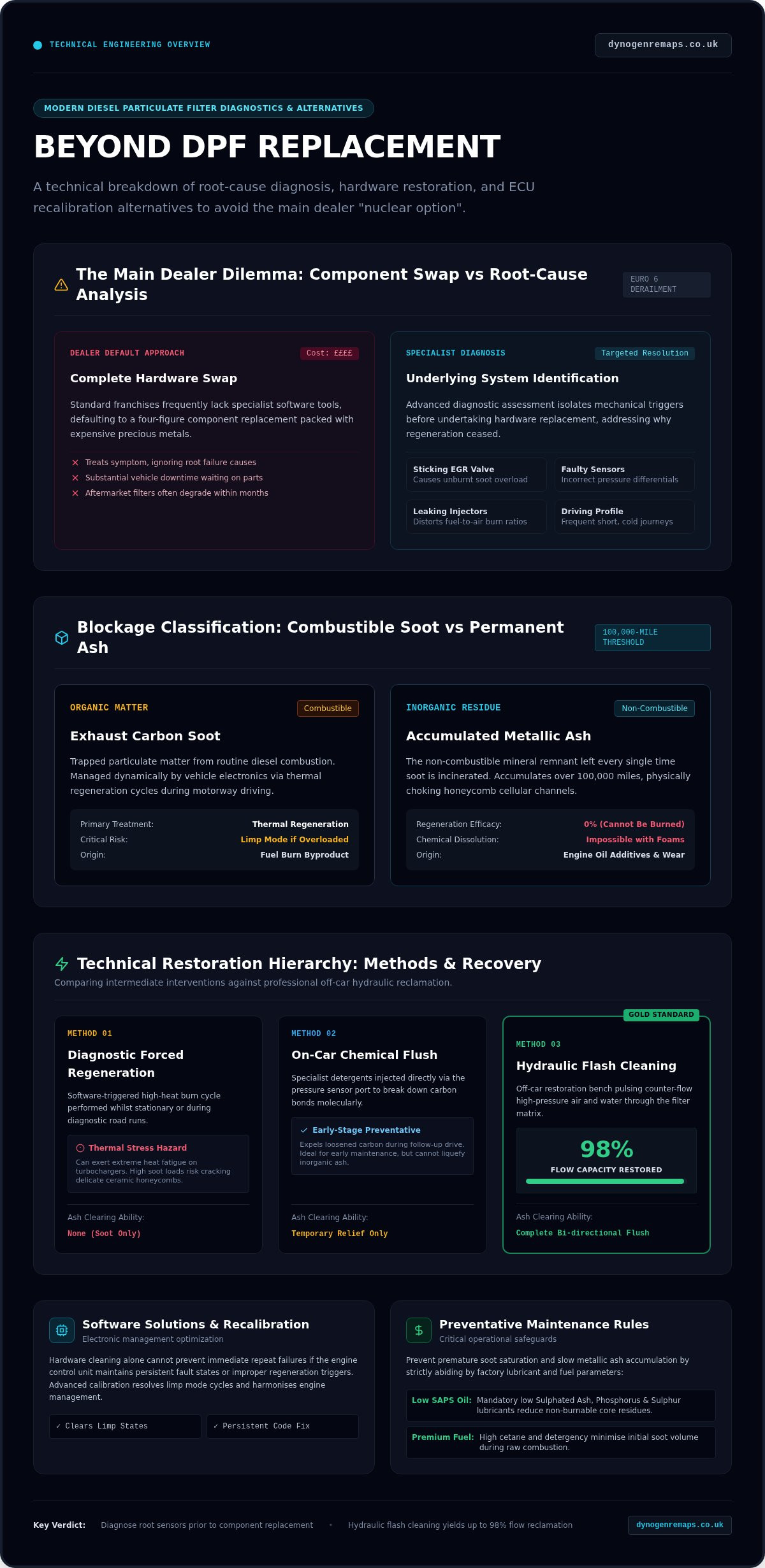
The diesel particulate filter is a sophisticated component designed to capture and store exhaust soot, reducing the harmful particulate matter emitted by your engine. Whilst it’s an essential part of modern emissions control, it’s also a common source of mechanical anxiety for diesel owners. Many drivers fall into the “Main Dealer Trap” because standard garages often lack the specialist diagnostic tools or software expertise to perform anything other than a complete component swap. This default position is the “nuclear option” because it treats the symptom rather than the disease, often ignoring the underlying faults like a sticking EGR valve or a faulty pressure sensor that caused the blockage in the first place.
The Real Cost of DPF Replacement in 2026
Replacing a DPF on a modern Euro 6 vehicle is an incredibly expensive undertaking. The hardware itself is packed with precious metals, leading to part costs that frequently reach several thousand pounds before labour is even considered. When you factor in dealer hourly rates and the necessary sensor calibrations, the total bill can be staggering. Whilst some owners seek out “cheap” aftermarket filters to save money, these often fail within months because they lack the surface area or coating quality of the original equipment. Additionally, the hidden cost of vehicle downtime whilst waiting for dealer parts can disrupt your life or business for weeks.
Soot vs. Ash: Identifying Your Blockage Type
Your engine manages soot through a process called regeneration, which burns off the carbon particles during long motorway drives or by injecting extra fuel to raise exhaust temperatures. However, soot isn’t the only byproduct. Every time soot burns, it leaves behind a tiny amount of metallic ash. Over 100,000 miles, this ash accumulates and physically chokes the filter’s internal structure. Ash buildup is a permanent physical obstruction that cannot be cleared by the vehicle’s onboard regeneration systems. Finding viable alternatives to DPF replacement starts with a precise diagnostic assessment to determine if the blockage is combustible soot or hardened ash residue. Common triggers for premature soot failure include frequent short journeys, leaking fuel injectors, and neglected oil changes using incorrect specifications.
Professional DPF Cleaning Methods: Restoring Flow and Function
When searching for effective alternatives to DPF replacement, professional cleaning services offer a sophisticated middle ground between a temporary “Italian tune-up” and a costly hardware swap. These methods are designed to physically remove the obstructions that trigger limp mode and dashboard warnings. Whilst many owners first attempt a “forced regeneration” through a diagnostic tool, this software-triggered process has significant limitations. It relies on extreme heat to burn off soot, which can place immense thermal stress on the turbocharger and engine components. If the soot loading is too high, a forced regen may even fail or cause internal damage to the filter’s delicate ceramic honeycomb.
On-Car Chemical Cleaning: Pros and Cons
Chemical cleaning involves injecting specialist foams or liquids directly into the filter housing through a pressure sensor port. These high-impact chemicals are formulated to break down carbon deposits at a molecular level, allowing them to be expelled during a subsequent drive. This method is an excellent choice for early-stage blockages or as a preventative measure during a routine service. However, it’s important to recognise that chemicals cannot dissolve metallic ash. If your filter is “face-loaded” with ash residue from high mileage, an on-car flush will only provide a temporary reprieve before the light returns.
Hydraulic Flash Cleaning: The 98% Restoration
Hydraulic flash cleaning represents the pinnacle of hardware restoration technology. This “off-car” method requires the technician to remove the filter and place it into a specialist cleaning station. The machine pulses high-pressure water and air in the opposite direction of the exhaust flow, effectively flushing out the deep-seated ash and soot that chemicals cannot reach. This meticulous process can restore up to 98% of the original flow capacity, providing a longevity that rivals a brand-new component. For many drivers, this is the ultimate solution for a physically choked filter, especially when combined with a DPF Solution to prevent future soot accumulation.
Choosing the right method depends entirely on the nature of the blockage. A professional diagnostic assessment will reveal whether your vehicle requires a simple chemical intervention or the deep-restoration power of a hydraulic flash clean. By opting for these advanced cleaning techniques, you can avoid the excessive markups of a main dealer replacement whilst ensuring your engine breathes with the efficiency of a factory-fresh unit. This structured approach to maintenance ensures that your vehicle remains responsive and reliable, protecting both your driving experience and your long-term ownership costs.
Software-Based DPF Solutions: Resolving Persistent Faults
ECU recalibration serves as one of the most effective alternatives to DPF replacement when physical cleaning alone fails to clear dashboard warnings. Often, a vehicle remains trapped in limp mode because the Engine Control Unit continues to reference “learned” values from the period of the blockage. Our specialist technical software solutions address these persistent faults by recalibrating the ECU to recognise the restored flow levels. This process is far more sophisticated than simply deleting error codes; it involves a deep understanding of how pressure and temperature sensors interact with the exhaust system to trigger regeneration cycles.
Dynogen leverages over 15 years of technical expertise to provide bespoke software-based emissions fault correction. We use advanced diagnostic equipment to ensure that sensor data is accurate before applying any software changes. If a sensor is reporting incorrect data, the DPF will inevitably block again regardless of how many times it is cleaned. By refining the software parameters, we can ensure the engine manages its emissions components with greater precision, leading to a smoother and more reliable driving experience. This methodical approach ensures that the root cause of the fault is addressed, rather than just the visible symptoms.
Fixing Limp Mode and Dashboard Error Codes
Limp mode is a safety protocol designed to protect the engine from damage, but it can become a persistent nuisance even after a filter has been physically cleared. The ECU stores historical data regarding soot accumulation, and unless these values are professionally reset through software coding, the car may continue to restrict power. Professional diagnostics are essential here to distinguish between a genuine hardware failure and a software-induced restriction. We provide a comprehensive recalibration that synchronises the hardware’s physical state with the ECU’s digital expectations, effectively clearing the path for full power restoration.
Emissions Software Calibration for Longevity
Software calibration allows for a more intelligent management of the engine’s regeneration cycles, which is critical for long-term reliability. There is a direct link between EGR behaviour and DPF soot accumulation; a poorly functioning EGR valve will rapidly increase the soot load, overwhelming the filter. By optimising these systems together, we create a more harmonious environment for the engine to operate within. You can improve car drivability with remapping to see how these software adjustments transform the vehicle’s responsiveness and efficiency. This holistic approach ensures that your diesel engine remains at the leading edge of performance whilst avoiding the prohibitive costs of main dealer hardware replacements.
Preventing Future Blockages: Maintenance and Performance Tuning
Resolving an existing fault is only half the battle; ensuring the issue does not return requires a proactive approach to engine health. Whilst many drivers view alternatives to DPF replacement as a one-time fix, the most effective long-term strategy involves optimising how your engine produces soot in the first place. This begins with fundamental maintenance that many standard garages overlook. For instance, a faulty thermostat or failing glow plugs can prevent the engine from ever reaching the critical temperatures required for active regeneration. If your vehicle cannot “see” that it’s hot enough, it will never initiate a clean, leading to a rapid and avoidable soot buildup.
The choice of consumables is equally vital. Modern diesel engines require “Low SAPS” (Sulphated Ash, Phosphorus, and Sulphur) engine oil to protect the delicate honeycomb structure of the filter. Using the wrong oil specification is a primary cause of non-combustible ash accumulation. Similarly, fuel quality plays a significant role. Premium fuels or high-quality additives can lower the ignition temperature of soot, making it easier for the filter to clear itself during normal driving conditions. By addressing these technical nuances, you move away from reactive repairs and towards a state of sustained mechanical excellence.
The Role of Economy Remapping in DPF Health
A sophisticated Diesel economy tuning UK service is one of the most intelligent ways to safeguard your exhaust system. By optimising air-to-fuel ratios, we can achieve a more complete combustion process, which naturally reduces the volume of particulate matter entering the filter. A more efficient engine is inherently a cleaner engine amongst modern diesel variants. This recalibration ensures that the engine isn’t over-fuelling, which is a common trigger for premature DPF saturation. The result is a vehicle that not only saves you money at the pump but also places significantly less strain on its emissions hardware.
A Checklist for Long-Term DPF Reliability
Maintaining flow requires more than just the occasional motorway blast. A successful “DPF Drive” typically requires a sustained period of 2,500 RPM for roughly 20 minutes to ensure the exhaust gas temperatures are high enough to incinerate soot. You should also be vigilant regarding the cooling system; a diesel engine running too cold is a DPF’s worst enemy. If you’ve recently cleared a blockage, consider a professional software audit to ensure your system is operating at peak efficiency. For a permanent solution to persistent emissions faults, explore our specialist DPF Solution to restore your vehicle’s performance and reliability.
Choosing the Right Alternative with Dynogen Remapping Solutions
Selecting the most effective alternatives to DPF replacement requires more than just a quick fix; it demands a synergy between physical restoration and technical recalibration. Whilst a chemical clean might temporarily clear a blockage, it often fails to address the software flags that keep a vehicle in limp mode. At Dynogen Remapping Solutions, we advocate for a holistic strategy that combines deep diagnostics with bespoke software adjustments. This multi-faceted approach ensures that your engine doesn’t just run again, but performs with the efficiency and responsiveness you expect from a high-calibre diesel machine.
Our position as a technical authority is built upon a foundation of 15 years of specialist experience. We have witnessed the evolution of emissions technology from its early stages to the complex Euro 6 systems of today, allowing us to stay at the leading edge of fault correction. By moving beyond the “replace rather than repair” mentality of the main dealer, we provide a more personalised and technically superior service. We take immense pride in our workmanship, ensuring that every vehicle we treat is returned to its owner in peak mechanical condition, free from the stifling restrictions of a clogged filter.
Why a Specialist Remapper Beats a General Garage
General garages often rely on basic OBD-II scanners that merely “read codes,” leading to a cycle of part-swapping that rarely solves the underlying issue. In contrast, our specialists focus on “interpreting data.” We analyse live sensor feeds to understand why the blockage occurred, whether it’s due to an EGR fault, a sensor drift, or an inefficient combustion cycle. We have developed a deep library of custom-calibrated software solutions that generic tools simply cannot match. This level of precision is why safe engine tuning UK is at the core of every service we provide, ensuring that your vehicle remains reliable long after you leave our workshop.
Next Steps: Restoring Your Vehicle’s Performance
When you contact us for a DPF Solution, the process begins with a comprehensive technical consultation. We don’t believe in one-size-fits-all answers. Instead, we use advanced diagnostic equipment to pinpoint the exact state of your filter and the health of your engine’s management system. Once we’ve identified the root cause, we can combine your DPF fix with an Economy Remap or a Stage 1 Performance Remap, effectively turning a repair into a significant upgrade. This dual-purpose approach saves you time and money whilst delivering a car that feels smoother and more powerful than the day you bought it.
Your vehicle represents a significant investment, and it deserves a level of care that exceeds the standard dealership offering. By choosing a specialist path, you avoid the multi-thousand-pound cost of hardware replacement and gain a more permanent, high-performance solution. We invite you to book a professional diagnostic review with our team today. Let us apply our technical mastery to your vehicle, resolving your emissions faults and restoring the pure joy of the driving experience.
Secure Long-Term Reliability for Your Diesel Engine
Navigating DPF issues doesn’t have to result in a multi-thousand-pound dealer bill. By understanding the distinction between soot and ash, and choosing precision cleaning or ECU recalibration, you can restore your vehicle’s performance whilst maintaining a sensible budget. These technical alternatives to DPF replacement address the mechanical root causes that generic part-swaps often ignore.
With over 15 years of technical remapping experience, we specialise in software-based emissions fault correction and custom-calibrated solutions for every vehicle. Our methodical approach ensures your car exits limp mode and returns to its peak efficiency. Don’t let a blocked filter compromise your driving experience any longer. Contact Dynogen Remapping Solutions for an expert DPF software fix today and rediscover the smoothness and responsiveness of a perfectly tuned engine. We look forward to helping you achieve total mechanical confidence and peak performance.
Frequently Asked Questions
Is it legal to use alternatives to DPF replacement in the UK?
It is entirely legal to use alternatives to DPF replacement in the UK, provided the filter remains physically present and functional within the exhaust system. Professional cleaning and ECU recalibration are legitimate maintenance procedures designed to restore original performance. However, the Road Vehicles Regulations make it an offence to use a vehicle on the road that has been modified so that it no longer complies with its designed emissions standards.
Can a DPF be cleaned if the vehicle is already in limp mode?
Yes, a DPF can be cleaned whilst the vehicle is in limp mode, but the process must be paired with diagnostic software to reset the ECU. Limp mode is a protective software state triggered by specific sensor data. Once the physical blockage is removed through specialist cleaning, a technician must recalibrate the learned values in the Engine Control Unit to signal that the exhaust flow has returned to factory parameters.
How much can I save by cleaning a DPF instead of replacing it?
Cleaning a DPF typically costs a fraction of the price of a main dealer replacement, which often exceeds £2,000 on modern Euro 6 vehicles. By opting for professional restoration methods, you can save thousands of pounds whilst achieving a similar result in terms of exhaust flow and engine performance. These cost-effective alternatives to DPF replacement ensure your vehicle remains roadworthy without the prohibitive expense of brand-new hardware or lengthy dealer backorders.
Will a software DPF solution cause my car to fail the MOT?
A software solution focused on recalibration and fault correction will not cause an MOT failure, provided the DPF is physically present and the engine meets smoke opacity limits. The MOT test includes a visual inspection for the DPF canister and a metered smoke test. If the software ensures the engine is running efficiently and the filter is clean, the vehicle should comfortably pass the emissions standards required by UK law.
What is the difference between a forced regeneration and a professional clean?
Forced regeneration is a software-triggered process that uses extreme heat to burn off soot whilst the filter is still on the vehicle. In contrast, a professional clean involves using specialist chemicals or hydraulic machines to physically flush out both soot and non-combustible ash. Whilst forced regeneration is a useful diagnostic tool, it cannot remove the metallic ash buildup that eventually chokes every filter over high mileages.
How long does a professional DPF cleaning service take?
The duration of the service depends on the chosen method, with on-car chemical flushes typically taking between two and three hours. If the filter requires a more intensive hydraulic “off-car” flash clean to remove deep-seated ash, the process usually takes a full working day. This includes the time required for removal, the multi-stage cleaning cycle, drying, and the final diagnostic recalibration to ensure the ECU recognises the restored flow capacity.
Can a Stage 1 remap help prevent DPF blockages?
A Stage 1 Performance Remap can help prevent blockages by optimising the combustion cycle and air-to-fuel ratios. When an engine runs more efficiently, it naturally produces less particulate matter, which reduces the soot load placed on the filter. By refining the engine’s calibration, you create a cleaner burn that allows the DPF to operate for longer periods between active regeneration cycles, significantly extending the component’s total lifespan.
Why does my DPF warning light keep coming back after being cleared?
The warning light often returns because the underlying mechanical cause of the soot buildup has not been resolved. Issues such as a sticking EGR valve, faulty pressure sensors, or even a failed cooling system thermostat can prevent the car from regenerating naturally. Simply clearing the fault code or performing a surface-level clean is a temporary fix; a permanent solution requires a specialist diagnostic review to identify and repair these technical root causes.