
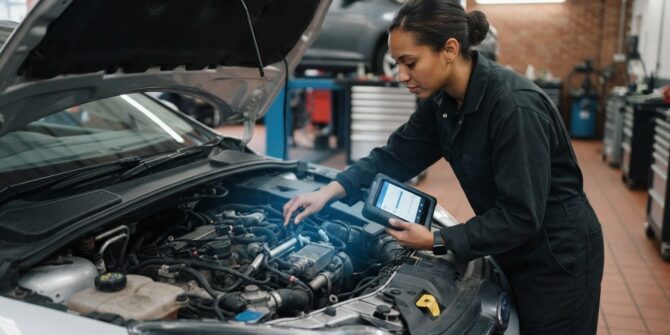
Could the symptoms pointing to your EGR valve be coming from another part of the engine or emissions system? A warning light, rough running or a drop in performance can make your car feel unreliable, but EGR valve problems and symptoms are clues, not a confirmed diagnosis.
It’s understandable to suspect the EGR valve when your vehicle starts behaving differently. The difficulty is that similar signs can have several causes, so replacing or cleaning a component without proper checks may not solve the problem. This guide explains what to look for, how diagnosis can distinguish an EGR fault from related issues, and when to arrange prompt attention rather than carry on driving as normal.
You’ll also learn what diagnosis and repair may involve, why the right solution depends on your vehicle’s condition, and why emissions compliance matters when considering software-based options. Dynogen has more than 15 years of vehicle tuning and technical software experience, and provides an EGR Solution. The right next step depends on the fault and the vehicle, so diagnosis should guide any work.
Key Takeaways
- EGR valve problems and symptoms can include uneven idling, hesitation, reduced power, smoke, warning lights or limp mode, but they don’t confirm the cause.
- The EGR valve works with the engine management system, so faults can affect how your vehicle runs.
- Similar symptoms may involve the MAF sensor, intake, wiring or DPF. Diagnosis helps distinguish between possible causes.
- Record when symptoms occur and which warning lights appear. Avoid clearing fault codes or replacing parts before the evidence has been assessed.
- Diagnosis should guide any repair or software intervention. Dynogen’s EGR Solution is a vehicle-specific option to consider in the context of the fault and applicable requirements.
EGR Valve Problems and Symptoms: What Drivers May Notice
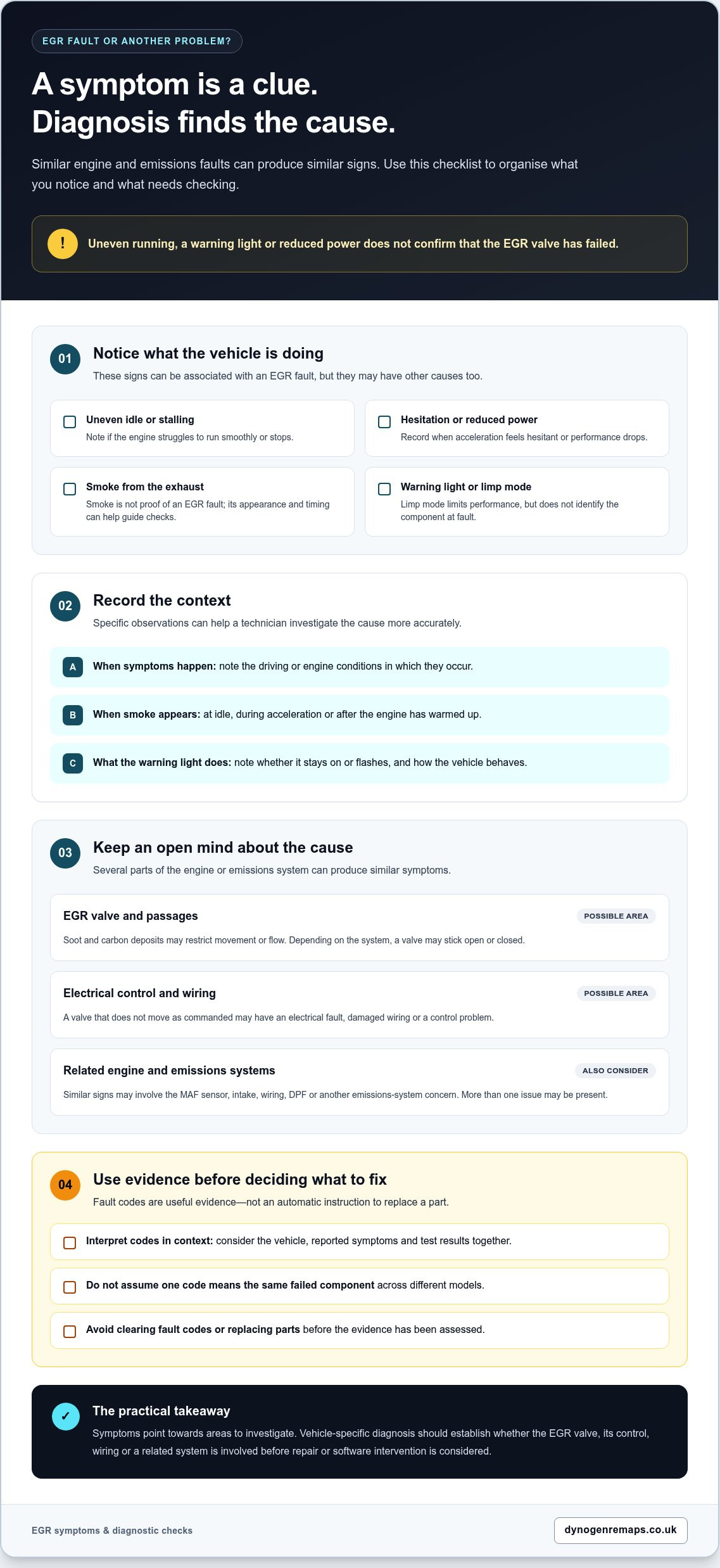
Uneven running or a warning light can point towards an EGR issue, but neither proves the valve is at fault. The same signs can arise from other engine or emissions-system problems, so treat them as clues rather than a diagnosis. EGR valve problems and symptoms vary according to the vehicle, engine, type of fault and conditions in which it occurs.
EGR fault symptoms are indicators that need diagnostic confirmation, not proof that the valve itself has failed. Note what you’ve noticed and when it happens. Those details can help a technician investigate the cause more accurately.
Which symptoms can be associated with an EGR fault?
Possible signs include an uneven idle, hesitation when accelerating, reduced power, exhaust smoke, an engine warning light or limp mode. Some drivers may also experience stalling, particularly if the engine is struggling to run smoothly. These symptoms can occur when an EGR fault affects engine operation, but they can also have other causes.
Reduced performance or limp mode may accompany some engine-management faults. Limp mode limits performance to help protect the vehicle, but it doesn’t identify which component triggered the response. Visible smoke isn’t proof of an EGR valve problem either. Its appearance and when it occurs may help guide checks, but smoke can have different causes. Make a note of whether it appears during acceleration, at idle or after the engine has warmed up.
The EGR system recirculates some exhaust gas as part of engine operation. For a technical overview of Exhaust Gas Recirculation (EGR), see Wikipedia. The system’s operation and controls can differ between vehicles, which is one reason symptoms aren’t identical across every make and engine.
Can an EGR warning light identify the faulty component?
No. A dashboard warning light signals that the vehicle has detected an issue, but it doesn’t necessarily mean the EGR valve has failed. The fault may involve another part of the system, an electrical connection or a related engine-management concern. A warning light alongside poor running deserves attention, but the cause still needs investigating.
Diagnostic codes provide useful evidence, not an automatic instruction to replace a part. Their meaning depends on the vehicle and must be considered alongside the reported symptoms and test results. Don’t assume that one code points to the same failed component across different models. Record when the light appears, whether it stays on or flashes, and how the vehicle behaves. That context can help guide the next checks.
How the EGR Valve Works, and Why It Can Develop Faults
The EGR system routes a measured amount of exhaust gas back into the engine’s intake under controlled conditions. This changes the composition of the air entering the engine and helps manage combustion. The EGR valve regulates the flow; it isn’t simply open all the time. Its operation depends on the engine design and the vehicle’s calibration.
The engine control unit (ECU) manages the valve as part of the wider engine-management system. It uses information from sensors and controls the valve according to operating conditions. A problem with the valve, its electrical control or another part of the system may therefore affect how the EGR system behaves.
What does an EGR valve do in a vehicle?
In broad terms, the valve opens and closes to meter exhaust gas into the intake when the ECU calls for it. The precise strategy differs between petrol and diesel engines, and between vehicle models. For a component-industry overview of how EGR systems work and how to troubleshoot EGR problems, Delphi Auto Parts provides further technical context.
What can cause EGR valve problems?
Soot and carbon deposits can build up in the EGR valve or passages, potentially restricting movement or flow. Depending on the system, a valve may stick open or closed. A valve that doesn’t move as commanded may also have an electrical fault, damaged wiring or a problem with its control.
An EGR fault may involve the valve, its control or related systems. An intake restriction or sensor fault, for example, may affect readings the ECU relies on or create symptoms that resemble an EGR issue. Carbon build-up is one possible contributor, not a diagnosis in itself. The condition and behaviour of the system need to be assessed together.
This is why EGR valve problems and symptoms should be considered alongside vehicle-specific checks, rather than used alone to decide which part needs replacing. Diagnostic information needs to be interpreted in context to establish whether the valve, its wiring, its control or a related system is involved. Dynogen provides a vehicle-specific EGR Solution for EGR-related concerns. The appropriate next step depends on the fault and the vehicle’s requirements.
EGR Fault or Another Problem? How Diagnosis Separates the Causes
Reduced power, uneven running or an engine warning can have more than one explanation. An EGR fault is one possibility, but similar behaviour may involve air metering, the intake, electrical connections or another emissions component. A fault code can help narrow the investigation, but it isn’t proof that a particular part has failed.
Which faults can resemble EGR valve problems?
The same symptom can arise from different faults, and more than one issue may be present. The table shows why checks need to match the vehicle and the evidence recorded.
| Possible sign | Other possible causes | What needs checking |
|---|---|---|
| Hesitation or reduced power | An EGR issue, MAF sensor or intake fault, or a DPF-related problem | Relevant sensor readings, intake condition and emissions-system data |
| Uneven running or stalling | EGR operation, air-metering concerns or another engine-management fault | Live data, valve operation and related system behaviour |
| Warning light or limp mode | An EGR-related fault, wiring issue or another emissions-system fault | Stored codes, wiring and connections, and vehicle-specific test results |
These are possibilities, not direct symptom-to-part matches. A DPF-related issue, for instance, may also affect performance, while a wiring fault could disrupt a component’s signal or control. Vehicle-specific service information helps identify the right tests and interpret codes without relying on a universal meaning.
What happens during a proper EGR diagnosis?
Fault-code diagnosis combines scan data, inspection and the vehicle’s symptoms. A technician will usually start by recording what the driver has noticed, when it occurs and any warning messages. They can then scan the ECU, review stored information and consider whether the results fit the reported behaviour.
Codes are clues, not a verdict. Live data can show how relevant readings change as the engine operates. Physical checks can help assess the valve, connectors, wiring and related intake components. Depending on the findings, the technician may test whether the EGR system responds as expected and compare the result with vehicle-specific service information.
What to Do If You Suspect an EGR Valve Fault
If your car’s behaviour changes, an evidence-led approach is more useful than guessing which part has failed. The signs can have several causes, so record what’s happening and arrange suitable diagnosis before deciding on a repair or software work.
- Record the symptoms. Note changes such as hesitation, rough running, smoke or reduced power, and whether they are getting worse.
- Make a note of warning messages. Record which lights appear, whether they stay on or flash, and any messages shown on the dashboard.
- Describe the driving conditions. Note when the issue began and whether it occurs when the engine is cold or warm, at idle, or under acceleration.
- Preserve diagnostic evidence. If a code has been read, keep a record of it. Avoid clearing codes or replacing parts before the evidence has been recorded and interpreted, as this can remove useful context or lead to unnecessary work.
- Arrange checks based on the evidence. The fault needs to be considered in the context of your vehicle and its symptoms before deciding on the next step.
Can you keep driving with suspected EGR problems?
Repair, cleaning or software work: what’s the distinction?
The right route depends on the diagnosis, the component’s condition and the vehicle’s requirements. Physical inspection, cleaning or repair addresses a component or passage; an ECU software change alters engine-management behaviour. These are not interchangeable remedies, and software work isn’t a substitute for investigating a mechanical or electrical fault. Before any change to emissions equipment or its controls, consider current UK roadworthiness and emissions requirements. Don’t assume that removing or disabling equipment is automatically suitable or lawful for road use.
Dynogen has more than 15 years of vehicle tuning and technical software experience, and provides an EGR Solution for EGR-related concerns. Its software-based work should be considered in light of the diagnosed fault, the vehicle and applicable requirements. Find out more about Dynogen’s EGR Solution.
EGR Valve Problems: When Specialist Diagnosis and a Compliant Solution Matter
Deciding what to do about an EGR concern starts with establishing what has actually failed. Symptoms, diagnostic evidence and checks on the specific vehicle should be considered together before choosing a repair or software intervention. Acting on a suspected cause alone risks addressing the wrong issue, particularly when other engine or emissions components can produce similar signs.
How specialist EGR support fits into the diagnostic process
Dynogen Remapping Solutions brings more than 15 years of vehicle tuning and technical software experience to EGR-related work. Its EGR Solution is a specialist technical service, not a universal remedy for every fault. The appropriate route depends on the diagnosis, the condition of the components and the vehicle’s requirements.
Software-based work and mechanical repair are distinct. A software change alters how engine management operates; it doesn’t physically clean, repair or replace a damaged valve, wiring or other component. Diagnosis should establish whether a software-based approach is suitable, or whether mechanical investigation or repair is needed instead. Software intervention shouldn’t be treated as a shortcut around an unresolved fault.
Choose a responsible next step for your vehicle
Bring together the details that help explain the problem: when symptoms occur, which warnings have appeared, diagnostic findings and the results of vehicle-specific checks. This evidence gives a specialist a clearer basis for discussing options and their suitability, rather than relying on a warning light or code in isolation.
Emissions equipment and its controls also need careful consideration. Don’t assume that removing or disabling an emissions system is an appropriate fix or compliant for road use. Consider the current road-use and emissions requirements that apply to your vehicle before any changes are made. A responsible solution must account for both the technical fault and those requirements.
If you’re weighing up a diagnosed EGR concern, explore Dynogen’s EGR solutions as a vehicle-specific option to consider alongside the diagnosis and applicable requirements.
Take the Next Step with Confidence
EGR valve problems and symptoms can raise concern, but warning lights, reduced power or rough running don’t confirm that the valve itself has failed. Bring together the symptoms, diagnostic evidence and vehicle-specific checks before choosing a repair or software intervention.
Any solution should also take account of the vehicle’s condition and applicable road-use and emissions requirements. Mechanical work and ECU software changes serve different purposes, so neither should be treated as a universal fix. Whether relying on regular vehicle upkeep from automotive maintenance specialists such as BLACKCAT AUTO LLC or addressing complex diagnostic faults, a measured, technically informed approach helps you make a decision based on the cause rather than guesswork.
Dynogen combines more than 15 years of vehicle tuning experience with specialist EGR and vehicle software solutions. If you have a diagnosed EGR concern, explore Dynogen’s EGR Solution and take the next step towards a vehicle-specific approach.
Frequently Asked Questions
What are the most common symptoms of a faulty EGR valve?
Possible symptoms include an uneven idle, hesitation, stalling, reduced power, smoke, an engine management light or limp mode. The exact signs depend on the vehicle and the nature of the fault. None confirms that the EGR valve itself has failed, as problems with the intake, sensors, wiring or other emissions components can cause similar behaviour. Record when symptoms happen and have the cause diagnosed before replacing parts.
Can you drive with EGR valve problems?
Will an EGR fault cause the engine management light to come on?
It can, if the ECU detects an issue related to the EGR system, but an engine management light doesn’t prove that the valve has failed. The warning may relate to the valve’s control, wiring or another engine or emissions component. A diagnostic scan can retrieve useful fault information, but codes need interpreting alongside symptoms, live data and checks on the vehicle. Don’t replace a component solely because a warning light is on.
Can a blocked EGR valve cause loss of power or limp mode?
A restricted EGR passage or valve may contribute to poor running or reduced performance, depending on the vehicle and fault. Limp mode can also occur in response to other engine-management or emissions-system issues, so it isn’t specific evidence of a blocked EGR valve. A technician can assess the stored codes, relevant live data and physical condition of the system to determine whether the EGR is involved or another fault needs attention.
What happens if an EGR valve is stuck open or closed?
The effect depends on the engine design and how its management system responds. If applicable to that system, a valve stuck open may allow exhaust gas to flow when it shouldn’t; one stuck closed may prevent the commanded flow. Either condition can be associated with poor running or a warning, but those signs aren’t conclusive. Vehicle-specific diagnosis is needed to establish whether the valve is sticking and what has caused it.
Can an EGR valve be cleaned, repaired or fixed with software?
Cleaning may be suitable where deposits are restricting a serviceable component, while a mechanically or electrically faulty part may need repair or replacement. The right choice depends on inspection and diagnosis. Software changes are different: they alter engine-management behaviour and don’t physically clean or repair a valve. They aren’t a universal fix or a substitute for investigating the fault, and any work must be considered in the context of the vehicle and applicable requirements.
Does an EGR valve fault mean the car will fail its MOT?
An EGR fault alone doesn’t automatically mean a car will fail its MOT. The outcome depends on the vehicle’s condition and the applicable test requirements. However, UK MOT checks include emissions-control systems, and evidence that an EGR valve is missing or obviously disabled can result in an automatic failure. Don’t assume that removing or disabling emissions equipment is an acceptable road-use solution; consider current requirements before making changes.