
Could a pop and bang map be legal to fit yet still put your car at risk on UK roads? The answer to the pop and bang map legality UK question depends on more than the map itself. The vehicle’s noise, emissions equipment, condition and intended use all matter.
It’s understandable to want a clear answer, especially when tuning advice online can conflict. An aftermarket map doesn’t automatically make a vehicle road-legal, and no particular calibration guarantees an MOT pass. Excessive exhaust noise, emissions above the permitted limit or tampering with emissions-control equipment may cause problems. An undeclared ECU modification could also affect your insurance.
This guide explains how roadworthiness, noise and emissions requirements apply, what to consider before commissioning or using a map, and why road and track use aren’t the same. It also covers Dynogen Remapping Solutions’ pop and bang or crackle-map calibration, with the vehicle and intended use in mind, rather than sound alone.
Key Takeaways
- For pop and bang map legality UK, the map’s label alone doesn’t determine whether a car is suitable for public-road use. The whole vehicle and how it’s used matter.
- Assess noise, exhaust condition, emissions and roadworthiness separately. One result doesn’t settle every compliance question.
- Before commissioning a map, consider your intended use, exhaust configuration, emissions equipment, warning lights and known mechanical faults.
- Track use isn’t a blanket exemption. Venue rules apply, and the journey to and from the track raises separate road-use considerations.
- Dynogen’s pop and bang or crackle-map calibration is considered in the context of the vehicle and its intended use. A map can’t guarantee compliance or an MOT pass.
Are pop and bang maps legal in the UK? The answer depends on road compliance
A map’s label alone doesn’t determine whether a car can lawfully be used on public roads. The question is whether the finished vehicle meets the requirements that apply to it, including roadworthiness, exhaust noise and emissions. An aftermarket calibration isn’t a legal verdict, and the sound it produces isn’t the only factor.
A pop and bang, or crackle, map is an engine control unit (ECU) calibration intended to create popping sounds from the exhaust, usually when the driver lifts off the accelerator or decelerates. The effect varies with the vehicle, calibration and exhaust configuration. Two cars with maps described by the same name may sound and behave differently, so the label can’t establish whether either car is suitable for road use.
Some strategies have a technical relationship to the principles described in an anti-lag system, but the terms aren’t interchangeable. The relevant point is that calibration changes how a vehicle behaves. Detailed ECU mechanics are a separate subject.
What does a pop and bang map change?
In broad terms, the calibration is designed to produce exhaust pops during overrun or deceleration. The result depends on the vehicle and its setup, so there’s no single sound or mechanical effect that applies to every map. A considered calibration takes the vehicle as a whole into account rather than treating maximum volume as the goal.
Is the map itself automatically illegal?
Short answer: the map name alone doesn’t settle whether the vehicle is lawful for public-road use. What matters is the vehicle’s resulting condition and whether it meets the requirements that apply. A map shouldn’t be assumed road-legal simply because it can be installed, nor automatically unlawful solely because it is called a pop and bang map.
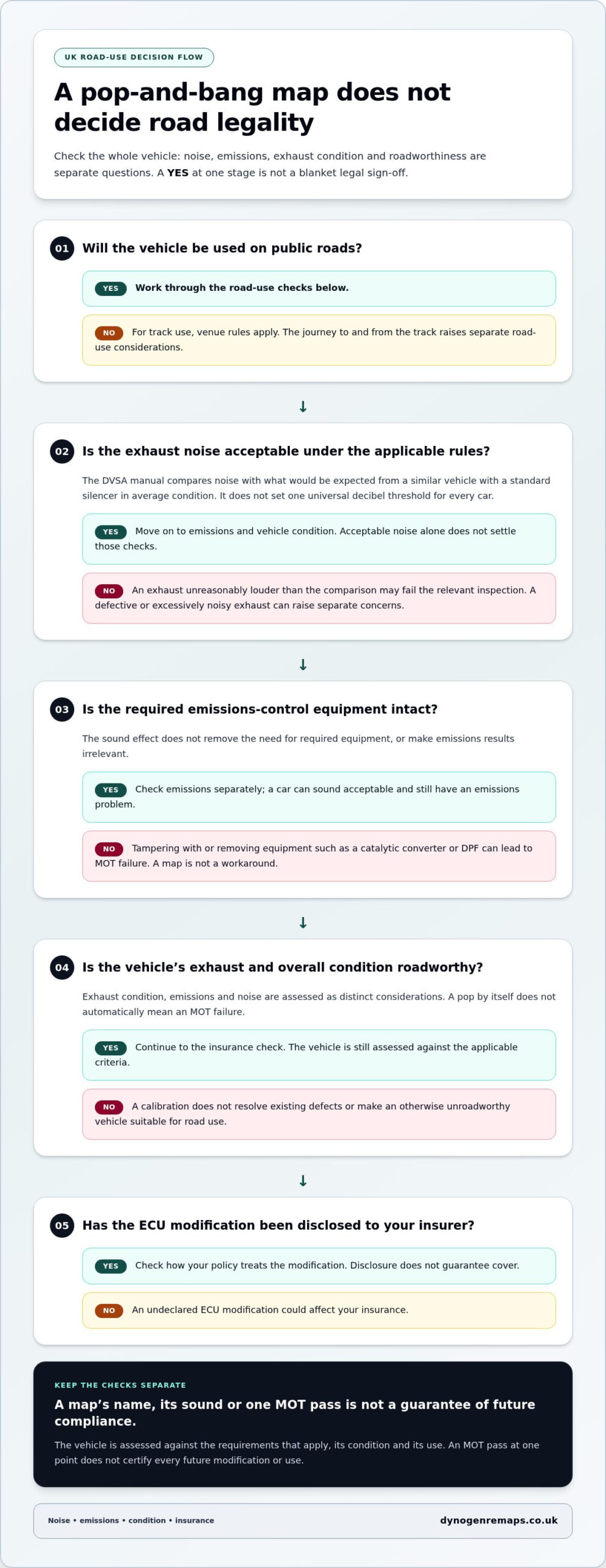
For a road car, consider separate questions: is the exhaust in a compliant condition, is its noise acceptable under the applicable rules, and does the vehicle continue to meet relevant emissions and roadworthiness requirements? An MOT pass at one point doesn’t certify every future modification or use.
Legal compliance is also different from social acceptance. A loud exhaust may attract complaints or unwanted attention even where a driver believes the car meets the rules. Disapproval from other people isn’t, by itself, a legal test. Keep the distinction clear and don’t use public reaction as a substitute for checking the requirements.
Rules and inspection guidance can change, and their application depends on the vehicle and its use. Before choosing a map, check current 2026 government road-use requirements and DVSA MOT inspection guidance relevant to exhausts, noise and emissions. This is a more reliable basis for a decision than an online claim that every pop and bang map is either legal or illegal.
UK noise, emissions and MOT rules that can affect a pop and bang map
A pop and bang map can raise several separate compliance questions. Don’t treat a loud exhaust, an emissions fault and a roadworthiness defect as the same issue. Each concerns a different part of the vehicle and may be assessed differently. The pop and bang map legality UK question depends on the calibration’s effects, the vehicle’s condition and the requirements that apply.
The Road Vehicles (Construction and Use) Regulations 1986 are relevant to vehicle construction and use, including exhaust noise. They should be considered alongside current DVSA inspection guidance, which explains how an MOT tester assesses a vehicle. For practical inspection criteria, consult the UK MOT inspection rules.
- Noise: The DVSA manual says exhaust noise must not be unreasonably above what would be expected from a similar vehicle with a standard silencer in average condition. That isn’t a universal decibel threshold for every car.
- Exhaust condition: The exhaust is assessed as a vehicle component. Its condition and whether it is excessively noisy are distinct considerations. A pop alone doesn’t automatically mean an MOT failure. The vehicle is assessed against the applicable inspection criteria.
- Emissions: Emissions are considered separately from sound. A car may sound acceptable but still have an emissions problem, or produce pops without that sound alone establishing an emissions failure.
- Roadworthiness: The overall condition of the vehicle matters. A calibration doesn’t resolve existing defects or make an otherwise unroadworthy vehicle suitable for road use.
How can exhaust noise affect road use and an MOT?
Noise is judged in context, not simply by whether a car pops or draws attention. Under the DVSA manual, an exhaust that is unreasonably louder than the standard-silencer comparison may fail the relevant inspection. A defective or excessively noisy exhaust can also raise separate concerns about its condition. There’s no sound-based guarantee of a pass: the vehicle is assessed at the time of the test.
Why emissions equipment and insurance still matter
The sound effect doesn’t remove the need for required emissions-control equipment or make emissions results irrelevant. Tampering with or removing equipment such as a catalytic converter or DPF can lead to MOT failure. A map is not a workaround. Keep the vehicle’s emissions system intact and in proper working condition.
Tell your insurer about ECU changes and other modifications, then check how your policy treats them. Disclosure doesn’t guarantee cover or a particular premium. The insurer’s terms determine the effect. The map, the vehicle’s equipment and condition, and the inspection result are related but distinct parts of compliance. If you’re considering a pop and bang calibration, explore Dynogen’s pop and bang map service with your intended use and the whole vehicle in mind.
Road use versus track use: common pop and bang legality claims compared
“It’s for track use” describes intended use, not a blanket exemption from noise controls, venue conditions or road requirements. To assess a pop and bang setup, consider where the car is driven, how it reaches that location and which rules apply in each setting.
| Situation | What to consider |
|---|---|
| Public-road use | The car must meet the requirements that apply to road vehicles. GOV.UK explains the UK rules on modified exhausts, including restrictions on modifying an exhaust to make it noisier than its type-approved level. |
| Use at a track | A track setting doesn’t automatically remove venue conditions. Check the circuit’s published noise limits and other requirements before attending. A vehicle may be refused access if it doesn’t meet them. |
| Travel between venues | If you drive the car on public roads to and from a circuit, road-use compliance remains relevant during those journeys. Transporting it rather than driving it changes the journey, but doesn’t override the circuit’s own rules. |
Does track-only use make a pop and bang map legal?
Track-only use isn’t a universal permission for any calibration or exhaust setup. A circuit may set its own noise limits and operating conditions, so review its published rules before attending. If the vehicle is also driven on public roads, assess that use separately. The intended setting alone doesn’t determine whether the car meets the requirements for each part of its use.
Can a quiet mode or map switch guarantee compliance?
No. A selectable calibration can change how the car behaves in a given mode, but it can’t certify the whole vehicle. The exhaust’s specification and condition, emissions-control equipment and the way the car is used still matter. A switch also doesn’t prove that a modified exhaust meets the relevant noise rules in every situation.
There’s a similar misconception about MOTs. Passing a test records the result of an inspection at that time; it isn’t permanent approval of every setting, later change or future use. If the vehicle’s condition or configuration changes, the earlier result can’t guarantee that it will continue to meet road requirements.
For pop and bang map legality UK decisions, keep road use, track rules and transport arrangements distinct. Consider Dynogen’s pop and bang map calibration in the context of the vehicle and its intended use, not simply whether a switch or track label is present.
Before commissioning a pop and bang map: a UK driver’s compliance checklist
A clear brief makes a calibration discussion more useful. Start with how you intend to use the car and its current condition, then work through the details that can affect suitability. This checklist can help you prepare, but it can’t guarantee an MOT result or legal outcome.
- State your intended use. Explain whether the car will be driven on public roads, used only on private property or taken to a track. If you plan track use, review the circuit’s published noise limits and conditions.
- Describe the vehicle’s current condition. Note its service history, warning lights, known mechanical faults and recent changes. Understand existing issues before considering ECU calibration.
- Record the exhaust configuration. Identify the fitted exhaust components and their condition. Changes to the exhaust can affect noise and how the complete vehicle should be assessed.
- Check emissions equipment. Establish whether the vehicle’s emissions-control equipment is present and working as intended. A sound effect doesn’t replace the requirements that apply or resolve an emissions fault.
- Review current guidance and venue rules. Check relevant UK road-use requirements and DVSA inspection guidance, as well as the rules for any circuit or private site where you plan to use the car.
- Speak to your insurer. Read your policy terms and disclose ECU or other vehicle modifications as required. Ask how your policy treats the changes. Disclosure alone doesn’t guarantee cover or a particular premium.
- Discuss sound expectations and calibration records. Describe the character and level of sound you want rather than relying on a generic label or online clip. Keep a record of the original calibration and any changes made, so the vehicle’s setup is documented.
What should be assessed before calibration?
A vehicle-specific assessment is more useful than a generic promise about sound or results. Service history, warning lights, known faults, exhaust configuration and emissions equipment all help build a clearer picture of the car and its intended use. Dynogen’s safe engine tuning guidance offers further context on considered tuning and reliability.
What should drivers clarify about road use?
Be precise about where the vehicle will be used, and distinguish public-road journeys from track or private-site use. Before using a modified car, review current official requirements and your insurer’s terms. No checklist can certify that a particular vehicle will pass an MOT or meet every legal requirement in every situation.
For a considered discussion about your vehicle and intended use, explore Dynogen’s pop and bang map service. A careful approach to pop and bang map legality UK starts with the whole vehicle, not the calibration label alone.
How Dynogen approaches pop and bang map decisions responsibly
A pop and bang or crackle map should be considered as part of the vehicle’s complete setup, not as a shortcut to the loudest possible exhaust note. Dynogen provides pop and bang map calibration, taking the vehicle and its intended use into account. The map itself doesn’t establish whether a vehicle is suitable for public roads, and no calibration can guarantee legal compliance or an MOT pass.
With over 15 years of vehicle-tuning experience, Dynogen brings technical knowledge to ECU work. Advanced software and equipment support the calibration process, while the vehicle’s characteristics and exhaust configuration help inform what the map may produce. Discussing the desired sound and how the car will be used is more useful than relying on a generic promise based on the map’s name.
Why vehicle-specific calibration matters
Vehicles can respond differently to calibration, and exhaust configuration also affects the result. A sound demonstrated on one car isn’t a reliable prediction for another. Dynogen’s calibration is considered in relation to the specific vehicle rather than assuming every setup will behave alike. This helps set realistic expectations, but it doesn’t certify the car’s roadworthiness, emissions performance or compliance with noise requirements.
For broader context on ECU calibration and performance software, read the performance software buyer’s guide. It can help place a pop and bang map within the wider tuning conversation, where the calibration should be understood in relation to the vehicle rather than judged by sound alone.
What should a driver do next?
Before deciding, bring together the practical details: intended use, current vehicle condition, exhaust configuration, emissions equipment, warning lights and known faults. Review current official requirements for road use, your insurance policy terms and any venue rules if the car is intended for track use. These checks support a better-informed decision, but can’t predict every inspection outcome or provide a legal guarantee.
The central question in pop and bang map legality UK is not simply whether a map can be installed. It’s whether the vehicle, in its resulting configuration and intended use, meets the requirements that apply. Dynogen can discuss your vehicle and what you want from the calibration, focusing on considered technical work rather than maximum volume.
Discuss your pop and bang map requirements with Dynogen and outline your vehicle, intended use and sound expectations before deciding whether this modification is right for you.
Make your next tuning decision with clarity
The key to pop and bang map legality UK is looking beyond the map’s name. Public-road suitability depends on the vehicle’s condition and whether it meets relevant noise, emissions and other requirements. Track use has its own venue rules, and a past MOT pass or selectable quiet mode doesn’t guarantee ongoing compliance.
Before choosing a calibration, be clear about your intended use, check the vehicle’s condition and equipment, and review current guidance and your insurance terms. A realistic conversation about the sound you want and the car’s setup is a stronger starting point than aiming for maximum volume.
Dynogen offers pop and bang or crackle maps, bringing over 15 years of vehicle-tuning experience and advanced software and equipment to its work. Its focus is considered calibration, not a promise of legality or an MOT result. Discuss your pop and bang map requirements with Dynogen and take the next step with a clearer understanding of your vehicle and intended use.
Frequently Asked Questions
Are pop and bang maps illegal in the UK?
Not automatically, but the map label alone can’t establish whether a vehicle is lawful to use on public roads. UK rules prohibit modifying an exhaust to make it noisier than its type-approved level, and roadworthiness and emissions requirements still apply. The practical question is how the calibration affects the complete vehicle and whether it meets the rules for its use. Check current official guidance before deciding.
Can a car with a pop and bang map pass its MOT?
Yes, it may pass if it meets the applicable inspection requirements at the time of the test. The tester assesses relevant factors such as exhaust condition and noise, emissions, and required emissions-control equipment. A pop sound alone doesn’t automatically mean failure, but a previous pass doesn’t guarantee future results. Vehicle condition, configuration and inspection findings all matter.
Will a pop and bang map make my car fail its MOT?
Not necessarily. An MOT failure depends on whether the vehicle has an issue covered by the inspection, such as exhaust noise judged unreasonably high, a defective exhaust, excessive emissions or evidence of tampering with emissions-control equipment. The map’s name or presence alone doesn’t predict the result. Keep the vehicle properly maintained and assess its actual condition rather than assuming it will pass or fail.
Can I use a pop and bang map on UK public roads?
Only if the vehicle, in its modified condition, meets the requirements that apply to public-road use. These include relevant exhaust-noise, emissions and roadworthiness requirements. A map marketed as suitable for road use doesn’t prove compliance, and a track setting doesn’t change the rules for journeys on public roads. Check current official guidance and consider the car’s exhaust and emissions equipment before using it.
Do I have to tell my insurer about a pop and bang map?
Tell your insurer about ECU changes and other vehicle modifications, and check your policy’s terms. Insurers set their own requirements for disclosure and how modifications affect cover. Don’t assume a change is too minor to mention, or that disclosure will automatically preserve cover or leave your premium unchanged. If you’re unsure how your policy treats the calibration, get clarification from your insurer before relying on the cover.
Can a pop and bang map affect emissions or the exhaust system?
It can change how the engine behaves and may affect exhaust noise, but the precise effects depend on the vehicle and calibration. Emissions results and emissions-control equipment are separate from the sound effect. A map doesn’t remove the need for required equipment or resolve an existing fault. Have the vehicle’s setup and condition considered together, and don’t treat louder pops as evidence of an emissions problem by themselves.
Is a pop and bang map legal on track but not on the road?
Track use isn’t a blanket exemption from requirements. Circuits can set their own noise limits and conditions, so check the venue’s published rules before attending. If you drive the car to and from the circuit, public-road requirements still apply during those journeys. Whether the map is suitable depends on the vehicle, where and how it’s used, and the rules relevant to each setting.