
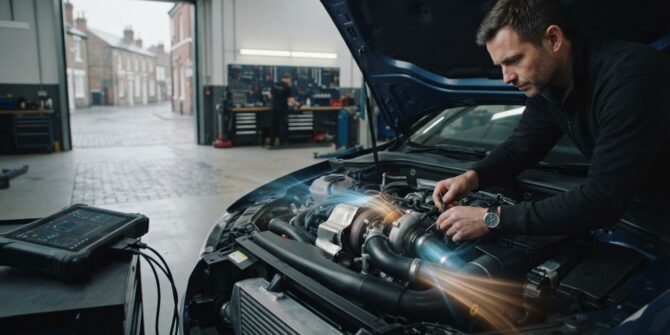
A sluggish turbo doesn’t automatically mean the turbo itself is failing. A brief delay while exhaust gases build boost can be normal, but a pronounced pause when pulling away or overtaking can point to a fault with the turbo system, a sensor or another component. Knowing how to fix turbo lag starts with distinguishing normal boost build-up from a genuine loss of response, rather than jumping straight to an expensive replacement or remap.
This guide covers common causes of excessive lag and practical checks to help narrow them down, including signs of boost leaks, control faults and restricted airflow. You’ll learn what you can inspect safely, when diagnostic equipment or a professional assessment is needed, and how to match a repair to the evidence. We’ll also explain when a remap may be relevant, rather than treating it as a first-line answer. If the engine and boost system are confirmed to be healthy, a carefully considered ECU calibration may help refine response. A remap can optimise a sound system, but it can’t repair a mechanical or sensor fault.
Key Takeaways
- Learn how to fix turbo lag by identifying the cause before replacing parts or changing the ECU calibration.
- Compare the delay with normal boost build-up, and note whether the response has suddenly worsened.
- Use dashboard alerts, fault codes and safe visual checks to guide diagnosis, not to assume a code identifies a failed component.
- Match the next repair or test to the confirmed fault, whether it involves air leaks, sensors, boost control or restricted exhaust flow.
- Consider a Stage 1 remap only when the engine and boost system are in sound condition. Software cannot repair a mechanical or sensor fault.
How to Fix Turbo Lag: Is the Delay Normal or a Fault?
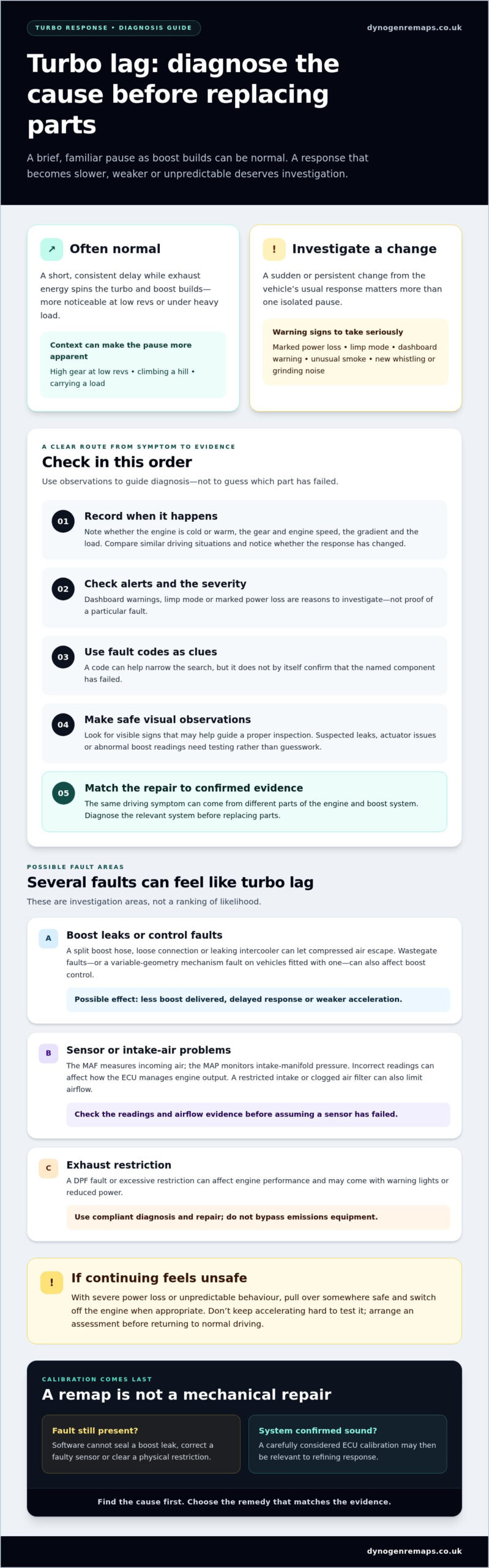
Turbo lag is the short delay between pressing the accelerator and feeling stronger engine pull, while exhaust energy spins the turbocharger and boost builds. Some delay can be normal, particularly at low engine speeds or under heavy load. The key is whether the response is brief and consistent, or has become noticeably slower, weaker or unpredictable. Understanding what a turbocharger is helps explain why boost response depends on engine speed and exhaust flow.
Road conditions and driving inputs affect how much lag you notice. Accelerating in a high gear at low revs, climbing a hill or carrying a load can make the pause more apparent than accelerating with the engine already turning faster. Compare similar situations and note the gear, engine speed, gradient and load when hesitation occurs. This gives you a clearer starting point for working out how to fix turbo lag, without assuming every pause means the turbo has failed.
What does turbo lag feel like in everyday driving?
You may notice a moment between pressing the accelerator and the engine delivering stronger pull, especially when pulling away, accelerating from low revs or overtaking. A brief, familiar delay under load differs from persistent hesitation in varied driving conditions. Record when it happens, including whether the engine is cold, the vehicle is climbing a hill, or the symptom also appears at higher revs. A change from the vehicle’s usual behaviour matters more than one isolated instance.
When is turbo lag a warning sign?
Treat a sudden change in response as a reason to investigate, particularly if the vehicle has a marked loss of power, enters limp mode or displays a dashboard warning light. Unusual smoke, a new whistling noise or a grinding sound can also point to a problem that needs prompt attention. These symptoms don’t identify the cause on their own, but they shouldn’t be dismissed as normal turbo lag.
If power loss is severe, the vehicle behaves unpredictably or continuing would feel unsafe, pull over somewhere safe and switch off the engine when appropriate. Don’t keep accelerating hard to test the response. Note what happened and arrange an assessment before returning to normal driving. Distinguishing expected boost build-up from a developing fault is the first step towards an accurate diagnosis, rather than replacing parts on guesswork.
What Causes Excessive Turbo Lag? Check the Turbo System and Engine
A sluggish response can come from several parts of the engine and boost system, so a slow turbo isn’t automatically a failed turbo. Air leaks, boost-control problems, inaccurate sensor readings and restricted exhaust flow can all reduce performance or delay boost. These faults can feel similar behind the wheel, so symptoms alone can’t confirm which component is responsible.
The ECU uses sensor information to manage fuelling and boost pressure. If readings don’t reflect the engine’s actual airflow or pressure, the control strategy may not deliver the expected response. Diagnosis should establish what the system is doing before parts are replaced. Garrett Motion’s guide to diagnosing turbocharger problems also highlights the value of checking the wider system rather than focusing on the turbo alone.
Could a boost leak or turbo-control fault be responsible?
A split boost hose, loose connection or leaking intercooler can let compressed air escape before it reaches the engine. The turbo may still be spinning, but less boost is delivered, which can feel like delayed or weak acceleration. Boost control can also be affected by a fault with the wastegate or, on vehicles fitted with one, the variable-geometry mechanism that adjusts exhaust flow. Suspected leaks, actuator issues or abnormal boost readings need proper inspection rather than guesswork.
Can sensors, the DPF or airflow restrictions affect response?
The mass airflow (MAF) sensor measures incoming air, whilst the manifold absolute pressure (MAP) sensor monitors pressure in the intake manifold. Incorrect readings from either can affect how the ECU manages engine output. A restricted intake or clogged air filter can also limit the air available to the engine and reduce its ability to respond cleanly.
Exhaust restrictions matter too. A DPF fault or excessive restriction can affect engine performance and may be accompanied by warning lights or reduced power. The correct route is compliant diagnosis and repair, not bypassing emissions equipment. A fault code or a particular sound can help narrow the search, but neither proves that a specific part has failed.
For drivers considering how to fix turbo lag, the practical lesson is to identify the fault category first, then test the relevant components. A remap can’t seal a boost leak, correct a faulty sensor or clear a physical restriction. Once the engine and boost system are confirmed to be in sound condition, a considered calibration may be relevant. Explore ECU remapping and performance tuning as a response option, not a mechanical repair.
How to Diagnose Turbo Lag Safely Before Replacing Parts
A careful diagnosis can help prevent replacing a sound turbo or changing engine software that won’t address the underlying fault. Work through the evidence in order: record the symptoms, check for dashboard alerts, scan for fault codes, then make only safe visual observations. This gives a technician useful context and turns how to fix turbo lag from guesswork into a targeted investigation.
Which basic checks can a driver make?
Start with a short record of when the hesitation occurs. Note whether the engine is cold or warm, which gear you’re in, whether the vehicle is climbing a hill and how much load it’s carrying. Also record any warning lights, unusual smoke or new noises, and whether the response has changed over time. These details can help distinguish a repeatable condition from a developing fault.
With the engine switched off and fully cool, look for obvious damage, such as a visibly split hose or a loose connection in an accessible area. Keep clear of hot, moving or pressurised components. Don’t dismantle the turbo system or reach into areas you can’t inspect safely. A visual check may reveal an obvious issue, but it can’t rule out a hidden leak or control fault.
What can fault codes and live data reveal?
A suitable diagnostic scan can retrieve stored fault codes and, where available, relevant operating data. A code usually identifies a system or condition for further investigation, not a single component that should automatically be replaced. For example, a boost-related code needs to be interpreted alongside checks of hoses, control components, sensors and the engine’s operating conditions.
Specialist live-data checks can compare requested boost with actual boost as the engine operates. A mismatch is a useful clue, not a verdict: its meaning depends on the vehicle, the conditions during the test and the wider diagnostic evidence. Pressure testing and interpreting live data may require suitable equipment and experience, so leave these checks to a qualified professional if you’re unsure.
If the symptoms persist, codes return after clearing, or the cause remains uncertain, arrange a professional assessment rather than fitting parts at random. Diagnose the fault before replacing a turbo or changing engine software. That keeps the next step tied to evidence and helps ensure any repair or calibration addresses the real cause.
How to Fix Turbo Lag: Match the Remedy to the Diagnosis
The right repair depends on what testing finds. A new turbo or sensor fitted on assumption may leave the real cause untouched, so match each remedy to evidence from inspection and diagnosis. This is the practical route for how to fix turbo lag without turning a performance complaint into unnecessary parts replacement.
| Confirmed fault area | Sensible next step |
|---|---|
| Split hose, loose joint or intercooler leak | Locate the leak and repair or replace the affected connection or component, then verify boost delivery. |
| Sensor reading outside expected operation | Test wiring and sensor readings before deciding whether a sensor needs repair or replacement. |
| Restricted intake or exhaust flow | Inspect the relevant filter or exhaust system and address the restriction using an appropriate, compliant repair. |
| Wastegate, actuator or variable-geometry control issue | Test the control system and correct the identified fault before assessing turbo performance again. |
| Turbocharger fault confirmed after related checks | Make a diagnosis-led decision on repair or replacement, taking the condition of the wider system into account. |
When is a mechanical repair the right fix?
A confirmed damaged hose or leaking connection calls for inspection and a suitable repair, followed by a check that the system holds and delivers boost as intended. Sensor replacement should also follow testing: sluggish response alone doesn’t prove a MAF, MAP or other sensor has failed. Likewise, consider turbocharger replacement only after related air, exhaust and boost-control systems have been assessed. Replacing a part without finding the cause can leave the original fault in place.
Emissions equipment needs particular care. Any diagnosis or repair involving a DPF or other emissions system should keep the vehicle compliant for road use. Don’t treat software or hardware changes that conceal or bypass an emissions fault as a repair. Check current UK road-use requirements and MOT guidance before work involving these systems.
Can driving habits reduce perceived turbo lag?
Sometimes. Selecting a suitable gear before accelerating and keeping the engine within its useful rev range can make response feel more immediate, especially when climbing or overtaking. Avoid demanding strong acceleration from very low revs if changing down would better suit the conditions. Drive gently while the engine is cold, and don’t push the vehicle hard if warning lights or unusual behaviour appear.
Driving technique can make normal boost build-up less noticeable, but it can’t repair a leak, restore a faulty sensor or recover boost lost through a mechanical problem. Once testing confirms the engine and boost system are sound, a suitable calibration may be considered to refine response. Explore a Stage 1 Performance Remap as a considered tuning option, not a substitute for diagnosis or repair.
When Can an ECU Remap Help with Turbo Response?
An ECU remap may refine how a healthy engine delivers torque and responds to the accelerator, but it isn’t a repair for excessive lag caused by a fault. If the turbo system has a leak, a sensor is faulty, a filter is blocked or a component is worn, changing the software won’t correct the underlying problem. Diagnose the fault first. Calibration is only worth considering once the engine and boost system are operating correctly and the vehicle is suitable for tuning.
What can a professional remap change about response?
Engine calibration can adjust how the ECU manages torque delivery, throttle behaviour and boost requests within the vehicle’s operating limits. The aim is to tailor how power builds, not to promise an identical result for every model. Engine design, existing software and vehicle condition all influence what’s appropriate. For more context, read this guide to safe engine remapping, torque and power.
What should happen before considering a remap?
First establish that the engine, turbo system and relevant sensors are working properly. A vehicle-specific assessment should take account of its condition and existing calibration before any changes are considered. This helps ensure tuning decisions suit the car or van, rather than masking a fault or applying a generic approach. Explore the Stage 1 remapping guide to understand how a considered Stage 1 Performance Remap fits into the process.
For drivers researching how to fix turbo lag, the distinction is straightforward: repair faults with the appropriate mechanical or electrical work, and consider calibration only when diagnosis shows it may be relevant. Dynogen Remapping Solutions provides ECU remapping and performance tuning for cars and vans, with over 15 years of vehicle-tuning experience. A Stage 1 Performance Remap is a tuning option for a sound vehicle, not a substitute for fixing leaks, worn parts, blocked filters or sensor issues. Once diagnosis is complete, explore Dynogen remapping services as a considered next step towards tailored engine response.
Restore Response with the Right Next Step
Working out how to fix turbo lag starts with recognising whether the delay is normal or a new symptom, then using checks and diagnostic evidence to find the cause. Leaks, sensor issues, restrictions and boost-control faults need the appropriate repair first. Replacing a turbo or changing software without confirming the fault can leave the real problem unresolved.
Once the engine and boost system are confirmed to be sound, an ECU calibration may be a considered way to refine response. Dynogen Remapping Solutions brings over 15 years of specialist vehicle-tuning experience to ECU remapping and performance tuning for cars and vans across the UK. Explore Dynogen remapping services to consider whether a Stage 1 Performance Remap suits your vehicle.
Frequently Asked Questions
How can I fix turbo lag?
Start by noting when the delay happens, checking for dashboard warning lights and arranging a diagnostic scan if the problem persists. The correct fix depends on the cause: a boost leak, sensor fault, restriction or turbo-control issue each needs a different response. Fault codes can help narrow the investigation, but don’t assume they identify a failed part. Diagnose the problem before replacing the turbo or changing the ECU calibration.
Is some turbo lag normal?
Yes, a brief delay can be normal as the turbo builds boost, particularly at low engine speeds or under load. Compare the response with how your vehicle usually behaves in similar conditions. A sudden or worsening delay, persistent hesitation or marked loss of power is different. Warning lights, unusual smoke or new noises alongside the change warrant prompt investigation rather than being dismissed as normal turbo lag.
Can a remap fix turbo lag?
A remap may alter how a suitable, mechanically sound engine delivers torque and responds to the accelerator. It can’t repair a boost leak, faulty sensor, worn turbocharger or restricted exhaust system, so diagnose and resolve underlying faults first. A vehicle-specific assessment can then establish whether calibration is appropriate for your car or van and driving goals. A Stage 1 Performance Remap is a tuning option, not a fault repair.
What causes turbo lag to get worse?
Increasing lag can be caused by a boost leak, a turbo-control fault, inaccurate airflow or pressure readings, or restricted intake or exhaust flow. These issues can produce similar symptoms, so worsening response doesn’t identify a specific failed part. Note when the change occurs, including engine temperature, gear and load, and whether warning lights appear. A diagnostic scan and assessment can help pinpoint the cause before repairs are chosen.
Can a boost leak cause turbo lag?
Yes. A split boost hose or leaking intercooler connection can allow pressurised air to escape, leaving the engine with less boost than expected. You may notice weak acceleration or slower response, but other faults can feel similar. A visual check may reveal obvious damage, yet it can’t rule out a hidden leak. If you suspect one, arrange proper testing, especially if warning lights or unusual noises accompany the symptoms.
Does turbo lag mean my turbo is failing?
No. A failing turbo is one possibility, but delayed response can also result from air leaks, sensor errors, control-system faults or intake and exhaust restrictions. Don’t diagnose the turbo from lag alone. A technician can assess fault codes, inspect related systems and interpret operating data to establish whether the turbo is at fault. Replacing it before those checks may leave the actual cause unresolved and the sluggish response unchanged.
Can I drive with excessive turbo lag?
It depends on the symptoms and whether the vehicle remains safe and controllable. Don’t ignore limp mode, major power loss, heavy smoke, unusual mechanical noises or warning lights. If the vehicle behaves unsafely, pull over somewhere safe and arrange a professional assessment. Avoid hard acceleration until the cause is understood. If the change is mild and there are no severe warning signs, monitor the symptoms and have persistent or worsening hesitation checked promptly.