

If your car feels sluggish and unresponsive, a remap may not be the answer. A delay after pressing the accelerator can feel like a loss of power, but the causes can be quite different. Airflow, fuel delivery, ignition, sensors or the transmission could all be involved. A warning light or limp mode calls for prompt attention, not guesswork.
If your car’s performance has changed, first work out what the symptoms are telling you. This guide explains which systems can affect acceleration, how throttle lag differs from reduced power, and which checks you can make safely.
A Stage 1 Performance Remap can change engine response when a vehicle is suitable and functioning correctly, but it won’t repair a mechanical fault. Establishing the cause first is the clearest route to a reliable car and an informed next step.
Key Takeaways
- Sluggishness describes how the car behaves, not which component has failed. Note when the symptoms occur to help narrow down the cause.
- Air and fuel delivery, petrol-engine ignition and turbo boost can produce similar performance changes. Fault codes and inspection can help distinguish between them.
- Notice whether the car hesitates after you press the accelerator, struggles to maintain speed or loses power intermittently.
- Start with dashboard warnings and recent changes. Only check items that are safe to assess, such as engine oil and the air filter.
- A Stage 1 Performance Remap may suit a healthy vehicle, but investigate suspected faults before considering a tuning change.
Why does your car feel sluggish and unresponsive? Start with the symptoms
Slower acceleration or a delay after pressing the accelerator can be worrying, particularly if your car’s behaviour has changed without an obvious reason. But “sluggish” describes what you feel behind the wheel, not which component is at fault.
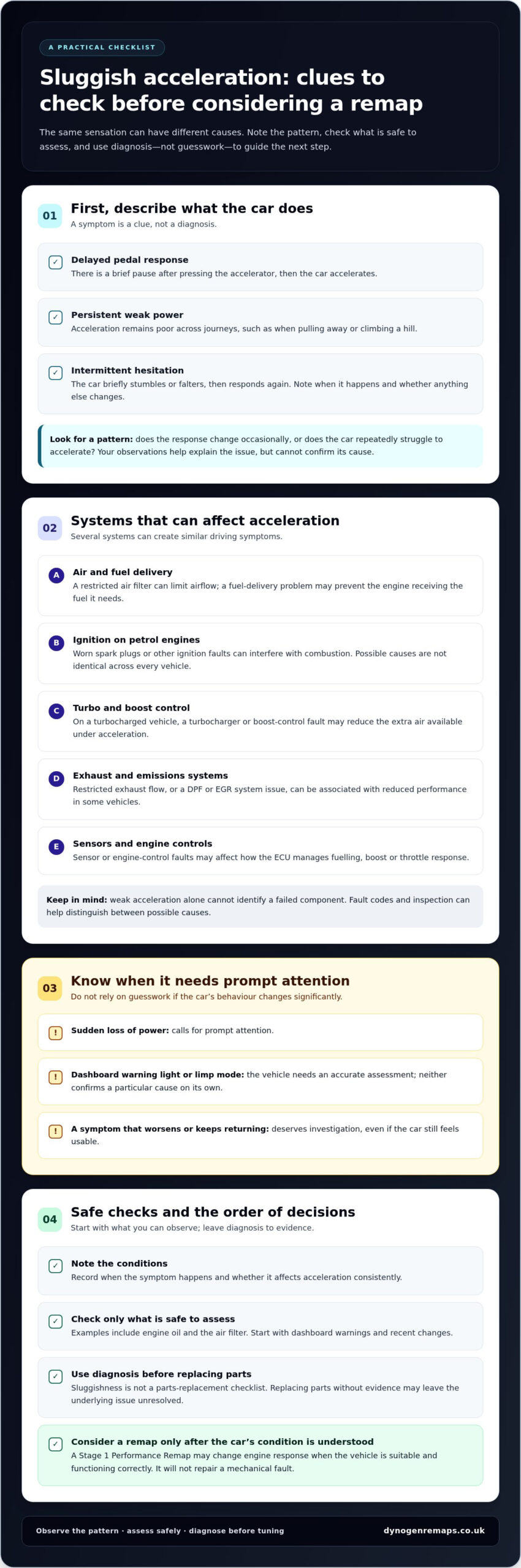
Sluggishness means a noticeable delay in response or a reduction in the car’s ability to accelerate as expected. A brief pause after pressing the accelerator is different from consistently weak power. Describing which one you experience can help explain the problem without guessing at its cause.
What does sluggish acceleration feel like in everyday driving?
You might notice that the car takes longer to pull away, gathers speed slowly when joining faster traffic, or hesitates when you ask for acceleration. A brief delay can feel different from a persistent lack of power that continues across journeys and driving conditions.
Look for a pattern. Does the response change only occasionally, or does the car repeatedly struggle to accelerate? Your observations are useful clues, but they can’t confirm which system is responsible. Restricted exhaust flow, for example, can be associated with reduced engine power, as described in this overview of the clogged catalytic converter. One sensation alone isn’t enough to identify a fault.
When should a change in responsiveness concern you?
A sudden loss of power, a dashboard warning light or the car entering limp mode calls for prompt attention. These signs can indicate that the vehicle’s control systems have detected a problem or are limiting performance. Don’t assume the cause from a warning or from how the car feels. The vehicle needs an accurate assessment.
A symptom that worsens or keeps returning also deserves investigation, even if the car still feels usable. Note when it happens and whether it affects acceleration consistently. Recording these details gives a clearer starting point for diagnosis than relying on a broad description alone.
What can make a car feel sluggish? The engine systems to understand
Similar driving symptoms can come from different parts of the engine and its supporting systems. A restricted air filter, fuel-delivery issue, worn ignition component, boost-control problem or inaccurate sensor reading may all affect acceleration. Inspection and relevant fault codes are more useful than guessing from how the car feels.
An engine needs the right air and fuel, effective combustion and a clear route for exhaust gases to leave. A problem at any stage can reduce performance, but the likely causes vary with the engine type and vehicle design.
How air, fuel and ignition problems can reduce engine response
A restricted air filter can limit airflow, while a fuel-delivery problem may prevent the engine receiving the fuel it needs. On petrol engines, worn spark plugs or other ignition faults can interfere with combustion. Diesel engines use a different combustion process, and their fuel and air systems vary between models, so possible causes aren’t identical across every vehicle.
These are possibilities, not a parts-replacement checklist. Sluggishness alone can’t tell you whether a filter, fuel component or ignition part has failed. Replacing parts without evidence may leave the underlying issue unresolved.
Could the turbo, DPF, EGR or a sensor be involved?
On a turbocharged vehicle, a fault affecting the turbocharger or boost control may reduce the extra air available under acceleration. A DPF or EGR system issue can also be associated with poor performance in some vehicles. Faults in sensors or engine control systems may affect how the ECU manages fuelling, boost or throttle response.
A warning light, smoke or limp mode helps describe what’s happening, but none confirms a particular cause on its own. Diagnostic information needs to be interpreted alongside the vehicle’s behaviour and condition.
One symptom can have several possible causes: weak acceleration could relate to restricted airflow, fuel delivery, petrol-engine ignition, turbo boost, exhaust flow, emissions-system operation or sensor and ECU behaviour. That overlap is why diagnosis should guide the next step, rather than an assumption about a single component.
Software changes aren’t a universal repair for mechanical or emissions-system faults, and removing emissions equipment shouldn’t be treated as a shortcut. Once the vehicle’s condition is understood, a remap may be relevant if the car is suitable and functioning correctly. Find out more about Stage 1 Performance Remapping and where it may fit after an underlying fault has been addressed.
Throttle lag or loss of power? Compare the clues before drawing conclusions
A car that feels slow to respond isn’t always losing engine power. The timing and consistency of the symptom can help distinguish delayed response from weaker acceleration, but they’re clues, not a diagnosis. Accelerator behaviour, gear changes and engine performance all affect how responsive a car feels.
| What you notice | Possible pattern | What to bear in mind |
|---|---|---|
| Delayed pedal response | The car pauses briefly after you press the accelerator, then accelerates. | If consistent, this may reflect how the accelerator, engine and gearbox respond. It doesn’t prove the car is mechanically sound. |
| Persistent weak power | Acceleration remains poor across journeys, such as when pulling away or climbing a hill. | A continuing loss of performance deserves investigation, particularly if it’s a new change. |
| Intermittent hesitation | The car briefly stumbles or falters, then responds again. | Note when it happens and whether warning lights or other unusual symptoms appear. |
What clues may point to throttle delay rather than a fault?
A response that feels consistently slow may be a characteristic of the vehicle’s accelerator and gearbox behaviour, or simply different from what you prefer. That impression alone can’t establish that everything is working correctly. A newly developed delay, or one that’s getting worse, is different from a response that has always felt the same. Treat a change as a symptom to investigate.
Which signs suggest the car needs investigation first?
Give priority to warning lights, limp mode, misfiring, unusual smoke or sudden power loss. A combination of signs can guide an assessment, but it can’t confirm the cause. These common signs of engine power loss also illustrate why symptoms can overlap. Avoid demanding hard acceleration if the car is behaving abnormally.
Record whether the problem appears under load, such as when accelerating uphill, and whether it began suddenly or has gradually worsened. If your car feels sluggish and unresponsive alongside a warning light or a clear loss of power, don’t assume a remap will resolve it. Software tuning can alter engine response on a suitable, healthy vehicle, but it isn’t a substitute for diagnosing a fault or clearing a warning light. Once the cause has been addressed, explore whether a Stage 1 Performance Remap is a suitable next step.
What can you check safely when your car feels sluggish?
A few careful observations can make the next step more productive, without turning a symptom into a parts-swapping exercise. Start with what the vehicle is reporting, then note when and how the change occurs.
Which first checks are safe and useful for a driver?
- Check the dashboard. Note any warning lights or messages, when they appeared in relation to the performance change, and whether the vehicle has entered limp mode.
- Think about recent changes. Record when the car was last serviced, whether the issue began after refuelling or other work, and whether the fuel level is low.
- Track the conditions. Note whether the symptom occurs on a cold start, uphill, during acceleration or throughout the journey. Record how often it happens and whether it’s getting worse.
- Make only safe visual checks. If you know how, check the engine oil level and inspect the air filter according to the vehicle handbook. Evaluating fluid condition—such as the guidance on assessing transmission fluid provided by Eagle Transmission & Auto Repair—can also offer useful clues. Don’t touch hot or pressurised components, or inspect anything while the engine is running.
A clear record is more useful than repeatedly trying to reproduce the problem, especially if doing so means hard acceleration or driving in a way that feels unsafe. Describe what happened rather than guessing which component is at fault.
What can diagnostic codes tell you about sluggishness?
An OBD-II reader may show a fault code when the vehicle’s systems detect an abnormal condition. A code can point towards a circuit or operating condition that needs attention, but it doesn’t always prove that a particular part has failed. Further checks may be needed to identify the underlying cause.
Write down the exact codes and any dashboard messages before clearing anything. Erasing codes can remove useful context for a later assessment, and it doesn’t fix the reason they appeared. Interpret readings alongside the symptoms, when they occur and the vehicle’s condition.
Persistent warning lights, limp mode or severe power loss need prompt attention. Avoid hard acceleration, and don’t continue driving if the vehicle’s behaviour makes the journey unsafe. Remapping shouldn’t be used to mask a fault. The car needs to be functioning correctly first. Vehicle condition also matters when considering safe engine remapping and power gains.
Once the vehicle is healthy and suitable, a Stage 1 Performance Remap may be a potential next step for changing engine response. Explore Stage 1 Performance Remapping after any suspected fault has been addressed.
When could remapping help a sluggish car, and what comes next?
A remap may be worth considering if the vehicle is mechanically sound and you want to change its engine response. It isn’t a repair for worn components, warning lights or emissions-system faults. If your car feels sluggish and unresponsive because something has gone wrong, identify and address the underlying issue before considering software tuning.
When is a Stage 1 remap a relevant consideration?
A Stage 1 Performance Remap is a performance option, not a fault-repair treatment. The vehicle needs to be functioning correctly, and you should have a clear goal, such as a different feel from the engine under acceleration. The outcome depends on the individual vehicle, so don’t assume a particular gain. Read this Stage 1 performance remapping guide to understand the process, and compare Stage 1 and standard drivability to set realistic expectations.
How does Dynogen approach performance software?
Dynogen Remapping Solutions provides Stage 1 Performance Remaps and Economy Remaps, using advanced software and equipment. The company has over 15 years of vehicle-tuning experience. These are distinct tuning services for different aims. Neither should be treated as a substitute for resolving a mechanical or emissions-system fault, and the result depends on the vehicle’s condition and suitability.
If performance has changed, note the symptoms and any warning messages, then establish the cause before deciding whether tuning fits your needs. Once the vehicle is functioning correctly, consider whether a performance or economy-focused remap better matches your goal.
Explore how Stage 1 remapping works and how Dynogen’s tuning services could suit your vehicle. View Dynogen remapping options.
Choose the right next step for your car
If your car feels sluggish and unresponsive, remember that the sensation is a symptom, not a diagnosis. Delayed throttle response and persistent loss of power can point to different issues. Note the pattern, and take warning lights, limp mode or sudden changes seriously.
Safe checks and diagnostic codes can help build a clearer picture, but codes don’t always identify a failed part. Address suspected mechanical or emissions-system faults before considering software tuning. A remap may alter engine response when the vehicle is suitable and functioning correctly, but it won’t repair a fault.
Dynogen Remapping Solutions provides Stage 1 Performance Remaps and Economy Remaps, backed by over 15 years of vehicle-tuning experience and advanced software and equipment. The two services suit different tuning aims. If your vehicle is healthy and you’re considering a performance-focused next step, explore Dynogen’s Stage 1 Performance Remap.
Understand the cause first, then choose the option that fits your car and your driving goals.
Frequently Asked Questions
Why does my car feel sluggish but have no warning light?
A car can lose responsiveness without immediately displaying a warning light. Air or fuel delivery, ignition, turbo boost, gearbox behaviour or other issues may affect acceleration before a warning appears. Note when the symptom occurs, whether it’s becoming more frequent and whether other changes appear, such as unusual noises or smoke. If sluggishness persists or worsens, a diagnostic assessment is more reliable than guessing or replacing parts.
Can a remap fix a car that feels sluggish?
A remap may alter engine response if the vehicle is suitable and functioning correctly, but it won’t repair a mechanical fault. If the car has recently lost power, shows a warning light or enters limp mode, establish the cause before considering tuning. Remapping before investigating an underlying issue can leave the fault unresolved. Once the car’s condition is understood, a Stage 1 Performance Remap may be a performance option.
Is throttle lag the same as loss of engine power?
No. They describe different experiences, although symptoms can overlap. Throttle lag is a delay between pressing the accelerator and the car responding. Loss of power means the vehicle can’t deliver its usual performance, either persistently or in particular conditions. Note when the behaviour occurs and whether warning lights appear. These observations can guide an assessment, but neither term identifies the cause by itself.
Can a blocked DPF make a car feel sluggish?
Yes, a DPF-related problem can affect performance on some diesel vehicles, especially if a fault leads to restricted operation or limp mode. Sluggishness alone doesn’t prove the filter is blocked, so consider warning messages and diagnostic information before drawing conclusions. Dynogen provides DPF software solutions, but don’t assume removal or a software change is the right response. Check current UK road-use and MOT requirements before any work involving emissions equipment.
What should I do if my car suddenly loses power?
Treat sudden, severe power loss as requiring prompt attention. Avoid hard acceleration, note any dashboard warnings or messages, and stop somewhere safe if the car can’t be driven predictably. Limp mode, smoke, unusual noises or a flashing warning light add urgency. Don’t try to identify the fault from one symptom alone, and avoid continuing a journey if the vehicle’s behaviour makes it unsafe—contacting a recovery provider such as Allout Towing ensures the vehicle can be transported for diagnostic checks without risking further mechanical damage.
Can an OBD-II code tell me exactly why my car is sluggish?
No. An OBD-II code can point to a monitored system, circuit or operating condition, but it doesn’t always identify the failed component. Different faults can produce similar codes, and some performance symptoms may not trigger a code. Record the exact code, warning messages and circumstances in which the problem occurs before anything is cleared. That information can then be considered as part of a proper diagnostic process.