
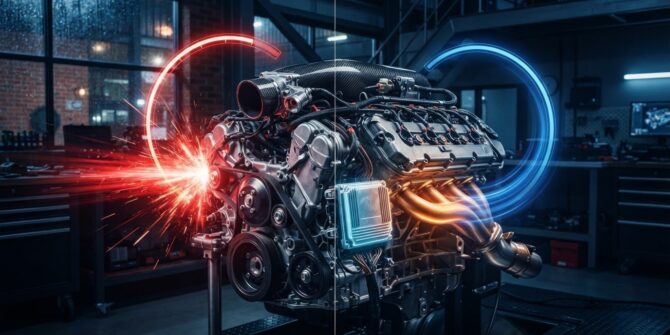
A hard-cut limiter abruptly interrupts engine output at its programmed RPM threshold. A soft-cut limiter progressively reduces power as the engine approaches its limit. The hard cut limiter vs soft cut limiter choice is about how the ECU manages that threshold: intervention can involve fuel, ignition or both. Normal operation resumes once revs fall below the limit.
It’s easy to think the difference is simply a sharper or smoother sound at high revs. The key distinction is the control strategy, and how it affects the engine as it reaches and moves away from its limit.
This guide explains how each limiter behaves, how hysteresis helps prevent repeated switching around the threshold, and why soft-cut operation varies between vehicles. You’ll also learn what these systems can and can’t protect against, so you can understand the trade-offs before considering an ECU calibration for your car.
Key Takeaways
- A hard cut sharply interrupts engine output at its programmed threshold; hysteresis helps prevent repeated switching as revs fluctuate around that point.
- Soft-cut behaviour can progressively reduce fuel or ignition, but the exact strategy depends on the ECU calibration.
- Fuel, ignition and throttle-based interventions affect engine operation differently, so the limiter strategy matters as much as the cut’s feel.
- A rev limiter can help control engine speed, but it can’t prevent every cause of over-revving, including a forced downshift in a manual car.
- When considering a Stage 1 Performance Remap, understand how the calibration manages engine speed alongside its performance changes.
Hard-cut limiter operation and hysteresis
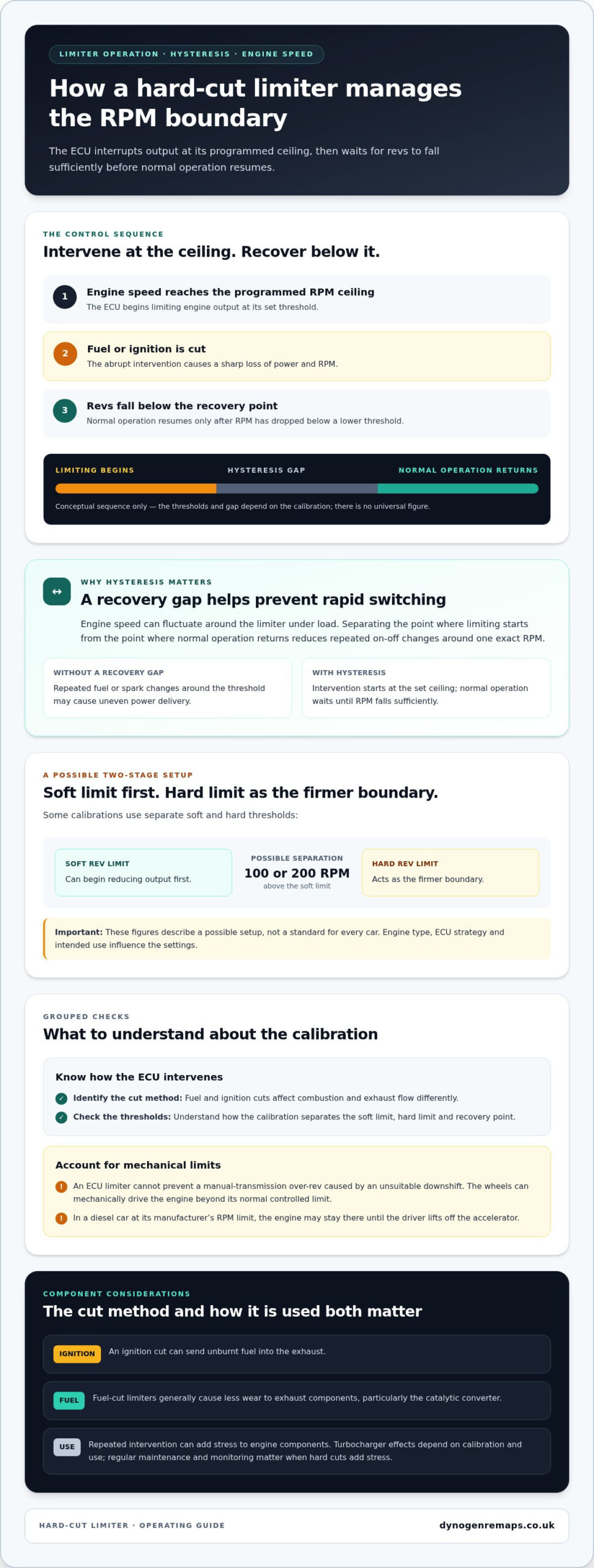
A hard-cut limiter intervenes when engine speed reaches its programmed RPM ceiling. The ECU can cut fuel delivery or ignition spark, causing an abrupt loss of power. Normal operation resumes as the engine slows below the threshold. In a diesel car at its manufacturer’s RPM limit, the engine may stay there until the driver lifts off the accelerator.
That sharp on-off behaviour can make the engine repeatedly hit the threshold if the accelerator stays down. Hysteresis helps by separating the RPM at which limiting begins from the point at which normal operation returns. For example, the ECU can cut output at its upper threshold, then restore it only after revs drop below a lower threshold. This gap reduces rapid switching around one exact RPM.
The distinction matters because engine speed can fluctuate around the limiter under load. Without a recovery gap, repeated fuel or spark changes may cause uneven power delivery. Hysteresis gives the ECU a clearer operating band: intervention starts at the set ceiling, while normal operation resumes only after RPM falls sufficiently. The gap depends on the calibration, so there’s no universal figure.
Some calibrations use separate soft and hard thresholds. A hard rev limit may be set 100 or 200 RPM above the soft rev limit. In that arrangement, the soft limit can begin reducing output first, with the hard cut acting as the firmer boundary. Those figures describe a possible setup, not a standard for every car. Engine type, ECU strategy and intended use influence the chosen settings.
A hard cut does not protect against every form of over-revving. In a manual car, an early downshift can force the engine beyond its redline through the wheels, even when the ECU limits engine power. Selecting too low a gear at speed, for example, can mechanically drive the engine faster than its normal controlled limit.
Are aftermarket rev limiters legal for road cars in the UK? Road use depends on the vehicle remaining compliant with applicable roadworthiness, emissions and noise requirements. A limiter setting alone doesn’t establish that the car meets them.
Can a hard-cut limiter damage an engine, turbo or catalytic converter? Repeated intervention can add stress to engine components, while ignition cutting can send unburnt fuel into the exhaust. Fuel-cut limiters generally cause less wear to exhaust components, particularly the catalytic converter. Effects on the turbocharger depend on how the system is calibrated and used.
- Identify the cut method: Fuel and ignition cuts have different effects on combustion and exhaust flow.
- Understand the thresholds: Check how the calibration separates the soft limit, hard limit and recovery point.
- Respect mechanical limits: An ECU limiter cannot prevent a manual-transmission over-rev caused by an unsuitable downshift.
- Use the limiter sparingly: Regular maintenance and monitoring matter when hard cuts place added stress on components.
How hard and soft cut rev limiters work
An ECU can limit engine speed by controlling fuel, ignition or, in modern drive-by-wire cars, throttle position. The chosen method determines whether power drops abruptly or progressively.
Comparing limiter operation
A hard-cut strategy intervenes sharply at its programmed threshold. The ECU interrupts fuel delivery or ignition, causing a sudden reduction in engine power and RPM. A soft-cut strategy starts limiting more gradually as RPM approaches its threshold. Depending on the calibration, it may retard ignition, reduce fuel or combine both methods.
Focus on the control method, not just the sound. An ignition cut can leave fuel unburnt in the exhaust, while a fuel cut stops combustion by withholding fuel. Modern production cars can also use ECU-controlled throttle position to keep engine speed within a safe range. Diesel engines rely on fuel control for practical rev limiting.
One distinction can cause confusion: a soft limiter can also mean a separate, lower RPM ceiling when a car is out of gear. That is not necessarily the same as a soft-cut strategy near the engine’s main limit. Check whether a description refers to the limiter’s operating condition or its method of reducing power.
Identifying the limiter type
How can you tell whether a car has a hard-cut or soft-cut limiter? First, consult the vehicle’s calibration information or diagnostic data to identify its programmed strategy. If observing its behaviour, a hard cut feels like a sharp interruption at the threshold; a soft cut usually feels like power being reduced progressively. Sound alone can mislead.
Don’t repeatedly hold the accelerator against the limiter to test it. A controlled assessment considers engine behaviour alongside ECU data, including whether fuel, ignition or throttle control is changing. A car may also have more than one limit, so reaching a lower stationary limit doesn’t prove how its main driving limiter works.
Imagine two cars reaching their programmed ceilings in the same gear. One abruptly loses output, then regains it as RPM falls. The other begins reducing power as revs approach the ceiling. Those responses suggest different strategies, but calibration data provides a clearer identification.
Finally, distinguish engine RPM control from road-speed control. A rev limiter manages how quickly the engine turns; a speed limiter restricts vehicle speed. Speed Limiter Removal concerns the latter, not the engine’s RPM cut strategy.
A forum contributor describes a soft limiter as gradually retarding ignition towards the limit, while another suggests that an injection system may cut fuel as well as ignition. A hard-cut rev limiter cuts fuel supply instantaneously when the engine reaches the limiter, causing a sudden drop in power and RPM. One forum user reports that their Saab’s hard limiter stopped the revs until they lifted their foot off the accelerator. Engine operation may resume once RPM falls below the limiter. An ECU can apply a rev limiter by cutting fuel or ignition.
Soft-cut limiter operation
A soft-cut limiter starts managing engine speed as RPM approaches its programmed ceiling. Instead of waiting for one abrupt interruption, the ECU progressively reduces engine output. It may retard ignition timing, reduce fuel delivery or combine both methods. The result depends on the engine and calibration, so “soft cut” describes a gradual intervention, not one universal ECU strategy.
On an injection engine, the ECU can reduce fuel or adjust ignition as revs climb. Some calibrations progressively cut cylinders, reducing torque in stages rather than switching everything off together. On a traditional carburettor engine, an ignition module may cut selected sparks above its set speed. One example uses spark cutting above 6,500 rpm, although that figure is illustrative, not a standard setting.
This staged intervention changes how the driver feels the limit. Instead of one sharp loss of power, acceleration can taper or become uneven as the engine nears its ceiling. A driver holding the accelerator down may feel repeated fluctuations while the ECU controls engine speed. Their intensity depends on the cut pattern, engine load and control system.
A soft-cut calibration also needs to be distinguished from a separate, lower stationary limit. The latter may restrict RPM when the car is out of gear, but it doesn’t automatically mean the ECU uses a soft-cut strategy while driving. For example, a car can have a lower neutral limit and a different method for controlling revs under load.
Can a soft-cut limiter damage an engine or exhaust system? Repeatedly operating against the limit can add stress. Ignition cutting may send unburnt fuel into the exhaust, where combustion can create pressure spikes and disturb the valve train. Fuel cutting is generally safer in most instances. Fuel-cut limiters are common in road cars because they cause less wear to exhaust components, particularly the catalytic converter.
For a road car, the key questions are what the ECU cuts and how progressively it intervenes. Fuel reduction avoids the unburnt-fuel route associated with ignition cuts. However, engine condition and calibration still matter. A soft cut is no substitute for choosing an appropriate RPM limit or maintaining the engine.
- Check the intervention: Determine whether the ECU adjusts fuel, ignition timing, or both.
- Notice the behaviour: Gradual power reduction suggests progressive limiting; a sharp interruption suggests a hard cut.
- Keep the setup in context: A neutral RPM ceiling and an in-gear rev limiter may operate differently.
Which limiter type is better for engine safety and longevity?
Neither label alone determines engine safety. The ECU’s intervention method, RPM setting and engine condition matter more than whether the cut feels hard or soft. A progressive fuel cut can reduce abrupt torque changes, while a hard fuel cut can provide a clear ceiling. Ignition cutting changes the comparison because it can send unburnt fuel into the exhaust.
Fuel cutting is generally safer in most instances. By stopping fuel delivery, the ECU prevents further combustion in the affected cylinders. Fuel-cut limiters are common in road cars because they cause less wear to exhaust components, particularly the catalytic converter. Diesel engines also rely on fuel cutting as the only practical rev-limiting system.
Ignition cuts need more care. If the ECU removes spark but continues fuelling, unburnt mixture can enter the exhaust manifold and ignite when combustion resumes. That combustion can create a pressure spike, push exhaust valves off their seats and disturb the valve train. Engines with known valve-train issues face particular risk, including the possibility of displaced rockers.
A soft cut isn’t automatically gentle on every component. A calibration that progressively retards ignition or cuts sparks can still stress the exhaust system. Conversely, a hard cut that stops fuel can avoid the same unburnt-fuel route. Compare what the ECU actually controls rather than judging safety by how smooth the rev-limit sensation feels.
The RPM setting matters just as much. A hard limit set slightly below the engine’s redline leaves a margin before the indicated maximum, rather than encouraging repeated operation at the edge. The right threshold must reflect the engine’s design and condition. Oil supply, cooling, valve-train health and previous wear all affect how an engine tolerates high RPM.
Engine overspeed can cause valve float, misfire, loss of compression or valve-to-piston contact. A limiter helps control engine speed during normal ECU operation, but it can’t remove mechanical risk in every driving situation. Regular maintenance and monitoring are important, especially if the car is repeatedly taken to its programmed limit.
- Check the cut strategy: Establish whether the ECU cuts fuel, ignition or both.
- Review the threshold: Keep the hard limit slightly below the engine’s redline.
- Consider engine condition: Valve-train problems make ignition-cut strategies especially concerning.
- Use the limiter as protection, not permission: Repeatedly hitting the limit still places stress on components.
For longevity, a well-calibrated fuel-based strategy is generally preferable to an ignition cut that leaves fuelling active. A progressive response can make intervention smoother, but the safest choice is the one matched to the engine, its condition and its intended use.
How do hard and soft cut limiters affect power, sound and exhaust temperatures?
A hard cut causes a sudden change in engine output when the ECU reaches its programmed threshold. The driver may feel a sharp interruption, followed by power returning as RPM falls. With a soft cut, the ECU progressively reduces output as revs approach the limit. This can feel more like uneven acceleration than an abrupt stop.
Sound depends on which part of combustion the ECU controls. A fuel cut stops fuel entering the affected cylinders, so combustion and power fall away. An ignition cut can leave fuel flowing without a spark. When ignition resumes, unburnt fuel may ignite in the exhaust, creating pops or bangs. Those sounds reflect the strategy, not proof of extra performance.
Holding the accelerator against a limiter can make either strategy cycle audibly. With a hard cut, the engine may alternate between interruption and recovery. A progressive soft cut can produce a more continuous, uneven note as the ECU reduces output. Exhaust noise also depends on the engine, exhaust system and calibration, so sound alone can’t identify the exact cut method.
Exhaust temperature is closely linked to whether fuel continues burning after leaving the cylinder. If an ignition cut leaves fuelling active, unburnt mixture can ignite in the exhaust manifold. That combustion can create pressure spikes and expose exhaust components to added heat and stress. Fuel cutting avoids supplying fresh fuel to the cylinders being cut, making it the safer option in most instances.
Fuel-cut rev limiters are common in road cars because they cause less wear to exhaust components, particularly the catalytic converter. That matters because repeated ignition cuts can send unburnt fuel towards the catalyst. A hard cut isn’t automatically harsher on the exhaust: its effect depends on whether the ECU cuts fuel or spark. Likewise, a soft cut isn’t automatically cooler if its calibration relies on ignition retard or spark cuts.
To understand a car’s behaviour, consider three details: whether power drops sharply or progressively, whether the ECU cuts fuel or ignition, and whether unusual exhaust after-firing occurs. These observations help frame the comparison, but ECU data is more useful than sound alone. Avoid repeatedly testing the limiter, as sustained operation at the threshold adds unnecessary load.
If changes to engine response are your goal, review ECU tuning options with the calibration strategy in mind. The way a map controls fuel and ignition shapes the driving experience as well as the sound.
Dynogen Remapping Solutions: Stage 1 Performance Remap
Dynogen Remapping Solutions offers a Stage 1 Performance Remap for drivers considering ECU tuning to change their vehicle’s performance characteristics. A remap is a broader calibration decision than simply choosing a hard or soft rev-limit behaviour, so it’s useful to understand your priorities before making changes.
If you want a different balance of performance and everyday drivability, consider how you use the car and what you want from its engine response. Dynogen Remapping Solutions also offers an Economy Remap for drivers focused on efficiency. The right option depends on the vehicle and your aims, not just the sound of the limiter.
To discuss your vehicle and tuning goals, contact Dynogen Remapping Solutions.
Make your next tuning decision with purpose
Choosing a hard-cut limiter versus a soft-cut limiter is only one part of shaping your vehicle’s behaviour. Before changing its calibration, decide what matters most: performance, fuel efficiency or addressing a specific system requirement. That gives the tuning conversation a practical starting point, based on how you use your car rather than the sound it makes at the rev limit.
Dynogen Remapping Solutions offers a Stage 1 Performance Remap for performance-focused tuning, an Economy Remap for efficiency-focused goals, and an AdBlue Solution for relevant system needs. These are distinct services, so the best next step is to discuss the aim behind any proposed change and how it relates to your vehicle.
Contact Dynogen Remapping Solutions to discuss your vehicle and tuning goals. A clear objective can help you move towards a considered calibration and a driving experience that better suits your priorities.
Frequently Asked Questions
What is a hard cut limiter and how does it work?
A hard-cut limiter is an ECU control that sharply interrupts engine output at a programmed RPM ceiling. It can cut fuel delivery or ignition, depending on the system. If you’re assessing one, note whether power returns as revs fall or only after you ease off the accelerator. That behaviour can offer a clue, but ECU calibration data gives a more dependable picture than sound alone.
What is a soft cut limiter and how does it work?
A soft-cut limiter progressively controls engine output as RPM approaches its set ceiling. The ECU may retard ignition, reduce fuelling or cut cylinders in stages. For example, a driver accelerating in a high gear may feel power become uneven before the engine reaches its maximum controlled speed. The precise sensation depends on the calibration, so the term describes gradual intervention rather than one fixed technique.
Hard cut vs soft cut limiter: what are the main differences?
The hard-cut limiter versus soft-cut limiter comparison comes down to the timing and character of ECU intervention. A hard cut acts abruptly at its threshold, while a soft cut reduces output progressively as revs approach it. To compare two calibrations, consider the cut method, how the engine responds under load, and whether you prioritise a defined interruption or smoother power control. Neither label alone establishes safety.