
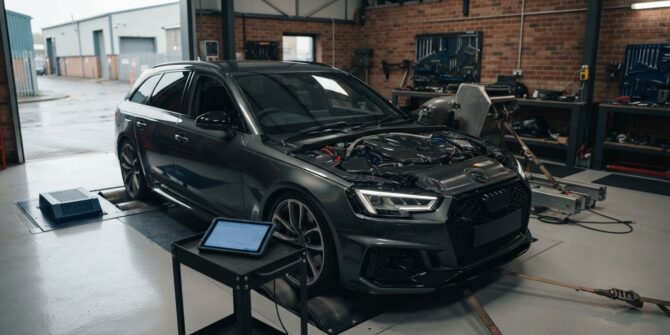
A sharper Octavia vRS starts with a calibration matched to its engine, not a one-size-fits-all file. A Stage 1 Skoda Octavia VRS remap adjusts the ECU software to improve power delivery and torque while retaining the standard engine components. The featured 2.0 TDI is rated at 181 bhp, while an earlier 2.0 TDI CR vRS is listed at 170 bhp.
It’s natural to want stronger performance without compromising everyday drivability or reliability. The right approach depends on the specific engine and ECU, so identifying your Octavia’s generation and variant is an important first step.
This guide explains what Stage 1 tuning involves, how custom calibration can shape the driving experience, and what to expect from power, torque and standard components. It also covers reliability considerations and the Octavia generations discussed, helping you make a more informed decision about tuning your vRS.
Key Takeaways
- Identify your Octavia’s exact engine and ECU before considering a Stage 1 calibration; the 2.0 TDI versions use different ECU types.
- Custom tuning can shape how power is delivered, so consider the driving response you want as well as peak output.
- Compare any projected gains with your car’s original power and torque figures to understand what the change means in practice.
- Keeping standard components makes the calibration’s suitability for the vehicle’s existing condition and setup an important consideration.
- The article covers Octavia vRS models including the 5E range, listed for 2013-2020, and variants shown from 2015 onwards.
Stage 1 ECU remap for the Skoda Octavia vRS 2.0 TDI
A Stage 1 calibration revises engine-control software to alter how the engine delivers performance. The correct file depends on the Octavia’s engine, ECU and condition, so identify the exact variant before comparing figures.
Stage 1 ECU remap options
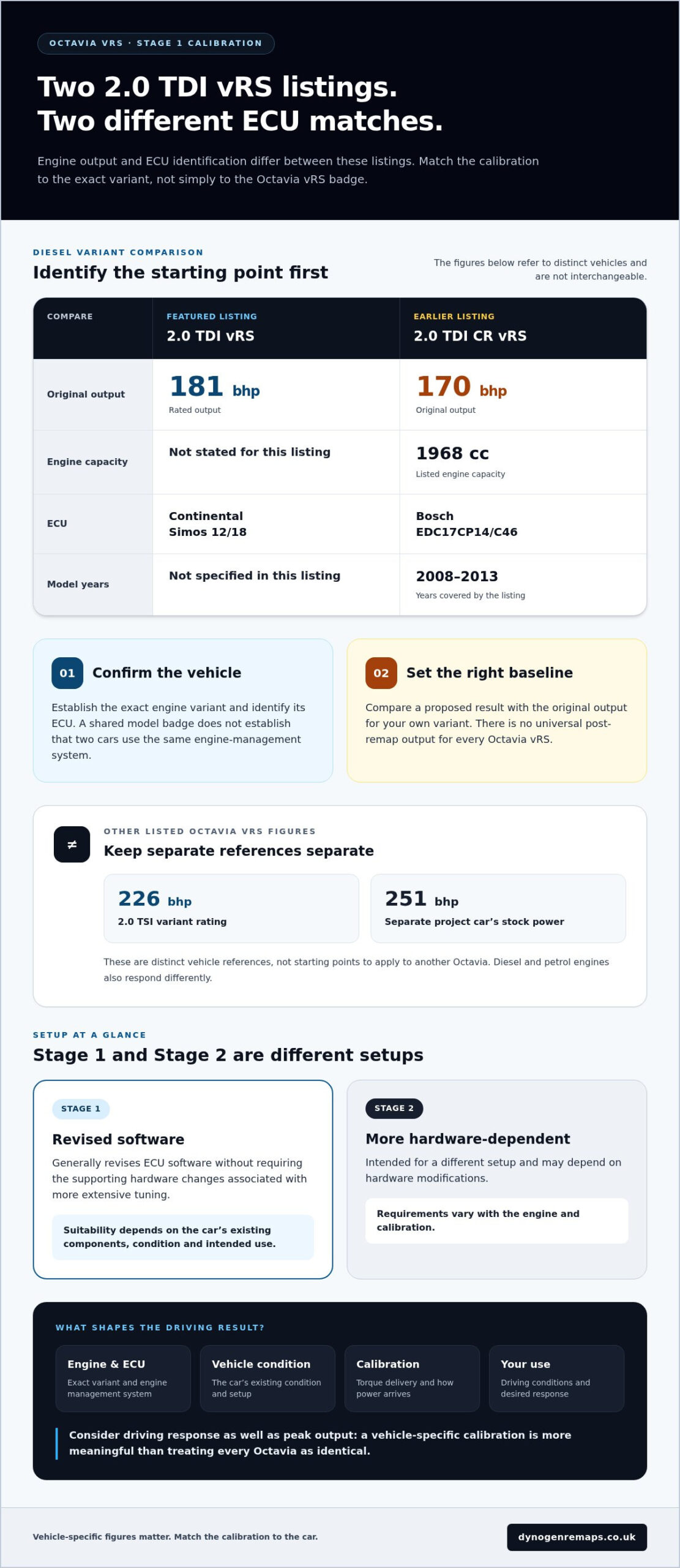
The 2.0 TDI vRS featured here is rated at 181 bhp and uses a Continental Simos 12/18 ECU. An earlier 2.0 TDI CR vRS has a 1968 cc engine, an original output of 170 bhp and a Bosch EDC17CP14/C46 ECU. That listing applies to model years 2008-2013.
An ECU calibration must match the engine management system, not just the Octavia badge. First establish the engine variant and ECU identification, then consider the car’s condition and how you use it. This helps define a suitable balance between stronger response and everyday drivability.
Stage 1 power figures
Other listed Octavia vRS figures include a 2.0 TSI variant rated at 226 bhp and a separate project car with stock power of 251 bhp. These are distinct vehicle references, not interchangeable starting points. A diesel and a petrol engine also respond differently because their engine and software characteristics differ.
Use the original output for your exact variant as the baseline when reviewing a proposed result. One advertised figure cannot describe every Octavia vRS, and there is no universal post-remap output for all models. Torque delivery, engine condition and ECU calibration all affect how the car feels.
Stage 1 remap notes
Stage 1 generally means revising ECU software without requiring the supporting hardware changes associated with more extensive tuning. Stage 2 is intended for a different setup and may depend on hardware modifications; its requirements vary with the engine and calibration. A Stage 1 choice should therefore reflect the car’s existing components and intended use.
For a considered Skoda Octavia VRS remap, match the proposed calibration to the exact engine and ECU, and ask how it will affect power delivery rather than focusing only on peak output. A vehicle-specific approach is more meaningful than applying figures from another Octavia as though every car were identical.
Ownership, compliance and supporting modifications
Does remapping affect warranty, insurance or road tax in the UK? Warranty coverage depends on its terms and the modification. Tell your insurer about the change and ask how it affects your policy. For road tax, consider whether any change to recorded vehicle details affects your circumstances.
Is a remapped Octavia vRS legal and MOT-compliant? A remap must leave the car compliant with applicable road-use and emissions requirements. Retain emissions equipment and ensure the vehicle meets the relevant MOT emissions assessment.
What supporting modifications are needed before Stage 2? Requirements depend on the engine and the intended calibration. Discuss the planned hardware changes as a matched setup, rather than assuming a Stage 1 configuration is ready for Stage 2.
How do Stage 1 and Stage 2 differ? Stage 1 focuses on revised software for the existing setup, while Stage 2 involves a more hardware-dependent configuration. The exact distinction depends on the engine and tuning approach.
How do I choose a reputable UK specialist? Look for a specialist who identifies the Octavia’s engine and ECU, explains the calibration, and discusses diagnostics and expected drivability. Clear, vehicle-specific reasoning is more useful than an unqualified headline figure.
Custom tuning
Custom ECU tuning shapes how an Octavia vRS responds, rather than treating peak output as the only goal. Fuel use, transmission behaviour and everyday driving conditions all matter when assessing a calibration.
Custom ECU calibration
A custom calibration adjusts engine-control software to suit the vehicle and the driver’s priorities. The important considerations include the engine variant, ECU, fuel and transmission, alongside the desired balance of response and usable power. A petrol car running 99 RON, for example, has a different operating context from a diesel used for steady motorway journeys.
Before choosing a tune, decide what you want to improve: acceleration response, power delivery through the rev range, or relaxed progress in normal driving. Then compare the proposed calibration with those aims. This keeps the discussion focused on how the car drives, not just a headline figure.
Customer remap experiences
One customer review describes a 242 hp Octavia vRS with a 7-speed DSG, tuned using 99 RON fuel. That example highlights the value of considering the transmission and fuel alongside the engine. A calibration’s character is experienced through the complete car, including how power arrives and how the gearbox responds.
Other UK customer reports describe a remapped vRS delivering power to 4500 rpm. These accounts offer useful examples of real-world impressions, but they describe individual vehicles and driving experiences. Treat them as context, then focus on whether the calibration suits your own Octavia’s engine, fuel and use.
Fuel economy and real-world performance
How does a remap affect Octavia vRS fuel economy and real-world performance? A remap can change engine response and power delivery, whilst fuel economy depends on driving conditions and how the driver uses that performance. Customer reports include a 5 mpg increase at a steady 75 mph after remapping a 2.0 TDI CR vRS, and another reported an improvement of about 3 mpg.
Those figures are individual reports, not a universal result for every Octavia. A steady motorway run differs from frequent acceleration, traffic or short journeys, so compare like-for-like conditions when judging economy. For performance, consider the useful rev range and smoothness of delivery, not simply peak power. A Stage 1 Performance Remap is relevant when your priority is a tailored performance calibration.
A customer reported that their Skoda Octavia had covered 38k miles after having it remapped. That mileage provides one ownership datapoint, rather than a measure of what every calibration will achieve or how any individual engine will fare. When considering a used or already tuned car, ask what work was carried out, what fuel and driving pattern the owner used, and whether the vehicle has been maintained consistently. A mileage figure alone cannot show how the car was driven, how the calibration was developed, or whether the current setup matches your priorities. Use the owner’s account as background, then judge the car’s condition and response in person and seek clear details about the remap before making a decision.
Power and torque improvements
Power and torque describe different aspects of an Octavia vRS’s performance. Power relates to the engine’s capacity to sustain work, while torque contributes to the force felt during acceleration. A useful comparison starts with the exact vehicle’s original figures, then considers how the calibration changes delivery across the rev range.
The available figures describe different cars, not one universal vRS baseline. One listed Octavia variant is rated at 226 bhp. A separate Octavia vRS project had stock power of 251 bhp and stock torque of 394 Nm. Those figures must remain tied to their respective examples when assessing any proposed tuning result.
That distinction matters because a model badge alone doesn’t identify an engine or its starting output. Compare the registration and engine variant with the vehicle’s technical records, then establish its baseline. For example, the 226 bhp listing should not be substituted for the project car’s 251 bhp and 394 Nm figures.
Torque delivery can shape how the car feels during everyday acceleration. A stronger response at lower engine speeds may reduce the need to change down, while power retained higher in the rev range can support continued acceleration. The useful outcome depends on the delivery curve, not a single peak value.
For a meaningful comparison, ask for the original and proposed power and torque figures for the same Octavia configuration. Check that each figure uses the same unit, and distinguish engine output from wheel measurements. A dyno result is most useful when the vehicle, measurement method and calibration are clearly identified.
Driving conditions also affect how gains feel. In a 7-speed DSG Octavia vRS, the transmission’s gear changes influence how the engine’s torque reaches the road. On a manual car, gear choice and clutch condition affect the experience. Comparing the same route and driving style before and after tuning gives a clearer impression than relying on a single acceleration run.
Peak figures don’t describe response, smoothness or consistency. Review how the calibration manages torque through the rev range, especially if you use the Octavia for commuting as well as brisk driving. A balanced setup should suit the engine and transmission together, rather than chase a headline number that says little about usable performance.
The 251 bhp and 394 Nm project figures are stock values, not post-remap results. Likewise, the 226 bhp listing is a separate vehicle reference. Use those numbers to understand why model-specific baselines matter; assess any expected improvement against the exact Octavia’s original output and the shape of its power and torque curves.
The project also included fitting an NVM downpipe, a Go Fast Bits DV+ and a Powerflex lower engine mount to the Skoda Octavia VRS.
Reliability and retaining standard components
A Stage 1 calibration can work with an Octavia vRS’s standard components, but the car’s condition still matters. The engine, turbocharger, clutch or DSG transmission must cope with the revised power delivery. Existing faults or wear can become more noticeable when the engine produces greater torque.
Begin with a health check before changing the ECU software. Review stored fault codes, servicing history and signs of uneven running, then investigate problems rather than tuning around them. On a 2.0 TDI, for example, a warning light or inconsistent boost response deserves attention before calibration. Sound maintenance gives a clearer starting point for assessing how the vehicle behaves afterwards.
When retaining standard hardware, the calibration must suit the parts already fitted. The turbocharger, fuel system, cooling system and exhaust equipment all form part of the engine’s setup. Asking components to deliver more than they can reliably provide may increase stress. Choose a target that reflects the existing configuration and how you drive the Octavia, not simply a peak figure.
What are the risks of remapping an Octavia vRS DSG gearbox or manual clutch? Extra torque can increase demands on a DSG clutch pack or manual clutch, particularly if either component is worn. Slipping, harsh engagement or poor gear changes should be diagnosed before tuning, since software cannot repair mechanical wear.
Driving style also affects component load. Repeated hard acceleration places different demands on the drivetrain than smooth commuting in a 7-speed DSG car. After tuning, pay attention to changes such as clutch slip, unexpected gear changes, smoke or new warning lights. These symptoms call for diagnosis, not harder acceleration to test the result.
- Engine: address fault codes, uneven running and boost issues before calibration.
- Clutch: investigate slipping or difficult engagement on a manual Octavia.
- DSG: note harsh shifts or inconsistent gear changes before increasing engine torque.
- Servicing: keep the vehicle’s maintenance current and retain records for future diagnostics.
A controlled post-remap drive helps establish a useful baseline. Note how the engine responds, how the gearbox changes gear and whether the car runs smoothly under normal use. A mobile phone can record observations such as warning messages or when a symptom occurs, giving a technician practical detail for diagnosis.
Standard components can remain in place for a Stage 1 setup, but that doesn’t remove the need for sound judgement. Match the calibration to the Octavia’s engine and drivetrain, and treat mechanical symptoms as maintenance issues first. A reliable result depends on the whole vehicle, not ECU software alone.
Octavia generations supported
Octavia vRS tuning spans distinct model years, engine variants and ECU types, so the registration year alone isn’t enough to identify a match. The listed range includes the Octavia (5E), covering 2013-2020, and a vRS variant shown for 2015 onwards. These dates help narrow the search, but the engine and ECU identify the specific calibration needs.
Earlier cars appear in the model data too. The 2.0 TDI CR vRS listing applies to model years 2008-2013, with a 1968 cc engine and Bosch EDC17CP14/C46 ECU. A later 2.0 TDI vRS example is rated at 181 bhp and uses a Continental Simos 12/18 ECU. Those details show why two diesel vRS models shouldn’t be treated as identical.
Petrol variants add another distinction. A listed 2.0 TSI vRS uses a 1984 cc petrol engine and Continental Simos 19.6 ECU. Compare those identifiers with the diesel examples: fuel type, engine capacity and ECU differ, even within the same Octavia vRS nameplate. Matching software to the exact engine management system is essential to a vehicle-specific calibration.
Identify your Octavia before tuning
Start with the vehicle’s model year and engine designation, then establish its fuel type and ECU details. For example, a 2008-2013 2.0 TDI CR vRS belongs to a different listed ECU application from the 2.0 TSI petrol example. Registration documents can help identify the car, while diagnostic identification can clarify which control unit it uses.
Use the 5E code as a useful range identifier, not as the only information needed to select software. The 2013-2020 range covers multiple years, and the listed 2015 onwards vRS entry gives a separate model-year reference. A correct identification process brings these details together rather than assuming all 5E cars share one engine or ECU.
What the generation range means
The listed examples cover diesel and petrol Octavia vRS applications across different model years. They include the 2008-2013 2.0 TDI CR, the 2013-2020 Octavia (5E) range, and a vRS variant shown from 2015 onwards. This proves that generation and variant both matter when assessing tuning compatibility.
Before choosing a calibration, record the Octavia’s model year, engine, fuel type and ECU identification. Then compare those details with the intended application, rather than relying on a broad “Octavia vRS” description. That practical sequence helps distinguish a 2.0 TDI from a 2.0 TSI and supports a more accurate discussion of the vehicle’s setup.
Dynogen Remapping Solutions: Stage 1 Performance Remap
Dynogen Remapping Solutions offers a Stage 1 Performance Remap for Octavia vRS drivers seeking sharper engine response and stronger performance. It’s a natural next step once you’ve identified your engine, ECU and priorities, whether that means improved acceleration or more responsive everyday driving.
The right option depends on what you want from the car. A Stage 1 Performance Remap focuses on performance, whilst an Economy Remap is suited to drivers prioritising efficiency. Dynogen also offers AdBlue and DPF Solutions for relevant system concerns. Matching the service to your Octavia’s requirements keeps the decision focused on the outcome you need.
Contact Dynogen Remapping Solutions to discuss your Octavia vRS tuning requirements.
Choose the right direction for your Octavia
Your next step is to decide what you want the car to do differently. A Skoda Octavia VRS remap should reflect your priorities, whether you’re seeking a more responsive drive or a calibration aligned with efficiency. Keeping that goal clear helps focus the discussion on your vehicle and how you use it.
Dynogen Remapping Solutions offers a Stage 1 Performance Remap for performance-focused tuning and an Economy Remap for drivers prioritising efficiency. Its AdBlue Solution addresses a different system need. These options give you a clear starting point for discussing the outcome you’re looking for, rather than choosing a service by name alone.
Share your Octavia’s details and your driving priorities to begin a practical conversation about the right approach. Contact Dynogen Remapping Solutions to discuss your requirements and take the next step with confidence.
Frequently Asked Questions
Which Skoda Octavia vRS models and engines can be remapped in the UK?
Examples include the 2.0 TDI CR vRS listed for model years 2008-2013, the Octavia (5E) range covering 2013-2020, and a vRS variant shown from 2015 onwards. Listed petrol and diesel examples use different engines and ECUs, so identify your vehicle by model year, engine and ECU rather than relying on the vRS badge alone. This helps match the calibration to the specific car.
What power and torque gains does a Stage 1 remap give each Octavia vRS engine?
There isn’t one fixed Stage 1 gain for every Octavia vRS engine. The useful change depends on the exact engine and ECU, its starting condition, fuel and transmission, as well as how the calibration delivers torque through the rev range. Compare the proposed output with your car’s original figures, and assess both the power increase and the shape of the torque delivery rather than treating one headline figure as universal.