

An ECU remap should suit the way you use your vehicle, not simply chase a bigger power figure. A suitable calibration can prioritise sharper performance, fuel efficiency or more usable pulling power for towing. The change is made through the engine control unit, and its effect on warranty cover depends on the vehicle and the terms of that cover.
It’s sensible to weigh up the potential driving benefits alongside practical questions about your vehicle, how it’s used and what a software change could mean for warranty claims. This guide explains how mobile remapping works, how performance, economy and towing-focused options differ, and what to consider before choosing a tune. You’ll also learn how a specialist remapping service can fit into that decision, so you can approach the next step with a clearer understanding of what your vehicle needs.
Key Takeaways
- Choose a tune around how you use your vehicle, whether that means sharper response, improved economy or more useful pulling power.
- Understand how a mobile remap is carried out and what can affect the process at your location.
- Consider the effect a software change may have on your vehicle warranty before deciding to proceed.
- Learn how ECU tools and tailored files shape a remap, and why the vehicle’s condition matters.
- Explore performance and economy remapping options suited to your vehicle and driving needs.
Will a remap from a remap specialist affect my vehicles warranty?
An ECU remap involves changing engine-control software, which can affect how a petrol or diesel vehicle responds. European vehicles use manufacturer software calibrated for their engine and emissions systems. A revised file can alter parameters such as fuelling, boost pressure and throttle response. The effect on warranty depends on the warranty terms and whether a fault is linked to the altered calibration. A remap doesn’t automatically mean every unrelated warranty claim is refused, but software changes can complicate claims involving the engine or related components.
Before authorising a remap, read the vehicle warranty wording and ask for the proposed work and software warranty terms in writing. A software warranty and a manufacturer’s vehicle warranty are separate matters. Check what the software warranty covers, its exclusions and how claims are handled. Keep the original ECU file and records of the work. These provide a reference if the vehicle needs diagnosis or its factory calibration restored.
Is ECU remapping legal in the UK, and does it affect MOT emissions tests? An ECU remap itself doesn’t settle whether a vehicle remains suitable for road use; its emissions systems and applicable requirements still matter. An MOT emissions test assesses the vehicle’s emissions, so a calibration that increases emissions or interferes with emissions equipment can create a failure risk. Diesel particulate filters (DPFs) have been mandatory on vehicles since about 2009 to help meet Euro 4, 5 and 6 emissions requirements.
Do I need to tell my insurer about an ECU remap? Yes. Disclose the change to your insurer before driving with the modified calibration. Provide the remap details they request and keep their response with your policy documents. Insurers assess modifications under their policy terms, so an undeclared change can affect how a claim is handled.
Avon Tuning accreditation and a software warranty are separate points to assess. If a garage cites Avon Tuning accreditation, examine what it covers and whether it relates to the work being carried out. Read the software warranty separately; accreditation alone doesn’t explain its scope. Stage 2 tuning can require supporting hardware upgrades, so the calibration should match the vehicle’s fitted components rather than assume standard hardware will suit every setup.
Which ECU remapping garages serve North West England? Mobile and workshop-based tuning garages serve customers in different parts of the UK, including the North West. Compare their process: ECU identification, diagnostic checks, saving the original file and checks after programming. Suitable tools communicate with the vehicle’s ECU; a generic file may overlook differences between engine versions or fitted hardware. Ask how the garage records the original software and explains its calibration.
Can an ECU remap be reversed or returned to the factory settings? Yes, the original ECU file can be restored if it was saved before tuning. Restoration returns the calibration to its previous software state; it doesn’t reverse hardware changes or repair an existing fault.
Mobile remapping across Greater Manchester and the North West
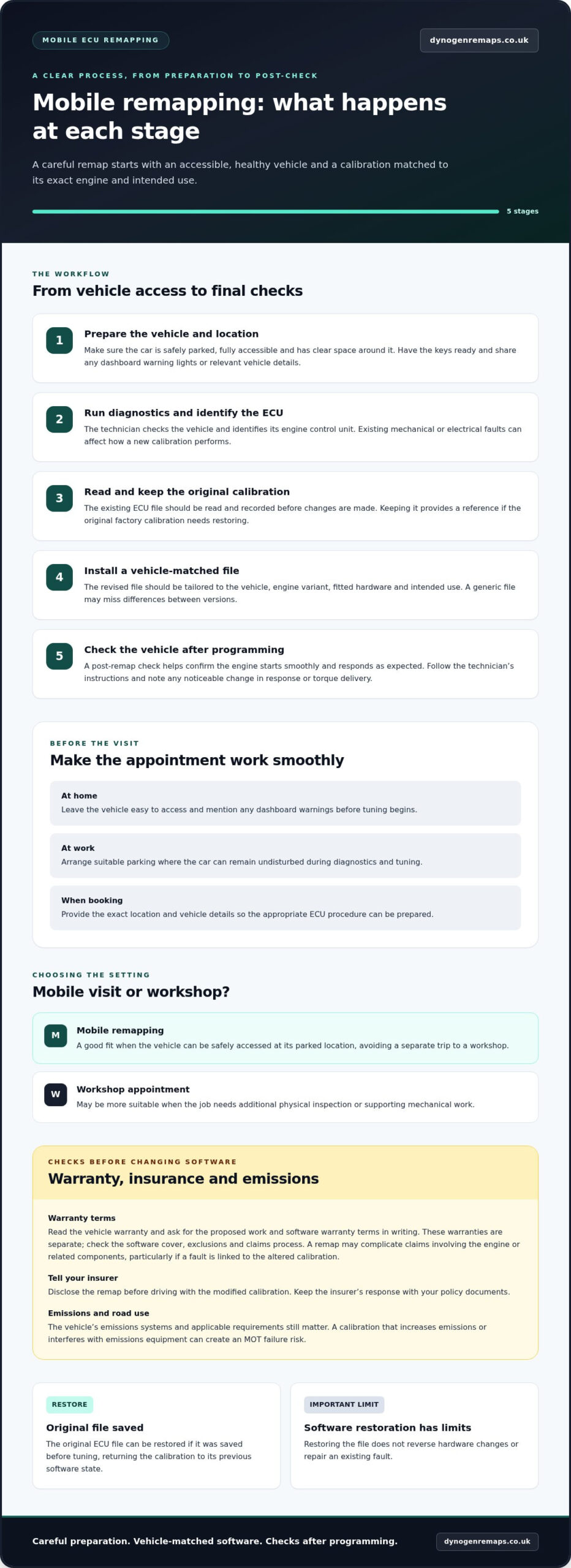
Mobile remapping brings ECU tuning straight to a vehicle’s location, avoiding the need for a separate trip to a workshop. The process still relies on careful preparation: the vehicle must be fully accessible, safely parked and ready for comprehensive diagnostic checks. The technician identifies the engine control unit, reads its existing calibration and safely installs a revised file tailored to the vehicle. A thorough post-remap check helps confirm that the engine starts smoothly and responds precisely as expected.
Choosing a home or workplace visit can make professional tuning much easier to fit around a busy daily schedule. Before the appointment, have the vehicle keys readily available and make sure the technician can comfortably reach the car. A clear, open space around the vehicle greatly helps with diagnostic access and efficient working. The overall condition of the engine and the presence of any dashboard warning lights matter too, since an existing mechanical or electrical fault can affect how a new calibration performs.
Vehicle owners can often choose between a convenient mobile service and a traditional workshop-based remapping appointment. A mobile visit perfectly suits a vehicle that can be safely accessed directly at its parked location. A workshop environment can sometimes be more appropriate when the job requires additional physical inspection or supporting mechanical work. In either setting, a sound, professional process records the original ECU file before any changes are made, then meticulously checks the vehicle after programming. That secure record also provides a reliable reference if the original factory calibration ever needs restoring.
- At home: Leave the vehicle easily accessible and share any relevant dashboard warnings before the tuning work begins.
- At work: Arrange a suitable parking space where the car can remain undisturbed throughout the diagnostics and tuning process.
- During booking: Provide the exact location and specific vehicle details when arranging a visit, so the correct ECU procedure can be thoroughly prepared in advance.
- After tuning: Follow the technician’s instructions carefully and note any noticeable change in engine response or torque delivery.
Mobile ECU remapping follows strict technical principles: the ECU file must match the exact vehicle, engine variant and intended use. Simply relying on the newest software version alone is never enough; true accuracy depends entirely on identifying the engine management system correctly and applying a thoroughly tested calibration. A generic file may easily overlook subtle differences between vehicle versions, which is why reading the original data and verifying vehicle identification are vital parts of the service.
Ultimately, the most practical choice always depends on the vehicle’s current condition, the specific work required and proper access at the chosen location. If a vehicle needs deeper investigation beyond software tuning, a workshop-based assessment may prove to be the more suitable route. For drivers weighing up the benefits of a convenient mobile visit, Dynogen Remapping Solutions mobile ECU remapping details can help explain the full service, our professional approach and how we operate.
Performance, economy and towing-focused remaps
Start by matching the calibration to your main use: acceleration, fuel economy or towing. A diagnostic check, along with the vehicle’s engine, transmission and existing hardware, helps define a suitable approach.
Performance Gains in BHP and Torque
BHP describes engine power, whilst torque affects the force available through the rev range. Consider both figures, alongside where the engine delivers its torque and how that suits your driving. One featured BMW 120i F20 customer build rose from 182 bhp to 264 bhp after a custom Stage 1 tune. That example shows a specific vehicle’s result, not a figure to assume for another model.
For towing, usable torque delivery matters more than a headline peak figure alone. If you regularly pull a trailer, discuss the load, gearbox behaviour and engine response at lower revs. Those details help determine whether a calibration should prioritise smoother pulling power or sharper acceleration.
Performance and Economy Remaps
A performance calibration focuses on engine response, power delivery and throttle response. An economy calibration instead aims to make the vehicle’s output better suited to steady, efficient driving. Neither option removes the need for sound maintenance: tyre pressure, servicing and driving style also influence fuel consumption.
Before choosing, describe a typical journey, such as urban trips around Rochdale or regular motorway driving. A diagnostic assessment can identify existing faults that affect engine operation. Discuss emissions equipment too, since the calibration should be considered alongside the vehicle’s emissions systems and road use.
Car Performance Modifications
Car performance modifications include software changes and, for some setups, supporting hardware. Stage 2 tuning can require hardware upgrades, so the calibration must correspond with the components fitted. Chip tuning is often used to describe ECU software adjustment, but the term alone doesn’t explain what changes or whether other modifications are involved.
List existing changes, such as an upgraded intake or exhaust, before tuning begins. The technician can then compare those parts with the ECU file and diagnostic results. Avoid choosing a tune by its label alone; vehicle condition, hardware and intended use all shape the appropriate setup.
For a towing vehicle, discuss the trailer or caravan, typical routes and load pattern before selecting a calibration. This helps centre the conversation on practical torque delivery, rather than peak BHP alone. A custom Stage 1 tune on a VW Crafter camper, for example, increased output from 105 bhp to 188 bhp. That build is an illustration, not a predicted result for every camper or towing vehicle.
Use a clear decision process: describe how you drive, complete diagnostics, identify any hardware changes, then compare the calibration priorities. In Greater Manchester, including Rochdale, this approach helps connect the tuning choice to real journeys. Keep emissions systems in view, and make sure performance aims, economy priorities and towing demands are discussed together before work starts.
Remapping equipment and ECU file customisation
ECU file work combines diagnostic equipment, software and vehicle-specific information. Understanding each step helps you assess how a calibration is developed and applied.
Custom Stage 1 and Stage 2 Maps
A custom Stage 1 map changes engine management software while retaining standard hardware. Its calibration should suit the vehicle’s ECU, engine and intended use, rather than simply carry a generic label. Stage 2 tuning may require supporting hardware upgrades, so the file must account for the parts fitted. Identify existing modifications before work begins, including changes to the intake or exhaust.
Choosing a map means matching software to the complete setup. A calibration created for standard components may not suit a modified vehicle. A proper discussion should establish the hardware configuration and your priorities before settling on the map.
The ECU Remapping Process
An ECU remap changes the software that controls engine operation. Diagnostic equipment communicates with the electronic control unit, allowing its existing file to be read and a revised calibration written. The process includes identifying the ECU, saving its original data, applying the selected software and checking the vehicle afterwards.
There isn’t one fixed appointment duration: the steps involved depend on ECU access, diagnostics, file development and post-programming checks. A complex access method or additional diagnosis adds work before the vehicle is ready to leave. Keep the original file recorded, since it provides a reference for restoring factory software.
Custom map development starts with the vehicle’s identity and specification. The engine, ECU version, transmission and fitted hardware all inform the calibration. Software can adjust parameters that influence fuelling, boost and throttle response, but changes must remain coherent with the vehicle’s systems. For a mobile service, equipment still needs reliable access to the ECU and a suitable connection at the vehicle.
A tailored file can be more suitable than a generic calibration when the vehicle’s data and modifications are taken into account. The important distinction is how the file is selected and checked, not whether a garage describes it as custom. A clear explanation of the process should cover diagnostics, original-file storage, software installation and final vehicle checks.
Customer reviews can offer practical examples of communication and aftercare. Look for comments describing the vehicle type, the work completed and how follow-up questions were handled, rather than relying only on broad praise. After a remap, note any change in engine response and keep the work records with the vehicle documents. Those details help make later diagnosis more informed.
ECU remapping in Bolton and the North West
For Bolton drivers, the useful question isn’t simply how much power a tune adds. It’s whether the calibration suits the vehicle’s daily use, condition and existing hardware. A car used for short local journeys has different demands from a van covering regular motorway miles. That distinction should shape the discussion before any software changes are made.
Start with three details: your vehicle’s make and model, how you use it, and what you want to improve. For example, a driver seeking sharper throttle response may prioritise acceleration, whilst someone covering long distances may favour smoother delivery. A technician can use those priorities alongside diagnostic results to identify a suitable direction. Clear aims make it easier to judge whether the proposed work matches your needs.
Bolton is part of a wider North West driving area, so describe the journeys that matter rather than relying on a postcode alone. Explain whether you mainly drive around town, travel between Greater Manchester towns, or regularly carry equipment. For a work vehicle, mention its usual load and route. Those details help specialists assess how the engine is used and what a calibration should seek to enhance.
A remapping specialist should be able to explain the process in practical terms. Ask how technicians identify the ECU, record the existing software and check the vehicle after programming. Compare that explanation with a dealer’s approach if you’re weighing up software changes and warranty considerations. The important point is understanding what work is proposed, what it changes, and how the vehicle is assessed before and after.
Use this sequence to prepare for a local remapping discussion:
- Describe the goal: explain whether you want improved response, economy or more usable pulling power.
- Share vehicle details: provide the model, engine type and any modifications already fitted.
- Discuss condition: mention warning lights, recent repairs or changes in engine behaviour.
- Clarify the process: ask how the original file and final checks are handled.
That preparation helps distinguish a tailored conversation from a generic recommendation. It also gives you a basis for considering whether software tuning alone suits the vehicle, or whether a mechanical issue needs attention first. A remap isn’t a repair for a fault. If diagnostics identify an engine problem, resolving it first gives a clearer starting point for tuning decisions.
Drivers seeking ECU remapping around Bolton can use these questions to compare the proposed work with their priorities, without judging it by headline claims alone. To discuss a North West remapping enquiry, get in touch about your vehicle and outline how you use it.
Dynogen Remapping Solutions: Stage 1 Performance Remap
Dynogen Remapping Solutions offers a Stage 1 Performance Remap for drivers seeking a more responsive vehicle. If your priority is fuel efficiency, an Economy Remap may better match your driving aims. The right option depends on how you use the vehicle and what you want from its engine response.
Dynogen also provides AdBlue and DPF solutions for drivers dealing with concerns involving those systems. These are distinct from performance tuning, so identify the issue and your goal before choosing a service. A clear understanding of the vehicle’s needs helps you focus on the relevant solution.
For an ECU remap in the North West, share your vehicle details and intended use when making an enquiry. Visit dynogenremaps.co.uk to contact Dynogen Remapping Solutions.
Choose a tune that fits your next journey
Before arranging an ECU remap in the North West, decide what you want to feel differently behind the wheel. Is your priority sharper performance, a more economical drive, or resolving a concern involving an emissions system? A clear goal makes the conversation more productive and helps keep the proposed work focused on your vehicle’s real use.
Dynogen Remapping Solutions offers a Stage 1 Performance Remap for drivers seeking a performance-focused option, alongside an Economy Remap for those prioritising efficiency. Its AdBlue Solution addresses a different need, so it’s worth identifying whether your concern is engine behaviour or an AdBlue system issue before choosing a direction. The right starting point is the one that matches your vehicle and what you want from it.
Share your vehicle details and driving priorities with Dynogen Remapping Solutions to discuss the relevant option. Contact Dynogen Remapping Solutions and take the next step towards a considered tuning choice.
Frequently Asked Questions
Why remap your car?
Drivers remap a car to adjust how its engine responds to everyday demands. For example, someone regularly joining fast-moving traffic may value smoother acceleration, whilst a driver covering long motorway journeys may prioritise efficiency. A vehicle used for towing has different requirements again. Start by identifying the change you want to feel or achieve, then consider whether the vehicle’s condition and use suit that objective.
How much power and torque can an ECU remap add to different cars?
There’s no single power or torque increase that applies to every car. The result is shaped by the engine, its existing calibration, vehicle condition and any fitted hardware. A turbocharged engine and a naturally aspirated engine respond differently to software changes. When comparing proposed figures, look for results relevant to the same engine and vehicle specification, and consider how the torque is delivered, not just its peak value.
How do Stage 1, Stage 2 and custom ECU remaps compare?
Stage 1 generally describes software tuning with standard hardware, whilst Stage 2 can involve supporting hardware changes. A custom remap describes how a calibration is tailored to a vehicle’s ECU, engine and setup, rather than identifying a particular hardware stage. These terms aren’t interchangeable. For example, a modified car needs its fitted components considered alongside its software, so the stage label alone doesn’t tell you whether a map suits that setup.
What should I check when choosing an ECU remapping provider?
Check whether the remapping specialist explains the proposed calibration in terms you can relate to your car and driving aims. Ask what records you’ll receive, including the work completed and the original software file. Look for reviews that describe a specific vehicle or use case, such as a van carrying a regular load, rather than relying only on general praise. Clear documentation makes future servicing and discussions about the vehicle’s software more straightforward.
Can an ECU remap affect a car warranty, reliability or fuel economy?
A remap changes engine software, so warranty terms are relevant to claims involving affected systems. Read the policy wording and keep records of the calibration. Reliability also depends on the vehicle’s condition and whether its components suit the revised settings; software tuning won’t repair a mechanical fault. Economy is influenced by calibration, driving style, route and load. For instance, frequent acceleration can outweigh efficiency gains during steady driving.
Which ECU remapping garages serve North West England?
Mobile and workshop-based tuning garages serve customers across North West England. Compare how they identify the ECU, run diagnostic checks, save the original file and check the vehicle after programming.