
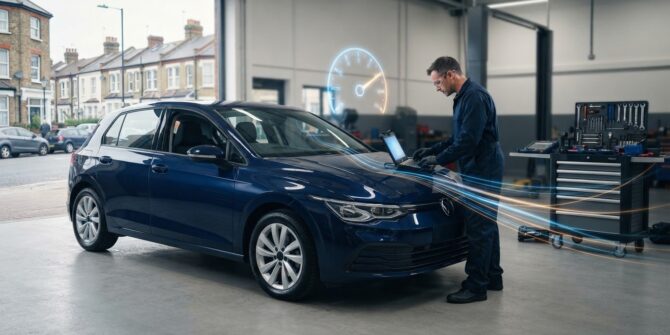
Removing a factory speed limiter is an ECU software adjustment, not a dashboard setting. If you’re researching how to remove a factory speed limiter, the change involves accessing the vehicle’s electronic control unit, modifying its limiter settings and testing the revised software. According to the UK Government, every vehicle covered by regulation 36A must be fitted with a speed limiter that meets the applicable requirements.
It’s understandable to want more control over your vehicle’s performance, but changing a speed limiter can have legal and insurance implications. This guide explains how factory limiters work, how ECU adjustments are made and why specialist tools and careful testing matter. It also covers key considerations for UK drivers, including rules for regulated vehicles, possible insurance effects and the mechanical demands of driving beyond a vehicle’s original limit. You’ll have a clearer basis for deciding whether an adjustment suits your vehicle and how to approach it responsibly.
Key Takeaways
- Learn how the ECU controls a factory speed limiter and what an adjustment changes.
- Understand why specialist equipment and careful testing are part of the reprogramming process.
- Identify the legal and insurance considerations to weigh before changing a vehicle’s limiter.
- Recognise why a vehicle’s intended use and mechanical condition matter when considering a higher speed limit.
- See how a Stage 1 Performance Remap differs from a limiter adjustment when exploring vehicle tuning options.
Legal and insurance consequences
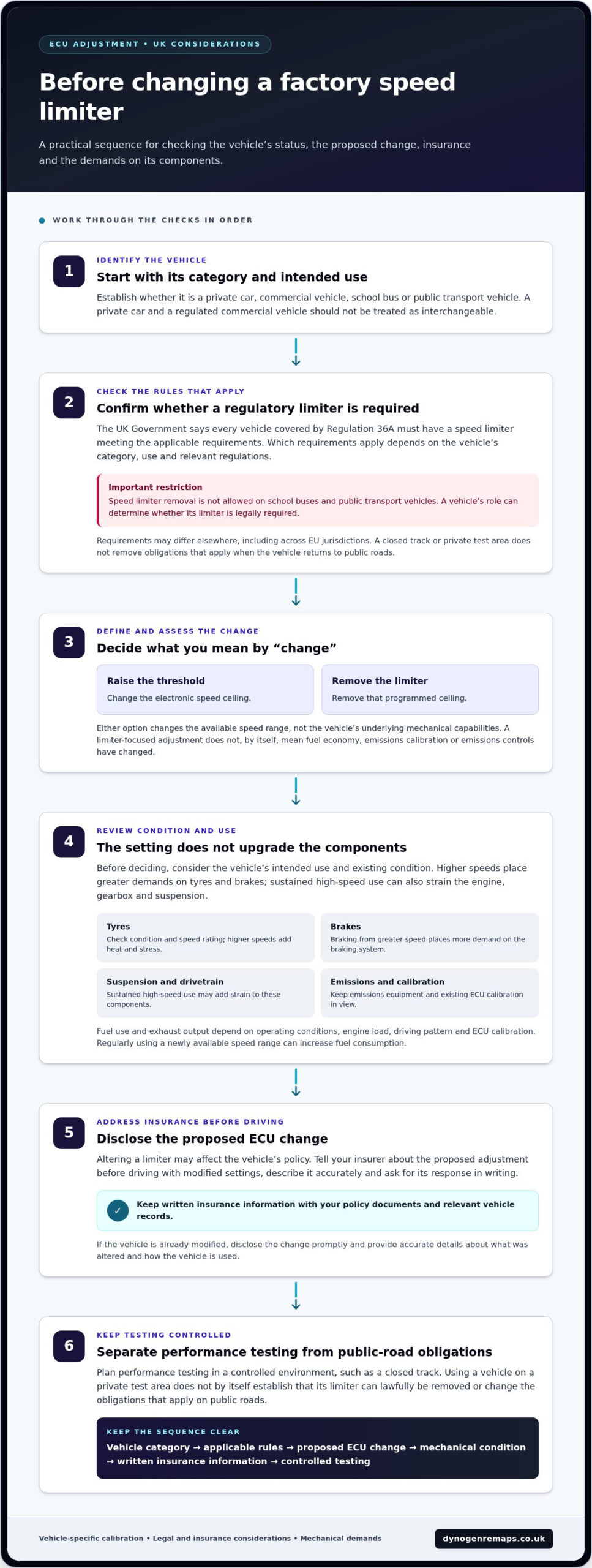
In the UK, regulatory speed limiters are often legally mandated for commercial vehicles. According to the UK Government, every vehicle covered by regulation 36A must be fitted with a speed limiter that meets the applicable requirements. Which requirements apply depends on the vehicle’s category, use and relevant regulations, so a private car and a regulated commercial vehicle shouldn’t be treated as interchangeable.
That distinction matters before changing factory settings. Removing a limiter from a vehicle subject to a regulatory requirement can conflict with the rules that apply to it. Speed limiter removal is not allowed on school buses and public transport vehicles. Commercial passenger transport needs particular care: the vehicle’s role can determine whether the limiter is a legal requirement, not simply a performance setting.
For other vehicles, don’t assume a modification is automatically lawful in every situation. UK requirements may differ from those elsewhere, including across EU jurisdictions. Before arranging an adjustment, identify the vehicle’s classification and intended use, then establish which requirements apply where it is registered and driven. Using a vehicle on a closed track or private test area doesn’t remove obligations that apply when it returns to public roads.
Insurance needs equal attention. Removing or altering a limiter may affect your vehicle’s policy. Tell your insurer about the proposed ECU change before driving with the modified settings, and ask for its response in writing. Keep that confirmation with your policy documents. If the vehicle is already modified, disclose the change promptly and provide accurate details about what was altered and how the vehicle is used.
Use a clear sequence before proceeding:
- Identify whether the vehicle is a private car, commercial vehicle, school bus or public transport vehicle.
- Establish whether its category or use requires a regulatory limiter.
- Describe the proposed ECU adjustment accurately to your insurer.
- Keep written insurance information and relevant vehicle records together.
- Restrict any performance testing to a controlled environment, such as a closed track.
These steps help distinguish a vehicle’s technical capability from its legal and insurance position. Adjusting a limiter doesn’t change the vehicle’s classification or intended role. For example, using a commercial vehicle on a private test area doesn’t by itself establish that its limiter can lawfully be removed. The relevant rules still depend on the vehicle and its use.
Exceeding the original speed limit can also place extra stress on the engine, tyres, brakes and suspension. Consider these mechanical demands alongside the legal and insurance questions. Treat the adjustment as a change with consequences to assess, not as a software setting without wider effects.
Removing or changing the factory-set limiter
Drivers searching “how to remove factory speed limiter” are usually considering a change to the ECU’s programmed speed threshold. The practical choice is whether to raise that threshold or remove the limiter. Either way, the change affects the vehicle’s available speed range, not its underlying mechanical capabilities.
Removing a limiter doesn’t automatically change fuel economy or emissions calibration. The effect on fuel use, exhaust emissions, tyres and vehicle wear depends chiefly on driving speed, engine load and how the vehicle is used after adjustment.
A factory limiter sets an electronic ceiling. Changing it alters that ceiling, not necessarily the other engine settings. For example, a vehicle travelling faster may need more engine power to overcome increased aerodynamic drag. That can raise fuel consumption, particularly if the driver regularly uses the newly available speed range. If the vehicle continues at its previous speeds, the effect may differ.
Emissions depend on operating conditions and ECU calibration. A limiter-focused adjustment doesn’t, by itself, mean emissions controls have been altered. Sustained higher engine loads can affect combustion conditions and exhaust output. The vehicle’s engine management and driving pattern influence the outcome, so keep emissions compliance in view, especially for public-road use.
Tyres and other components face greater physical demands as speed rises. Higher speeds increase heat and stress in tyres, while braking from greater speed places more demand on the braking system. The engine, gearbox and suspension may also experience additional strain during sustained high-speed use. Changing the ECU setting doesn’t upgrade those components or change a tyre’s speed rating.
Before deciding, consider these practical points:
- Clarify whether you want to raise the threshold or remove it.
- Consider whether the vehicle’s intended use requires a different limit.
- Review tyre condition and speed rating, plus brake and suspension condition.
- Account for the vehicle’s emissions equipment and existing ECU calibration.
- Plan performance testing for a controlled environment, such as a closed track.
If you’re asking “how to remove factory speed limiter”, first define the change you want and how you’ll use the vehicle. A car used mainly for commuting may gain little from removing its speed ceiling, while track use presents different demands. Neither use removes the need to consider vehicle condition, emissions and component loads.
Treat professional adjustment as a vehicle-specific calibration decision, not a universal switch. The ECU file must suit the vehicle’s existing software and mechanical condition. A poor match can cause drivability problems or interfere with related control strategies. A specialist can assess whether a limiter adjustment fits the intended use and explain the work involved.
After adjustment, testing should confirm that the vehicle behaves correctly in a controlled environment. Check engine response, warning lights and braking behaviour, then assess the vehicle for signs of abnormal stress. Don’t test a higher maximum speed on public roads. Treat fuel use, emissions, tyres and vehicle wear as connected factors in the decision.
ECU access and speed-limiter adjustment
A search for “how to remove factory speed limiter” often leads to ECU software, because the limiter setting is stored in the vehicle’s electronic control unit. The ECU manages engine functions, and its calibration determines how the limiter responds as the vehicle approaches its programmed threshold. Accessing the correct ECU data is the first technical step.
Before changing software, a technician identifies the vehicle and its control system. Make, model, engine and ECU version matter because calibration files are vehicle-specific. The technician establishes a suitable connection and extracts the ECU data. This original read provides a reference for reviewing the existing settings and identifying the limiter parameters.
Next, the relevant settings are adjusted in the ECU file. This is a targeted software change, not a physical alteration to the engine or accelerator. Other calibration areas must remain appropriate to the vehicle’s existing configuration. Changing unrelated settings can affect engine response, so define the requested adjustment clearly before work begins.
Once the revised file is prepared, it is reinstalled into the ECU. The vehicle is then tested to assess how the updated software operates. For anyone researching “how to remove factory speed limiter”, these stages matter: extracting the data, modifying the relevant settings, reinstalling the file and testing the vehicle form one connected process.
A careful ECU workflow includes these checks:
- Confirm the vehicle identity and ECU version before selecting a calibration file.
- Read and preserve the existing ECU data before making changes.
- Keep the adjustment focused on the agreed speed-limiter setting.
- Reinstall the revised file using equipment suited to that ECU.
- Test the vehicle afterwards and review its behaviour for faults or warnings.
For example, vehicles in the same model range can have different engines or ECU software. A file suited to one configuration may not suit another. Accurate identification helps prevent mismatched data being written to the control unit. The technician must also distinguish the factory limiter from other speed-related controls, since each may be managed differently.
Testing should assess more than whether the vehicle passes its former threshold. The engine should respond consistently, and the ECU should show no new faults after the change. Test in a controlled environment, such as a closed track, rather than on public roads. This allows the revised calibration to be assessed without using public-road driving to explore its limits.
ECU access and file modification require specialist knowledge because the control unit manages multiple engine functions. A considered adjustment depends on accurate vehicle identification, suitable software changes and a structured test process. This approach treats the limiter as part of the vehicle’s wider control system, not an isolated setting.
Factory speed limiters and ECU controls
A factory speed limiter uses electronic controls to keep a vehicle below a set speed. Understanding how the ECU applies that limit helps explain its purpose and the risks of changing it.
Factory ECU controls
The engine control unit (ECU) processes vehicle data and manages engine operation, including its response to a programmed speed threshold. When the vehicle reaches that threshold, the control system can restrict engine output to prevent further acceleration. The exact behaviour depends on the vehicle’s make, model and ECU calibration.
A factory limiter is distinct from the dashboard speed display. The display shows speed to the driver; the ECU setting controls how the vehicle responds. For example, if the ECU detects that the vehicle has reached its programmed limit, it can reduce power rather than relying on the driver to judge speed. The system’s purpose and calibration vary by vehicle.
Regulation matters for some vehicle categories. According to the UK Government, legislation.gov.uk, every vehicle covered by regulation 36A must be fitted with a speed limiter that meets the applicable requirements. This is why vehicle category and use are important considerations, rather than treating every factory setting as an optional performance feature.
When reviewing a limiter, focus on three details: the vehicle’s classification, its intended use and how its ECU manages engine output. A commercial vehicle subject to a regulatory requirement must be considered differently from a privately used car. Those details clarify whether the limiter serves a required function or is a factory-set control that may be adjusted.
Risks without a speed limiter
Driving without the factory limit removes an electronic ceiling, allowing the driver to request speeds beyond the original threshold. Driving faster can increase stress on the engine, tyres, brakes and suspension. Those components retain their original design and condition even when the ECU setting changes.
For example, sustained high-speed driving can place additional demands on tyres and braking components. Adjusting the limiter doesn’t improve their condition or make the vehicle more suitable for higher speeds. The driving experience may feel less restricted, but the vehicle’s mechanical capacity remains a separate consideration.
Use a controlled environment, such as a closed track, to test a vehicle with its limiter removed. Public roads aren’t an appropriate place to explore the vehicle’s revised maximum speed. Consider the vehicle’s intended role before changing an ECU control, particularly where regulatory requirements may apply.
Before deciding, assess whether the ECU limit serves a legal or operational purpose, then consider the vehicle’s condition and intended use. The limiter is one part of a wider control system. Removing it changes the vehicle’s available speed range without changing its tyres, brakes, suspension or engine hardware.
What tools or software are used to reprogram a vehicle’s speed limiter?
Changing an ECU-integrated speed limiter requires specialist tools, not a basic dashboard control. The equipment must access the vehicle’s electronic control unit, read its existing software and write back the revised calibration. The precise setup depends on the vehicle and ECU, so one generic device cannot serve every model.
ECU flashing equipment transfers software data between a vehicle and a technician’s computer. An OBD-II connection can provide a way to communicate with the vehicle’s control systems, while a scanner can help read diagnostic information. These tools have different roles: a scanner alone cannot replace the equipment and expertise needed to alter ECU software.
Software is also needed to work with ECU data and adjust the limiter setting. The technician identifies the relevant control parameters, makes the intended change and prepares the revised file for installation. This must match the vehicle’s ECU version. A file intended for a different engine or control unit can be unsuitable, even if the vehicles share a model name.
A typical workflow brings several pieces of equipment and checks together:
- Identify the vehicle and ECU before selecting the connection method.
- Use appropriate equipment to extract and preserve the original ECU data.
- Modify the relevant limiter setting in the software file.
- Use ECU flashing equipment to reinstall the revised file.
- Run diagnostic checks and test the vehicle in a controlled environment.
Each step has a distinct purpose. The original read gives the technician a reference for the vehicle’s current calibration. The modified file contains the requested adjustment, while post-installation checks help identify diagnostic faults or unexpected behaviour. Keeping these stages separate makes the process easier to assess and reduces the risk of mistaking a data transfer for a complete calibration job.
Trained engineers and technicians use certified tuning equipment for this work. That matters because a speed limiter sits within software controlling the wider vehicle, not in an isolated mechanical switch. A careful operator needs to understand the ECU data, choose compatible equipment and apply the change without disturbing unrelated settings.
For an ECU-based speed adjustment, arrange specialist speed limiter adjustment rather than relying on a general-purpose code reader. The right equipment supports a controlled process, but it doesn’t replace accurate vehicle identification, competent software handling or testing after the file is reinstalled.
Dynogen Remapping Solutions: Stage 1 Performance Remap
Dynogen Remapping Solutions offers a Stage 1 Performance Remap for drivers considering ECU tuning beyond a speed-limiter adjustment. A remap and a limiter change are different: one concerns engine calibration, while the other alters the programmed speed threshold. Knowing your priority helps you choose the relevant route.
If your aim is to explore engine performance tuning, a Stage 1 Performance Remap may be more relevant than changing the limiter alone. If you’re focused specifically on the factory speed threshold, Dynogen Remapping Solutions also offers Speed Limiter Removal. The right service depends on the change you want and the vehicle’s intended use.
For an efficiency-focused ECU option, Dynogen Remapping Solutions offers an Economy Remap. Contact the team to discuss which remapping service fits your vehicle and requirements.
Choose your next tuning step with confidence
Understanding how to remove a factory speed limiter is only useful if the adjustment suits your vehicle’s purpose. Before proceeding, decide whether your priority is changing the limiter, exploring engine tuning or addressing another vehicle system. A clear objective makes the next conversation more focused.
Dynogen Remapping Solutions offers Speed Limiter Removal for drivers seeking a limiter adjustment. If your interest is broader ECU tuning, its Stage 1 Performance Remap may be more relevant. An Economy Remap and AdBlue Solution are also available for different vehicle requirements. These are distinct services, so start with the change you actually want rather than treating them as interchangeable.
Keep your intended use, insurance position and applicable vehicle requirements in view as you choose. This gives you a practical basis for discussing the right direction and understanding the work involved.
Contact Dynogen Remapping Solutions to discuss your vehicle’s tuning requirements and take a considered next step.
Frequently Asked Questions
What is a Speed Limiter?
A speed limiter is an electronic control that restricts a vehicle from exceeding a programmed speed threshold. It differs from cruise control, which maintains a selected speed, and a speed warning, which alerts the driver without necessarily limiting engine output. For example, a warning can prompt the driver to slow down, whilst a limiter can intervene as the vehicle reaches its set ceiling.
⚙️ How is the Process Done?
A specialist accesses the vehicle’s ECU, reads its existing calibration and makes the requested limiter adjustment in compatible software. The revised file is then written back to the ECU, followed by diagnostic checks and testing. An OBD-II scanner can provide diagnostic information, but it isn’t a complete reprogramming solution by itself. The vehicle’s ECU type and software determine the compatible access method and calibration.
What is a factory speed limiter and how does it work?
A factory speed limiter is a programmed control that restricts the vehicle’s speed through its electronic management system. It works differently from a speedometer, which displays the vehicle’s speed, or a warning alert, which simply notifies the driver. The limiter’s setting and response are built into the vehicle’s calibration, so two versions of a similar model may behave differently.
Which vehicles have factory speed limiters, and why are they fitted?
Factory limiters appear in vehicles including commercial vehicles, where regulatory requirements may apply, and in other vehicles with manufacturer-set controls. According to the UK Government, legislation.gov.uk, every vehicle covered by regulation 36A must be fitted with a speed limiter that meets the applicable requirements. Limiters can also control maximum speed as part of a vehicle’s intended operating setup; the vehicle category and use matter.
Can a factory speed limiter be removed or adjusted by the manufacturer or dealer?
A manufacturer or dealer can make ECU changes through software and calibrations approved for the vehicle. That route differs from aftermarket ECU tuning, which modifies vehicle software outside the manufacturer’s standard update process. The available adjustment depends on the vehicle’s supported configuration and the reason for the change. A factory software update may not offer the same option as a dedicated limiter adjustment.
Is it legal to remove a factory speed limiter in the UK?
Legality depends on the vehicle’s category and use, so removal is not a universal yes-or-no decision. UK rules require vehicles covered by regulation 36A to have a compliant limiter, according to the UK Government. Regulatory limiters are often legally mandated for commercial vehicles, and removal is not allowed on school buses and public transport vehicles. Track use doesn’t itself change requirements for public-road use.
Could removing a speed limiter affect vehicle insurance, warranty, MOT, or type approval?
Yes, a limiter modification may affect insurance, so disclose the ECU change to your insurer and keep its response with your policy documents. Warranty terms govern how modifications relate to cover, while MOT and type approval are separate compliance matters. Don’t assume that passing an MOT settles insurance or approval questions. Keep records of the calibration change and assess each issue independently before using the modified vehicle.