

A remap can improve a Ford Transit Custom’s MPG by recalibrating the engine to deliver more torque at lower revs. Drivers who regularly use motorways report fuel-economy improvements of 8-15%, with payload, route and driving style shaping the result. Ford Transit Custom remap MPG varies with those same conditions, so one van’s figures won’t predict another’s.
It’s understandable to want better fuel economy without compromising everyday usefulness or safety. This guide explains what a remap changes, what to expect from the 2.0 TDCi EcoBlue 136 bhp model, and why real-world results differ. To assess Ford Transit Custom remap MPG for your own needs, you’ll also learn about performance gains, safe tuning considerations and insurance implications.
Key Takeaways
- Choose an economy-focused or performance-focused calibration according to your priorities, as each tunes engine behaviour towards a different outcome.
- Compare Stage 1 figures against your Transit Custom’s exact engine variant; for example, the 2.0 EcoBlue 130ps is listed at about 165ps after remapping.
- Assess how your usual routes, payload and driving habits affect fuel use before deciding whether a remap suits your working day.
- Understand how a modified engine may affect warranty cover, and tell your insurer about the remap so your policy reflects the change.
- For the 136 bhp 2.0 TDCi EcoBlue, the ECU and engine specification are key details when considering a calibration.
What Does a Remap Do to a Ford Transit?
A remap revises the engine control unit (ECU) software, changing how a diesel engine responds to driver input. On motorway journeys, Ford Transit Custom drivers report fuel-economy improvements of 8-15% after remapping.
Economy and Performance Calibrations
An economy calibration prioritises efficient engine response, while a performance calibration focuses more on power and torque. The distinction matters because the same Transit Custom can be tuned for different driving needs. For regular delivery routes, consider how often the van stops, carries a load or cruises at a steady speed. For frequent overtaking or heavier work, decide whether sharper response matters more than an economy-led setup.
The ECU controls engine operation, so changing its calibration can alter how much torque is available at lower revs. This may help the van maintain speed with fewer downshifts. Choose a remap to suit the vehicle’s actual work, rather than selecting a map by name alone.
Reported Motorway Fuel-Economy Improvements
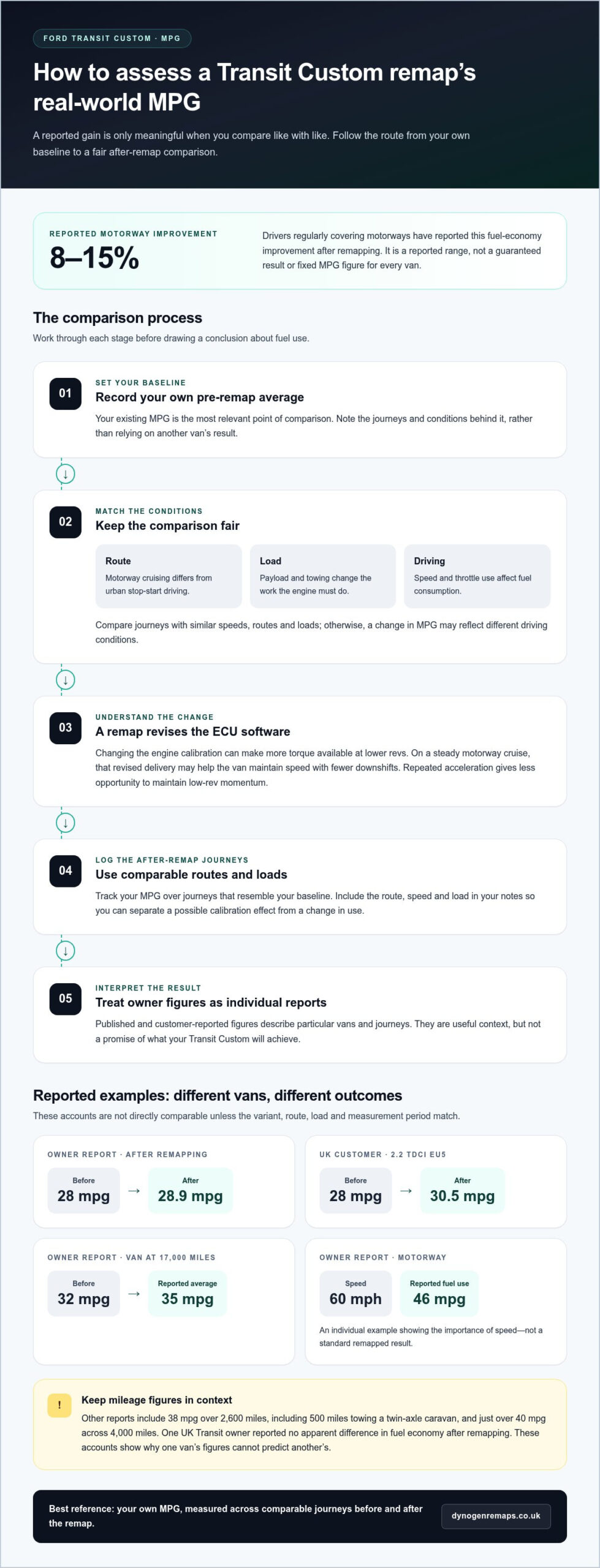
Motorway use is where reported economy gains are clearest: drivers regularly covering these routes have reported improvements of 8-15% after a remap. A steady cruising speed gives the engine more opportunity to use its revised low-rev torque delivery than repeated acceleration does. The percentage is a reported range, not a fixed MPG figure for every Transit Custom.
For comparison, one owner reported 46 mpg while driving at 60 mph on a motorway. That example shows the importance of speed when judging fuel use; it isn’t a standard remapped result. Compare journeys with similar speeds, routes and loads to understand whether an MPG change reflects the calibration or different driving conditions.
Real-World MPG Comparisons
Reported before-and-after figures offer useful context, but they describe individual vans and journeys. One Transit Custom owner recorded 28.9 mpg after remapping, compared with 28 mpg beforehand. Another UK customer reported a change from 28 to 30.5 mpg on a 2.2 TDCI EU5 variant. These reports show modest gains, not a single MPG outcome that applies across all engines.
Other owners have reported different averages: one recorded 38 mpg over 2,600 miles, including 500 miles towing a twin-axle caravan. Another reported just over 40 mpg across 4,000 miles. Those figures cannot be directly compared without matching vehicle variant, route, load and measurement period. Use your own pre-remap average as the most relevant baseline.
Driving Conditions and Customer Reports
Route and driving behaviour shape the MPG you see after an ECU change. Motorway cruising at a steady speed differs from urban stop-start driving, where repeated acceleration uses fuel and reduces the opportunity to maintain low-rev momentum. Payload and towing also change the work the engine must do. So, the answer is not identical for both settings: motorway reports include 8-15% improvements, while urban results depend more on stop-start use and load.
Customer accounts illustrate that spread. One owner reported an average of 38 mpg over 2,600 miles with towing, while another reported 35 mpg as their van reached 17,000 miles, up from 32 mpg. A UK Transit owner also said remapping made no apparent difference to fuel economy. Log MPG over comparable routes and loads to make a more useful assessment.
Typical stage 1 power and torque gains
Stage 1 tuning recalibrates the engine software to increase power, torque or both, while retaining the standard hardware. The figures depend on the Transit Custom’s engine and factory output, so identify the exact variant before comparing remap estimates. For example, the 2.0 EcoBlue 105ps and 170ps versions start from different baselines and have different typical Stage 1 outputs.
Factory options for the 2.0 TDCI include 105 PS, 130 PS, 170 PS and 185 PS. A Stage 1 remap for the 105ps EcoBlue is listed at about 135ps, while the 130ps version is listed at about 165ps. The 170ps version is listed at about 205ps. These are variant-specific examples, not interchangeable targets for every Transit Custom.
Torque changes can be just as relevant as peak power in a working van. Torque may increase after a Stage 1 remap, but the result depends on the specific vehicle and calibration. For the 130ps version, listed torque rises from 340Nm to about 390Nm. Those outputs indicate how the calibration can alter pulling response, particularly when accelerating or carrying a load.
More torque can make a van feel more responsive, with less need to rely on high revs for acceleration. This may make everyday driving feel more flexible, including when joining faster traffic or tackling inclines. It does not change the van’s payload rating or make overloading safe. Consider the work the vehicle does, and assess power and torque together rather than judging the result by peak horsepower alone.
Other listed examples underline why the engine code and version matter. A 2.0 EcoBlue mild-hybrid 130ps is listed at about 160ps after a Stage 1 remap, with torque moving from 340Nm to about 385Nm. The 170ps EcoBlue is listed at about 450Nm after remapping. That is a different output from the 105ps example, so a single headline gain cannot represent every model.
Before comparing tuning figures, note the model year, engine, factory power rating and whether the van is mild-hybrid. Then compare the expected remapped power and torque against that exact specification. A Stage 1 calibration approach should be considered in that vehicle-specific context, with the intended use guiding the balance between stronger response and everyday drivability.
Fuel efficiency when carrying loads or driving on motorways
Payload, route and throttle use all affect a Transit Custom’s fuel consumption. To assess a remap’s effect on MPG, compare similar journeys before and after recalibration.
Fuel Efficiency Under Load
A loaded van demands more from its engine than an unladen one, especially during acceleration and on inclines. Extra torque at lower revs may help the engine pull with fewer downshifts, but the load still affects how much work it must do. Compare journeys with similar routes and payloads, rather than comparing an empty-van trip with a working one.
Driving style matters too. Applying the throttle smoothly and anticipating traffic reduces repeated acceleration, while abrupt inputs demand more from the engine. For a useful comparison, record the mileage, fuel used and typical load across several comparable trips. A Transit Custom Sport owner reported 34 mpg after an oil and filter change at 10,000 miles; that account illustrates why maintenance and usage also belong in the comparison.
Motorway Fuel Efficiency
Motorway journeys provide steadier conditions than urban stop-start driving, giving the engine more opportunity to use torque at lower revs. Transit Custom drivers who regularly travel on motorways have reported fuel-economy improvements of 8-15% after remapping. The range is a reported outcome, not a fixed prediction for each van or journey.
Speed, traffic and payload still influence the result. A clear motorway run at a steady pace is different from a congested route with repeated braking and acceleration. Compare journeys at similar speeds and with similar loads. Otherwise, an MPG change may reflect different driving conditions rather than the calibration.
Part-throttle driving is another useful measure. It means using light or moderate accelerator input rather than accelerating fully. A remapped engine may deliver more torque at lower RPM, potentially helping it maintain speed with less throttle. The effect depends on the route, gear and load, so assess typical working journeys rather than occasional hard acceleration.
Driving behaviour can further shape economy after tuning. Anticipate traffic, accelerate progressively and avoid unnecessary speed changes; these habits reduce the repeated demand placed on the engine. A motorway owner reported 46 mpg at 60 mph, showing how a stated speed and journey type help explain a customer figure. It isn’t a direct comparison with a different van or route.
For a practical before-and-after check, use the same fuel-measuring method and compare similar journeys. Note whether the Transit Custom was carrying tools, towing or travelling mainly on motorways. Keep maintenance events in the record too, since a reported 34 mpg after an oil and filter change demonstrates that servicing can coincide with changing fuel figures. This gives owners a clearer view of how their driving style and working load relate to economy.
Remap safety, reversibility and insurance
A remap does not exempt a Ford Transit Custom from applicable UK emissions requirements. Its emissions equipment must remain functional. Reliability and DPF behaviour depend on the vehicle’s condition and how its engine software is calibrated.
Insurance and Reversibility
Tell your insurer about an ECU modification and ask how it affects your policy. Insurers assess modifications under their own terms, and failing to disclose a change can cause problems if you later make a claim. Consider Ford warranty cover too: a forum contributor reported that a remap could void the cover if Ford discovered the modification.
Reversibility depends on whether the original calibration is retained and can be restored to the ECU. Before tuning, establish whether the original software will be saved and how the standard setting can be reinstated. Keep records of the work and remap details so you can explain the modification to your insurer or a future owner.
Emissions, Reliability and DPF Risks
A Transit Custom’s DPF is part of its emissions-control system. A remap is not a reason to remove or disable emissions equipment. Changes that interfere with the DPF or its operation can affect emissions performance and vehicle reliability. Preserve the standard emissions systems and consider their condition before changing the engine calibration.
Extra torque can put more demand on the clutch and transmission, particularly if the van regularly carries heavy loads. Resolve existing faults, warning lights or poor running before tuning. A calibration cannot repair a worn component, and adding engine demand to a vehicle that is already struggling can make diagnosis more complicated.
A sensible safety process starts with the vehicle itself. Review its service history, dashboard warnings, engine performance and any known DPF issues. Make sure the van runs consistently before changing its software. Otherwise, it may be harder to distinguish an existing fault from a change related to the tuning.
Tuner experience matters because Transit Custom variants have different engine and ECU configurations. The calibration should match the exact vehicle, not just its model name or an advertised power figure. Discuss how you use the van, such as for regular motorway journeys or carrying tools, and how the tune balances response with reliability. Clear explanations of the calibration, original software and emissions equipment help you understand the work.
After tuning, monitor starting, acceleration, warning lights and DPF behaviour during normal driving. Record any new symptoms rather than treating them as routine, and take a change in the vehicle’s behaviour seriously. Protect the van’s working role by assessing its condition first, understanding the software changes and keeping your insurer informed.
Ford Transit Custom 2.0 TDCi EcoBlue 136 bhp remap
The 2.0 TDCi EcoBlue 136 bhp is a specific Transit Custom variant, not the same specification as the 105ps, 130ps or 170ps examples. Its listed original output is 136 bhp, and it uses diesel fuel. These details give owners a precise starting point when assessing a calibration for this engine.
This variant has a 1995cc engine and a Bosch MD1CS027 ECU. Both details matter when identifying the vehicle and its engine management system. Before discussing a remap, match the registration or vehicle records to the engine specification, then establish that the ECU fitted is the Bosch MD1CS027. Model name alone doesn’t identify every technical detail.
Don’t assume that outputs listed for other EcoBlue versions apply here. The 105ps and 130ps examples have different factory ratings, and the mild-hybrid 130ps has its own specification. None provides a reliable remapped power figure for the 136 bhp version. Use the 136 bhp original rating as the baseline, and avoid treating another variant’s advertised result as this model’s expected outcome.
For this 1995cc diesel, calibration decisions should begin with intended use. A van used for steady motorway journeys may have different priorities from one regularly accelerating with tools or other payload aboard. Consider how the engine responds at everyday speeds, how often acceleration is needed, and whether fuel economy or stronger response matters more. Those priorities help define the purpose of the software change.
The Bosch MD1CS027 identifier also helps keep the discussion specific. Record the ECU details alongside the 136 bhp rating and engine size before comparing calibration information. Then assess the vehicle’s condition, service history and any warning lights. A sound starting point makes it easier to distinguish existing mechanical concerns from changes in engine behaviour after a remap.
For MPG, compare the same 136 bhp van over similar routes and loads before and after any software change. Record fuel used and distance travelled using the same method each time. This gives a more meaningful comparison than borrowing fuel economy figures from a 105ps or 170ps Transit Custom. Route, payload, speeds and driving behaviour still affect the figures you record.
Use the 136 bhp rating, 1995cc engine and Bosch MD1CS027 ECU as the core identification checks for this variant. Explore remapping options for your Transit Custom with those vehicle details and your driving priorities in hand.
Dynogen Remapping Solutions: Stage 1 Performance Remap
Dynogen Remapping Solutions offers a Stage 1 Performance Remap for drivers seeking sharper response and stronger engine performance from their Transit Custom. Drivers comparing Ford Transit Custom remap MPG should consider the van’s engine specification and everyday use, as well as their priorities for economy and performance.
If fuel efficiency is your main aim, an Economy Remap may better suit that priority. When considering Ford Transit Custom remap MPG, think about your usual routes, payload and driving style. These details help clarify whether efficiency or stronger power delivery matters more.
Contact Dynogen Remapping Solutions to discuss the right next step for your Transit Custom.
Choose the remap that fits your next mile
Set your priority before choosing a calibration. If you’re weighing a Ford Transit Custom remap against your MPG needs, consider how the van earns its keep: steady motorway work, frequent stops, regular payloads or a mix of duties. This practical picture is more useful than chasing a headline figure.
Dynogen Remapping Solutions offers a Stage 1 Performance Remap for drivers focused on performance and an Economy Remap for those prioritising efficiency. It also offers an AdBlue Solution. Match the conversation to your Transit Custom’s engine specification and everyday use, then decide which goal deserves priority. A considered choice starts with the van you actually drive.
Contact Dynogen Remapping Solutions to discuss the right next step for your Transit Custom, and move forward with a clear plan.
Frequently Asked Questions
How do I know if my Transit or another van can be re-mapped?
Suitability depends on the vehicle’s ECU and engine specification. Identify the make, model, year, engine and ECU details from the vehicle records or diagnostic information, then match those details to the remap. Dynogen Remapping Solutions states it can remap vehicles with an ECU manufactured after 1999. A van’s age alone doesn’t establish compatibility, so use its ECU information as the key starting point.
How long does the process take?
A mobile Stage 1 remap session for a Ford Transit Custom typically takes around one to one and a half hours. The ECU calibration load during that session typically takes 30 to 45 minutes. Time can also involve the work needed around loading the software, so distinguish the calibration itself from the full session when planning vehicle use.
What if the Transit already has modifications?
Tell the tuner about any existing engine or ECU modifications before discussing further software changes. Share details of hardware changes, previous remaps, warning lights and running issues. For example, a van with an existing calibration needs its current software considered alongside its engine specification. This gives the tuning discussion an accurate starting point and avoids treating the vehicle as standard.
How much MPG improvement can a Ford Transit Custom remap achieve?
Ford Transit Custom drivers who regularly travel on motorways report fuel-economy improvements of 8-15% after a remap. Recorded MPG also depends on route, payload, speed and driving style, so compare similar journeys before and after the change. Keep a record of distance and fuel used, and avoid comparing an unloaded motorway trip with a stop-start working route.
Which Ford Transit Custom engines and model years can be remapped?
Compatibility depends on the engine and ECU fitted, rather than the Transit Custom name alone. Examples include the 2.0 TDCI EU6 105 bhp variant for model years 2016-2019, and the 2.0 EcoBlue fitted in most Customs from 2018 onwards. Dynogen Remapping Solutions states it can remap vehicles with an ECU manufactured after 1999; identify your exact ECU before assessing a vehicle.
Can a remap increase Ford Transit Custom torque and power, and by how much?
Yes. The amount depends on the engine variant and its original output. As one example, the 2.0 EcoBlue 105ps is listed at about 135ps and 330Nm after a Stage 1 remap, compared with standard torque of 270Nm. Treat figures as variant-specific estimates, not a target shared by every Transit Custom. More torque can make acceleration feel stronger under everyday driving conditions.
Does remapping a Ford Transit Custom affect its warranty or insurance in the UK?
A remap can affect Ford warranty cover if Ford discovers the modification. Tell your insurer about the change and ask how it affects your policy, as terms depend on the insurer and cover. Keep a record of the remap and any original ECU software details with the vehicle documents. This gives you clear information when discussing the modification.
How can I choose a reputable Ford Transit Custom remapping specialist in the UK?
Look for clear, vehicle-specific explanations of the ECU calibration, expected outputs and how the van’s intended use informs the setup. Dynogen Remapping Solutions states that its technical team has over 15 years of experience and uses advanced software and equipment. Its Stage 1 Performance Remap and Economy Remap address different priorities, so consider whether performance or fuel efficiency better suits your regular work.