

Vehicles that regularly tow a caravan, trailer or horsebox may benefit from remapping for better towing performance, particularly if the engine feels flat below 2,000 rpm or needs frequent downshifts. A towing-focused calibration can prioritise smoother power delivery and usable torque at lower and mid-range revs. It does not increase the vehicle’s manufacturer-stated towing weight, gross train weight, nose weight limit or payload.
If towing leaves your vehicle working hard, you may want stronger, more responsive power without a sudden surge. The aim is a more composed pull under load, not simply a higher peak-power figure. Whether remapping for better towing performance suits your vehicle depends on its condition, transmission and intended use.
This guide explains which vehicles may benefit, how tuning can affect low- and mid-rev power, and what mechanical checks matter before a remap. It also covers what a tune cannot change, helping you make a considered decision based on your vehicle and the loads you tow.
Key Takeaways
- Vehicles that feel flat at low revs or need frequent downshifts under load may benefit from tuning focused on usable mid-range torque.
- A smoother, progressive delivery can make towing feel more controlled than a sudden surge of power.
- Assess the engine, clutch, gearbox, cooling system and brakes before tuning; a remap won’t repair an existing mechanical fault.
- Fuel economy depends on how and where you drive, so judge a remap by its suitability for your vehicle and towing needs, not by peak-power figures alone.
- Dynogen Remapping Solutions’ Stage 1 Performance Remap is a relevant option for drivers seeking a tailored change to engine performance.
Which Vehicles Benefit From Remaps For Towing?
Cars and vans that regularly tow a caravan, trailer or horsebox may benefit if the engine struggles to pull smoothly under load. A towing-focused ECU remap can adjust fuel delivery, turbo boost, torque limiters and throttle response. These changes shape how the engine delivers power, but do not alter the vehicle’s towing equipment. Diesel engines are often suited to towing because they produce useful torque at lower revs.
A strong candidate is a mechanically sound vehicle that feels unresponsive while towing within its rated limits. A calibration can refine accelerator response and the engine’s torque request. For example, smoother throttle response can make it easier to control power as a trailer moves off or climbs a hill. The result depends on the engine, software and existing modifications.
Fuel economy depends on more than the remap. Revised power delivery may help a driver maintain pace with fewer revs and downshifts, potentially improving fuel use. Route, traffic, speed, terrain, trailer weight and driving style all affect the result. Steady open-road driving differs from stop-start urban towing, where frequent acceleration increases fuel demand.
Economy can also differ between towing and unladen driving. A vehicle may use less fuel while towing if the remap helps avoid repeated downshifts, but the trailer still adds resistance and load. When driving solo, the same engine response may lead to different gear choices or acceleration. Compare similar journeys and conditions to see how your own use affects consumption.
In the UK, a remapped road vehicle must remain roadworthy, insured and compliant with applicable emissions and MOT requirements. Tell your insurer about an ECU remap, as failing to declare a modification can cause problems with a claim. Remapping does not increase the manufacturer-stated maximum trailer weight, gross train weight, nose weight limit, payload or braked trailer limit. Stay within the vehicle’s stated limits.
The main risks arise when increased engine demand exposes an existing weakness or the calibration does not suit the vehicle. Towing already places extra demand on the engine, clutch, gearbox, cooling system and brakes. A remap will not repair a boost leak, sticking turbo actuator, worn clutch or DPF issue. It may also affect warranty cover, while a modification can influence resale value and buyer interest.
Power and torque delivery at lower and mid revs
For towing, useful torque through the middle of the rev range matters more than headline power at high engine speeds. A caravan or horsebox adds resistance, so smooth, progressive delivery helps the vehicle build speed without a sudden surge. Consistent accelerator response can make it easier to maintain momentum, particularly on a gradual climb or when joining faster traffic.
A torque-focused ECU calibration adjusts how the engine responds to a torque request. Depending on the vehicle, this may involve fuel delivery, boost pressure and torque limiters. These controls work together: boost supports airflow, fuel delivery affects combustion, and the ECU manages the requested output. The aim is a predictable increase in pulling force, rather than a sharp peak that arrives only at higher revs.
That distinction affects gear choice. If useful torque arrives sooner, a manual vehicle may need fewer downshifts to maintain pace on a hill. In an automatic, engine output and transmission behaviour interact, so the calibration needs to suit how the gearbox changes gear under load. An abrupt torque increase can make progress less composed, even if the maximum power figure looks impressive.
Diesel engines are often used for towing because they produce useful torque at lower engine speeds. However, a torque curve is more informative than a single peak figure: it shows how much pulling force is available across the rev range. When reviewing proposed results, look at where torque builds and whether delivery remains progressive. A peak figure alone does not describe how the vehicle will feel pulling a trailer.
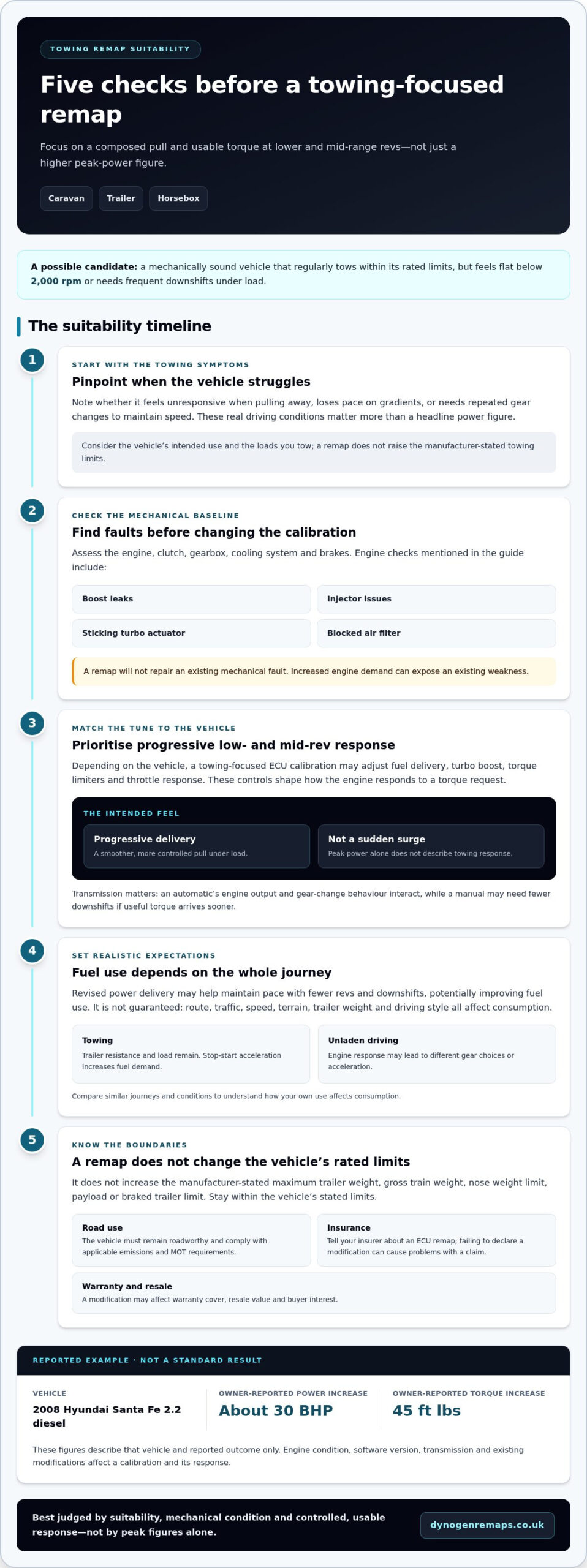
One reported example involved a 2008 Hyundai Santa Fe 2.2 diesel. Its owner said a remap increased power by about 30 BHP and torque by 45 ft lbs. Those figures describe that vehicle and reported outcome, not a standard result for every Santa Fe or towing vehicle. Engine condition, software version, transmission and existing modifications all affect the calibration and its response.
Before choosing a torque-focused tune, consider the driving situations that trouble you: pulling away with a loaded trailer, holding speed on gradients, or maintaining progress without repeated gear changes. A useful discussion of torque-focused remapping should centre on those real conditions, the vehicle’s gearbox limits and smooth delivery. The objective is controlled, usable response, not maximum output at any cost.
Vehicle condition and mechanical checks before tuning
Vehicle suitability depends on engine type, transmission, mechanical condition and the demands placed on the tow vehicle. Consider these factors before choosing an ECU calibration or another option.
Vehicle and Engine Suitability
Diesel cars and vans can suit towing calibration because diesel engines produce useful torque at lower revs. Petrol vehicles can also be assessed, but engine characteristics and software determine how a calibration behaves. Consider the vehicle’s intended towing use, existing modifications and gearbox limits. High mileage alone does not rule out tuning; present condition matters more than the odometer reading.
Before tuning, check the engine for boost leaks, injector issues, a sticking turbo actuator and a blocked air filter. Check for clutch slip and DPF problems too. These faults affect engine performance under load, and a remap will not repair them. Address mechanical issues first, then assess the vehicle’s baseline behaviour. Starting from a fault-free condition helps distinguish an existing problem from a tuning result.
Manual and automatic vehicles need different checks. In a manual, clutch condition matters because towing increases the load placed on it. In an automatic, assess whether the gearbox shifts smoothly under load and whether its torque limits suit the intended calibration. A remap is not a remedy for an automatic transmission that already feels weak, delayed or rough. Include transmission behaviour in the suitability assessment.
Safety and Long-Term Reliability
A remap’s suitability for safe towing and long-term reliability depends on the vehicle’s condition, calibration and use. Towing adds demand to the engine, clutch, gearbox, cooling system and brakes. A calibration should account for these components, gearbox torque limits and the vehicle’s intended workload. No software change can compensate for a worn clutch or an existing cooling problem.
Is a remap better for towing than a tuning box or other upgrades? Neither option is automatically better. An ECU remap changes the vehicle’s software, while the right choice depends on compatibility, condition and intended use. Other mechanical upgrades address different needs, so compare what each change actually does for the vehicle.
Before approving a tune, describe the trailer, typical journeys and driving conditions. Review the vehicle’s fault history, existing modifications and transmission behaviour too. These details help determine whether the calibration suits the vehicle. For example, if a diesel van has an unresolved DPF fault, address that issue before expecting software changes to improve towing response.
High mileage alone does not decide suitability, but a worn component can affect how the vehicle handles additional load. Keep the manufacturer’s towing limits in view: a remap does not raise the permitted towing capacity, payload or braking limits. A sound vehicle, appropriate calibration and careful maintenance all matter for dependable towing over time.
Benefits of remapping for towing
A towing-focused remap aims to improve how an engine delivers power under load. The practical benefit is a more usable response, not simply a larger peak-power figure. For a driver pulling a caravan, trailer or horsebox, smoother acceleration can make it easier to build and maintain momentum. The calibration should suit the vehicle’s engine, transmission and towing use.
Usable mid-range torque can reduce the need for repeated downshifts on a gradient. That can make progress feel more settled, especially when the driver needs to adjust speed gradually. A progressive torque curve is preferable to a sudden surge: accelerator response remains more controllable as the engine works against a trailer’s load.
Specific results vary between vehicles. One tuning firm listed an increase of 50 bhp and 105 Nm for a remapped Hyundai Santa Fe. A Santa Fe owner also reported gaining about 4 mpg after remapping. These are individual reported figures, not a standard outcome for every Santa Fe or tow vehicle. Vehicle condition, software and driving conditions all affect results.
Fuel economy depends on how and where the vehicle is driven. A remap that helps a driver use fewer revs and downshifts can support better economy, but towing load, route, traffic and acceleration also matter. Compare similar journeys before and after tuning, including trailer weight and driving style. Solo and towing fuel use are different measures, so record them separately.
There are clear limits to the benefit. A remap does not increase the vehicle’s manufacturer-stated maximum trailer weight, gross train weight, nose weight limit or payload. Nor does it alter the vehicle’s permitted braking limits. Check the vehicle and trailer limits before setting off, and distribute and secure the load correctly.
Powertrain response is only one part of a towing setup. Before a major trip, check the towbar, electrics and trailer brakes. Set towing tyre pressures as directed for the vehicle and trailer, and inspect the tyres’ condition. A well-calibrated engine cannot compensate for a poorly secured load, faulty electrics or ineffective brakes.
Assess the remap by the driving problem it addresses. Note whether the vehicle struggles to pull away, loses pace on hills or needs frequent gear changes, then compare its behaviour under similar conditions. A smoother pull and more composed response are useful outcomes. A headline power increase alone does not show how the vehicle performs with a trailer attached.
Choosing a specialist tuning workshop
A towing calibration should start with the vehicle, not a generic power target. The make, model, engine, gearbox and ECU software version all affect what the engine can safely deliver. Existing modifications matter too. A considered tuning plan relates those details to the trailer, typical routes and driving conditions, rather than relying on a headline increase in peak power.
The tuning approach should account for the vehicle’s intended load and transmission limits. For a manual car, clutch condition helps determine whether extra torque is appropriate. For an automatic, shift behaviour under load and gearbox torque limits matter too. A sound calibration aims for progressive delivery across the useful rev range, not an abrupt surge that makes pulling away or climbing less controlled.
Clear explanations matter. A specialist should be able to describe which ECU controls affect the result, such as fuel delivery, boost pressure or torque requests, and how those changes relate to towing. They should also distinguish engine performance from legal towing limits. A remap cannot raise the manufacturer-stated maximum trailer weight, gross train weight, nose weight limit or payload.
Vehicle condition must form part of the decision. A boost leak, injector fault, clutch slip or DPF problem can undermine performance before tuning begins. An automatic gearbox that shifts roughly or responds slowly also needs attention; a remap will not repair it. The calibration should account for the vehicle’s condition and existing modifications, rather than treating every example of the same model identically.
Set out your real-world use before settling on a tuning objective. Describe whether you tow a caravan, horsebox or work trailer, and where the vehicle struggles, such as pulling away or maintaining speed on hills. This gives the calibration a practical target. Fuel economy also depends on route and driving style, so assess it against comparable journeys rather than assuming a fixed saving.
For UK road use, a remapped vehicle must remain roadworthy, insured and compliant with applicable emissions and MOT requirements. Tell your insurer about the modification, since failing to declare it can cause problems with a claim. A well-considered workshop choice weighs these obligations alongside engine response and transmission behaviour. Explore towing-focused remapping as a next step when you’re ready to discuss your vehicle’s requirements.
Dynogen Remapping Solutions: Stage 1 Performance Remap
Dynogen Remapping Solutions offers a Stage 1 Performance Remap for drivers considering an ECU tune to change engine performance. If towing leaves your vehicle short of response, this is a relevant next step after checking its condition, gearbox and permitted towing limits. Explain how you use the vehicle and what you want to improve, such as smoother response under load.
If fuel efficiency is your main priority, an Economy Remap is another option. Neither type of remap changes the vehicle’s manufacturer-stated towing capacity, and a tune will not repair an existing mechanical fault. The right choice depends on your vehicle and driving needs, so be clear about the outcome you want when discussing a remap.
Contact Dynogen Remapping Solutions to discuss your vehicle, or visit dynogenremaps.co.uk.
Plan your next step with confidence
Choosing remapping for better towing performance starts with a clear goal for your vehicle: identify the response you want during everyday towing, then discuss the vehicle’s condition and use with a specialist. Focus the conversation on practical priorities, rather than chasing a peak figure that may not reflect how you drive.
Dynogen Remapping Solutions offers a Stage 1 Performance Remap for drivers seeking an engine performance adjustment, and an Economy Remap for those focused on efficiency. Its AdBlue Solution addresses a separate vehicle-system need. The suitable route depends on the work you want the vehicle to do, and a remap cannot change its permitted towing limits.
Bring your vehicle details and a clear description of your towing routine to the discussion. That gives you a useful starting point for considering whether a tuning option matches your priorities. For a measured next step, contact Dynogen Remapping Solutions and discuss your vehicle’s needs. A considered decision is the foundation for a more assured towing experience.
Frequently Asked Questions
Is a Remap for Towing Performance Worth It?
It may be worthwhile if your vehicle regularly tows and its current response makes journeys harder than necessary. Consider how often you tow, which situations cause difficulty and whether the vehicle is mechanically sound. For occasional light towing, careful gear selection and sensible load distribution may address the issue without tuning. A remap is most relevant when you want a more tailored engine response for regular towing, not a higher permitted load.
What does ECU remapping change for towing performance?
An ECU remap alters software settings that govern engine response. For towing, adjustments may involve fuel delivery, boost pressure, torque requests and accelerator response. These settings influence how the engine builds power as you pull away or climb a gradient. The calibration should suit the specific engine and transmission. It changes how the vehicle delivers power, not its towbar, brakes or manufacturer-set towing limits.
How much extra torque can a remap provide for towing?
There is no single reliable torque increase that applies to every towing vehicle. The result depends on the engine, ECU software, transmission limits, vehicle condition and existing modifications. A figure quoted for one engine variant cannot be transferred directly to another, even within the same model range. Focus on the torque curve and how progressively it builds, then consider whether that delivery suits your trailer and everyday driving.
Can an ECU remap improve fuel economy when towing?
A remap may support lower fuel use if the revised response helps you hold speed with fewer downshifts, but driving conditions remain important. For a fair comparison, record fuel use on similar routes with a similar trailer load and driving pace. Hills, congestion, acceleration and time spent idling can all affect the result. An unladen journey is not a like-for-like comparison with a towing trip.
How do I choose a reputable UK vehicle remapping specialist?
Look for a specialist who considers your exact vehicle, engine and gearbox rather than offering one generic result for every model. Describe the trailer and relevant driving conditions, then assess whether the explanation addresses those details. A useful discussion should cover the intended engine response, mechanical condition and transmission limits. Treat a peak torque figure without context as incomplete, not as a full assessment of suitability.
How can I check whether a vehicle is suitable for remapping before towing?
Start with the vehicle’s maintenance and fault history, then note any warning lights, uneven running, smoke or clutch slip. Check whether an automatic gearbox shifts smoothly, including under load. Resolve any boost leak, injector issue or DPF problem before tuning. Identify the vehicle’s existing modifications and towing requirements too. These details help establish whether the engine and transmission are suitable for calibration.