
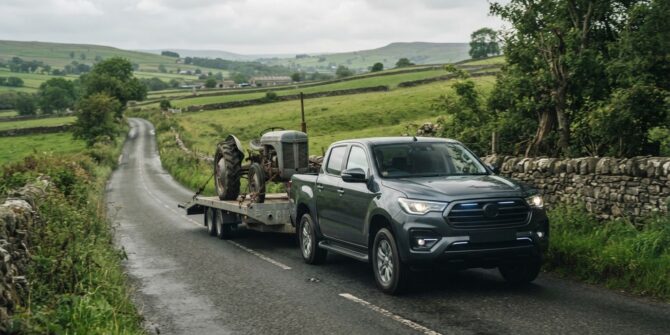
The right Nissan Navara tuning for towing prioritises controlled, usable low-down torque over headline power. A tested Navara produced 450 Nm between 1,500 and 2,500 rpm, with 190 bhp at 3,750 rpm, giving a useful reference point for how its power is delivered. A custom calibration should suit the vehicle’s condition and the loads it regularly tows, rather than apply a one-size-fits-all map.
When a Navara is working hard, smooth response at low revs can matter more than a higher peak-power figure. The load, transmission and driving conditions all influence which calibration is appropriate. Towing limits and handling remain important after tuning.
This guide explains how different towing demands affect the choice of map, how ECU calibration can focus on low-rev torque, and what to consider when carrying heavy loads. A remap should form part of a considered approach to towing performance, not replace sensible loading and control.
Key Takeaways
- Choose a tow-focused map for smoother, more usable power delivery under load, rather than chasing peak power alone.
- Factor in the trailer, payload and vehicle’s combined weight when planning a towing setup; the Navara’s noseweight limit is 140kg.
- Custom ECU calibration should take account of the engine, transmission and how the vehicle is used, not rely on a one-size-fits-all approach.
- Drive to the load and conditions: towing aids can support control, but they don’t replace careful loading or attentive handling.
- A Stage 1 Performance Remap is the relevant option to explore when you want your Navara’s engine calibration tailored towards improved performance.
Low-down torque for towing
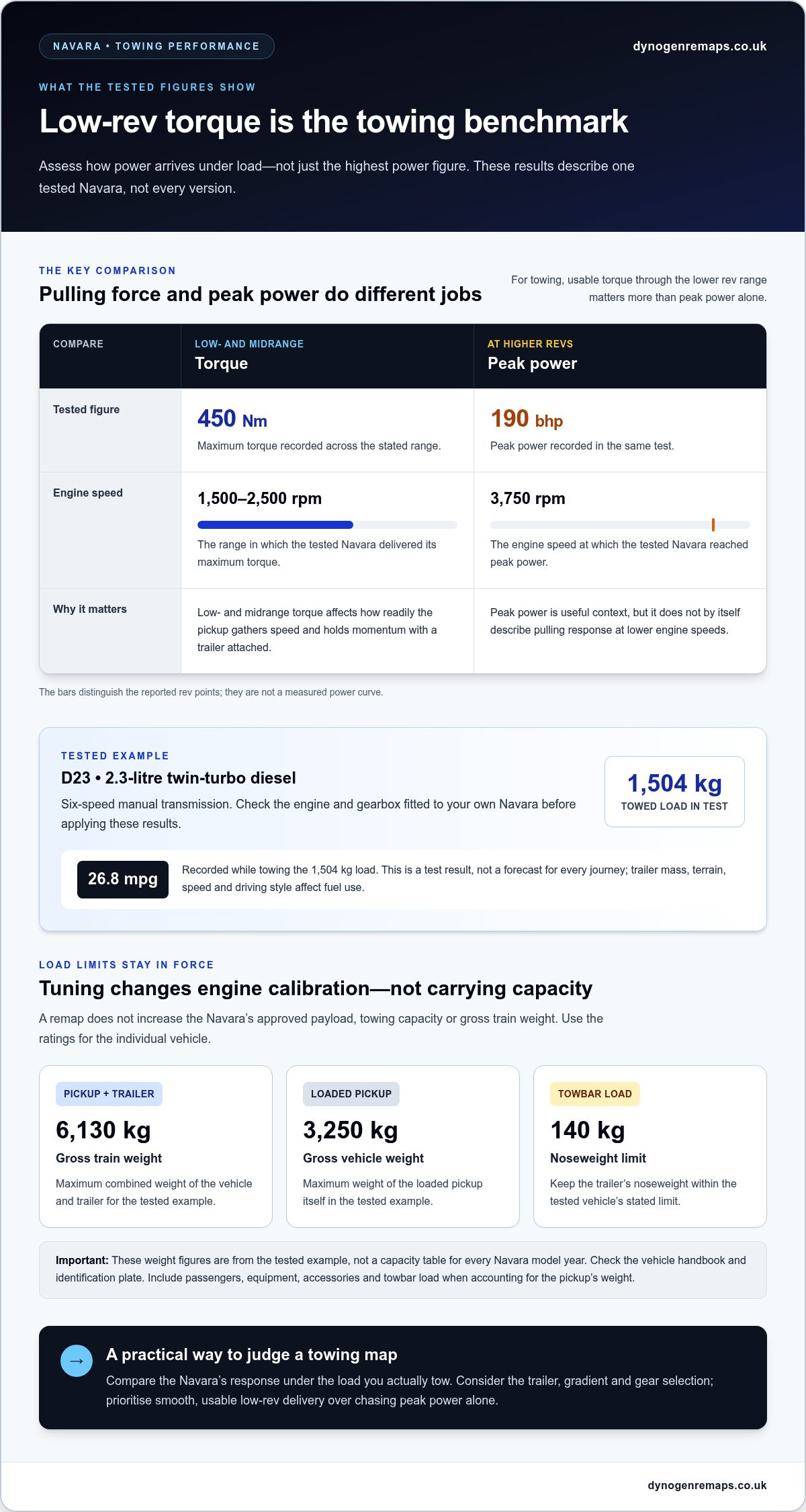
For towing, usable torque through the lower rev range matters more than peak power alone. A tested Navara delivered 450 Nm from 1,500 to 2,500 rpm, a clear reference for assessing its pulling response.
Low- and midrange torque delivery
Low- and midrange torque describes the engine’s pulling force before it reaches peak power. With a trailer attached, this delivery affects how readily the Navara gathers speed and holds momentum as engine revs change. The tested figure of 450 Nm across 1,500-2,500 rpm shows where that model’s maximum torque was available.
Look at the rev range, not just the peak torque figure. A towing-focused map aims to make response more useful at lower engine speeds, rather than encouraging the driver to chase power higher in the rev range. On a gradient, for example, steady delivery can help maintain progress without repeated hard acceleration.
Torque figures alone don’t describe the full towing experience. Trailer weight, road gradient and gear selection all affect the load on the engine. Compare the standard response with how the Navara behaves under the load you actually tow.
Engine and gearbox suitability
For a concrete towing benchmark, the evidence-backed configuration is the D23’s 2.3-litre twin-turbo diesel with a six-speed manual. That is the engine and gearbox combination in the tested example, rather than proof that every Navara version performs identically.
The test recorded 190 bhp at 3,750 rpm and 450 Nm between 1,500 and 2,500 rpm. Those figures distinguish peak power from the lower-rev torque that matters during towing. Check the engine and gearbox fitted to your own Navara before applying test results to it.
Gear selection also affects how the engine uses its torque. A manual driver can choose a suitable ratio for a climb or changing road speed, while a remap changes engine calibration, not the gearbox’s physical ratios. Assess both together when evaluating a towing setup.
Tuned and standard towing performance
A standard Navara provides the baseline: the tested example produced 450 Nm and 190 bhp. A performance remap is intended to provide more low-rev torque for towing, but the change should be judged through power delivery, not an unsupported promise of a particular increase.
In the same test, the Navara returned 26.8 mpg while towing a 1,504 kg load. That gives a specific example of consumption under load, not a forecast for every journey. Trailer mass, terrain, speed and driving style all influence fuel use.
The Navara won the Pick-Up Category in the Towcar of the Year 2021 awards. That result gives useful towing context, but it doesn’t establish that a tuned Navara outperforms rival pickups. Compare how each vehicle delivers torque under load, then consider the Navara’s tested figures and your own towing conditions.
Carrying heavy loads
Engine tuning can alter how a Navara responds under load, but it doesn’t change its rated vehicle or trailer weights. Start with the individual vehicle’s approved figures, then calculate the load and noseweight it must carry.
Tuning and legal load limits
An ECU remap changes engine calibration; it doesn’t increase the Navara’s published payload, towing capacity or gross train weight. Stronger pulling response does not make a heavier trailer or payload permissible. Use the vehicle’s approved limits as the boundary for every loading plan.
Payload includes the people and equipment carried in the pickup, as well as accessories fitted to it. A loaded trailer also places weight on the towbar, so noseweight affects the vehicle’s available carrying capacity. The tested Navara’s noseweight limit was 140kg. Keep the combined vehicle and trailer within the relevant limits, rather than treating engine output as extra capacity.
Before a journey, take these practical steps:
- Identify the approved vehicle and trailer limits for the specific Navara.
- Include passengers, tools, accessories and towbar load when accounting for the pickup’s weight.
- Position cargo securely and distribute it to maintain stable handling.
- Keep the trailer’s noseweight within the vehicle’s 140kg limit.
These checks matter whether the Navara is standard or tuned. A remap can change its response under acceleration, but loading remains subject to the vehicle’s approved weight limits.
Braked towing capacity and gross train weight
For the tested Navara, gross train weight was 6,130kg and gross vehicle weight was 3,250kg. Gross train weight is the maximum combined weight of the vehicle and trailer; gross vehicle weight covers the loaded pickup itself. Both figures matter when assessing a towing combination.
There isn’t one towing figure that applies to every UK Navara model year. The tested figures are a reference for that example, not a capacity table for every model year. Use the vehicle’s handbook and identification plate to establish its approved braked towing limit and weight ratings.
Gross train weight can constrain a combination even when the trailer is below its own permitted limit. For example, loading the pickup close to its 3,250kg gross vehicle weight leaves less room within the tested combination’s 6,130kg gross train weight. Check both totals together before loading, then account for the trailer’s own weight and cargo.
A tuned engine doesn’t revise those ratings. Match the trailer and payload to the Navara’s own approved figures, and treat the 140kg noseweight limit as a separate loading constraint. This keeps the decision based on vehicle capacity, not on how much torque the engine produces.
The forum poster expected the new van carrying motorbikes to weigh 2.4 to 2.7 tons; a 1.2 to 1.3-ton trailer reduced the Navara’s range to 325 km per tank.
Custom ECU calibration
Custom calibration means adjusting engine control settings around a specific Navara and its working demands. For towing, the aim is controlled power delivery under load, rather than a generic increase in peak output. The D23’s 2.3-litre twin-turbo diesel is one example: its engine and transmission combination should inform the calibration approach.
Start by defining your towing pattern. A Navara pulling a trailer on steep routes faces different demands from one carrying tools on flatter roads. Note the usual trailer, terrain, journey length and gear changes. These details help identify whether you need better low-rev response, smoother acceleration or the ability to maintain speed under load.
Check the vehicle’s condition before considering revised settings. A sound calibration process starts with a diagnostic assessment of the Navara’s existing behaviour and any faults. Changing the map won’t fix an engine that already runs poorly. Record symptoms such as hesitation, uneven acceleration or frequent gear changes, then separate mechanical concerns from the response you want.
The calibration should account for the gearbox as well as the engine. For example, the tested D23 configuration used a six-speed manual, so its usable engine response needs to work with the driver’s gear selection. A different Navara specification may behave differently. Identify the exact engine and transmission before comparing calibration options or applying another vehicle’s results.
Describe the intended outcome in practical terms. “More power” is too broad for a towing brief. Give a real example, such as joining a faster road with a trailer or maintaining progress on a climb. This focuses the discussion on torque delivery and throttle response, rather than treating peak power as the only measure.
Hardware changes can also affect the decision. One forum respondent recommended pairing an ECU remap with a matching exhaust system for improved Navara towing performance. That’s a recommendation, not a universal requirement. Consider the vehicle’s existing exhaust and intended use rather than assuming every Navara needs the same combination.
Before proceeding, agree what the calibration is intended to change and how you’ll assess the result. Where conditions allow, compare the Navara on the same route or in a similar towing situation. Note throttle response, gear selection and how consistently it maintains progress. These observations are more useful than relying on a single headline power claim.
For Nissan Navara tuning for towing, customisation means matching engine response to the vehicle’s actual work. A clear brief, accurate engine and gearbox identification, and an assessment of the vehicle’s condition provide a more relevant basis than a generic map. Keep the goal practical: predictable performance on the loads and routes the Navara regularly handles.
Navara towing stability and handling
Engine response is only one part of a stable towing setup. Trailer loading, vehicle condition and driver inputs also affect how a Navara behaves on UK roads.
A remap doesn’t increase a Navara’s approved towing limits or make overloading acceptable. Keep the vehicle within its approved ratings and compliant for road use. Tell your insurer about ECU changes and follow its instructions on cover. Your policy terms determine how modifications affect your insurance.
For suspension, brakes and cooling, consider the vehicle’s condition and the work it needs to do. A loaded trailer can reveal worn suspension or braking components, so address faults before towing. Sustained, demanding towing can increase thermal demand; one forum respondent suggested an intercooler upgrade in that context. That may be relevant for demanding use, but it isn’t a universal requirement for every Navara.
Tuning for towing can increase drivetrain demands if the engine delivers more torque. The gearbox, clutch, torque converter and differential all help transfer power. If the Navara develops slipping, unusual noise or harsh shifts, investigate the symptoms rather than asking a remap to mask them. Warranty implications depend on the vehicle’s terms and modification history, so understand them before changing its calibration.
Prepare the Navara and trailer together before setting off. Check that the trailer is coupled securely, its load is stable, and its lights and tyres are in sound condition. Confirm the pickup’s tyres, brakes and suspension are suitable for the load. Place cargo to avoid unnecessary movement, and keep the towbar load within the Navara’s 140kg noseweight limit.
All Nissan Navaras are fitted with Trailer Sway Assist, Hill Descent Control and Hill Start Assist as standard. These systems support specific driving situations, but they don’t replace sound loading or attentive control. Trailer Sway Assist can help respond to sway, while Hill Start Assist supports moving off on an incline. Drive smoothly and leave room to react to changing road conditions.
- Match the vehicle, trailer and cargo to their approved weight limits.
- Secure the load and keep noseweight within 140kg.
- Inspect tyres, brakes, suspension, coupling and trailer lights before departure.
- Use the Navara’s assistance systems as support, not as a substitute for careful driving.
For example, a Navara towing a furniture trailer needs a stable load, sound tyres and functioning brakes, not simply more engine response. Check the complete combination before each journey. If the vehicle handles unusually, stop safely and assess the setup.
Tow-focused ECU tuning
A tow-focused map should suit the Navara’s regular work. Define the goal first: smoother progress with a loaded trailer, fewer hard accelerations or more responsive throttle on inclines. These are distinct aims, so a useful calibration brief describes the journeys and loads rather than simply requesting extra power.
Start with a repeatable example from your own driving. Note when the Navara struggles to hold speed, needs a downshift, or feels slow to respond. One owner reported a Navara shifting into fourth at 3,500 rpm on small inclines while towing. That account illustrates a symptom to investigate, not a result every Navara will share.
Then identify the vehicle precisely. Engine, gearbox and existing modifications all affect how a map should be considered. A D23 with a modified exhaust, for example, is not the same setup as an unmodified pickup. Record relevant hardware and describe whether towing is occasional or part of the vehicle’s regular work.
Calibration involves balancing several elements. The aim is usable response across the rev range, not a sharp surge that makes acceleration difficult to control. Throttle response, torque delivery and gear selection should work together. A driver pulling a trailer up a long incline needs predictable power, not an abrupt change when pressing the accelerator.
Use these steps to make the brief more useful:
- Describe a typical towing journey, including hills, traffic and road type.
- Record the trailer and cargo you commonly carry.
- Note when the Navara changes gear or loses momentum under load.
- List engine, gearbox and exhaust changes already fitted.
- State whether smooth response or stronger acceleration is the priority.
Compare the Navara on the same route and under a similar load before and after calibration. Note throttle response, gear changes and how easily it maintains progress. An unloaded drive alone may not give a useful picture, because a pickup can feel different with a trailer attached. Keep any test within the vehicle’s approved load limits.
Fuel economy also depends on the journey, trailer, terrain and driving style. Calibration cannot remove the extra work of moving a loaded trailer. Compare consumption over similar journeys, and treat a single trip as an example rather than a reliable forecast. Smooth acceleration and suitable gear selection still matter after tuning.
Finally, distinguish engine response from towing capacity. A revised map changes calibration, not the Navara’s approved weight limits or the trailer’s physical demands. If you want calmer, more predictable progress under load, document the symptoms and intended use before choosing a calibration approach.
Discuss your Navara’s towing requirements with a specialist and explain the load, route and driving behaviour you want to improve.
Dynogen Remapping Solutions: Stage 1 Performance Remap
Dynogen Remapping Solutions offers a Stage 1 Performance Remap for Navara owners seeking a change in engine performance. If towing leaves you wanting more responsive power delivery, this is the relevant option to discuss alongside your vehicle’s engine, gearbox and regular loads.
A remap changes engine calibration, not the Navara’s approved towing capacity, payload or weight limits. Keep those ratings central to your setup, and describe the trailer, routes and driving behaviour you want to improve when considering a tuning option. An Economy Remap is a separate option for a different priority.
For a considered next step, contact Dynogen Remapping Solutions to discuss your Navara and towing requirements.
Plan your Navara’s next step
Decide whether Nissan Navara tuning for towing is right for the work your pickup needs to do, rather than focusing on a headline figure. Before discussing calibration, write down the change you want to feel, such as more composed response on regular trailer journeys or a setup better suited to changing workloads. A clear aim keeps the conversation practical and focused on your Navara.
Think about how you’ll judge the result in everyday use. Choose familiar routes and describe the conditions that matter, from stop-start traffic to longer climbs. This gives the discussion a useful reference point and helps separate a specific need from a general desire for more power.
For a considered conversation about your Navara’s requirements, contact Dynogen Remapping Solutions. Take the next step with a clear picture of how you use your pickup, and move towards a setup that fits the job.
Frequently Asked Questions
Which map is right for a Navara that tows?
For a Navara that regularly tows, choose a Stage 1 Performance Remap with towing response as the priority, rather than peak power alone. A useful calibration brief describes your usual trailer, route profile and gear-change behaviour. Dynogen Remapping Solutions offers a Stage 1 Performance Remap; an Economy Remap addresses a different priority. The right choice depends on whether your main goal is engine response under load or efficiency during everyday driving.
How does a Nissan Navara towing tune affect torque, horsepower, fuel economy and reliability?
A towing tune aims to improve low-rev torque, while its effect on horsepower depends on the calibration. Fuel economy depends on trailer mass, terrain, speed and throttle use, so increased torque doesn’t automatically mean lower consumption. Reliability also depends on engine and drivetrain condition, servicing, loading and driving style. Assess the result through consistent response under your usual towing conditions, rather than assuming a particular fuel saving or lifespan.
How does a tuned Nissan Navara compare with a standard Navara and rival pickups for towing?
A remap is intended to improve low-rev torque and make power delivery more useful when towing, but the article gives no specific tuned-versus-standard increase. The tested standard Navara produced 450 Nm and 190 bhp; its Towcar of the Year award provides context, not proof that a tuned Navara outperforms rival pickups.