

The diesel may be the stronger choice for fuel economy, whilst a turbo petrol remap can deliver a sharper power increase. When comparing petrol vs diesel remapping, the typical gains differ: a quality diesel remap can increase torque by 20-35%, while a quality turbo petrol remap can increase power by 15-20%. These figures describe different outcomes, so the better fit depends on how you drive and what you want from the car.
It’s natural to expect a diesel to use less fuel, particularly on longer journeys, and remapping can make its low-rev torque more accessible. But fuel economy depends on how you drive: a stronger response can also tempt you to use more fuel.
This guide compares how petrol vs diesel remapping can affect fuel use, power and torque. It explains why turbocharged cars often offer more scope for software gains than naturally aspirated models, and provides a practical way to weigh your priorities against your vehicle’s condition.
Key Takeaways
- A diesel remap may support better fuel economy on steady longer journeys, but driving style and vehicle condition shape the result.
- Compare power and torque gains separately: the most useful improvement depends on how and where you drive.
- Turbocharged engines generally offer more scope for software tuning than naturally aspirated petrol engines.
- Understand how fuel injection, ignition timing and boost pressure are adjusted before choosing a calibration.
- Use the decision guide to weigh your priorities, driving patterns and vehicle health before selecting a remap.
Is a stage 1 diesel remap better for fuel economy?
A diesel Stage 1 remap can support better fuel economy when the calibration improves part-throttle efficiency. For a driver covering 10,000 miles a year, the outcome still depends on routes, vehicle condition and driving style.
Fuel economy after remapping
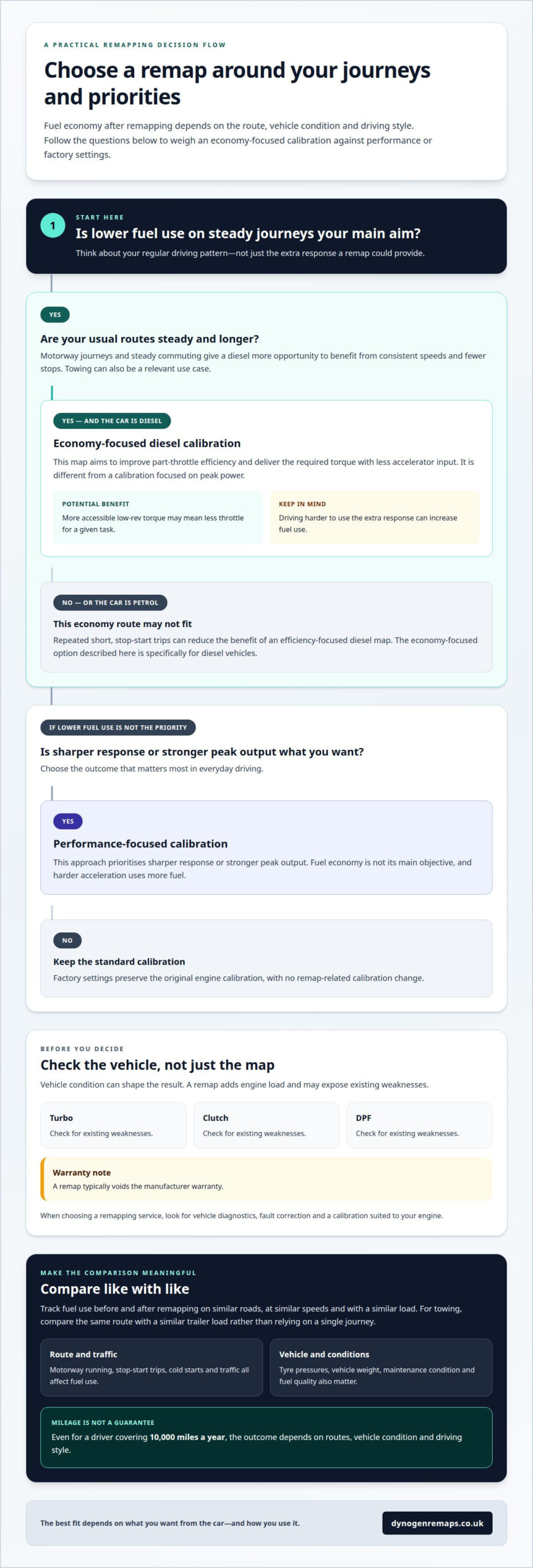
An ECU remap adjusts engine management so the engine can produce useful torque with less throttle input. On a diesel, this may improve efficiency during steady cruising, where small changes in throttle influence fuel use over a journey. That differs from a peak-power calibration, which prioritises output over part-throttle economy. For a fair comparison, track fuel use on similar roads, at similar speeds and with a similar load.
Real-world driving conditions
A motorway commute gives a diesel more opportunity to benefit from consistent speeds and fewer stops than short, stop-start trips. Cold starts, traffic, tyre pressures, vehicle weight, maintenance condition and fuel quality also affect economy. Repeated short journeys, for example, can reduce the benefit of an efficiency-focused map. Record your routes and fuel use before and after remapping to make a more meaningful comparison.
Economy-focused and performance-focused maps
An economy-focused calibration aims to improve part-throttle efficiency and deliver the required torque with less accelerator input. A performance-focused map instead prioritises sharper response or stronger peak output, so fuel economy is not its main objective. Modified hardware can also affect calibration priorities. Decide what matters most before choosing a map: lower fuel use on regular commutes, or more responsive acceleration.
Potential diesel economy gains
Diesel engines can offer clear potential for economy gains, particularly on motorway journeys, commutes or while towing. A remap may improve combustion efficiency and make low-rev torque more accessible, reducing the throttle needed for a given task. However, driving harder to use the extra response can increase fuel use. If you tow, compare fuel use on the same route with a similar trailer load rather than relying on a single journey.
| Option | Main calibration aim | Fuel-economy consideration | Best fit |
|---|---|---|---|
| Economy-focused diesel | Part-throttle efficiency | Driving style and routes shape consumption | Steady commuting or motorway use |
| Performance-focused diesel | Sharper response or peak output | Harder acceleration uses more fuel | Drivers prioritising performance |
| Standard calibration | Original engine settings | No remap-related calibration change | Drivers keeping factory behaviour |
Choose an economy-led map if steady journeys and fuel use matter most. Prioritise performance if stronger response is your main goal.
Examples of vehicle-specific power and torque gains
Remap results depend on the engine and its original calibration, so examples are more useful than a single headline percentage. Comparing power in bhp and torque in Nm can also show how changes may affect acceleration and everyday response.
Vehicle-specific power gains
Vehicle examples put the figures into context. A Range Rover Evoque rose from 180HP and 430Nm to 210HP and 490Nm after a Stage 1 remap. A Ford Focus ST TDCi increased from 150 bhp to 185 bhp, with torque moving from 350 Nm to 420 Nm. A Fiesta ST 1.5 EcoBoost went from 200 bhp to 230 bhp.
Stage 1 power and torque gains
A Stage 1 calibration changes software while retaining the vehicle’s factory hardware. Turbocharged diesels typically gain 15 to 25% more horsepower, whilst the exact result depends on the engine and its starting output. For comparison, a BMW M140i example rose from 340 bhp to 400 bhp. These figures describe specific vehicles, not a universal target.
Low-down and mid-range diesel torque
Diesel engines typically deliver strong torque lower in the rev range, so a torque increase can make acceleration feel more immediate without constant downshifting. The Focus ST TDCi example gained 70 Nm, rising from 350 Nm to 420 Nm. That extra pulling force can be useful during overtaking or when carrying a load.
Power and torque describe different parts of the driving experience. Power relates to how quickly the engine can do work, while torque is its rotational pulling force. A petrol car such as the Fiesta ST 1.5 EcoBoost may feel more eager as revs rise; a diesel’s stronger low-down delivery can make progress feel effortless at lower engine speeds.
Throttle response is another consideration. The ECU controls how engine inputs translate into fuel injection and output, so revised mapping can make the vehicle respond more promptly to the accelerator. Your driving style matters too: a sharper response may encourage harder acceleration, while smoother inputs help you make the most of accessible mid-range torque.
Compare the factory output with the remapped figures for your exact engine variant, then consider where its power arrives. A Focus ST TDCi’s change from 350 Nm to 420 Nm tells a different story from the BMW M140i’s rise from 340 bhp to 400 bhp. Explore vehicle-specific remap information to understand how the intended driving feel shapes a calibration.
Petrol vs Diesel Remapping: What Are the Differences and Which is Better?
When choosing a UK remapping service, look for vehicle diagnostics, fault correction and calibration suited to your engine. A remap typically voids the manufacturer warranty, and the extra engine load can expose existing weaknesses in the turbo, clutch or DPF.
Petrol and diesel engine calibration
Petrol and diesel engines need different ECU adjustments because they ignite fuel differently. Petrol engines use spark ignition, so calibration can refine ignition timing and the air-to-fuel ratio. Diesel engines use compression ignition, and tuning commonly adjusts injection timing, injection quantity and turbo boost pressure. Fuel type therefore shapes which engine-management settings matter most.
Turbocharged petrol engines offer scope to adjust boost alongside ignition and fuel delivery. Diesel calibrations commonly focus on usable torque and managing exhaust temperatures. These are distinct priorities, not interchangeable software settings. A suitable map accounts for the specific engine, its existing hardware and how you intend to use the vehicle.
Power delivery and engine characteristics
Diesel engines typically produce more torque at lower engine speeds, which can make acceleration and towing feel more effortless. Turbocharged petrol engines tend to offer a broader power band and responsive throttle characteristics. The right choice depends on the driving feel you want: accessible pulling power or a petrol engine’s rev range and response.
Naturally aspirated petrol engines have less scope for software-only gains because they lack the same boost adjustments. Their typical improvement from remapping is 5 to 10%, compared with 15-20% for a quality turbo petrol remap. That difference makes the engine’s induction type a practical starting point when comparing expected performance.
Engine health and damage risks
A pre-remap health check matters because extra load can put pressure on worn components. Diesel checks should consider injector condition, turbo wear and DPF health; petrol checks should identify faults such as worn spark plugs or dirty sensors. A remap cannot fix underlying mechanical problems, so diagnose and rectify faults before calibration.
For a UK vehicle, an assessment should include a fault-code scan and relevant turbo and DPF checks. Calibration limits also need to account for exhaust gas temperature and DPF capacity on diesels, or knock limits on petrol engines. Removing or tampering with emissions equipment compromises the vehicle’s compliance and is illegal in the UK.
Choose according to the engine and the result you value. A healthy turbo diesel may suit drivers seeking low-rev torque, while a turbo petrol can suit those prioritising a responsive power band. For a naturally aspirated petrol car, modest software gains may make a remap less compelling than on a turbocharged model.
Ignition timing, boost pressure and fuel injection
Petrol and diesel calibrations alter different engine-management settings to shape combustion, response and torque. The adjustments depend on whether the engine uses spark ignition, compression ignition or turbocharging.
Boost pressure and fuel injection
On a turbocharged engine, boost pressure controls how much compressed air enters the cylinders. The ECU must coordinate that air with fuel delivery, so changing boost alone is not a complete calibration. Petrol tuning can adjust boost, ignition timing and throttle response together. Diesel tuning also manages injection quantity and timing, balancing torque delivery with exhaust gas temperatures.
Diesel torque and injection tuning
Common-rail diesel ECUs control fuel-delivery pressure, timing, duration and injection events. Adjusting these parameters can build torque lower in the rev range, where diesel engines are designed to pull strongly. Calibration must also account for exhaust temperatures and DPF capacity. For a towing vehicle, smooth torque delivery matters more than an abrupt increase that places unnecessary load on the engine.
Petrol remapping and fuel consumption
Petrol remapping can refine fuel delivery and ignition timing, and adjust boost pressure on turbocharged engines. These changes may sharpen throttle response and improve power delivery, but a performance-led calibration does not necessarily prioritise fuel economy. Driving style still matters: using stronger acceleration more often can increase consumption. The calibration should suit your intended use rather than treating sharper response and lower fuel use as identical goals.
Fuel delivery and ignition timing
Petrol engines use spark plugs to ignite an air-fuel mixture, making ignition timing central to combustion. Diesel engines instead compress air and inject fuel directly into the cylinder, so tuning focuses on injection timing and quantity. The ECU coordinates each process to suit its fuel type. Incorrect petrol in a diesel tank is a fuel-delivery problem, not a mapping issue; an ECU remap cannot make the wrong fuel suitable.
During calibration, live data can help assess boost pressure, exhaust temperatures and fuel trims. These readings show how the engine responds under load, rather than relying only on factory figures. On a petrol engine, ignition strategy must respect knock limits; on a diesel, exhaust temperature and DPF capacity guide safe settings. These checks help align software changes with the engine’s operating conditions.
For a practical comparison, identify the engine type first, then review its fuel delivery and ignition or injection strategy. A turbo petrol calibration may combine boost and ignition changes, while a diesel map works chiefly with injection and torque delivery. Matching those settings to the vehicle’s condition and intended use is central to a coherent tune.
Suitability of turbo petrol and turbo diesel vehicles
Turbocharging gives both petrol and diesel engines scope for software calibration, but suitability depends on more than fuel type. Start with the vehicle’s condition, your priorities and the engine’s original operating limits. A healthy turbocharged car with a calibration written for its specific engine is a strong candidate for a considered remap.
For a turbo diesel used for commuting or towing, low-rev torque can make everyday driving feel more effortless. The calibration must still respect boost pressure, exhaust temperatures and DPF capacity. A diesel with injector problems, boost leaks or a worn turbo needs those faults addressed first; extra engine demand cannot repair them.
A turbo petrol car can suit drivers who want stronger response across the rev range. Its calibration can coordinate boost, ignition and fuel delivery, with knock limits guiding the settings. This differs from a diesel map’s emphasis on injection and torque delivery. The best fit depends on whether sharper acceleration or accessible pulling force matters more in regular driving.
Vehicle health is a deciding factor for both fuel types. Before choosing a remap, assess the car methodically rather than treating software as a fix for mechanical wear:
- Scan for fault codes and resolve existing engine-management faults.
- Inspect the turbo system for wear or boost leaks.
- Assess diesel injectors and DPF condition where fitted.
- Check petrol ignition components and sensors for faults.
- Match the intended calibration to the vehicle’s hardware and use.
That sequence helps distinguish a suitable tuning candidate from a car that needs repairs first. For example, diagnose a diesel that hesitates under load before altering its torque delivery. A petrol car with misfires also needs its ignition fault resolved before you can properly assess a calibration.
Consider the car’s everyday role as well as its mechanical condition. A turbo diesel used for regular motorway journeys or towing has different priorities from a turbo petrol driven mainly for responsive acceleration. If fuel efficiency is the priority, the calibration should be developed around that aim; a performance-led map may instead prioritise sharper response or output.
Keep your expectations realistic. Software changes work within the limits of the engine and supporting hardware, so the same approach will not suit every turbocharged vehicle. A naturally aspirated petrol engine lacks turbo boost adjustments, which means less scope for software-only gains than a turbo model.
Choose the remap that matches the vehicle’s health and your main driving goal, not simply the fuel type. If your turbocharged car is ready for a tailored calibration, explore vehicle-specific remapping as the next step.
Dynogen Remapping Solutions: Stage 1 Performance Remap
Dynogen Remapping Solutions’ Stage 1 Performance Remap is the next step for drivers seeking a tailored change in engine performance. It may suit a healthy turbocharged car when stronger power and response are the priority; an Economy Remap is aimed at drivers focused on fuel efficiency. The choice should reflect your vehicle, its condition and the way you use it, rather than fuel type alone.
For a performance-led goal, discuss how the Stage 1 Performance Remap could suit your car. If economy matters more, consider whether an Economy Remap better matches your everyday driving. Dynogen Remapping Solutions also offers DPF and AdBlue solutions for relevant vehicle needs.
Contact Dynogen Remapping Solutions or visit dynogenremaps.co.uk to discuss your vehicle.
Choose a remap that fits your next drive
Start with the outcome you want, then consider your car’s condition and how you use it. That makes the decision about petrol vs diesel remapping specific to your vehicle, not simply its fuel type. Be clear about whether you value everyday efficiency, a different driving feel or stronger performance before taking the next step.
Dynogen Remapping Solutions offers a Stage 1 Performance Remap for performance-focused drivers and an Economy Remap for those prioritising efficiency. An AdBlue Solution is also available for drivers with a relevant system concern. These options address different needs, so matching the service to your goal is the useful place to begin.
Share your vehicle details and driving priorities with Dynogen Remapping Solutions to discuss a suitable direction. Contact Dynogen Remapping Solutions to take the next step towards a considered choice for your car.
Frequently Asked Questions
Is Diesel or Petrol Cars Better for Tuning?
Neither fuel type is automatically better; the right choice depends on the engine and your priorities. A turbo diesel can suit drivers who value strong pulling force at lower engine speeds, while a turbo petrol may appeal if you prefer a responsive power band. Compare the car’s intended use, existing hardware and maintenance condition before deciding. Naturally aspirated petrol engines usually offer less scope for software-only tuning.
Can Remapping Cause Engine Damage?
Remapping can increase demand on engine components, particularly if a calibration exceeds suitable operating limits or existing faults remain unresolved. A worn turbo, boost leak or faulty injector can become more consequential under added load. Before tuning, arrange a diagnostic scan and address issues such as misfires, abnormal boost behaviour or warning lights. Also consider the clutch and transmission, since increased torque can put extra strain on drivetrain components.
Is Remapping Legal in the UK?
A remap is legal in the UK when the vehicle continues to meet its applicable emissions requirements. Removing or tampering with emissions equipment, including a DPF or AdBlue system, is illegal. A remap does not change the car’s official emissions standard or make it compliant with an emissions zone. Tell your insurer about the modification, as insurers assess engine software changes under individual policies.
Is it safe to remap a high-mileage diesel engine?
Mileage alone does not determine whether a diesel is suitable; injector condition and boost leaks are key checks. A high-mileage car in sound mechanical condition is different from one with poor running, turbo wear or DPF problems. A diagnostic assessment should identify faults before calibration. If the engine already struggles under load, resolve the underlying issue first rather than expecting a remap to restore lost performance.
Which Offers Better Value?
Value depends on whether the calibration supports your main goal, not on the fuel badge. If everyday economy is your priority, compare an efficiency-led approach with your usual routes and fuel use. If you prioritise response, you may value a performance-led tune more. Record comparable journeys and consumption before deciding. Factor in vehicle condition and intended ownership too, since tuning cannot correct mechanical wear.
What is ECU remapping for petrol and diesel cars?
ECU remapping changes the software instructions used by a car’s engine control unit. The ECU manages engine operation, and revised calibration changes how it responds to driver input and operating conditions. For example, software on a turbocharged car can be adjusted to alter boost control and delivery. Settings vary between petrol and diesel engines, so the calibration must suit the vehicle rather than rely on a universal file.
How does petrol remapping differ from diesel remapping?
Petrol remapping centres on spark ignition, with calibration addressing ignition timing and fuel delivery. Diesel remapping instead adjusts fuel-injection parameters and commonly focuses on torque delivery. A turbo petrol calibration may also alter boost and throttle response, while a diesel tune must account for exhaust temperatures and DPF capacity. These differences shape how each car feels, so choose according to the engine’s characteristics and your intended driving.
How much power and torque can petrol and diesel remapping add?
A quality turbo petrol remap typically increases power by 15-20%, while a quality diesel remap typically increases torque by 20-35%. Naturally aspirated petrol engines typically improve by 5 to 10% after remapping. These figures describe different measures, so compare power with power and torque with torque. The useful result also depends on where in the rev range the engine delivers its output, not just the peak figure.