
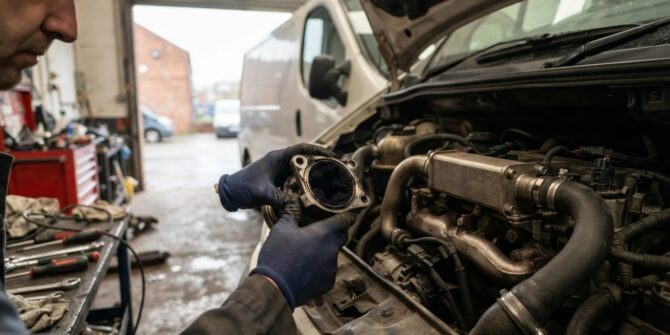
An EGR delete disables or removes the exhaust gas recirculation system, which normally routes some exhaust gas back into the engine intake. The EGR delete benefits most often claimed include sharper throttle response, improved fuel economy and fewer carbon deposits. But removing emissions equipment fitted at the factory is illegal for use on public roads in the UK.
If the system is faulty or clogged, it’s understandable to want a lasting fix rather than another warning light. But claimed improvements in response or fuel economy don’t make deletion the right choice for every vehicle, particularly when road legality and other emissions equipment are involved.
This guide explains what changes when the EGR is deleted, compares deletion with keeping or repairing the system, and covers the UK implications for MOT testing, warranty, insurance and resale. It also explains why diagnosing the specific fault matters before choosing a solution, and which factors should guide a practical decision for your vehicle.
Key Takeaways
- An EGR fault can involve the valve, cooler, hoses or sensors, so identify the cause before choosing a solution.
- Compare keeping, repairing or deleting the system against your vehicle’s road use and emissions equipment, not just hoped-for power or MPG changes.
- The Road Vehicles (Construction and Use) Regulations 1986 are cited by UK Legislation as governing the legality of EGR deletes on public roads.
- Consider how an EGR modification could affect emissions compliance, warranty cover, insurance and future resale before making a decision.
- For performance tuning, Dynogen Remapping Solutions’ Stage 1 Performance Remap is a separate option to consider; it doesn’t remove the need to address an EGR fault or UK road-use rules.
EGR valves, coolers and other failure points
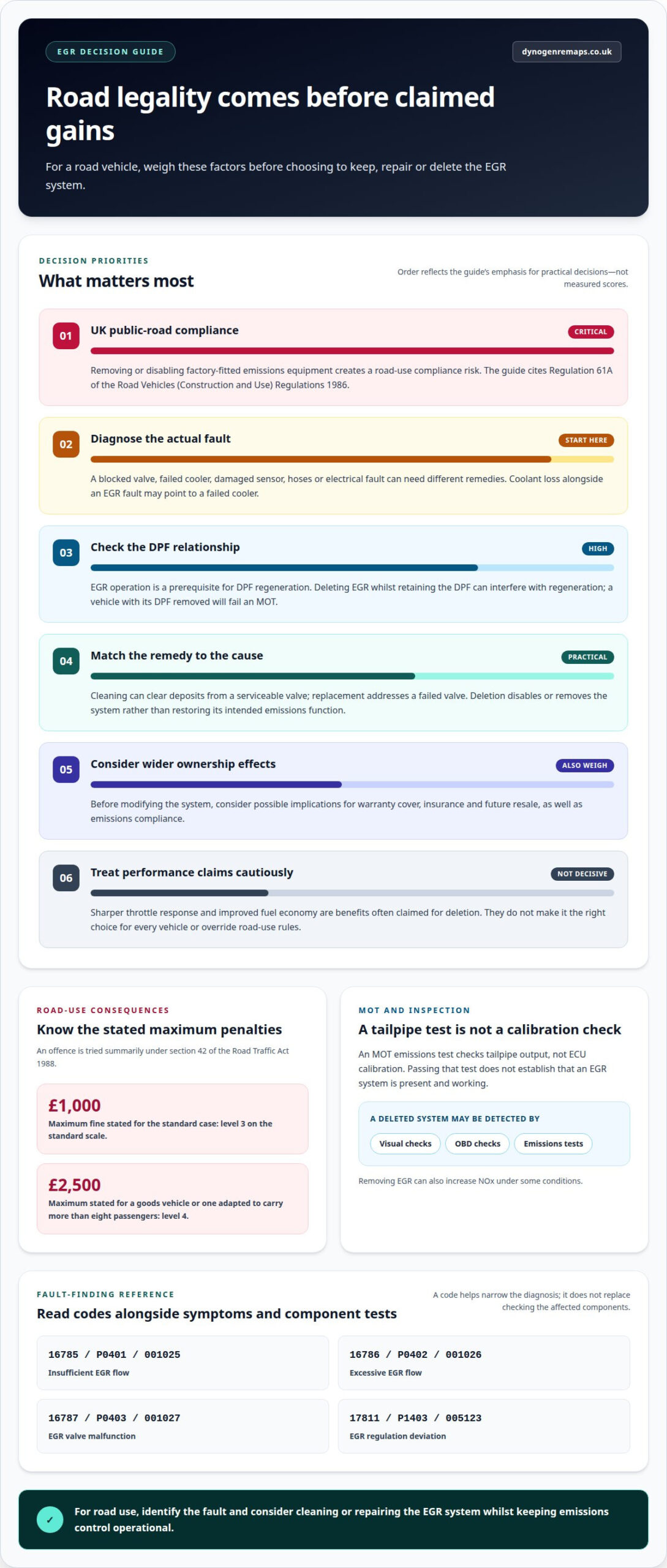
Cleaning or replacing a faulty EGR valve keeps the emissions system working; deletion disables or removes it instead. Diagnose the specific fault first: a blocked valve, failed cooler and damaged sensor each need a different remedy.
The EGR valve meters exhaust gas back into the engine intake. Soot can restrict its movement or block passages, while electrical or sensor faults can disrupt control. A TDI owner reported their EGR system was 50% blocked, illustrating how restriction can build without proving deletion is the right fix.
Many diesel engines use an EGR cooler to lower exhaust temperature before gas returns to the intake. A failed cooler can let coolant enter the intake, so coolant loss alongside an EGR fault deserves attention. Removing components eliminates the valve, cooler, associated hoses and sensors as potential failure points, but it won’t repair unrelated engine faults.
The EGR system also interacts with the diesel particulate filter (DPF). EGR operation is a prerequisite for DPF regeneration, so deleting EGR while retaining the DPF can interfere with regeneration. A vehicle with its DPF removed will fail an MOT, so it’s essential to distinguish an EGR fault from a DPF problem.
Fault codes help narrow the diagnosis: 16785/P0401/001025 indicates insufficient EGR flow; 16786/P0402/001026 indicates excessive flow; 16787/P0403/001027 indicates an EGR valve malfunction; and 17811/P1403/005123 indicates an EGR regulation deviation. Read the code alongside symptoms and component tests before choosing a remedy.
MOT Failure Risk
An EGR delete can leave factory emissions equipment disabled, creating a road-use compliance risk as well as a mechanical change. An MOT checks tailpipe output rather than ECU calibration, and a deleted system may fail inspection if visual checks, OBD checks or emissions tests detect the change. Cleaning or replacing a valve, by contrast, aims to retain the factory system.
Deleting, Cleaning or Replacing the EGR Valve
Cleaning removes deposits from a serviceable valve and its passages; replacement addresses a valve that has failed. Deletion removes or disables the system and may eliminate several potential failure points, but it doesn’t restore the intended emissions function. For street use, repair or cleaning is the relevant comparison. Identify the fault before treating deletion as a mechanical cure.
| Option | Addresses valve restriction | Retains EGR function | Key consideration |
|---|---|---|---|
| Clean | Yes, if deposits are the cause | Yes | Does not fix a failed component |
| Replace | Replaces a faulty valve | Yes | Targets valve failure |
| Delete | Disables or removes the system | No | Can affect DPF regeneration and road compliance |
Match the diagnostic result to the repair, while accounting for the DPF and how you intend to use the vehicle.
UK rules on removing factory-fitted emissions equipment
Removing a factory-fitted EGR system affects emissions equipment and public-road compliance. Consider the legal position before weighing any claimed performance change.
Emissions Legality and Inspection Outcomes
For a faulty EGR system, the legal alternatives are to clean or repair its components, or replace the faulty valve, while retaining emissions control. These options address the fault without disabling factory-fitted equipment. The Road Vehicles (Construction and Use) Regulations 1986 are cited by UK Legislation as governing EGR-delete legality on public roads.
Regulation 61A prohibits using a vehicle on a UK road when an emissions-control device isn’t in good and efficient working order. An EGR delete disables or removes part of that system, so a vehicle may no longer meet this requirement. The distinction is important: a repair restores function, whereas a delete removes it.
An offence is tried summarily under section 42 of the Road Traffic Act 1988. The stated maximum fine is level 3 on the standard scale, or £1,000. For a goods vehicle or one adapted to carry more than eight passengers, the stated maximum rises to level 4, or £2,500. These penalties make road use a central decision point.
An MOT emissions test checks tailpipe output, not ECU calibration. Passing a tailpipe test therefore doesn’t establish that an EGR system is present and working. A deleted system may fail an on-road inspection if visual checks, OBD checks or emissions tests identify the change. Keeping the original system operational differs from deletion on this compliance criterion.
Increased NOx Emissions
EGR lowers combustion temperature to reduce nitrogen oxide (NOx) emissions. Removing it can increase NOx under some conditions, so the effects aren’t limited to a warning light or a change in engine response. The legal concern is emissions control; the physical concern is how altered combustion affects the engine and exhaust system.
Engine temperature, turbo behaviour, DPF operation and emissions can all matter after a change. One reported V10 AYH engine ran cooler after EGR was disabled, with cold-weather problems below −20°C. Some diesel vehicles may also experience higher exhaust gas temperatures or knocking. Turbo response depends on airflow and calibration, while EGR operation is a prerequisite for DPF regeneration.
The DPF connection makes a delete particularly consequential on vehicles retaining the filter: interrupted regeneration can affect its operation. For a road vehicle, repairing or replacing the faulty EGR component preserves the emissions system; deletion trades that function for the removal of potential EGR failure points. Consider the diagnosed fault, public-road use, DPF configuration and emissions consequences together.
Warranty, insurance and resale implications
An EGR modification can affect more than engine behaviour. Consider warranty terms, insurer records, the vehicle’s DPF and what a future buyer needs to know.
Warranty and Resale Implications
An EGR delete can affect warranty coverage related to the engine or emissions system. That doesn’t mean every warranty claim is automatically rejected: the connection between the modification and the failed component matters. Keep records of the work and diagnosis, so the modification and fault history are clear if an engine or emissions claim arises.
When selling, a buyer may want to know whether the EGR hardware remains, whether the ECU has been altered and whether the original components are available. Clear records help distinguish an intentional modification from an unresolved fault. Prepare an accurate account of the work and explain how the vehicle is configured for road use.
Insurance Implications
An EGR delete changes emissions equipment and can involve altered engine-management settings. Tell your insurer what has changed, including whether hardware was removed or software altered. Ask how the modification is recorded and keep the insurer’s response with the vehicle documents. Don’t assume an unchanged registration or MOT result makes the modification irrelevant to your policy.
Insurance consequences depend on the policy wording and the details supplied. For example, an insurer considering an engine-related claim needs an accurate account of the vehicle’s setup. Record the date and nature of the change, retain invoices or work records, and describe any related fault codes. This creates a clearer record than relying on a verbal explanation later.
The DPF deserves separate attention. In the UK, a vehicle with its DPF removed will fail an MOT. An EGR delete and DPF removal are different changes, but a vehicle with both modifications faces the DPF-related MOT outcome regardless of how the EGR alteration is described. Keep the two systems distinct in records and when speaking with an insurer or buyer.
Before committing to a sale or insurance renewal, use a simple document check:
- Record which EGR components were removed, disabled, cleaned or replaced.
- Note any ECU changes and retain the associated job records.
- Identify whether the DPF is present and disclose its condition accurately.
- Keep warranty correspondence and insurer responses alongside maintenance documents.
This paperwork doesn’t make an emissions modification lawful for public-road use or restore warranty cover. It does give insurers, warranty administrators and prospective buyers a precise description of the vehicle, rather than leaving them to infer its condition from an intake fault or warning light.
EGR valve function and exhaust-gas recirculation
In a diesel engine, the EGR valve controls a measured flow of exhaust gas back into the intake. This process, called exhaust gas recirculation, changes the gases entering the engine during combustion. The valve regulates that route; it doesn’t supply fuel or replace the air intake.
This controlled return serves an emissions purpose. EGR lowers combustion temperature, reducing nitrogen oxide (NOx) emissions. The valve can also affect how the engine runs. Its role is to balance exhaust flow into the intake while the engine runs, not simply to remove exhaust from the system.
The basic route is straightforward:
- Exhaust leaves the engine and reaches the EGR passage.
- The EGR valve meters how much gas returns towards the intake.
- The intake receives that measured exhaust flow alongside incoming air.
- Combustion takes place with the recirculated gas present.
On diesel engines fitted with an EGR cooler, exhaust is cooled before returning to the intake. The cooler forms part of the gas route, while the valve regulates flow through the system. A fault in one component doesn’t automatically mean the other has failed. Separating a valve problem from a cooler or passage problem helps identify what needs attention.
An EGR delete changes this designed route. It removes or disables the EGR system and blocks exhaust flow into the intake. A software-only change can leave the valve physically installed while disabling the engine management system’s interaction with it. Either way, the engine no longer uses exhaust gas recirculation as intended.
That difference explains why a delete isn’t the same as cleaning a valve. Cleaning aims to clear deposits and retain the original recirculation function. Replacing a failed valve also preserves the system’s purpose, provided the rest of the route works. Deletion instead removes that function and its emissions benefit, even if it eliminates the valve as a potential failure point.
For diagnosis, follow the fault rather than assuming the EGR valve is responsible. A flow-related code can indicate that the system isn’t delivering the expected amount; a valve-malfunction code points more directly to valve operation. Checking the relevant passages, valve and associated parts helps distinguish restricted flow from component failure. That distinction matters before choosing cleaning, replacement or a system change.
For a road vehicle, the central trade-off is clear: the EGR system recirculates exhaust to reduce NOx, while a delete stops that process. Understanding the route makes it easier to assess symptoms, interpret diagnostic results and recognise what changes physically and electronically.
Exhaust gas recirculation and soot build-up
Exhaust gas recirculation sends some exhaust back into a diesel engine’s intake. That exhaust carries soot, which can combine with oil vapour and form deposits along intake passages. Over time, deposits can restrict airflow or affect how smoothly the engine runs. Their presence alone doesn’t prove the EGR valve is the only cause.
The amount and location of build-up depend on the engine and how its EGR system operates. A restriction may develop in the valve, intake manifold or passages leading towards the cylinder head. A diagnostic result, inspection of affected parts and the vehicle’s symptoms help distinguish deposits from a failed sensor or another fault.
Removing or disabling EGR stops recirculated exhaust entering the intake, removing one source of soot in that route. Reduced carbon deposits and oil contamination are claimed EGR delete benefits, but they aren’t proof of improved overall engine health. Other causes of deposits remain, and changes to the system can affect emissions, engine calibration and DPF operation.
Owner reports illustrate why a single outcome shouldn’t be assumed. One TDI owner reported a clean intake after 100k with a tune retaining dynamic EGR. Another TDIClub participant said their wagon had run with EGR deleted since 2004 without needing an intake clean. These individual examples show different reported experiences, not a controlled comparison between vehicles.
For a soot-related complaint, use a practical sequence:
- Read the engine fault codes and note the symptoms.
- Inspect the EGR valve and intake passages for restriction or deposits.
- Check whether the fault points to flow, valve operation or another component.
- Compare cleaning or repair with the consequences of changing EGR operation.
Cleaning can remove deposits while retaining the factory EGR function. Replacing a faulty valve addresses that component, but won’t clear deposits elsewhere unless those areas are cleaned too. Deletion takes a different approach: it prevents EGR flow rather than removing existing build-up from the intake.
That distinction matters if the vehicle retains its DPF, because EGR operation is a prerequisite for DPF regeneration. Reducing soot in the intake doesn’t remove that dependency. For a road vehicle, consider the deposit location, diagnosed cause, emissions equipment and intended use together before choosing a remedy.
For a vehicle with recurring intake deposits, discuss the engine’s EGR and soot concerns before choosing a change that alters its emissions system.
Dynogen Remapping Solutions: Stage 1 Performance Remap
Dynogen Remapping Solutions offers a Stage 1 Performance Remap for drivers considering performance tuning, but it isn’t a substitute for fixing an EGR fault or maintaining factory emissions equipment. If the EGR system is causing concern, its EGR Solution is the relevant service to discuss; an Economy Remap is another option for drivers focused on efficiency.
First decide whether your priority is resolving an EGR issue or changing how the vehicle performs. Keeping those aims distinct helps you choose a suitable next step without treating an emissions-system delete as a road-use upgrade.
For guidance on the options, contact Dynogen Remapping Solutions.
Choose the next step with your vehicle’s use in mind
Before changing a vehicle’s emissions setup, decide what you want to improve: resolve a fault, refine performance or prioritise fuel economy. Treat advertised EGR delete benefits as claims to weigh against your vehicle’s road use and the outcome you need, not as a decision in themselves. If your priority is an EGR concern, a solution focused on that system is more relevant than a performance remap.
Dynogen Remapping Solutions offers an EGR Solution alongside its Stage 1 Performance Remap, Economy Remap and AdBlue Solution. These address different requirements, so matching the service to the vehicle’s issue is a sensible starting point. Individual results depend on the vehicle and the work involved.
For a considered next step, contact Dynogen Remapping Solutions to discuss the option that fits your vehicle. A clear conversation can help you move forward with confidence and keep the decision focused on your priorities.
Frequently Asked Questions
What is an EGR Delete?
An EGR delete disables or removes a vehicle’s exhaust gas recirculation system. Depending on the method, the valve may remain physically installed while the ECU stops controlling it, or components and exhaust passages may be altered. For example, a software-only change can leave the hardware in place. The key difference is that the engine no longer operates with its factory EGR function.
What are the main benefits of an EGR delete on a diesel van?
Claimed advantages for a diesel van include sharper throttle response, fewer EGR-related components to fail and less soot entering the intake. Some drivers also report steadier fuel economy. These are possible reasons to consider the modification, not guaranteed results for every van. A work van that retains its DPF needs particular care because EGR operation supports DPF regeneration.
What is an EGR Valve?
An EGR valve is a controlled component in the engine’s exhaust gas recirculation system. It opens or closes to regulate how much exhaust returns towards the intake. In practice, a fault may involve the valve’s movement, an electrical connection or restricted flow around it. A diagnostic code can help identify the issue, but interpret it alongside symptoms and component checks.
What is an EGR in Diesel?
In a diesel vehicle, EGR means exhaust gas recirculation. The system routes a measured quantity of exhaust back into the engine intake, changing combustion conditions and helping reduce nitrogen oxide emissions. It’s part of the engine’s emissions equipment, not a separate fuel additive or an intake filter. A diesel’s EGR setup can also work alongside its DPF, so changing one system can affect the other.
What does an EGR delete do and how does it work?
An EGR delete blocks or disables the route that returns exhaust gas to the intake. A hardware change may remove or blank components; a software-only approach can leave the valve fitted while changing ECU control. A mismatch between the physical system and engine management can trigger warning lights, limp mode or driveability problems. The method therefore changes the gas-flow arrangement and may also change ECU behaviour.
What are the claimed benefits of an EGR delete for performance and fuel economy?
Supporters commonly claim improved throttle response and fuel economy, and some report more consistent MPG after suitable tuning. The reasoning is that restricting exhaust flow into the intake may alter engine response and reduce deposits. These claims don’t establish a specific gain for every vehicle. Engine design, existing faults, driving pattern and calibration all influence how a vehicle behaves after its EGR operation changes.
Does an EGR delete improve engine reliability or reduce carbon build-up?
Removing EGR parts eliminates potential failure points, including the valve and, where fitted, the cooler. It also stops recirculated exhaust contributing soot to the intake. However, deletion doesn’t clear existing deposits or resolve unrelated faults. A blocked valve may itself restrict flow, so diagnosis can show whether cleaning or replacement will address the actual problem without changing the vehicle’s emissions setup.
Is deleting an EGR valve legal for road vehicles in the UK?
No. Removing emissions equipment fitted by the manufacturer is not legal for use on UK public roads. The Road Vehicles (Construction and Use) Regulations 1986 are cited by UK Legislation as governing EGR-delete legality. For a faulty system, cleaning, repairing or replacing the affected component while retaining its emissions function is the road-use alternative. An MOT result doesn’t make a removed system lawful.