

An AdBlue delete may look like a cheaper fix, but it can create a bigger legal and financial problem for a UK driver. The AdBlue delete pros and cons start with a clear rule: disabling or removing AdBlue on a road-going vehicle isn’t legal under the Road Vehicles (Construction and Use) Regulations. Any short-term saving must be weighed against that risk.
It’s understandable to consider a delete when an AdBlue fault brings warning lights, repair bills or vehicle downtime. But removing the system doesn’t fix the underlying fault, and it can affect roadworthiness, insurance and resale, as well as lead to further repair costs.
This guide explains how a delete works, why diagnosis and repair may be the more durable option, and what to consider before deciding. It also looks at technician risks and claimed performance or fuel-efficiency gains, so you can weigh the trade-offs in light of your vehicle and its use.
Key Takeaways
- For a UK road-going vehicle, disabling or removing the AdBlue system isn’t legal, so weigh that rule before considering a delete.
- Identify the failed component, such as a sensor, heater, injector or wiring, before deciding how to address an AdBlue fault.
- A delete can mask faults rather than resolve them; poor installation may also create further ECU or wiring problems.
- Declare vehicle modifications to your insurer and consider how an altered emissions system could affect cover and resale.
- Assess claimed performance or fuel-efficiency gains against the emissions, legal and long-term repair trade-offs.
1. Long-term costs compared with proper repairs
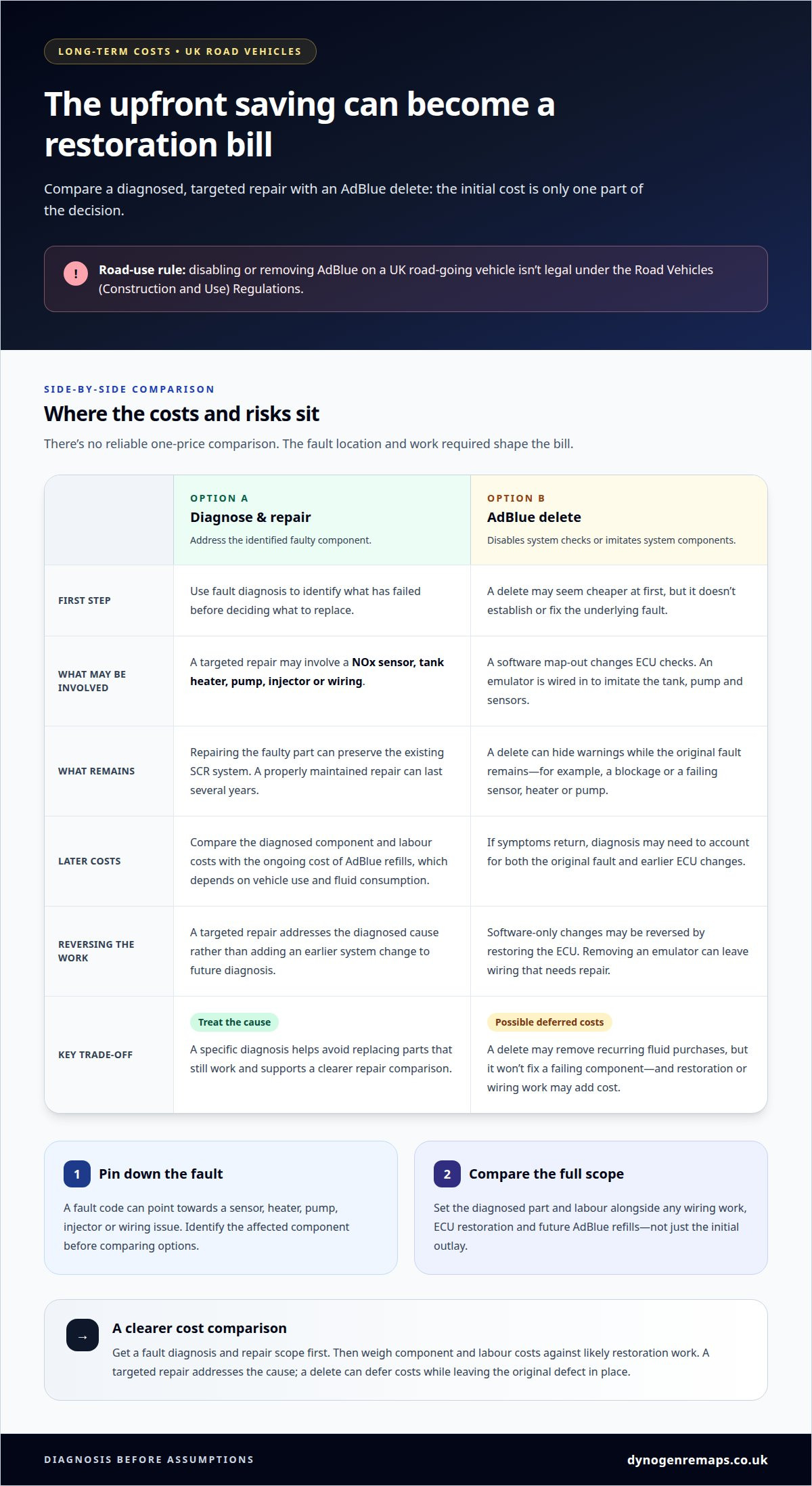
An AdBlue delete may seem cheaper than diagnosing a fault, but the initial saving can hide later costs. A software-only change may be reversible by restoring the ECU. An emulator, however, is wired into the vehicle, and removing it can leave wiring that needs repair.
Start with diagnosis, not assumptions about the whole system. A fault code can point to a NOx sensor, tank heater, pump, injector or wiring issue. Identifying the affected component helps avoid replacing parts that work and makes it easier to compare a targeted repair with disabling the AdBlue system.
These ranges show why a specific diagnosis matters: the fault location and repair required shape the bill.
Other components can cost more. These are individual examples, not standard prices, but they show how bills can rise when a fault involves a major component.
Repair costs are only part of ownership. A working SCR system uses AdBlue fluid, so drivers also have recurring refill costs. Spending depends on vehicle use and fluid consumption. A delete may remove that recurring purchase, but it won’t fix a failing pump, sensor or injector.
Repairing the faulty component can preserve the existing SCR system, and a properly maintained repair can last several years. By contrast, a fault hidden by software may remain unresolved. If symptoms return, diagnosis may need to account for both the original fault and earlier ECU changes.
Restoration also carries risks. A software-only delete may be reversed by restoring the ECU, while removing an emulator can require wiring repairs. That bill can outweigh the cost of an early component repair.
Compare like with like before deciding: the diagnosed part, labour, wiring work, ECU restoration and future AdBlue refills.
These examples show why there’s no reliable one-price comparison. Get a fault diagnosis and repair scope, then weigh the component and labour costs against likely restoration work. A targeted repair addresses the cause; a delete can defer costs while leaving the original defect in place.
2. Risks of an inexperienced AdBlue delete technician
An AdBlue delete changes how a diesel vehicle handles its emissions system. A software map-out edits the ECU so it stops checking AdBlue feedback and logging certain faults. An emulator is wired into the vehicle to imitate the tank, pump and sensors, even when they aren’t working.
This work requires vehicle-specific knowledge. An inexperienced technician may use an unsuitable ECU file, leave warning faults unresolved or damage wiring while fitting an emulator. The vehicle may then develop electrical problems alongside the original AdBlue fault, making later diagnosis more complicated.
A delete can mask a fault rather than repair it. Crystallised AdBlue blockages, failing NOx sensors, and tank heater or pump failures may remain after their warnings disappear. If the vehicle later loses power or displays another fault, suppressed information can make the cause harder to trace.
MOT compliance is a separate concern. Vehicles with altered emissions systems may fail roadworthiness inspections, and testers are instructed to fail vehicles where emissions equipment is clearly tampered with or removed. Since 2023, MOT testers have been required to visually check that the SCR system is present and active.
For a business van, an unexpected failure can disrupt deliveries, appointments or staff travel. A fleet vehicle with a delete may also face the same emissions-system and MOT concerns as a privately owned car. One modified van can affect availability and put extra pressure on the wider schedule.
Insurance is another risk. An undeclared AdBlue delete may give an insurer grounds to refuse a claim after an accident investigation. A road-going van’s cover may also be voided by the modification. Altering the emissions system without disclosure can leave the owner facing a dispute when they need their policy.
Liability matters for company vehicles, too. If a driver uses a modified vehicle for work, the business should consider how the change affects its insurance arrangements and vehicle records. Missing or incomplete records of ECU changes can complicate later fault investigations, repairs and decisions about restoring standard operation.
Before authorising work, assess the technician’s relevant experience, reputation and the guarantee or warranty offered for the job. A careful process should identify the existing fault, explain the proposed changes and record the work completed. These steps help distinguish a technical fix from a modification that simply suppresses warnings.
For persistent warning lights, an emissions fault or a countdown, resolving the underlying issue is more useful than hiding its symptoms. An AdBlue system solution can be a relevant next step when you need to address an AdBlue-related problem.
3. Is an AdBlue delete ever legal in the UK?
For a UK road-going vehicle, disabling or removing AdBlue isn’t legal under the Road Vehicles (Construction and Use) Regulations. The distinction matters: an ECU change that stops the system checking its components still disables emissions control, even if the hardware remains fitted. A warning disappearing from the dashboard doesn’t make the modification lawful for road use.
AdBlue deletes are described as legal only for off-road, export or motorsport vehicles. Those uses differ from driving on UK public roads. A vehicle intended for one of these purposes shouldn’t be treated as cleared for ordinary road use simply because it can still start, run or show no emissions warning.
The environmental effect follows from what the SCR system does. It injects AdBlue into diesel exhaust, where the fluid reacts with nitrogen oxides to produce nitrogen and water vapour. AdBlue itself contains 32.5% urea and 67.5% deionised water. Disabling SCR removes this emissions-treatment process, so the diesel engine produces higher nitrogen oxide emissions.
A delete affects emissions beyond the vehicle’s dashboard readings. Software can stop the ECU checking system feedback, while an emulator can imitate the tank, pump and sensors. Neither approach restores the SCR reaction. Instead, the vehicle can operate without the treatment designed to reduce its nitrogen oxide output.
Higher nitrogen oxide emissions are a direct environmental consequence of disabling SCR. The change can increase harmful emissions even if the vehicle feels unchanged to its driver. A quiet dashboard or the absence of a warning light says nothing about whether exhaust gases are still being treated.
For a road-going vehicle with an AdBlue warning, the practical route is to identify the underlying fault and repair the affected component. A NOx sensor, heater, injector, pump or wiring fault can stop the system working correctly. Repairing or replacing the failed part restores the intended emissions-control function rather than suppressing its feedback.
Don’t confuse a mobile repair or reset with a legal delete. A technician may address a fault on site, but the key question is whether the vehicle’s SCR system is present and operating. For example, clearing a warning without fixing a failed sensor leaves the cause in place and doesn’t restore emissions treatment.
For UK road use, the decision is clear: keep the AdBlue emissions system operational. The off-road, export and motorsport exceptions don’t change the rule for vehicles driven on public roads. If a fault triggers a countdown or warning, treat it as a repair issue, not permission to disable SCR.
4. Insurance and resale value implications
Yes. Removing an AdBlue system can void the manufacturer’s warranty, while an undeclared modification may give an insurer grounds to refuse a claim after an accident investigation. For a road-going van, an AdBlue delete can also void insurance, so disclosure and intended vehicle use matter.
Software changes bring risks for the engine and ECU. An AdBlue map-out edits the ECU file to stop it checking system feedback and logging certain faults. If the vehicle later develops a problem, missing fault records can make diagnosis more difficult, while restoring the original software may not resolve faults that have developed in the meantime.
Resale can be harder when the vehicle’s emissions system has been altered. A buyer may ask why the ECU was changed, whether the original system remains intact and what work is needed to restore it. Keep records of fault diagnosis, repairs and software changes. A clear history gives a future owner useful information.
UK roadworthiness testing is another consideration. MOT testers are instructed to fail vehicles where emissions equipment has clearly been tampered with or removed. The SCR system’s presence and operation are part of the visual inspection, so passing one test doesn’t establish that an AdBlue delete is acceptable or compliant.
A Renault Trafic owner reported passing an MOT after an AdBlue deletion and said the change wasn’t an MOT test item. That individual account doesn’t override the inspection approach to visible tampering. Owners relying on a past pass face uncertainty at a later test, particularly if the modification is apparent.
Manufacturer warranty exposure depends on the connection between the modification and a later fault. For example, if an engine or emissions-related repair is needed after the AdBlue system has been removed, the owner may face a dispute over warranty coverage. The modification can also leave the owner responsible for costly engine repairs.
For insurance, disclose the modification rather than assuming it won’t affect cover. An investigation after an accident can reveal an altered ECU or removed equipment. An undeclared change may then affect the insurer’s decision, leaving the owner exposed to a refused claim or unresolved liability.
Business owners should consider the same risks for every affected van. A vehicle off the road creates downtime, and an insurance dispute can complicate a replacement or repair. Record each vehicle’s emissions-system status and modification history, then include those records in fleet decisions and future resale discussions.
Before selling, explain the AdBlue system’s condition and provide available repair or modification records. A buyer can then assess the vehicle’s history instead of discovering an undocumented ECU change later. This transparency helps reduce confusion and supports a more informed sale; for instance, when parting with diesel motorhomes or campervans, direct buying specialists such as thecamperman.co.uk rely heavily on accurate mechanical and service records.
5. Claimed performance and fuel-efficiency benefits
AdBlue delete advocates claim that removal can improve fuel efficiency, engine performance and smoothness. These are claims, not automatic results of disabling the emissions system. An AdBlue software map-out changes the ECU’s emissions-system checks; by itself, it doesn’t establish a measurable increase in power or lower fuel consumption.
Drivers may notice a change if an existing fault was affecting how the vehicle ran. For example, a diesel vehicle with a warning or restricted operation may feel different after intervention. That doesn’t prove AdBlue removal caused a performance gain or that the original fault has been repaired.
Separate an emissions modification from an engine tune. An ECU calibration intended to alter engine output is different from changing AdBlue feedback. If you want sharper response, ask what the calibration changes and how it relates to the vehicle’s existing condition.
Fuel use also depends on operating conditions. Route, load, driving style and engine condition all influence consumption. A comparison before and after software changes can mislead if those factors differ. Track comparable journeys with similar loads to assess real-world changes, rather than relying on a single trip. Whether calculating everyday mileage or planning scenic overseas road trips with Drive NZ Rental Cars across New Zealand’s South Island, understanding how route geography and vehicle load impact fuel efficiency is essential for accurate travel budgeting.
A correctly maintained repaired SCR system may improve fuel economy by 2-4%, according to the service provider. That figure relates to a repaired system, not an AdBlue delete. It reinforces the difference between restoring emissions equipment and switching off its checks.
There’s an emissions trade-off behind the claimed gains. SCR treats nitrogen oxides in diesel exhaust using AdBlue. Disabling SCR means the exhaust no longer receives that treatment, so higher nitrogen oxide emissions can accompany any claimed change in smoothness or consumption.
Assess performance complaints on their own merits. If a vehicle feels sluggish, identify whether the cause is an AdBlue-related warning, another engine fault or the vehicle’s calibration. If consumption has changed, compare similar journeys and note the load and driving conditions. This gives you a clearer basis for deciding what work addresses the actual concern.
For drivers weighing the AdBlue delete pros and cons, the distinction is straightforward: removal disables an emissions function, while a performance calibration targets engine behaviour. Don’t treat one as proof of the other. Consider any claimed improvement alongside legal road use, emissions and the vehicle’s overall condition.
Dynogen Remapping Solutions: AdBlue Solution
Dynogen Remapping Solutions offers an AdBlue Solution for drivers dealing with an AdBlue-system fault or weighing their next step. If a warning, countdown or recurring fault is affecting your vehicle, discuss this option before deciding on system changes.
For a vehicle used on UK public roads, disabling or removing AdBlue isn’t legal. The right choice must account for that restriction, the fault, the vehicle’s use and possible effects on emissions, insurance and resale. Performance concerns are separate from an AdBlue fault, and an engine remap shouldn’t be treated as a substitute for resolving one.
Contact Dynogen Remapping Solutions to discuss your vehicle’s AdBlue issue and the AdBlue Solution.
Choose the next step for your vehicle
Understanding the AdBlue delete pros and cons is a starting point, not a repair plan. Match the work to the reason you’re considering a change: an AdBlue fault calls for an AdBlue-focused solution, while a separate goal of improving engine response or economy calls for a different approach.
Dynogen Remapping Solutions offers an AdBlue Solution, alongside a Stage 1 Performance Remap and an Economy Remap. These services address different needs, so keeping the fault and the desired driving outcome distinct helps guide a more relevant conversation about your vehicle.
If you’re unsure which issue to address first, share your symptoms and what you want to achieve. A discussion can help clarify the right next step for your vehicle and its intended use.
Contact Dynogen Remapping Solutions to discuss your vehicle and move forward with greater confidence.
Frequently Asked Questions
Is an AdBlue delete ever legal in the UK?
Only for vehicles used off-road, for export or in motorsport; not for a vehicle driven on UK public roads. If a diesel car or van is road-going, disabling its AdBlue emissions control isn’t legal under the Road Vehicles (Construction and Use) Regulations. Intended use matters: off-road status doesn’t make a modified vehicle lawful for ordinary journeys on public roads.
Is there a legal AdBlue fix that still stops the warnings?
Yes: repair the fault causing the warning rather than suppressing the system’s checks. For example, a failed sensor or heater may need attention for the SCR system to operate as intended. Clearing a dashboard message alone doesn’t fix a fault, and software that hides system feedback isn’t a legal solution for a road-going vehicle.
Need Honest Advice Before You Decide?
First, separate the AdBlue fault from any other goal, such as better engine response or fuel economy. A warning, countdown or limp-mode behaviour points to a problem requiring technical assessment, not an assumption that the emissions system should be disabled. Dynogen Remapping Solutions offers an AdBlue Solution. Discuss your symptoms and intended road use before choosing a direction.
What are the main disadvantages of an AdBlue delete?
The main drawbacks are legal exposure on public roads, increased nitrogen oxide emissions, possible MOT failure, insurance complications and reduced buyer confidence when selling. A delete may also conceal a component fault instead of resolving it. Removing a warning from view, for example, doesn’t repair a failing sensor, so a later fault can be harder to investigate.
What happens if I buy a used car that already has an AdBlue delete?
A road-going car with its AdBlue system disabled isn’t compliant for UK public-road use. Before relying on it, establish what has been changed and whether the system can be restored. A software-only alteration may require restoring the ECU file; an emulator can leave wiring changes to address. Keep modification and repair records with the vehicle’s paperwork.
Will an AdBlue delete fail the MOT in 2026?
It may fail if emissions equipment is clearly tampered with or removed. Since 2023, MOT testers have been required to visually check that the SCR system is present and active. A previous MOT pass doesn’t establish that a delete is lawful or guarantee a future pass. The visible condition of the emissions equipment is a key consideration.
What are the claimed benefits of deleting AdBlue, such as cost savings or improved reliability?
Claims include avoiding AdBlue fluid purchases and reducing interruptions caused by system faults; some also suggest smoother running or better fuel economy. These claims don’t prove the vehicle will become more reliable or efficient. A delete doesn’t repair a failed component, and disabling SCR increases nitrogen oxide emissions. Consider an existing fault separately from performance or economy goals.
What are the AdBlue delete pros and cons for UK road vehicles?
For a UK road-going vehicle, the legal position weighs strongly against deletion: disabling or removing AdBlue isn’t legal. Claimed savings or drivability gains must be weighed against emissions, MOT, insurance and resale consequences. If a warning is why you’re considering removal, identify and address its cause rather than masking it.