

Imagine you’re halfway through a critical journey when a sudden chime alerts you to a persistent AdBlue system fault message on your dashboard, accompanied by a terrifying countdown to a non-start condition. It’s a scenario that leaves many drivers feeling stranded and anxious, particularly when faced with the prospect of a “limp mode” that guts your engine’s power. You aren’t alone in your frustration. The sheer complexity of Selective Catalytic Reduction hardware means even a minor sensor glitch can lead to a multi-thousand pound repair bill at a dealership.
We understand that your vehicle is a vital tool for work or travel, and its reliability shouldn’t be held hostage by temperamental emissions components. This guide explores the mechanical triggers behind these warnings and explains how a professional software recalibration can provide a permanent resolution. By opting for a sophisticated AdBlue Solution, you can eliminate the countdown for good and restore the smooth, responsive driving experience you expect. We’ll examine the common causes of failure, compare the real-world costs of traditional repairs, and detail the technical process of professional software-based correction.
Key Takeaways
- Understand the technical triggers behind the AdBlue system fault message and why ignoring the dashboard countdown can lead to a total engine non-start.
- Identify the primary hardware culprits, including failing NOx sensors and fluid crystallisation, that frequently cause Selective Catalytic Reduction (SCR) systems to malfunction.
- Compare the high cost of repetitive dealership component replacements with the efficiency and reliability of a permanent software-based recalibration.
- Learn the essential immediate actions to take when a warning appears to protect your vehicle from entering restricted “limp mode” power levels.
- Discover how Dynogen Remapping Solutions’ specialist AdBlue Solution leverages 15 years of ECU expertise to restore vehicle reliability and eliminate recurring fault codes for good.
What is the AdBlue System Fault Message and Why Does it Appear?
Encountering an AdBlue system fault message is a frustrating experience that often catches drivers off guard. Whilst many initially assume they simply need to top up their reservoir, this specific warning typically signals a deeper technical failure within the Selective Catalytic Reduction (SCR) architecture. Since the introduction of Euro 6 emissions standards in September 2015, manufacturers have been legally required to integrate these complex systems to drastically reduce harmful Nitrogen Oxide (NOx) output.
This technology relies on Diesel Exhaust Fluid (DEF), a urea-based solution that reacts with exhaust gases. Even if your tank is brimming with fresh fluid, the warning can persist because the Engine Control Unit (ECU) has detected a logical or hardware inconsistency that prevents the SCR system from operating within its strict legal parameters.
The Role of the SCR System in Modern Diesels
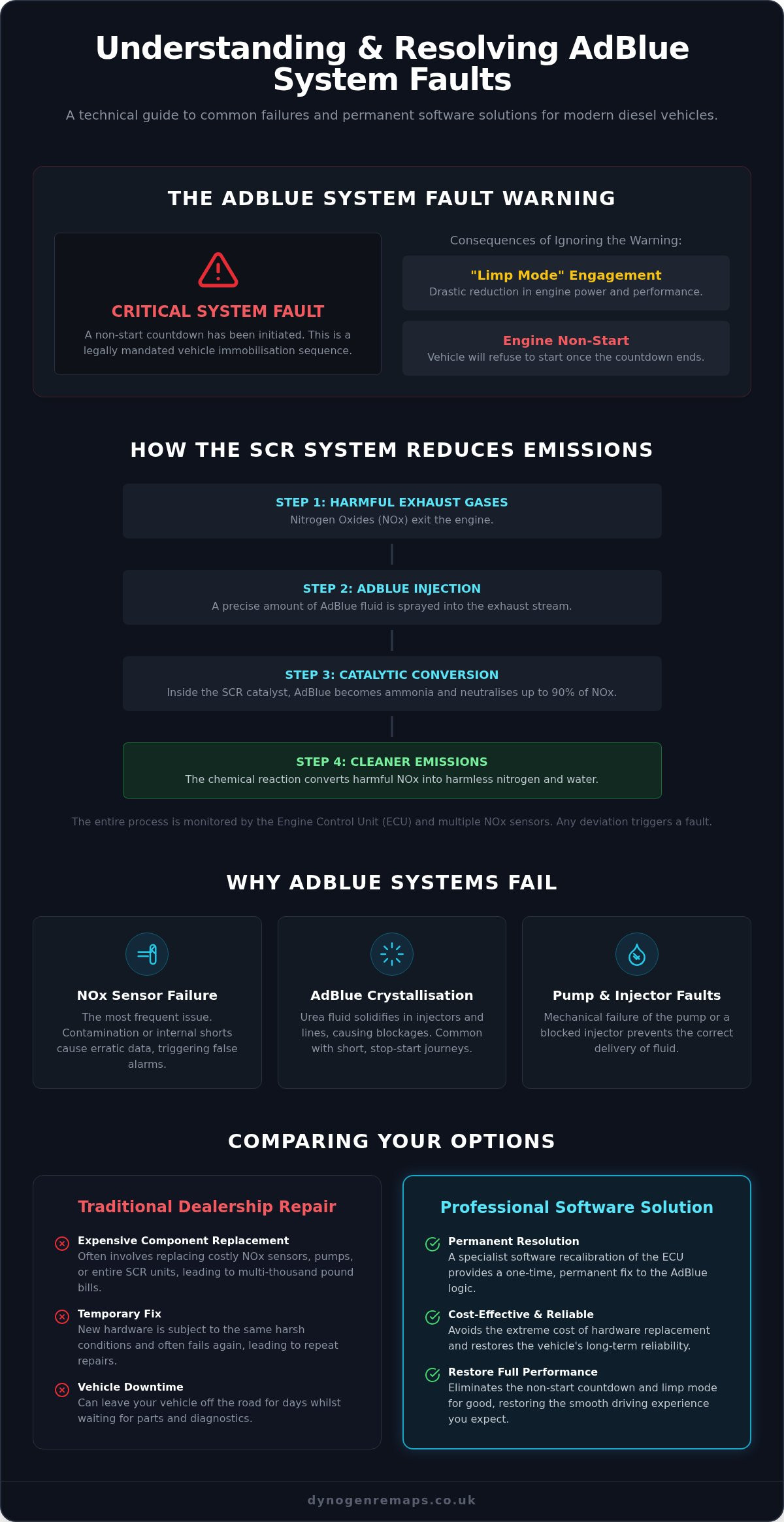
Selective Catalytic Reduction is a sophisticated chemical laboratory housed within your exhaust system. It uses a precision injector to mist AdBlue into the hot exhaust stream, where it breaks down into ammonia and reacts with NOx inside the catalyst. Modern ECUs are programmed to be extremely sensitive to this data, constantly cross-referencing readings from upstream and downstream NOx sensors to ensure the chemical reaction is perfect. This sensitivity is a direct result of stringent emissions standards; the vehicle’s software logic is designed to prioritise environmental compliance over mechanical convenience, meaning even a minor sensor drift can trigger a full-scale system alert.
Why Your Dashboard Displays a Non-Start Countdown
The appearance of an AdBlue system fault message and its accompanying countdown is not a suggestion. It is a mandatory regulatory safety feature. UK and European laws dictate that a vehicle cannot be driven indefinitely if its emissions control system is compromised. Consequently, manufacturers must implement a tiered warning system that escalates from a simple “low fluid” alert to a critical system failure. The non-start message is a software-enforced immobilisation. This drastic measure ensures the vehicle remains compliant with the law, effectively forcing a repair by threatening to leave the driver stranded once the remaining mileage reaches zero.
Common Causes: Why AdBlue Systems Fail So Frequently
The underlying architecture of a modern diesel exhaust system is surprisingly delicate, often struggling to withstand the harsh environments in which it operates. Whilst the primary goal of Selective Catalytic Reduction (SCR) is to neutralise pollutants, the hardware required to achieve this is prone to a variety of mechanical and chemical failures. One of the most prevalent issues is AdBlue crystallisation. Because the fluid is a mixture of high-purity urea and deionised water, it can revert to a solid, white crystalline state when exposed to air or when the vehicle is used for short, stop-start journeys that prevent the exhaust from reaching optimal operating temperatures. These crystals quickly clog injectors and narrow delivery lines, eventually triggering a persistent AdBlue system fault message.
Environmental factors also play a significant role in system reliability. Extreme cold can cause the fluid to freeze, whilst excessive heat in the engine bay can degrade the chemical composition of the urea solution before it even reaches the exhaust. The sensors themselves are particularly vulnerable; they are positioned directly within the high-heat exhaust stream, where they are constantly bombarded by soot, vibration, and thermal cycling. This brutal environment ensures that even premium-brand components have a finite lifespan, often failing long before the vehicle’s major mechanical parts.
NOx Sensor and Injector Failures
Nitrogen Oxide (NOx) sensors are the most frequent culprits behind an AdBlue system fault message. These precision instruments act as the “eyes” of the ECU, monitoring the efficiency of the SCR catalyst in real-time. If a sensor becomes contaminated by carbon deposits or suffers an internal electrical short, it sends erratic data to the vehicle’s brain. A single reading that falls outside of expected parameters is often enough to trigger a non-start countdown, even if the catalyst is actually functioning correctly. Similarly, a blocked injector prevents the precise misting of fluid, leading to a chemical imbalance that the system interprets as a critical failure.
Pump Malfunctions and Tank Issues
The AdBlue delivery module is a complex assembly that houses the pump, heater, and level sensors, often integrated directly into the storage tank. These units are notoriously prone to internal leaks, where the corrosive urea fluid reaches the internal circuit boards and causes total electrical failure. When the pump fails to maintain the required pressure, the software immediately identifies a delivery fault. Because these components are often sold as sealed units, a minor pump defect frequently necessitates a complete tank replacement at a significant cost. For those seeking a more reliable alternative to repetitive hardware replacements, our professional AdBlue Solution provides a sophisticated software-based correction that bypasses these hardware dependencies entirely.
When your dashboard displays an AdBlue system fault message, you’re faced with two fundamentally different repair philosophies. The traditional dealership model relies on a component-replacement strategy, which treats the symptoms rather than the underlying software logic. In contrast, a professional software recalibration addresses the root cause of electronic triggers, offering a more logical and cost-effective path for high-mileage or out-of-warranty vehicles.
The Cost Reality of Main Dealer Repairs
Main dealers operate under strict manufacturer protocols that often mandate the replacement of entire modules rather than individual components. Research indicates that a single NOx sensor can cost between £200 and £500, whilst an AdBlue pump assembly often ranges from £600 to over £1,500. When you factor in premium labour rates, which in the UK can exceed £150 per hour, and initial diagnostic fees, a single visit can easily surpass £2,000. In complex cases involving the entire SCR assembly, some owners have reported bills reaching as high as £3,500.
The most frustrating aspect of this approach is the “vicious cycle.” Because the original design flaws in the hardware remain unaddressed, there’s a significant risk that the fault will return once the new parts are exposed to the same heat, vibration, and crystallisation issues. You aren’t just paying for a part; you’re paying for a temporary reprieve from a systemic engineering problem that the manufacturer has failed to resolve at the source.
Why Software Recalibration is a Superior Alternative
Choosing a software-based solution represents a shift toward permanent vehicle reliability. By adjusting the ECU parameters, we can modify how the vehicle interprets data from the SCR system, effectively silencing the triggers that lead to non-start countdowns and limp mode. This process is rooted in the same advanced engineering principles we use for our Performance software for cars, where precision coding is used to refine the engine’s management system for better efficiency and responsiveness.
This recalibration is a necessary evolution because, as highlighted in academic studies on Reliability Challenges for Automotive Aftertreatment Systems, these emissions components are inherently prone to environmental degradation. A one-time software fix eliminates the need for repetitive, expensive hardware swaps. It provides a definitive end to the anxiety of dashboard warnings, ensuring your vehicle remains a dependable tool for work or travel rather than a source of constant financial drain.
What to Do When the AdBlue System Fault Message Appears
Seeing an AdBlue system fault message flash onto your instrument cluster is a moment of high anxiety, but your immediate response determines whether you face a minor inconvenience or a total vehicle lockdown. Your first action should be a methodical check of the basics. Confirm your fluid levels are adequate and inspect the area around the filler neck and tank for any tell-tale white crystalline deposits, which indicate a leak. If your tank is already full, you must recognise that you are dealing with a technical malfunction that requires more than just a top-up.
Ignoring the warning is a high-stakes gamble. The non-start countdown is a relentless software protocol; once it hits zero, the vehicle’s immobiliser will prevent the engine from firing to ensure emissions compliance. This isn’t a mechanical failure that you can “drive through” to see if it clears. It is a programmed response that requires professional intervention to override.
Initial Diagnostics and Troubleshooting
It’s vital to distinguish between a routine ‘low fluid’ alert and a genuine system failure. Whilst a low fluid warning is simply a prompt for maintenance, a system fault signals that the ECU can no longer verify the efficiency of the SCR process. Be wary of using budget AdBlue fluids found at some discount retailers; these often lack the purity required and can accelerate the crystallisation process in your injectors. A simple dashboard reset or clearing codes with a basic OBD2 scanner will not resolve a hardware logic error because the underlying fault will immediately be redetected by the sensors.
The Path to a Permanent Fix
When the countdown begins, time is your most valuable asset. Waiting until the remaining mileage hits zero often leads to a total vehicle lockdown, necessitating an expensive recovery to a workshop. Instead, consult a specialist whilst the vehicle is still mobile and able to reach a service centre under its own power. A general garage may attempt to swap sensors blindly, but a seasoned specialist understands the complex ECU architecture involved in emissions control. To receive a precise diagnostic, ensure you have your vehicle’s make, model, engine size, and any specific error codes, such as P20EE or P2BA9, ready for your technician.
Taking proactive steps now prevents the frustration of being stranded by a non-start command. If you are tired of temporary fixes that fail to address the root cause, contact us for a professional AdBlue Solution that provides a definitive end to these persistent dashboard warnings.
Permanent AdBlue Software Corrections by Dynogen
Dynogen brings over 15 years of technical expertise to the forefront of automotive software development, specialising in the correction of complex emissions-related failures. Whilst dealerships remain focused on the repetitive replacement of hardware, our approach centres on the fundamental logic within the Engine Control Unit (ECU). By applying a sophisticated AdBlue Solution, we address the root cause of the AdBlue system fault message, ensuring that your vehicle no longer relies on the temperamental sensors and pumps that lead to restricted power and non-start countdowns.
Our team understands that a vehicle is more than just transport; it’s an essential asset for your business or personal life. This is why we prioritise a permanent fix that restores total reliability. By recalibrating the software architecture, we eliminate the persistent threat of “limp mode”, allowing you to drive without the constant anxiety of a dashboard warning returning a few hundred miles after a repair. This proactive recalibration ensures that the engine’s management system operates without being hampered by faulty peripheral components.
Our Technical Approach to Emissions Software
We utilise professional-grade diagnostic and recalibration software to manage SCR, DPF, and EGR parameters with absolute precision. Unlike generic “delete” files found on the budget market, our custom-calibrated maps are developed in-house to ensure they integrate seamlessly with your vehicle’s unique software version. This level of detail is a hallmark of our wider service range, including our expertise in Diesel economy tuning UK. We view emissions software correction as part of a total efficiency package, where engine health and fuel economy are optimised alongside the removal of technical faults.
Restoring Confidence in Your Vehicle
The ultimate benefit of our service is the restoration of your confidence in the machine you drive. Our specialist software coding provides a definitive resolution that hardware swaps simply cannot match. We support customers across the nation, providing a superior and more personalised alternative to standard corporate dealership options. Our seasoned specialists remain at the leading edge of ECU technology, ensuring that even the most modern and complex systems are handled with meticulous attention to detail and a steadfast commitment to the end-user’s experience.
If you’re ready to secure a permanent resolution to your dashboard warnings, Contact Dynogen today for a professional AdBlue software solution.
Restore Your Vehicle’s Reliability Today
Facing an AdBlue system fault message doesn’t have to mean accepting a cycle of expensive, repetitive dealership repairs. We have explored how delicate hardware like NOx sensors and pumps often fail due to environmental factors; however, a software-first approach offers the only truly permanent resolution. By addressing the logic within the ECU, you can bypass the technical glitches that lead to restricted power and non-start countdowns for good.
Our team at Dynogen leverages 15 years of technical remapping experience to provide superior, tailored results. As specialist emissions software experts, we offer national UK coverage for ECU recalibration, ensuring that professional-grade solutions are accessible regardless of your location. This commitment to technical excellence means you can return to the road with absolute confidence in your vehicle’s performance and longevity. It’s time to move beyond temporary fixes and restore your vehicle to its peak operational state.
Solve your AdBlue fault permanently with Dynogen’s expert software solutions
Frequently Asked Questions
Can I still drive my car with an AdBlue system fault message?
You can drive temporarily, but you are effectively on borrowed time. Once the AdBlue system fault message is detected, the ECU triggers a mandatory non-start countdown. If you ignore this and the mileage hits zero, the vehicle will refuse to start after the next ignition cycle. It is vital to address the fault whilst you still have mobility to avoid expensive recovery fees and total immobilisation.
Will an AdBlue software fix pass an MOT test?
Current UK MOT regulations are becoming increasingly strict regarding emissions tampering. A vehicle with a disabled or malfunctioning AdBlue system will fail its MOT test if the tester identifies the modification or if the emissions levels fall outside legal limits. Whilst a software solution removes the dashboard warning, it is technically illegal for vehicles used on public roads. You should always verify current DVSA enforcement policies before proceeding.
How much does it cost to fix an AdBlue fault permanently?
The cost of a permanent fix depends on the route you choose. Dealership repairs often involve replacing pumps and sensors, which can range from £600 to over £3,500 in complex cases. Specialist software solutions are typically more cost-effective than repetitive hardware swaps. Whilst we don’t quote fixed prices here, software recalibration represents a one-time investment compared to the vicious cycle of main dealer component replacements.
Can I reset the AdBlue countdown myself with a scanner?
Most basic OBD2 scanners can clear the error code, but they cannot reset the internal software-logic countdown. The ECU will immediately re-run its diagnostic check; if the hardware fault or sensor drift is still present, the AdBlue system fault message and countdown will reappear within minutes. A permanent reset requires specialist dealer-level diagnostic tools or professional ECU recalibration to address the underlying software triggers.
Why does my AdBlue light stay on even though I’ve topped it up?
This occurs because the warning isn’t always about fluid volume; it’s often about system performance. If the NOx sensors detect that emissions aren’t being reduced effectively, or if the pump fails to maintain pressure, the light stays on regardless of tank levels. Crystallisation in the injector is a common culprit that prevents the fluid from reaching the exhaust stream, triggering a persistent electronic error.
What happens if the AdBlue countdown reaches zero?
Once the countdown reaches zero, the vehicle enters a “no-start” state enforced by the engine management software. This is not a mechanical failure but a regulatory immobilisation designed to prevent non-compliant driving. You won’t be able to restart the engine after turning it off, leaving you stranded. At this stage, you will likely require a low-loader recovery to a specialist facility to have the software logic unlocked.
Are AdBlue faults common in specific makes like Mercedes or Peugeot?
Certain manufacturers are notoriously prone to these issues. Peugeot and Citroen vehicles often suffer from internal tank pump failures and deformed urea tanks. Mercedes-Benz models frequently experience NOx sensor failures due to their extremely sensitive calibration. However, almost all Euro 6 compliant diesels using Selective Catalytic Reduction (SCR) technology are susceptible to these faults as the components age and fluid crystallisation naturally occurs over time.
Is an AdBlue software solution better than a DPF delete?
These are solutions for two different systems. An AdBlue Solution addresses the urea injection system, whilst a DPF Solution manages the particulate filter. Both are designed to restore vehicle reliability and prevent limp mode. Choosing a software-based correction for AdBlue is often preferred by owners who want to avoid the massive hardware replacement costs associated with failing SCR catalysts, temperature sensors, and high-pressure pumps.