

What if the mechanical fault triggering your vehicle’s sudden power loss isn’t a broken component at all, but a software-driven overreaction to an overly sensitive sensor? Many drivers find themselves trapped in a cycle of recurring dashboard lights and expensive, ineffective repairs that fail to address the root cause. If you’re looking to stop car limp mode issues once and for all, you must look beyond the hardware. We understand the sheer frustration of a vehicle that feels unreliable, especially when traditional garages suggest replacing costly parts like the turbo or DPF without a guaranteed result.
In this specialist guide, we’ll demonstrate how professional ECU software recalibration provides a permanent resolution to persistent limp mode triggers. You’ll discover how bespoke software solutions for AdBlue, EGR, and DPF systems can restore your engine’s performance and eliminate the anxiety of unpredictable power loss. We’re moving past the “parts-cannon” approach to focus on technical excellence and precision diagnostics. By the end of this article, you’ll understand why sophisticated software modifications are often the most efficient and reliable path to reclaiming your driving experience.
Key Takeaways
- Understand that limp home mode is a programmed safety state within your vehicle’s ECU designed to protect the engine from catastrophic damage.
- Identify why modern emissions systems, including DPF, EGR, and AdBlue, are the primary triggers for restricted performance and dashboard warning lights.
- Learn why the “parts-cannon” approach to mechanical repairs often fails to stop car limp mode issues, leading to recurring faults and wasted expenditure.
- Discover how professional ECU software recalibration can permanently resolve persistent engine faults by adjusting the triggers that activate safe mode.
- Recognise the value of bespoke technical tuning and advanced diagnostics in restoring engine responsiveness and long-term vehicle reliability.
Understanding Limp Mode: Why Your Car Has Lost Power
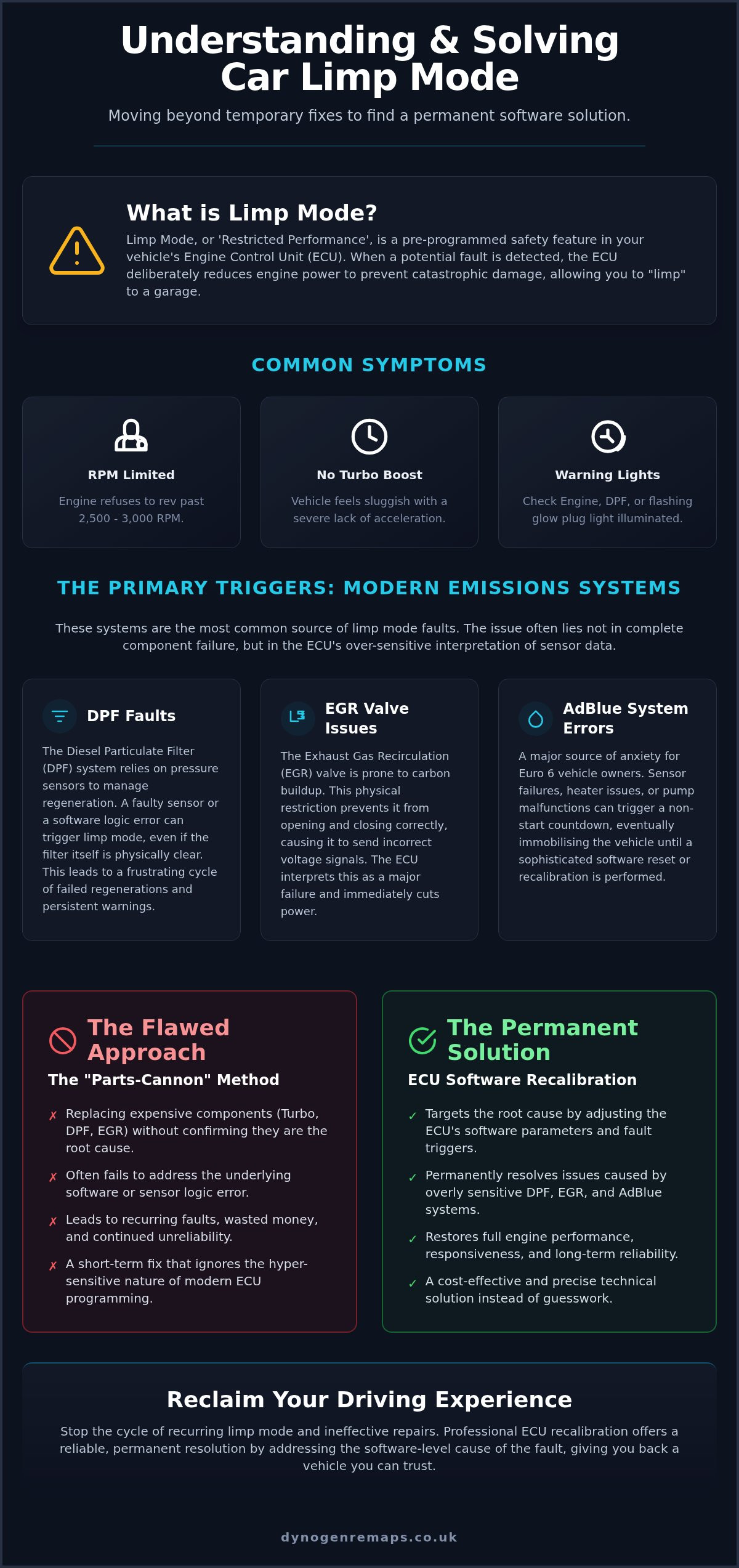
Limp home mode is a programmed software state designed by manufacturers to protect the mechanical integrity of your vehicle when the system detects a potential fault. Whilst it is intended to prevent catastrophic engine failure, it often manifests as a sudden, frustrating loss of power that can feel dangerous during motorway driving. When you attempt to Limp-home-mode, you’ll notice the Engine Control Unit (ECU) has significantly restricted the vehicle’s performance to avoid further stress on critical components. It’s a protective measure, but for many, it becomes a recurring nightmare that disrupts daily life.
To effectively stop car limp mode issues, you must first identify the specific symptoms that define this restricted state. Typically, the vehicle will refuse to rev beyond a certain limit, often capped at 2,500 or 3,000 RPM, and the turbocharger boost will be completely disabled. This lack of responsiveness is accompanied by various warning lights, signalling that the vehicle is no longer operating within its standard parameters. Many drivers experience the sheer frustration of an “intermittent” fault, where the car returns to normal after a simple restart, only for the power to vanish again minutes later as the sensor error re-triggers the safety logic.
The Role of the Engine Control Unit (ECU)
The ECU monitors hundreds of parameters simultaneously, from exhaust gas temperatures to fuel rail pressure, ensuring the engine operates at peak efficiency. When a sensor reports data that falls outside of pre-defined safety margins, the ECU logs a specific fault code and immediately triggers the restricted power state. This process is often overly sensitive; non-critical sensor errors can frequently force a perfectly healthy engine into a sluggish, unproductive state. The Engine Control Unit serves as the central brain of your vehicle, dictating engine behaviour based on a constant stream of sensor feedback.
Common Dashboard Triggers
Identifying the specific warning light is the first step in a professional diagnostic process. A solid “Check Engine” light is the most frequent indicator, but diesel owners must be particularly wary of the DPF warning symbol. If the Diesel Particulate Filter fails to regenerate, the ECU will eventually enforce a restricted state to prevent the filter from becoming completely blocked. Similarly, flashing glow plug lights often signal a fault within the emissions control system, such as a sticking EGR valve. Perhaps most stressful is the AdBlue non-start countdown, which provides a literal timer until the vehicle becomes immobilised, demanding a sophisticated software intervention to resolve the underlying logic error.
The Common Culprits: DPF, EGR, and AdBlue System Faults
Modern emissions control systems represent the single most common reason diesel vehicles enter a restricted power state. Whilst these components are integrated as a vehicle safety feature, their sensitivity often causes more disruption than protection for UK drivers. To effectively stop car limp mode issues, one must understand that the problem frequently lies in the software’s interpretation of sensor data rather than a total mechanical failure. These systems are designed with narrow tolerances; even a minor deviation can force the car into a sluggish, unproductive state.
DPF Warning Light and Software Logic
The Diesel Particulate Filter (DPF) is designed to capture soot, but it relies on a delicate balance of temperature and pressure to regenerate correctly. A common misconception amongst car owners is that every DPF warning requires a physical replacement or an expensive chemical clean. In reality, the ECU often enters limp mode because of a faulty pressure sensor or a software logic error that persists even after the filter is physically clear. This is why a professional DPF solution is frequently more reliable than a simple clean. It addresses the underlying software parameters that keep the vehicle in a fault state. Without recalibrating these parameters, the cycle of failed regenerations often leads to a permanent, non-resettable limp mode.
EGR Valve and AdBlue Faults
Exhaust Gas Recirculation (EGR) valves are prone to heavy carbon buildup, which physically restricts the valve’s movement. This mechanical resistance sends incorrect voltage signals back to the ECU, which interprets the discrepancy as a major system failure and immediately cuts turbo boost. AdBlue systems have become an even greater pain point for owners of newer Euro 6 vehicles. These systems utilise fragile NOx sensors and heaters that are notoriously prone to failure, often triggering a restrictive warning light or the dreaded “non-start” countdown.
This countdown is a unique software logic that actively threatens to immobilise the vehicle entirely once a set mileage is reached. It’s often triggered by a sensor reading that is only marginally outside of specifications. Professional AdBlue solutions resolve this by recalibrating how the ECU interprets these signals, preventing the countdown from ever reaching zero. If you’re facing a restrictive warning light, a specialist software recalibration can provide a more permanent, cost-effective fix than the standard “parts-cannon” approach of dealership repairs.
Why Traditional Mechanical Repairs Often Fail to Stop Limp Mode
Many vehicle owners encounter a frustrating cycle where their local garage repeatedly replaces sensors, valves, and filters without lasting success. This “parts-cannon” approach relies on the hope that swapping expensive hardware will eventually resolve the underlying fault. However, to truly stop car limp mode issues, you must recognise that the mechanical component is often only half of the equation. If the ECU’s internal logic remains stuck in a fault-state or is reacting to “ghost codes” from an oversensitive sensor, no amount of new hardware will restore your vehicle’s performance. Precision software recalibration is the only way to ensure the ECU accepts the new operating parameters and remains out of its restricted state.
The Limitations of Standard Garage Diagnostics
Standard diagnostic tools used by general garages often provide a surface-level overview of stored fault codes. Whilst a simple deletion might clear the dashboard light for a few miles, it rarely addresses the root architectural cause. True resolution requires a specialist who understands the complex relationship between hardware signals and software response. Many general repair centres lack the advanced equipment required for technical remapping, meaning they can’t access the deeper layers of the ECU where the real problems reside. By choosing a specialist who understands ECU remapping benefits, you ensure that the diagnostic process goes beyond just reading a code. It involves a methodical analysis of how the software dictates vehicle behaviour under specific load conditions, ensuring a permanent fix rather than a temporary band-aid.
The Cost Efficiency of Software Solutions
Replacing a DPF or an EGR unit is a significant financial commitment, often costing thousands of pounds when specialised labour is factored in. The irony is that these brand-new components are frequently subjected to the same software-driven failures that compromised the original parts. A technical software solution offers a far more cost-effective and permanent alternative. Through professional car tuning, we can recalibrate the ECU to ignore false triggers from problematic sensors that are notorious for causing “safe mode” activation. This isn’t a generic, off-the-shelf fix; it’s a bespoke calibration tailored to your specific vehicle. It ensures long-term reliability by optimising the parameters that govern emissions and power delivery, effectively ending the cycle of ineffective and costly mechanical repairs once and for all.
How to Permanently Resolve Limp Mode Issues via Software Calibration
Whilst hardware replacements focus on the physical symptoms, technical remapping addresses the underlying logic that dictates vehicle behaviour. To effectively stop car limp mode issues, a specialist must recalibrate the specific parameters within the Engine Control Unit that trigger the restricted state. This is a sophisticated, precision-based process that requires a deep understanding of ECU architecture. It isn’t a simple “hack” or a bypass; it’s a professional reconfiguration that ensures the software and hardware work in harmony without triggering unnecessary safety protocols for non-critical errors.
The Technical Remapping Process
Resolving persistent faults requires a methodical approach that mirrors a professional diagnostic consultation. The process follows a structured sequence to ensure the fix is both accurate and permanent:
- Step 1: Perform a comprehensive diagnostic to identify the specific software trigger. We look beyond basic fault codes to understand the live data stream.
- Step 2: Extract the original ECU data for analysis. This allows us to see exactly how the factory software is reacting to sensor inputs.
- Step 3: Apply custom-calibrated software to resolve the specific DPF, EGR, or AdBlue fault. This involves adjusting the maps to prevent the ECU from entering safe mode for the identified issue.
- Step 4: Road test and verify that the vehicle is no longer restricted. We ensure that power delivery is smooth and that no further warning lights are triggered under load.
Restoring Performance and Drivability
Eliminating the fault is often just the beginning of the transformation. By choosing to implement performance software for cars, you can reclaim the driving experience that was lost to restrictive safety modes. A Stage 1 remap can be combined with your fault fix to significantly improve throttle response and overall engine efficiency. This results in a noticeable increase in torque and BHP, effectively “unlocking” the engine from its previously restricted state and providing a much smoother power band.
Professional remapping ensures the engine operates within safe mechanical limits whilst eliminating software glitches that cause intermittent power loss. This dual approach not only stops the immediate problem but also enhances the vehicle’s longevity by optimising fuel mixtures and boost pressures. If you’re ready to restore your vehicle’s true potential and eliminate the anxiety of sudden power loss, our experts can provide a bespoke software solution tailored to your specific engine requirements.
Dynogen Remapping: Expert Solutions for Persistent Engine Faults
With over 15 years of technical tuning experience, Dynogen Remapping Solutions stands as a premier authority for drivers who need to stop car limp mode issues permanently. We’ve witnessed the evolution of automotive software from its early stages to the highly complex ECU architectures of 2026. This long-standing expertise allows us to offer a level of precision that standard corporate dealerships simply cannot match. Whilst a main dealer is often restricted by rigid manufacturer protocols that favour hardware replacement, we provide bespoke software modifications that target the root cause of engine restrictions.
Our Specialist Approach to Emissions Faults
We handle DPF, EGR, and AdBlue software solutions with meticulous attention to detail, ensuring that every calibration is custom-built for your specific vehicle. Our technicians utilise advanced diagnostic equipment to probe deeper than surface-level fault codes, identifying exactly why your ECU is triggering a restricted state. This commitment to technical excellence ensures that our modifications don’t just clear a light but restore long-term vehicle reliability. We take immense pride in our workmanship, providing reliable car remapping UK wide for owners who demand perfection in their vehicle’s performance.
Book Your Technical Diagnostic Today
Don’t allow your driving experience to be dictated by oversensitive sensors and recurring dashboard warnings. The cycle of expensive mechanical repairs and “limp home” events is both frustrating and unnecessary when a sophisticated software solution is available. By choosing a seasoned specialist, you’re opting for a superior, personalised alternative to the “parts-cannon” approach common in general garages. We invite you to reclaim the smoothness, power, and reliability of your vehicle through our elite technical services.
Contact Dynogen Remapping Solutions to fix your limp mode issues permanently. Our expert team is ready to provide a bespoke quote and a clear path toward restoring your vehicle’s true potential. Whether you’re dealing with a persistent DPF fault or a restrictive AdBlue countdown, we have the specialised knowledge and advanced equipment required to solve your complex mechanical problems once and for all. Let us help you stop car limp mode issues and rediscover the passion for the road.
Reclaim Your Vehicle’s True Performance
Navigating the complexities of modern engine management requires more than just swapping sensors; it demands a deep understanding of ECU architecture and software logic. We’ve explored how emissions-related faults in DPF, EGR, and AdBlue systems are often the primary triggers for restricted power states. By choosing a technical recalibration over the traditional “parts-cannon” approach, you ensure a permanent resolution that restores both reliability and driving pleasure. It’s time to stop car limp mode issues and move past the frustration of recurring dashboard warnings.
Utilising over 15 years of specialist tuning expertise and advanced technical software diagnostics, we provide a superior alternative to standard dealership options. Our national UK service covers all car and van makes, ensuring that expert help is accessible regardless of your location. Don’t let your vehicle remain in a sluggish, unproductive state when a sophisticated solution is within reach. Get a Professional Software Solution for Limp Mode at Dynogen Remapping and rediscover the smoothness and responsiveness your engine was designed to deliver. Your journey back to peak performance starts with a single specialist consultation.
Frequently Asked Questions
What exactly is car limp mode and is it safe to drive?
Car limp mode is a programmed safety state within the Engine Control Unit (ECU) designed to protect the engine from catastrophic damage. Whilst it allows you to limp home or reach a specialist garage, it’s not intended for regular driving. If you find yourself unable to drive safely, you can read more about how recovery specialists like Dependable Towing & Recovery Services help motorists in need. Operating a vehicle in this state for extended periods can cause secondary issues, such as soot buildup in the DPF. It’s essential to identify the underlying trigger to stop car limp mode issues before they escalate.
Yes, a bespoke software remap can resolve a vehicle currently stuck in limp mode if the trigger is related to emissions sensors or ECU logic. We perform a comprehensive diagnostic to identify the specific software trigger before applying a custom-calibrated solution. This process reconfigures the parameters within the ECU, effectively clearing the fault and restoring full engine performance without the need for expensive hardware replacements. Our goal is always a permanent, technically sound resolution.
Will a software solution for DPF or EGR issues pass an MOT?
Since February 2014, any vehicle with a removed or tampered Diesel Particulate Filter will fail its MOT inspection. Whilst a software-based DPF Solution or EGR Solution isn’t always visible during a standard test, driving on public roads with a tampered emissions system is illegal in the UK. We advise all clients to verify current MOT regulations and ensure their vehicle remains compliant with road traffic laws regarding emissions hardware. Accuracy and legal compliance remain paramount for every vehicle owner.
How long does a technical remapping service take to perform?
A professional technical remapping service typically takes between one and three hours to complete. This duration allows our specialists to perform a full diagnostic scan, extract the original ECU data, and apply a bespoke calibration tailored to your vehicle’s specific needs. We also include a road test to verify that the fault is permanently resolved and that the engine is performing correctly under real-world driving conditions. This methodical approach ensures high-quality results every time.
Why does my car keep going into limp mode after I restart it?
Restarting your car clears the temporary active fault from the ECU’s immediate memory, which often restores power momentarily. However, as soon as the engine reaches a specific temperature or load, the sensors re-detect the underlying error and trigger the safety state again. This cycle confirms that the fault is persistent and requires a technical software intervention rather than a simple dashboard reset to stop car limp mode issues once and for all. Persistence indicates a deeper logic error.
Is limp mode always caused by a mechanical failure?
Limp mode isn’t always indicative of a physical mechanical failure. In many modern vehicles, the ECU enters a restricted state due to over-sensitive software parameters or ghost codes from faulty sensors. These software-driven overreactions can occur even when the engine’s core components are perfectly healthy. Technical remapping allows us to adjust these tolerances, ensuring the vehicle only enters a protective state for genuine, critical mechanical risks. We focus on precision to avoid unnecessary power restrictions.
Can an AdBlue fault trigger limp mode even if the tank is full?
An AdBlue fault can absolutely trigger limp mode even if your tank is completely full. The system relies on a complex network of NOx sensors, heaters, and pumps that frequently fail due to crystallisation or electrical errors. These faults often trigger a non-start countdown that will eventually immobilise the vehicle entirely. A specialist software solution can resolve these logic errors, preventing the countdown from reaching zero and restoring full drivability. Our advanced equipment identifies the exact sensor causing the disruption.
What is the difference between a fault code delete and a custom remap?
A simple fault code delete merely hides the dashboard warning light without addressing the reason the code was logged. In contrast, a custom remap involves a deep reconfiguration of the ECU’s architecture to resolve the underlying logic error. By choosing a professional remapping service, you’re implementing a permanent fix that adjusts how the engine manages sensor data, rather than just masking a symptom that will inevitably return. True technical excellence requires addressing the root cause of the fault.