

Have you ever wondered why your vehicle, which feels perfectly capable on the daily commute, suddenly becomes sluggish and unrefined the moment you hitch up a caravan or horsebox? It’s a common frustration for many UK drivers who find themselves constantly shifting gears on motorway inclines or watching the fuel gauge drop at an alarming rate whilst under load. Professional remapping for towing power addresses these issues directly by recalibrating your engine’s ECU to prioritise low-end torque and mid-range responsiveness.
You’re likely tired of that anxious feeling when overtaking or the sense that your engine is working far harder than it should. By shifting the torque curve lower in the rev range, we can significantly reduce mechanical stress and improve driveability. In this guide, we’ll explore how a Stage 1 Performance Remap or an Economy Remap can transform your vehicle into a more capable, efficient, and confident towing machine. You’ll discover how custom software calibration provides the pulling power you need without compromising your engine’s long-term reliability.
Key Takeaways
- Understand why low-end torque is the essential “twisting force” required for heavy hauling and why it is far more critical than peak horsepower for towing stability.
- Learn how professional remapping for towing power recalibrates fuel injection and timing to provide smoother acceleration and fewer gear changes on steep motorway inclines.
- Discover how custom software calibrations protect your drivetrain by delivering significant performance gains whilst staying within the safe mechanical tolerances of your clutch and gearbox.
- Compare the specific benefits of a Stage 1 Performance Remap for maximum pulling capability against an Economy Remap for reducing fuel consumption whilst under load.
- Explore the technical precision behind custom-calibrated ECU software and why bespoke maps outperform generic alternatives for maintaining long-term vehicle reliability.
Understanding the Science of Towing Power: Torque vs Horsepower
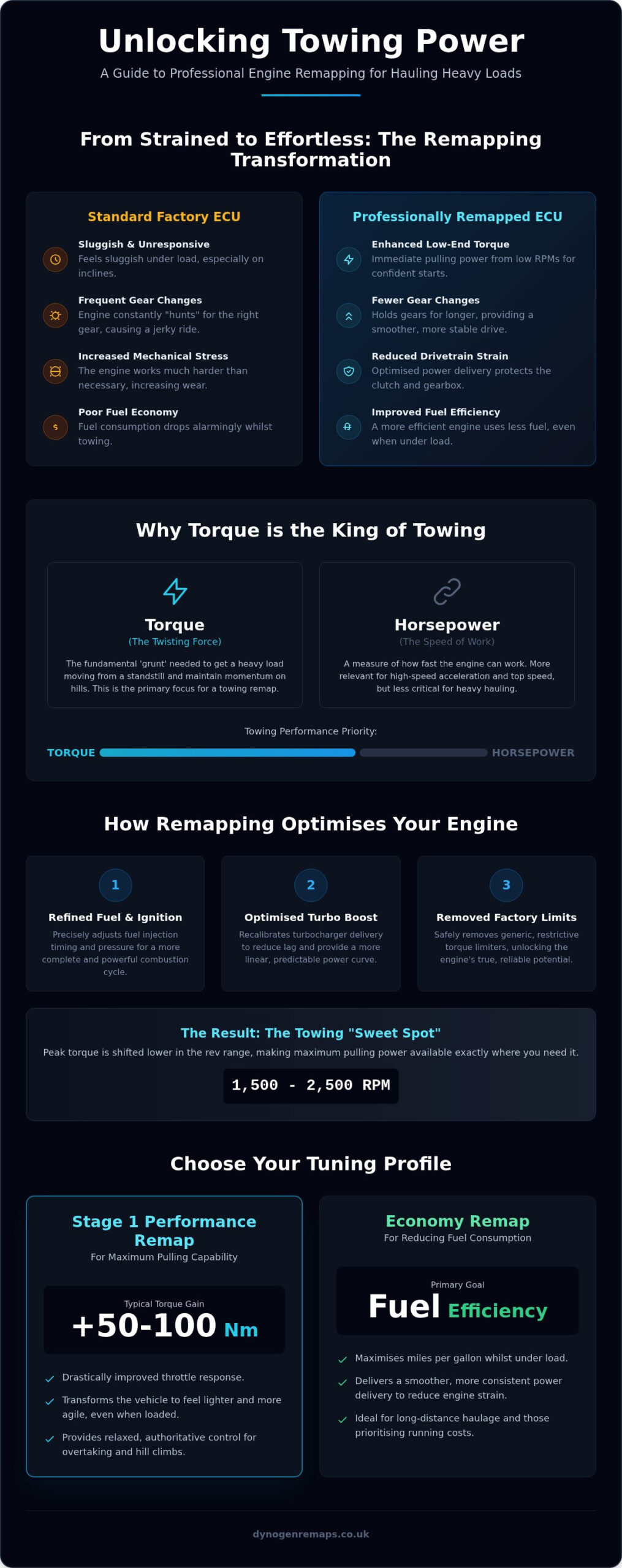
When you’re pulling a heavy caravan or a fully loaded commercial trailer, the figures on your vehicle’s spec sheet can be misleading. Many drivers focus on peak horsepower, yet horsepower is primarily a measure of how fast your engine can perform work at high speeds. In the context of hauling several tonnes, torque is the far more critical metric. Torque is the fundamental twisting force that allows your vehicle to overcome inertia and get a heavy load moving from a standstill. It represents the “grunt” of the engine, providing the mechanical leverage needed to maintain momentum against gravity and wind resistance.
A vehicle lacking sufficient low-end torque will quickly reveal its limitations through frequent, frustrating downshifting on motorway inclines. You’ll notice the engine hunting for gears as it struggles to maintain a constant speed, often resulting in a jerky driving experience and increased mechanical wear. Effective remapping for towing power identifies the “towing sweet spot,” which is the specific RPM range where torque is at its peak. By optimising this range, typically between 1,500 and 2,500 RPM for modern diesel engines, we ensure that the power is available exactly where you need it most during a haul.
Why Standard Factory Maps Often Struggle
Manufacturers develop factory ECU settings as a compromise to suit a global market. These standard maps must account for poor fuel grades in developing nations, extreme temperature variations, and strict global emissions categories. Consequently, factory software often includes restrictive torque limiters that artificially suppress the engine’s true capability. This leaves a significant margin of “hidden” power on the table. Professional recalibration removes these generic constraints, allowing the engine to operate with the precision and efficiency it was originally designed for whilst remaining within safe mechanical tolerances.
The Role of the Turbocharger in Pulling Power
The turbocharger is the heart of a modern diesel’s pulling capability. Our remapping process adjusts turbo boost delivery to ensure a more immediate and linear response. By reducing “turbo lag,” we make pulling away from busy junctions or navigating roundabouts with a trailer significantly safer and more predictable. This sophisticated adjustment of the air-fuel ratio ensures that the engine maintains sustained pulling power without over-fuelling, which protects your internal components and maintains optimal thermal efficiency throughout the climb.
How ECU Remapping Optimises Low-End Torque for Heavy Loads
ECU remapping involves a sophisticated recalibration of the software that governs your engine’s behaviour. For towing applications, we focus heavily on fuel injection timing and rail pressure. By advancing the timing and precisely increasing pressure, we ensure a more efficient combustion cycle. This technical adjustment results in a significant boost to low-end torque, providing the necessary grunt to pull heavy loads without the engine feeling strained. It’s a process of refinement that replaces generic factory settings with a map tailored for real-world demands; for high-quality software solutions, EcuFilesMarket provides professional Stage 1 and Stage 2 tuning files.
Many factory maps suffer from noticeable flat spots or dead zones in the power delivery. These are often the result of generic tuning designed to meet broad global standards rather than specific performance needs. Our custom calibrations smooth out these inconsistencies, delivering a linear and predictable surge of power. This creates a much wider power band, allowing the driver to select and hold gears more effectively. This is particularly vital when navigating rolling hills or merging onto motorways with a heavy trailer in tow.
Stage 1 Performance Remapping for Towers
A Stage 1 performance remap is widely considered the gold standard for those seeking enhanced towing capabilities. Whilst peak BHP increases, the real benefit lies in the substantial torque gains. On a typical turbo diesel engine, this can add between 50 and 100 Nm of torque, depending on the specific vehicle model. This enhancement drastically improves throttle response, making the vehicle feel significantly lighter even when fully loaded. It transforms the driving experience from one of constant effort to one of relaxed, authoritative control.
Optimising the Torque Curve
The goal of remapping for towing power is to shift the peak torque curve further down the RPM range. Instead of having to rev the engine high to find pulling power, you’ll find it’s available much earlier. This allows your vehicle to hold higher gears on steep inclines, reducing the need for constant downshifting. When an engine isn’t labouring at inappropriate revs, mechanical stress is reduced and fuel efficiency is often improved under load. If you’re ready to experience this level of precision, you can view our performance tuning options to see what your vehicle is capable of achieving.
Balancing Performance with Reliability: Drivetrain and Clutch Considerations
One of the most frequent questions we encounter is whether increasing an engine’s output will lead to mechanical failure. It’s a valid concern, especially when the vehicle is subjected to the additional strain of a heavy trailer or caravan. Professional remapping for towing power is not about chasing the highest possible numbers; it is about working within the specific mechanical tolerances established by the vehicle’s engineers. We prioritise a balanced approach that enhances capability whilst preserving the longevity of the engine and drivetrain components. By respecting these limits, we ensure that the added performance feels like a factory upgrade rather than an aftermarket compromise.
Protecting the Transmission and Clutch
Generic tuning boxes often trick the ECU into over-fuelling, which can lead to unpredictable torque spikes that punish the clutch and gearbox. In contrast, custom-calibrated software allows for precise control over how torque is delivered throughout the rev range. This is particularly vital for manual vehicles, where an aggressive low-end surge could cause premature clutch slip. For automatic and dual-clutch transmissions, we ensure the torque remains within the gearbox’s rated limit, preventing internal wear or overheating. Investing in safe engine remapping ensures that your vehicle remains a reliable tool for years to come, providing confidence that your drivetrain can handle the extra work without protest.
Maintaining Emissions Systems Whilst Towing
Towing puts significant load on an engine, which naturally increases the production of soot. If an engine map is poorly calibrated, this soot quickly clogs the Diesel Particulate Filter (DPF) and leads to Exhaust Gas Recirculation (EGR) valve failure. A clean, efficient map ensures a more complete burn of fuel, which actually helps prevent premature carbon buildup. We also monitor Exhaust Gas Temperatures (EGTs) during the calibration process to ensure the cooling system can manage the increased thermal load. By maintaining optimal air-fuel ratios, we provide the power you need without compromising the sensitive emissions hardware that keeps your vehicle road-legal. For those using vehicles exclusively for heavy hauling in off-road environments, we can also discuss specific DPF delete software solutions and UK regulations to maintain maximum operational uptime.
Choosing the Right Tuning Profile: Economy, Performance, or Hybrid?
Selecting the ideal calibration is a strategic decision that depends entirely on your vehicle’s primary duty cycle and the specific loads you intend to haul. For high-mileage drivers who spend significant time on the motorway with a trailer, an Economy Remap is often the most logical investment. This profile focuses on optimising fuel atomisation and combustion efficiency, which can lead to real-world improvements in MPG of between 5% and 15% whilst under load. By increasing torque at lower RPMs, the engine doesn’t have to work as hard to maintain cruising speeds, resulting in a more relaxed and cost-effective journey.
If your priority is raw pulling power for heavy plant trailers or navigating steep, technical terrain, a Stage 1 Performance profile is the superior choice. This calibration unlocks the engine’s full potential, often adding between 50 and 100 Nm of torque. For most users, a “Hybrid” approach provides the best of both worlds, blending the fuel-saving characteristics of an economy map with the responsive grunt of a performance tune. When deciding, consider your typical towing weight; a light caravan might only require a hybrid map, whereas a 3.5-tonne horsebox or plant trailer will benefit significantly more from a dedicated performance-based remapping for towing power.
Towing for Business: Van and Fleet Considerations
Commercial operators face unique challenges, where fuel costs and driver fatigue directly impact the bottom line. Professional van remapping for better MPG is an essential tool for fleet managers looking to reduce overheads. Beyond the financial savings, the improved driveability reduces the physical demand on drivers. A van that isn’t constantly hunting for gears is easier to manage in heavy traffic, leading to a more alert and safer workforce. The return on investment for a commercial towing fleet is often realised within months through reduced fuel spend and lower mechanical maintenance costs. Fleet operators running high-mileage vehicles such as the Transit can see these benefits in detail through our Ford Transit economy remap case study, which analyses real-world fuel efficiency gains and ROI for the 2.0-litre EcoBlue engine under load.
The Caravaner’s Choice: Performance and Overtaking Safety
For many caravanists, the primary motivation for remapping isn’t just speed; it’s the psychological comfort of overtaking safety. Having a reserve of power allows for shorter, more decisive overtakes on single-carriageway roads, which is vital when pulling a long, wind-sensitive load. A custom map eliminates the “tug” and “lurch” associated with sudden downshifts, replacing it with a smooth, linear surge of power. This creates a far more enjoyable driving experience, turning a stressful haul into a confident journey. If you want to see how a bespoke calibration can improve your next trip, you can request a custom quote for your vehicle today.
The Dynogen Approach to Professional Towing Remaps
At Dynogen Remapping Solutions, we approach every project with a meticulous attention to detail that only comes from over 15 years of industry-leading experience. Our methodology begins with a comprehensive diagnostic health check. We use advanced diagnostic equipment to ensure your engine is in peak condition before any software modifications occur. This professional stance ensures that remapping for towing power remains a safe and effective enhancement. Whether you are a private car owner looking to pull a caravan or a commercial van operator managing a heavy fleet, our tailored solutions provide the precision required for demanding UK road conditions.
Our specialists take pride in delivering results that exceed expectations. We don’t believe in generic, one-size-fits-all solutions. Instead, we focus on the unique mechanical health of your specific vehicle. By understanding the history and current state of the engine, we can calibrate a map that offers superior responsiveness and longevity. This commitment to technical excellence is what sets us apart from standard dealership options, providing a personalised service that respects the driver’s needs and the vehicle’s integrity.
This appreciation for automotive detail often extends beyond the workshop; for those who collect vehicle replicas, Diecast Cartel offers a premium selection of scale model cars, trucks, and tractors that mirror the variety of vehicles we work on every day.
Custom Calibration vs Generic Software
Your vehicle deserves a software profile that respects its specific mileage and wear patterns. Many cheap tuning devices rely on “canned” or generic maps that apply the same settings to every car of a certain model. These can be dangerous; they often ignore the subtle differences in engine health, leading to excessive heat or mechanical strain. We ensure every calibration is a reliable car remapping solution by writing the code specifically for your ECU. This bespoke approach eliminates the risks associated with inferior software and guarantees a smoother, more refined power delivery whilst hauling heavy loads.
Getting Started with Your Towing Upgrade
Initiating your vehicle’s transformation is a straightforward, consultative process. To provide an accurate quote and performance estimate, we simply require your vehicle registration, current mileage, and a clear understanding of your towing goals. During the appointment, our technician will handle the software installation with surgical precision, typically completing the process within a few hours. The difference is noticeable the moment you leave our centre. You’ll experience an immediate improvement in throttle response and a sense of effortless pulling power that completely redefines your vehicle’s capability.
Transform Your Vehicle’s Towing Capability
We’ve explored how shifting the engine’s focus from peak horsepower to low-end torque provides the essential “grunt” needed for heavy hauling. By prioritising the “towing sweet spot” between 1,500 and 2,500 RPM, you gain a vehicle that holds higher gears on motorway inclines and handles overtakes with absolute confidence. Professional remapping for towing power isn’t just about speed; it’s a strategic recalibration that reduces mechanical stress and improves real-world fuel efficiency whilst under load.
Dynogen brings over 15 years of expert vehicle tuning experience to every project, specialising in custom-calibrated software for both private cars and commercial vans across the UK. Our specialists focus on a precise balance of performance, economy, and long-term reliability to ensure your drivetrain remains protected. Don’t settle for a sluggish or strained driving experience when a bespoke solution is within reach. You can book your custom towing remap with Dynogen today to experience a more refined and capable vehicle on your next journey. We’re ready to help you unlock your engine’s true pulling potential.
Frequently Asked Questions
Will remapping for towing power void my vehicle’s warranty?
ECU recalibration will likely void the manufacturer’s warranty on engine and drivetrain components as most brands consider software modification a breach of terms. However, many owners of out-of-warranty vehicles find the performance enhancements far outweigh the loss of a factory guarantee. You should always review your specific policy details before proceeding with a custom software calibration to understand your current coverage levels.
Can a remap improve my fuel economy whilst I am actually towing a caravan?
Professional remapping for towing power often results in a 5-15% improvement in MPG under load. By increasing low-end torque, the engine maintains speed with less throttle input and fewer downshifts. This increased efficiency reduces the mechanical effort required to pull a caravan, leading to tangible savings at the fuel pump during long motorway journeys. It transforms a thirsty vehicle into an economical hauler.
Is remapping safe for an older vehicle with high mileage used for towing?
Remapping is safe for high-mileage vehicles provided the engine and drivetrain are in good mechanical health. We perform a comprehensive diagnostic check before every installation to identify any existing wear or technical issues. For older vehicles, we often recommend a more conservative calibration that prioritises reliability and smooth delivery over maximum peak power, ensuring the vehicle remains a dependable tool for hauling.
How much extra torque can I expect from a Stage 1 towing remap?
A Stage 1 calibration typically delivers a torque increase of 50-100 Nm on most modern turbo diesel engines. This significant boost provides the necessary leverage to get heavy loads moving effortlessly from a standstill. The exact gains depend on your vehicle’s specific make and model, but the result is always a more responsive and capable towing platform that feels lighter under load.
Do I need to inform my insurance company if I remap my car for towing?
You must inform your insurance provider about any ECU remap as it is considered a performance modification. Failure to declare the software update can invalidate your policy in the event of a claim. Most specialist insurers are familiar with remapping for towing power and can adjust your coverage to ensure you remain fully protected whilst pulling a caravan or heavy trailer on public roads.
Will my car pass its MOT after a performance remap for towing?
Your vehicle will pass its MOT provided the emissions control systems, such as the DPF and catalytic converter, remain intact and functional. Our performance calibrations are designed to work within legal emissions limits and do not involve tampering with factory hardware. As long as the mechanical emissions components are maintained, the software update will not cause an MOT failure or increased smoke levels.
Is there a difference between remapping a petrol or diesel vehicle for towing?
Diesel engines generally see more dramatic improvements because they rely heavily on turbocharging and high-pressure fuel systems to produce torque. Whilst turbocharged petrol engines also benefit from remapping, diesel units provide the superior low-end grunt required for heavy hauling. Our custom calibrations account for these fuel-specific combustion characteristics to ensure optimal torque delivery and thermal efficiency regardless of the engine type you use.
What happens if I am not happy with the results of the towing remap?
We prioritise customer satisfaction and will fine-tune the software if the initial results do not align with your specific towing requirements. Our specialists work closely with you to adjust the torque delivery and throttle response until the vehicle performs exactly as you need. This consultative process ensures you receive the most effective calibration for your unique driving style and hauling demands.