

Could the fix that stops an AdBlue countdown leave your vehicle unfit for the road? Searching for “AdBlue delete UK” advice after a warning appears is understandable, especially when a non-start message makes the problem feel urgent. But removing or tampering with the system isn’t a road-legal solution: a vehicle with a deleted AdBlue system must not be used on UK public roads.
A warning doesn’t identify which component has failed, and a software change can be difficult to distinguish from a proper diagnosis. Acting before the fault is understood could create further problems. Evidence of emissions-system tampering, or an emissions-related warning light, can also lead to an MOT failure. An undeclared modification may affect your insurance, so check with your insurer rather than assuming you’re covered.
This guide explains what an AdBlue delete involves, the UK road-use and MOT considerations, and why an emissions warning calls for diagnosis before decisions about work. It also covers practical questions to ask about the fault, the proposed solution and your options, so you can make an informed choice without compromising compliance.
Key Takeaways
- An AdBlue delete UK search usually refers to software changes intended to disable or bypass emissions controls. Before considering any proposed work, ask what it changes and whether the vehicle remains suitable for public-road use.
- An AdBlue warning or countdown doesn’t identify the failed component. Record the exact message and vehicle details, check the handbook and seek a proper diagnosis.
- SCR systems use AdBlue to help reduce nitrogen oxide emissions, but a warning can have different causes. Don’t assume that one fault code points to a particular repair.
- Ask for the proposed work and its scope in writing, including whether it repairs a fault or suppresses emissions-system monitoring.
- Before authorising a software change, check the MOT implications and tell your insurer about any material vehicle modification.
AdBlue delete UK: what drivers mean and why the search is urgent
A warning on the dashboard can quickly become a practical worry: will the vehicle keep running, or will a countdown prevent the next start? That pressure helps explain why drivers search for an AdBlue delete UK service. Before considering any software option, understand what “delete” means and why a warning alone is not a diagnosis.
AdBlue is a fluid used in compatible diesel vehicles with Selective Catalytic Reduction (SCR) systems to help reduce nitrogen oxide emissions. It is a type of Diesel Exhaust Fluid (DEF). A dashboard alert means the vehicle is reporting an issue or condition that needs attention, but it doesn’t necessarily identify the failed part.
What does an AdBlue delete involve?
An AdBlue delete generally means software changes intended to disable or bypass part of the vehicle’s emissions-control system. Such changes may suppress system monitoring or alter warning behaviour. That differs from diagnosing a fault and repairing the component responsible. A quieter dashboard doesn’t establish that the underlying problem has been fixed or that the vehicle remains suitable for UK road use.
This guide covers UK compliance and MOT considerations alongside diagnosis-first options. The aim is to help you understand the proposed work, what to ask before authorising it, and how to make an informed decision. It doesn’t provide instructions for altering or bypassing emissions controls.
Why do AdBlue faults trigger urgent searches?
A warning may come with a mileage or start countdown, creating concern about whether the vehicle will restart after it is switched off. The urgency is real, but similar messages can be associated with different underlying faults. A dashboard alert or fault code needs to be interpreted in context, not treated as proof that the system should be deleted.
A warning message identifies a problem, not necessarily its cause. Note the exact wording, any countdown and when the message appeared. Check the vehicle handbook for the manufacturer’s guidance, and seek qualified help if a non-start countdown is active. Don’t assume that suppressing an alert is the same as resolving the fault. Diagnosis gives you a clearer basis for discussing the options, the work’s scope and its implications before agreeing to anything.
How AdBlue and SCR work, and what can cause a warning
Understanding the system helps put a dashboard alert in context. Selective Catalytic Reduction (SCR) is an exhaust after-treatment process that uses AdBlue to help reduce nitrogen oxides (NOx) from compatible diesel vehicles. NOx is a group of pollutants produced during combustion. SCR treats exhaust as it passes through the system, rather than changing how the engine burns fuel.
What happens inside a selective catalytic reduction system?
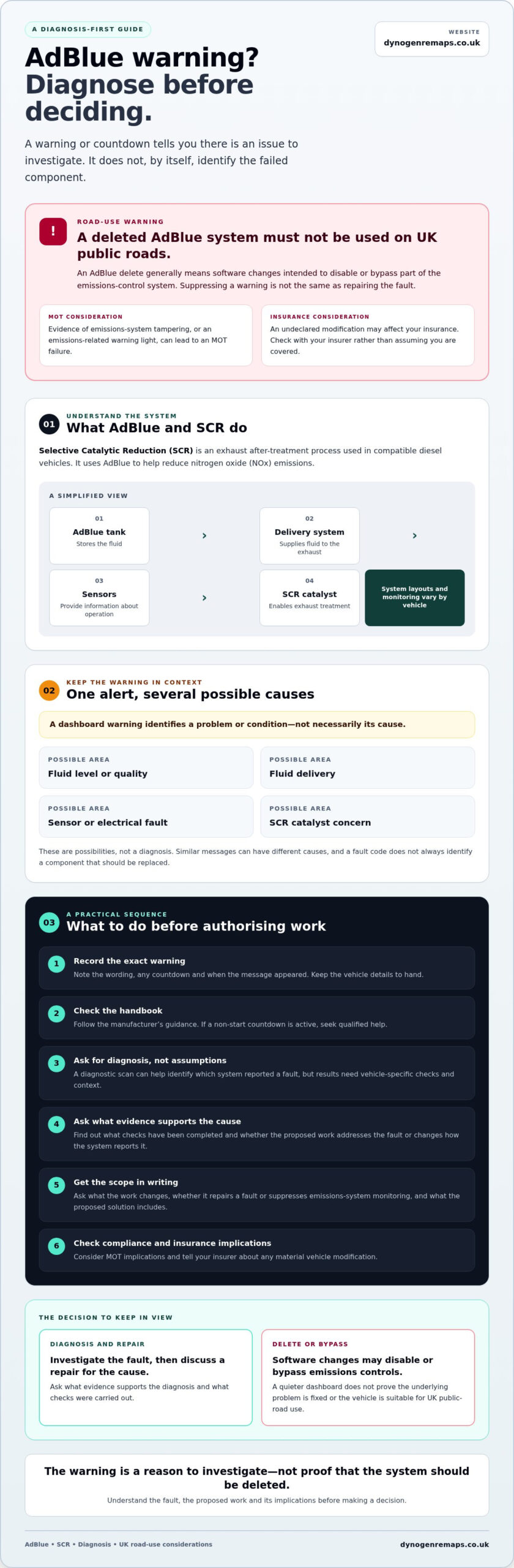
In broad terms, the AdBlue tank stores the fluid, and a delivery system supplies it to the exhaust. Sensors provide information about the system’s operation, while the SCR catalyst enables the exhaust treatment process. The engine or emissions-control system coordinates these parts, though layouts and monitoring arrangements vary by vehicle. That’s why a fault message needs to be interpreted for the specific vehicle, not against a generic parts list.
Which faults can produce an AdBlue warning or countdown?
Several fault categories may prompt an alert. These can include an issue with fluid level or quality, a problem with fluid delivery, a sensor or electrical fault, or a concern involving the SCR catalyst. These are possibilities, not a diagnosis. Similar dashboard messages can have different causes, and a fault code doesn’t always identify a component that should be replaced.
A diagnostic scan can help show which system has reported a fault, but the results need to be considered alongside vehicle-specific checks and the exact warning. Ask what evidence supports the proposed cause, what checks have been completed, and whether the recommendation addresses the fault or changes how the system reports it. Don’t authorise a parts replacement or software change based on the dashboard message alone.
For questions about roadworthiness, consult the relevant official guidance as well as a qualified professional. The GOV.UK MOT inspection manual on emissions sets out inspection guidance for testers. It provides useful context, but it doesn’t diagnose a particular vehicle’s fault.
If you’re considering the AdBlue delete UK options presented to you, ask how each proposal affects emissions-system operation and UK road use. Dynogen Remapping Solutions lists an AdBlue Solution. Clarify its scope and vehicle coverage directly, and ask which options are appropriate for your circumstances.
Is an AdBlue delete legal in the UK, and can the vehicle pass its MOT?
For a vehicle used on public roads, an AdBlue delete is not a lawful substitute for repairing its emissions controls. Regulation 61A of the Road Vehicles (Construction and Use) Regulations 1986 requires emissions-control equipment to remain effective. Disabling or tampering with a fitted AdBlue system can put the vehicle outside those requirements. Diagnosis and repair are different: they aim to address a problem while retaining the vehicle’s emissions controls.
What UK rules and MOT guidance should owners check?
The DVSA’s MOT inspection guidance covers emissions-control equipment. Testers may fail a vehicle if they find evidence that required equipment has been tampered with, or if an emissions-related warning light is illuminated. The official MOT inspection manual explains the relevant checks. A past MOT pass isn’t proof that a modified vehicle complies now, and no general guide can guarantee the result of an individual test.
Before authorising work described as an AdBlue delete UK solution, ask whether it disables emissions-system functions and whether the vehicle can still be used lawfully on public roads. The comparison below highlights the difference to clarify.
| Option | What it means | Questions to ask |
|---|---|---|
| Fault diagnosis and repair | Investigates the reported fault and addresses its cause while retaining emissions controls. | What checks support the diagnosis? What work is proposed, and how will the system operate afterwards? |
| Emissions-system deletion | Software changes disable or bypass part of the fitted emissions-control system. | Could this make the vehicle unsuitable for public-road use? How might the change affect MOT assessment and insurance? |
Could a delete affect insurance or vehicle resale?
Insurance is a separate consideration from MOT compliance. A vehicle modification may affect your policy terms, so tell your insurer what work is proposed and ask for confirmation of its effect on cover. Insurer disclosure doesn’t make an emissions-system delete road-legal or guarantee an MOT pass.
A buyer may also ask about warning history, modifications, invoices or evidence of work carried out. An undeclared or unclear change could raise questions about the vehicle’s condition and provenance, and may influence a buyer’s decision. Keep documentation and get the scope of proposed work in writing. If it isn’t clear whether the system is being repaired or suppressed, pause and ask for an explanation before agreeing to it.
AdBlue warning or non-start countdown: what to do
A countdown can make it tempting to approve the first suggested fix. Take time to record the details and understand the proposed work. A clear account of the warning and vehicle history gives a technician a stronger starting point than a dashboard message alone.
- Record the exact message. Note the wording, any countdown or mileage shown, the odometer reading and when the alert appeared. Include the vehicle’s make, model, year and engine details.
- Note recent changes. Record when AdBlue was last added, if known, and whether the warning appeared before or after a refill. Include changes in vehicle behaviour, such as reduced performance or difficulty starting.
- Check the handbook. Follow the manufacturer’s vehicle-specific guidance for the warning. Don’t rely on generic reset advice or repeatedly clear an alert without understanding its cause.
- Take a countdown seriously. If the message says the vehicle may not restart, seek qualified help promptly. Follow the handbook’s instructions and don’t continue driving against manufacturer guidance.
- Ask for an explained diagnosis. Request the fault-code findings and an explanation of what tests support the suspected cause before approving work.
Before authorising a repair or software work, ask the technician to set out the proposal in writing. Clarify whether it addresses a diagnosed fault or disables or suppresses a system function. Ask what the change means for UK road use, MOT assessment, any applicable warranty and your insurance. If the explanation doesn’t make that distinction clear, pause and ask for clarification.
Searching for an AdBlue delete UK option can bring up very different proposals. Don’t treat a warning light going out as proof that the original fault has been repaired. Ask what will change, what evidence supports the recommendation and whether the option is appropriate for how you use the vehicle.
For a considered discussion about your vehicle’s fault and the options available, discuss your AdBlue fault and available options. Confirm the scope of any proposed solution and its implications before deciding, particularly if you use the vehicle on public roads.
Choosing a responsible AdBlue specialist and your next steps
A responsible provider should explain what the available evidence shows, what remains uncertain and why a particular option is being suggested. Treat an unclear promise of a “permanent fix” as a reason to ask more questions, especially if the proposal involves changing vehicle software. Repairing a fault and suppressing emissions-system monitoring are not the same outcome.
How to assess an AdBlue diagnostic proposal
Before agreeing to work, ask the provider to explain the diagnosis in plain language and set out the proposed scope in writing. You should understand which checks support the suspected cause, what the work will change and what it won’t resolve. In particular, ask whether required emissions-control functions will remain in operation. Request a clear answer rather than relying on a general description such as “software solution”.
Use this checklist to guide the conversation:
- Evidence: What fault information or test results support the diagnosis? Could another cause explain the warning?
- Scope: Is the proposal to repair a fault, or to alter or suppress emissions-system monitoring? Ask for the distinction in writing.
- Use and compliance: What are the relevant UK road-use and MOT considerations for this vehicle? Don’t accept a guarantee of road legality or an MOT pass as a substitute for checking official guidance.
- Cover: Could the proposed modification affect a warranty or insurance policy? Confirm policy implications with the relevant provider or insurer.
These questions are especially useful when comparing results for AdBlue delete UK searches. A change that removes a warning from view doesn’t show, by itself, that the underlying fault has been repaired or that the vehicle is suitable for public-road use. If the answer about whether emissions controls remain active is evasive, pause before authorising the work.
What information to share before contacting a specialist
Prepare the vehicle’s make, model, year and engine details, along with the exact dashboard wording, any active countdown and a diagnostic report if you have one. Note relevant symptoms, recent repairs and when the warning first appeared. These details help frame a useful discussion, though they don’t replace vehicle-specific diagnosis.
Dynogen Remapping Solutions offers software solutions for AdBlue, DPF and EGR systems, alongside ECU remapping and performance and efficiency tuning for cars and vans. The company has over 15 years of vehicle-tuning experience. If you’re discussing an AdBlue Solution, clarify its scope, whether it is available for your vehicle and what it means for your intended use. Those details matter when deciding whether a proposal is appropriate.
When contacting a provider, share the warning and vehicle details, then ask for an explanation before authorising work. Make sure the proposed outcome and its implications are clear.
Make your next step an informed one
An AdBlue warning is a reason to establish what’s wrong, not assume a software delete is the answer. The key distinction is whether proposed work addresses a diagnosed fault or suppresses emissions-system monitoring. For a vehicle used on UK public roads, don’t treat an AdBlue delete UK service as a compliant repair. Check the relevant MOT guidance and discuss any modification with your insurer.
Before speaking to a specialist, have your vehicle details, exact dashboard message and any diagnostic findings ready. Ask for a clear explanation of the proposed work, its scope and its implications for your intended use. Dynogen Remapping Solutions provides software solutions for AdBlue, DPF and EGR systems, as well as ECU remapping and performance and efficiency tuning. Ask about the scope of its AdBlue Solution and what it means for your vehicle before deciding.
To discuss your vehicle’s warning and clarify the available options, contact Dynogen Remapping Solutions with your vehicle details and the exact dashboard message.
Frequently Asked Questions
Is an AdBlue delete legal in the UK?
An AdBlue delete isn’t a road-legal solution for a vehicle used on UK public roads: disabling or tampering with fitted emissions controls may breach requirements under Regulation 61A of the Road Vehicles (Construction and Use) Regulations 1986. The precise circumstances matter, so check current legislation and seek qualified advice. A fault repair aims to address a problem while retaining the emissions system; an AdBlue delete UK service disables or bypasses part of it.
Can a car with an AdBlue delete pass its MOT?
No general answer can guarantee whether a particular modified vehicle will pass or fail. MOT outcomes depend on the vehicle and current inspection requirements, which include checks on emissions-control equipment. Review the current DVSA MOT inspection manual and ask a qualified professional about your vehicle. A past MOT pass doesn’t establish that a modification complies with current requirements or will pass a future test.
What happens if an AdBlue delete is found on a UK vehicle?
Possible consequences include MOT difficulties, questions about whether the vehicle is suitable for public-road use, insurance complications or concerns from a future buyer. Outcomes depend on the circumstances, so don’t assume that every vehicle will face the same result. Check current official guidance and speak to your insurer about any modification. Keep records of work and ask a qualified professional to explain what has changed and what it means for your vehicle.
Can AdBlue software fix a fault without deleting the system?
It depends on the fault and what the proposed software change actually does. A diagnostic scan and vehicle-specific checks should inform the recommendation, rather than the dashboard message alone. Ask whether the work repairs the cause or changes system monitoring, and whether emissions-control functions remain active. Request the proposed scope and its road-use and compliance implications in writing before authorising work. A software change that suppresses a warning isn’t, by itself, proof of repair.
What causes an AdBlue non-start countdown?
Several AdBlue or SCR system faults may trigger a warning or countdown, depending on the vehicle. The displayed message alone doesn’t identify the failed component, so don’t assume a particular part needs replacing or that a software bypass is appropriate. Record the exact warning and vehicle details, consult the handbook for manufacturer guidance, and arrange vehicle-specific diagnosis. If a countdown is active, follow the handbook’s instructions and seek qualified help rather than relying on a generic reset.
Should I tell my insurer about an AdBlue system modification?
Yes. Contact your insurer and disclose the proposed or completed modification, then ask how it affects your policy. Insurance requirements and terms differ, so no general guide can promise cover or predict how a claim would be handled. Keep the insurer’s response for your records. This is separate from MOT compliance: telling your insurer doesn’t establish that the vehicle meets inspection requirements or is suitable for road use. Check the current DVSA guidance for MOT considerations.
What should I ask a garage about an AdBlue fault?
Ask what diagnostic evidence supports the suspected cause, what exact work is proposed and whether emissions-control functions will remain operational. Request a written explanation of relevant road-use and MOT implications, and contact your insurer if the work involves a modification. Clarify whether the recommendation repairs the underlying fault or changes how the system reports it. Clearing a warning code alone doesn’t prove that the cause has been identified or resolved.