

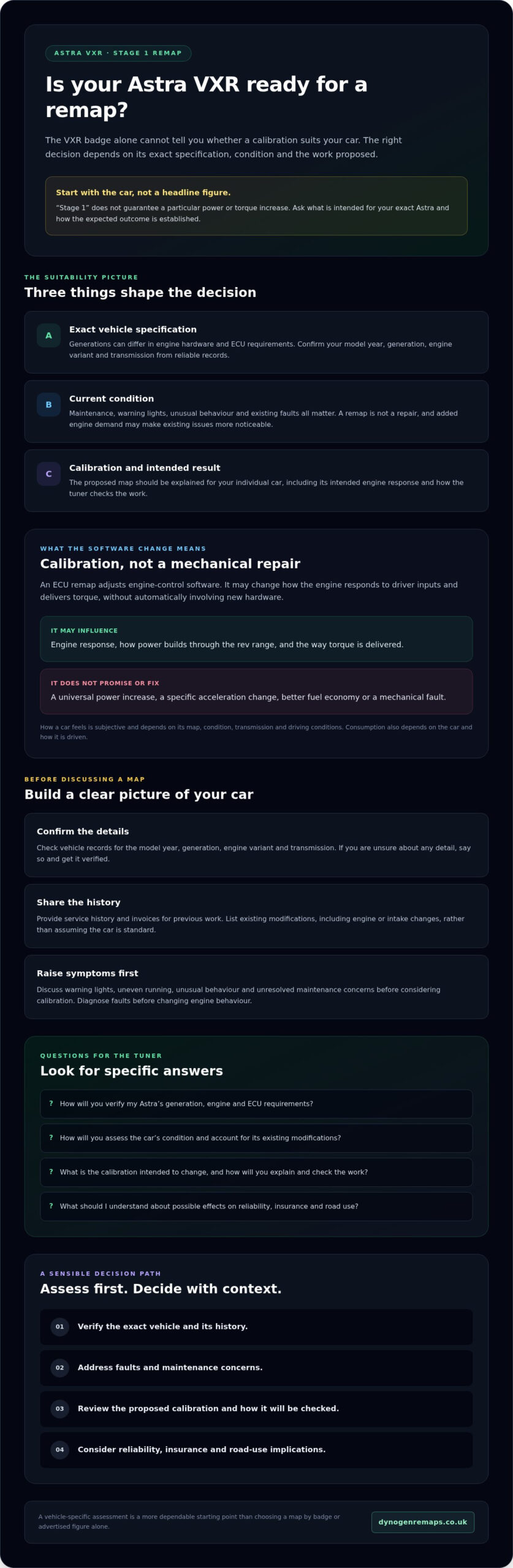
The VXR badge alone isn’t enough to tell you whether a Stage 1 remap is right for your car. Vauxhall Astra VXR tuning depends on the exact generation, engine and ECU, as well as the vehicle’s condition. A headline power figure may sound compelling, but it cannot show whether a calibration suits your individual Astra.
Before deciding, ask what a remap is intended to change and whether your car is ready for it. A vehicle-specific assessment can help set realistic expectations and identify mechanical concerns that should be addressed first.
This guide explains what a Stage 1 remap may alter, what it won’t repair or replace, and what to check before proceeding. You’ll also find questions to ask about the calibration, vehicle suitability and supporting requirements, so you can make a decision based on your car rather than the badge or a promising number.
Key Takeaways
- Use your vehicle records to confirm which Astra VXR you own, then share those details with a tuner before discussing a calibration.
- Judge Vauxhall Astra VXR tuning by how the proposed map suits your car and driving goals, not by headline figures alone.
- Ask how the tuner assesses suitability, explains its calibration approach and checks the work.
- Review your car’s maintenance and condition first. A remap won’t fix faults, and added engine demand may make existing issues more noticeable.
- Before proceeding, clarify potential effects on reliability, insurance and road use. Dynogen’s Stage 1 remap experience is one factor to consider as you research your options.
What does Vauxhall Astra VXR tuning involve, and is your car a candidate?
Vauxhall Astra VXR tuning through an ECU remap means adjusting the software calibration that governs how the engine operates. It doesn’t automatically involve fitting new parts. A suitable calibration may change how the engine responds to driver inputs, but the outcome depends on the car’s condition, specification and the work carried out. A headline figure alone can’t show whether a particular map is right for your Astra.
The VXR name identifies a performance model, not every technical detail beneath the bonnet. Generations can differ in engine hardware and ECU requirements, so don’t assume that advice or a calibration intended for one VXR will suit another. For background on the badge and its models, see Vauxhall’s VXR performance models, then verify your own car’s details using its records and a specialist assessment.
Which Astra VXR details should you identify first?
Before asking for tuning advice, confirm the model year, generation, engine variant and transmission using reliable vehicle records. Check the vehicle identification details, service history and invoices for previous work. Make a note of existing modifications, including engine or intake changes, rather than assuming the car is standard.
Share these details with the tuner before discussing a calibration. Similar-looking VXR models may have different hardware or ECU requirements, so the exact configuration should be verified rather than guessed. If you’re unsure about a detail, say so. A careful assessment starts by resolving uncertainty, not by promising a result.
What does a Stage 1 remap generally change?
A Stage 1 remap generally changes engine-control calibration, which can influence engine response and performance delivery. The parameters and intended behaviour depend on the vehicle and the tuner’s approach. “Stage 1” doesn’t guarantee a particular power or torque increase, so ask what is proposed for your exact car and how the expected outcome is established.
Software tuning is different from fitting hardware upgrades. If your Astra has already been modified, those parts may affect which calibration is suitable and could change the work involved. Tell the tuner what’s fitted before asking for a recommendation. For a broader explanation of the process, read the Stage 1 performance remapping guide.
Suitability also depends on condition. A remap isn’t a repair, and software can’t restore worn or faulty components. If the car has warning lights, unusual behaviour or unresolved maintenance concerns, raise them before considering a tune. A vehicle-specific assessment is a more dependable starting point than choosing a map from the VXR badge or an advertised figure alone.
How a Stage 1 remap can affect an Astra VXR’s response and performance
Engine calibration influences how the ECU manages the engine as you press the accelerator. Changes can affect how readily the engine responds and how it delivers torque, the pulling force you feel as the car accelerates. The aim and effect depend on the specific map, vehicle and driving conditions, so there’s no single result that applies to every VXR.
A Stage 1 remap is a software calibration adjustment intended to alter engine behaviour without automatically requiring hardware upgrades. It doesn’t promise a universal power increase or a particular change in acceleration. A tuner should explain what the calibration is designed to do for your vehicle rather than rely on a generic claim.
What may change in everyday driving after remapping?
Depending on the calibration, you may notice a different response to the accelerator or a change in how power builds through the rev range. Some drivers may describe the car as feeling more immediate or flexible, but those impressions are subjective. They don’t prove that a particular remap will deliver the same experience in another Astra, and they’re not a substitute for measured output.
Engine and transmission condition matter, too. A vehicle that runs consistently may feel different from one with an existing fault, while transmission behaviour can influence how changes in torque delivery feel on the road. Ask the tuner how they’ll assess your car and explain the intended driving characteristics. Don’t assume a performance-focused calibration will improve fuel economy. Consumption depends on the car and how it’s driven.
Why vehicle condition matters before tuning
Warning lights, uneven running or other symptoms should be investigated before calibration. A remap won’t repair a mechanical fault, and changing engine behaviour before diagnosing a problem can make it harder to identify what’s causing an issue. Review the service history, check that relevant maintenance is up to date, and share any concerns and previous modifications with the specialist.
For broader context on preparing a vehicle responsibly, read this safe engine remapping guide. If you’re considering hardware changes as well as Vauxhall Astra VXR tuning, consider their implications separately from the software work. GOV.UK explains requirements for structurally modified vehicles. Don’t assume that guidance means an ECU remap itself requires a DVLA notification. If you’re weighing up a Stage 1 Performance Remap, you can discuss your vehicle with Dynogen and ask what assessment would be appropriate.
How to compare Astra VXR tuning options and choose a remapper
A headline figure doesn’t tell you how a calibration was selected or whether it suits your Astra. When comparing Vauxhall Astra VXR tuning options, look at the process behind the offer. Does the remapper confirm your car’s specification, consider its condition and explain how results are assessed? A useful, vehicle-specific discussion should clarify what is proposed and what happens if checks uncover a concern.
| What to compare | Questions to ask | What a clear answer should explain |
|---|---|---|
| Diagnostics | How do you identify the vehicle specification and check for faults? | Which details and checks inform the suitability decision, and how existing diagnostic findings are handled. |
| Calibration approach | How is the map chosen for my exact Astra and its current condition? | Whether the recommendation accounts for the vehicle’s configuration and intended use, rather than relying on a generic promise. |
| Verification | How do you assess the outcome, and what records will I receive? | What is checked or measured, how any figures are obtained, and what information is documented. |
| Support and communication | What happens if the car is unsuitable or checks reveal an issue? | Whether the next steps and any limits are explained before work proceeds. |
What questions should you ask before booking?
Ask whether the proposed calibration is appropriate for your exact vehicle and its current condition. Clarify what checks take place before and after the remap, what records you’ll receive, and how the tuner handles unexpected diagnostic findings. A considered answer may be to postpone the work if the car needs attention first. That’s more useful than reassurance without an explanation.
How to judge performance figures and evidence
If a provider quotes power or torque figures, ask which vehicle specification they relate to and under what test conditions they were recorded. Find out whether the result was measured on your car, taken from another vehicle or offered as an estimate. These are not interchangeable: a result from another car may not reflect yours, while a projection isn’t a measured outcome.
Use figures as one part of the conversation, not as the decision itself. Ask how the proposed calibration fits your Astra’s condition and intended use. Clear communication about uncertainty is more useful than a number presented without context.
Also distinguish ECU calibration from modifications that alter the vehicle’s structure. If structural changes are involved, consult official government guidance on vehicle modifications. Don’t assume it applies directly to every remap. Choose a provider who can explain their process and limits in terms you can assess.
Will Astra VXR tuning affect reliability, insurance or road use?
A remap isn’t a repair, and no calibration can guarantee that an engine or drivetrain will remain reliable. Changing engine behaviour may place additional demand on components, making an existing fault or overdue maintenance more apparent. That doesn’t mean a remap will cause a failure, but the car’s condition matters. Vauxhall Astra VXR tuning should start with an honest assessment, not an assumption that software can compensate for a mechanical issue.
Before proceeding, check the car for symptoms such as warning lights, uneven running or unusual noises, and have concerns investigated. Ask the tuner why your vehicle is suitable, what the calibration is intended to do and what limits or conditions apply. If checks identify a problem, understand what needs resolving before considering a remap.
What can owners do to protect reliability?
Review the service history and address maintenance or diagnostic concerns before adding engine load. Give the tuner accurate details about previous work and modifications, then ask how they affect suitability. A considered recommendation may be to delay the work or not proceed. For more context on expected driving differences, read the Stage 1 versus standard driving comparison.
What should you check about insurance and warranty?
Contact your insurer before making changes. Describe the proposed remap and ask what must be disclosed, whether cover would change and how the insurer wants the modification recorded. Don’t rely on another driver’s experience, because policy terms and insurer requirements can differ.
Check the terms of any remaining manufacturer or third-party warranty, too. Ask the provider directly how an ECU remap could affect cover, including whether exclusions apply to particular faults or components. Don’t assume a remap preserves a warranty or that every warranty responds in the same way.
For road use, check current requirements with the relevant authority or a qualified adviser, particularly if other modifications are involved. The vehicle’s condition and the work carried out can affect which checks or obligations apply, so don’t rely on general online claims as a definitive answer. Clarify insurance, warranty and road-use questions before booking, not after the calibration is complete.
If you’re considering a Stage 1 Performance Remap, discuss your Astra’s suitability with Dynogen, including its condition, specification and intended use.
Choosing a Dynogen Astra VXR remap: assessment, process and next steps
A considered remapping decision starts with your specific car, not a promised figure. Dynogen Remapping Solutions offers a Stage 1 Performance Remap and has over 15 years of vehicle-tuning experience. This is useful context as you explore Vauxhall Astra VXR tuning, but it doesn’t confirm compatibility with every VXR specification or guarantee a particular outcome. Discuss your exact vehicle and its condition before seeking a recommendation.
What information should you have ready?
Gather the details that will help a specialist understand what you own and how you use it:
- Vehicle details: model year, generation, engine variant and transmission. Check your records if you’re unsure.
- Condition: mileage, relevant service history, warning lights, known faults or inconsistent running.
- Modifications: list changes to engine or exhaust hardware, including work carried out by previous owners.
- Your goals: explain how you’d like the car to feel, such as a different accelerator response or power delivery for your usual driving.
Be straightforward about anything uncertain. Accurate information gives the specialist a better basis for checking the vehicle specification and deciding whether remapping is appropriate to discuss.
What should a clear remapping consultation establish?
A useful conversation should clarify the vehicle’s identity and whether its current condition makes tuning a suitable option. Ask what Stage 1 work is proposed for your particular car, what checks or records are involved, and which driving characteristics the calibration aims to change. You should also understand any limitations, assumptions or reasons the work might be delayed or considered unsuitable.
Before agreeing to proceed, make sure the proposal is clear and that you’ve had the chance to raise questions about your car’s history and intended use. If a detail needs verifying, establish how it will be confirmed rather than relying on an assumption based on the VXR badge. Don’t take compatibility, results or warranty cover for granted without vehicle-specific confirmation.
Once you’ve gathered your vehicle details and clarified your goals, you can discuss a vehicle-specific remap with Dynogen. The conversation can help establish the relevant next steps for your Astra, without committing to a calibration before its specification and suitability have been considered.
Make your next remapping decision vehicle-specific
The right Stage 1 remap decision starts with the exact Astra VXR, not just its badge. Confirm the vehicle’s specification, condition and modifications, then compare tuners by the checks they perform and how clearly they explain their calibration. Headline figures alone can’t tell you whether a map suits your car or driving goals.
Remember, remapping isn’t a repair or a guarantee of reliability. Resolve existing concerns first, and check insurance and warranty terms with the relevant providers before proceeding. A careful assessment gives you a firmer basis for deciding whether Vauxhall Astra VXR tuning is appropriate for your vehicle.
Dynogen Remapping Solutions offers a Stage 1 Performance Remap and has over 15 years of vehicle-tuning experience. Share your Astra’s details and intended use to discuss whether a vehicle-specific remap may be suitable. Discuss a Stage 1 remap for your vehicle.
Frequently Asked Questions
Can every Vauxhall Astra VXR have a Stage 1 remap?
No. Suitability can’t be assumed from the VXR badge alone. It depends on the exact generation, engine, ECU, current condition and existing modifications. Before booking, confirm your vehicle details using reliable records and share them with a tuner. Ask them to verify the specification and assess whether a calibration is appropriate for your car. Compatibility and results shouldn’t be presumed without vehicle-specific confirmation.
How much power can a Vauxhall Astra VXR gain from tuning?
There’s no single gain that can be promised for every Astra VXR. Results depend on the vehicle’s specification and condition, the calibration and how output is measured. Ask whether quoted figures are estimates or measured results, and request the vehicle details and test conditions behind them. Evidence from another car may not reflect yours, so treat headline numbers as a starting point for questions, not a guaranteed outcome.
Is a Stage 1 remap safe for an Astra VXR?
A Stage 1 label alone can’t guarantee that a remap is suitable for your Astra. Suitability depends on the car’s condition, the calibration and the checks made before proceeding. Have warning lights, known faults or inconsistent running investigated first, then ask the tuner to explain the map’s limitations. Reliability also depends on maintenance and how the vehicle is used, not simply on a headline power claim or tuning stage.
Will remapping my Astra VXR affect my insurance?
Contact your insurer before arranging a remap and ask whether and how the modification must be declared. Don’t assume every policy treats remapping in the same way, or that cover and premiums will remain unchanged. Requirements and policy terms vary between insurers. Explain the proposed work clearly, ask how it affects your cover, and keep written confirmation so you can refer to the insurer’s response.
Can an Astra VXR Stage 1 remap improve fuel economy?
Fuel economy isn’t guaranteed by a performance-focused remap. Consumption can vary with driving style, journey type, vehicle condition and the calibration itself. For instance, frequent acceleration may affect fuel use differently from steady driving, regardless of the map. If economy is a priority, explain that to the tuner before discussing your options. Treat any estimate as specific to the vehicle and its use, not as a promise of savings.
What should I check before booking Vauxhall Astra VXR tuning?
Confirm your exact model, generation and engine, review the service history, and resolve warning lights or known faults before discussing a remap. Record existing engine or exhaust modifications so the tuner can assess the full specification. Ask what checks are made, how suitability is decided, what evidence supports quoted figures and what support is available afterwards. Before proceeding, also check your insurer’s requirements and the terms of any remaining warranty.