
The very system designed to keep your diesel engine clean is often the primary cause of its mechanical downfall. You’ve likely experienced the frustration of frequent, costly regenerations or the sudden loss of power that signals another trip to the garage. It’s a common struggle for UK drivers who find their vehicles trapped in limp mode because of a clogged filter, leading many to consider a dpf delete as a permanent solution. We understand that you want a reliable, responsive machine that doesn’t compromise on efficiency or performance.
This comprehensive guide explores the technical reality of software-driven recalibration and how it can restore your engine’s original vigour. We’ll examine how these professional solutions eliminate dashboard errors and improve throttle response whilst providing a clear, no-nonsense look at the UK legal framework. You’ll gain a thorough understanding of the “off-road use only” distinction and the current MOT inspection protocols. By the end of this article, you’ll have the expert knowledge required to navigate these complex mechanical and regulatory challenges with total confidence.
Key Takeaways
- Identify the mechanical warning signs of a saturated filter, including the onset of “limp mode” and the persistent engine management lights that signal a critical system failure.
- Explore why a professional dpf delete requires bespoke ECU recalibration rather than generic software to ensure a seamless, error-free integration with your vehicle’s control module.
- Clarify the essential UK legal requirements and “off-road use only” distinctions to ensure you remain fully informed about current MOT visual inspection standards.
- Understand how advanced software solutions can restore lost fuel economy and sharpen throttle response, transforming your driving experience whilst protecting engine longevity.
- Recognise the importance of a meticulous diagnostic phase to accurately isolate sensor failures before implementing any permanent technical software adjustments.
What is a DPF Delete and Why Do Modern Diesels Need It?
Modern diesel engines rely on a complex ecosystem of sensors and filters to meet stringent environmental standards. At the heart of this system sits the Diesel particulate filter (DPF), a sophisticated ceramic component designed to capture and store exhaust soot. Whilst it performs a vital role in reducing visible smoke, it remains one of the most common points of mechanical failure for UK vehicle owners. A dpf delete is often sought as a definitive remedy when these components become irreversibly blocked, moving beyond temporary fixes to address the root of the software and hardware conflict.
The Role of the Diesel Particulate Filter
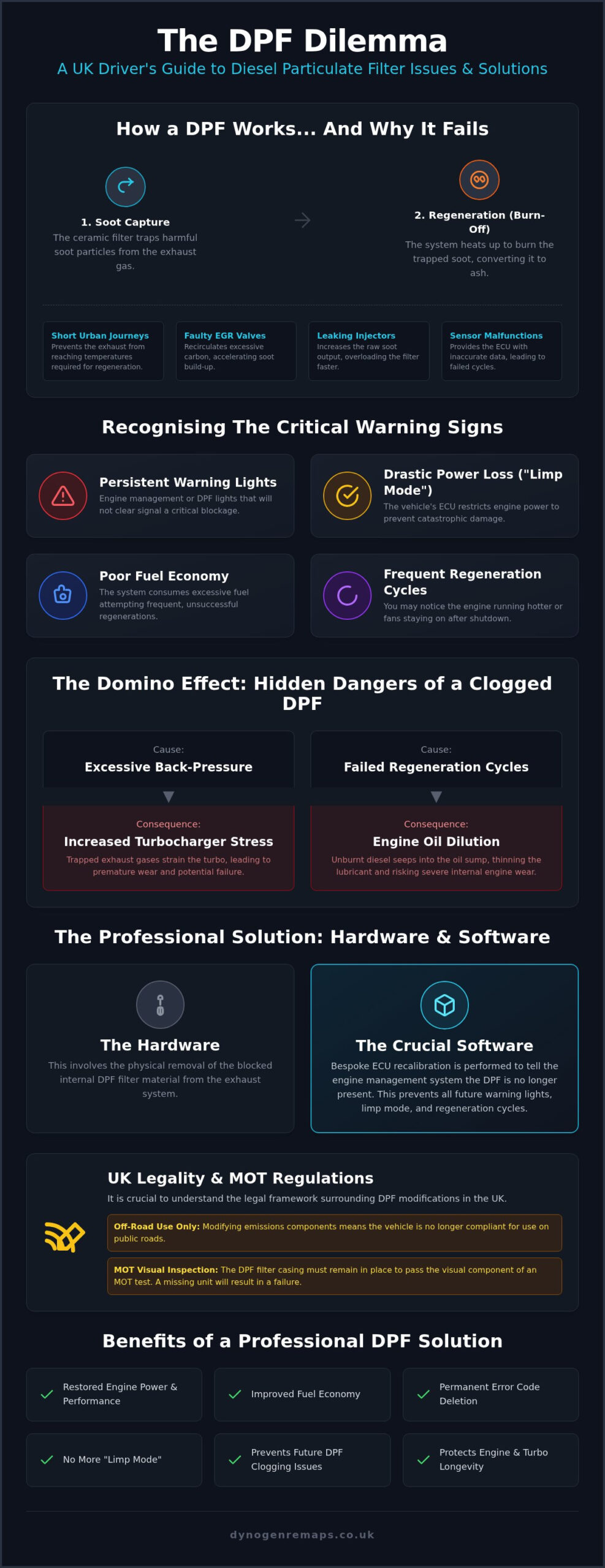
The DPF functions as a physical trap for particulate matter. As you drive, the engine’s ECU constantly monitors the pressure differential across the filter to determine how much soot has accumulated. When the load reaches a specific threshold, the vehicle attempts a “regeneration” to burn off the trapped particles. Passive regeneration occurs naturally during long motorway hauls where exhaust temperatures are high. Conversely, active regeneration involves the ECU injecting extra fuel to artificially raise temperatures. If these cycles are interrupted or fail to complete, the soot hardens into ash, eventually choking the engine’s ability to breathe.
Common Reasons for DPF System Failure
Most DPF issues stem from the mismatch between modern diesel technology and typical UK driving habits. Short urban journeys often prevent the exhaust from reaching the sustained temperatures required for a successful burn-off. This creates a cycle of failed regenerations that eventually forces the vehicle into a restricted power state. Other technical factors often accelerate this decline, including:
- Faulty EGR valves that recirculate excessive carbon into the intake.
- Leaking fuel injectors that increase the raw soot output.
- Sensor malfunctions that provide the ECU with inaccurate pressure data.
When these failures occur, the financial burden of dealership-level forced regenerations or full hardware replacement can be staggering. A professional dpf delete provides a permanent technical solution by recalibrating the engine management software. This process ensures the ECU no longer looks for the filter or triggers the regeneration cycle, effectively bypassing the hardware failure. It’s essential to distinguish between a physical removal and the sophisticated software bypass required to keep the dashboard free from permanent error codes and ensure the engine continues to operate smoothly.
Recognising the Symptoms of a Blocked DPF System
The dashboard warning light is rarely a suggestion; it’s a final warning from your vehicle’s management system. When the soot loading within the filter reaches a critical threshold, the Engine Control Unit (ECU) triggers a restricted performance state. You’ll notice an immediate drop in fuel economy as the system desperately attempts frequent, unsuccessful active regenerations. These failed cycles consume excessive diesel whilst providing no tangible benefit to the vehicle’s health.
The Dangers of Limp Mode
Limp mode operates as a protective protocol, yet it introduces significant safety risks on high-speed roads. By severely limiting boost pressure and fuel injection, the ECU ensures the engine cannot generate the heat or pressure required to cause a catastrophic filter fire. However, losing power whilst overtaking or merging onto a motorway creates an immediate hazard. Simply clearing the diagnostic trouble codes (DTCs) with a handheld scanner is a temporary fix; it doesn’t address the physical blockage. Without a permanent dpf delete or professional intervention, the vehicle will inevitably return to this restricted state within miles of driving. Understanding how to stop car limp mode issues through specialist software recalibration is essential before the problem escalates into a more serious mechanical failure.
Secondary Mechanical Issues Caused by DPF Clogs
Beyond the obvious loss of power, a choked filter initiates a cascading series of mechanical failures that many owners overlook. One of the most severe consequences is oil dilution. During failed regeneration attempts, the ECU injects additional fuel late in the combustion cycle. If this fuel doesn’t burn off, it can seep past the piston rings and into the oil sump. This thins the lubricant, significantly increasing the risk of engine bearing wear and total internal failure.
Excessive back-pressure also places an immense burden on the turbocharger. When exhaust gases cannot flow freely through the filter, they create a bottleneck that forces the turbo to work harder against higher temperatures. This often leads to premature seal failure or a total turbocharger seize. Combined with increased stress on the EGR valve and intake manifold, the cost of neglect can quickly exceed the value of the vehicle. Understanding the UK government regulations regarding these systems is vital before deciding on a course of action. If your vehicle is currently struggling with these symptoms, considering a professional DPF solution can prevent these expensive secondary failures and restore your engine’s reliability.
The Technical Process: Software vs. Hardware DPF Solutions
Precision diagnostics represent the first, and most critical, step in any professional DPF solution. Before any recalibration occurs, a specialist must identify whether the underlying issue stems from a simple sensor failure or a physically saturated filter core. Using advanced diagnostic interfaces, we interrogate the ECU to determine soot levels and pressure differentials with clinical accuracy. This thorough assessment ensures that a dpf delete is the appropriate technical path forward rather than a temporary sensor replacement.
ECU Remapping for DPF Correction
Executing a successful software bypass involves accessing the vehicle’s brain through the OBDII port or via bench tuning for newer, locked ECU architectures. This process is far more sophisticated than generic “file flips” found in entry-level services. We disable the regeneration logic entirely, which immediately prevents the injection of excess fuel that causes white smoke and hazardous oil dilution. Professional software must meticulously reconfigure sensor parameters within the ECU architecture to ensure the vehicle does not trigger permanent error codes or enter a restricted performance state once the hardware is bypassed. This custom approach ensures the engine operates with factory-level smoothness without the constant threat of limp mode. Modern diesel vehicles with SCR systems may also face related dashboard ultimatums, and owners dealing with an AdBlue non start countdown solution will find that the same principle of precision software recalibration applies to resolving those immobilisation threats permanently.
Physical Modification and Component Management
Once the software recalibration is complete, the physical internal filter core is typically removed whilst retaining the original exterior casing. This hollowing process allows exhaust gases to flow freely, significantly reducing back-pressure and lowering engine operating temperatures. Specialists carefully manage the temperature and pressure sensors to maintain a stock appearance, ensuring the modification remains discreet from a visual standpoint. It’s vital to consult the UK government guidance on DPFs to understand how these physical changes impact road legality and compliance. For those looking to maximise the benefits of this procedure, integrating the solution with Diesel Economy Tuning UK provides a comprehensive package that enhances fuel efficiency and sharpens throttle response. This dual-layered approach of software and hardware modification ensures your dpf delete delivers lasting mechanical reliability and peak performance.
Understanding UK Legality and MOT Regulations
Navigating the legal landscape of vehicle modifications requires a clear-eyed understanding of current UK statutes. Whilst the performance benefits of a dpf delete are undeniable, these services are strictly designated for “Off-Road Use Only”. This classification applies to vehicles used exclusively on private land, race circuits, or for competitive motorsport. Using a vehicle with a removed or bypassed DPF on a public highway is a breach of the Road Vehicles (Construction and Use) Regulations. It’s vital for every owner to grasp the implications before proceeding.
MOT Section 8.2.1.1: Visual Inspection Rules
Since February 2014, the MOT inspection manual has mandated a specific check for the presence of a Diesel Particulate Filter. If a DPF was fitted as standard equipment when the vehicle was manufactured, its absence results in an automatic Major failure. Testers look for signs of tampering, such as visible weld marks or a missing canister. A professional technical solution often involves hollowing the internal core whilst retaining the original housing to maintain a factory appearance. However, the vehicle remains subject to smoke opacity tests. These tests measure the density of the exhaust gas. Any significant increase in soot output can still lead to a failure, regardless of the canister’s physical presence.
The Road Vehicles (Construction and Use) Regulations
The 2014 amendment to the Road Vehicles (Construction and Use) Regulations, specifically Regulation 61a(3), made it a clear offence to use a vehicle that no longer complies with the emissions standards it was designed to meet. Enforcement can lead to substantial financial penalties. For a standard passenger car, the fine can reach up to £1,000. Light goods vehicles face even steeper penalties of up to £2,500. These regulations are strictly enforced to ensure that vehicles on public roads adhere to the environmental standards set at the time of their production.
Beyond government fines, failing to disclose an exhaust modification or software recalibration to your insurance provider can completely void your policy. Insurance companies view any change to the emissions system as a material modification that must be declared. If you’re preparing a vehicle for track use or private land operation, consulting a specialist for a bespoke DPF solution ensures the software is handled with the precision your engine deserves. This professional approach ensures your vehicle remains reliable in its designated environment whilst avoiding the pitfalls of generic, poorly executed modifications.
Professional DPF Solutions: Restoring Performance and Reliability
Integrating a dpf delete with a Stage 1 remap represents the pinnacle of diesel engine recalibration. This combined approach doesn’t just bypass a failing component; it transforms the vehicle’s entire power delivery. By removing the physical and software restrictions of a clogged filter, we unlock significant improvements in throttle response and overall engine longevity. The result is a machine that feels lighter, more responsive, and far more dependable than a vehicle struggling with constant emissions cycles.
Financial considerations also make a professional software solution the logical choice for off-road and track vehicles. Replacing a modern DPF unit at a main dealership frequently costs upwards of £1,500, a significant investment for a component that may fail again under similar driving conditions. Our technical software fee provides a permanent resolution that offers substantial long-term savings. With 15 years of specialist tuning experience, Dynogen Remapping Solutions ensures every calibration provides a “factory-feel” result that maintains smooth idling and progressive power bands across the entire RPM range.
Holistic Engine Health: DPF and EGR Synergy
We frequently recommend an EGR solution in tandem with DPF recalibration to address the root cause of carbon accumulation. The Exhaust Gas Recirculation (EGR) valve often contributes to the very soot buildup that chokes the filter. By optimising both systems, we achieve a perfect balance between enhanced airflow and mechanical reliability. This synergy prevents future carbon deposits from forming in the intake manifold, ensuring the engine breathes clean, oxygen-rich air for maximum efficiency. Improved airflow leads to lower combustion temperatures, which directly protects your turbocharger and internal engine components from heat-related stress.
Choosing a Specialist over a General Garage
Selecting the right technician is vital to avoid the catastrophic risks associated with low-quality tuning. Budget services often use generic, poorly written files that can lead to bricked ECUs or permanent limp mode states that are difficult to reverse. The commitment to precision and professional workmanship at Dynogen Remapping Solutions ensures every software adjustment is custom-calibrated to your specific vehicle architecture. We avoid the shortcuts that compromise safety, focusing instead on advancement and technical perfection. If you’re ready to restore your vehicle’s performance and eliminate dashboard errors, contact our experts for a professional technical software solution.
Restoring Engine Integrity and Driving Pleasure
Resolving DPF issues requires more than just a temporary fix; it demands a sophisticated understanding of your vehicle’s ECU architecture. By identifying the symptoms of a blocked filter early and choosing a professional dpf delete for your off-road or track vehicle, you protect your engine from secondary failures like oil dilution and turbocharger seize. This process ensures your car returns to its peak operational state, free from the restrictive logic of failing hardware.
The team at Dynogen Remapping Solutions leverages over 15 years of expert tuning experience to deliver results that generic garages simply cannot match. We utilise specialist diagnostic and coding equipment to provide custom software calibrated specifically for UK vehicles, whilst ensuring a seamless and reliable integration. Don’t let mechanical software errors dictate your driving experience any longer. Enquire about our professional technical DPF solutions today and rediscover the true performance potential of your diesel engine.
Frequently Asked Questions
Is a DPF delete legal in the UK for road use?
A dpf delete is not legal for use on public UK highways. Under the Road Vehicles (Construction and Use) Regulations, it’s an offence to use a vehicle that no longer meets its original emissions standards. These modifications are strictly designated for off-road use, such as on private land or race tracks. Using a modified vehicle on public roads can result in fines of up to £1,000 for cars or £2,500 for vans.
Will my car fail its MOT if I have a DPF delete?
Your vehicle will fail its MOT test if the tester identifies that the factory-fitted filter has been removed or tampered with. Since February 2014, MOT guidelines have included a mandatory visual inspection of the DPF canister. If the unit is missing or shows clear signs of being hollowed out, it’s recorded as a Major failure. Increased smoke opacity during the emissions test also often alerts testers to the modification.
Does a DPF delete improve fuel economy (MPG)?
Removing the filter and its associated software logic typically results in a noticeable improvement in fuel economy. This happens because the engine no longer works against the back-pressure created by a clogged ceramic core. The ECU also stops performing active regeneration cycles, which consume extra diesel to raise exhaust temperatures. Many owners report a significant gain in MPG whilst enjoying a much sharper throttle response during acceleration.
Can a DPF delete be reversed if I decide to sell the car?
Reversing the procedure is technically possible but requires both software and hardware restoration. A specialist can flash the ECU back to its factory settings to re-enable the emissions logic. If the internal filter core was physically removed, you’ll need to purchase and install a new DPF unit. This can be a costly exercise, with new hardware often priced between £1,000 and £3,500 depending on the vehicle model.
How much does a professional DPF software solution cost?
The cost for a professional dpf delete varies depending on whether you require a software-only solution or a combined hardware modification. Industry data suggests that software recalibration typically starts from approximately £150 to £199. More comprehensive procedures involving physical core removal and bespoke ECU coding can reach up to £600. These professional solutions represent a significant saving compared to the high cost of dealership-level filter replacements which can exceed £1,500.
Will a DPF delete cause my car to produce black smoke?
A well-executed software solution shouldn’t cause excessive black smoke under normal driving conditions. Whilst the filter is no longer there to trap particulates, a clean-running engine with high-quality tuning will maintain a clear exhaust. If a vehicle produces heavy smoke after a modification, it usually indicates an underlying mechanical fault, such as a boost leak or a poorly calibrated generic remap that injects too much fuel.
What is the difference between DPF cleaning and a DPF delete?
DPF cleaning is a maintenance procedure designed to remove soot and ash to extend the filter’s life. This can be done via chemical on-car treatments or off-car thermal cleaning. In contrast, a delete is a permanent technical solution that bypasses the system entirely through software recalibration. Whilst cleaning is a temporary fix for road-going vehicles, a delete is a definitive remedy for vehicles used exclusively in off-road environments.
Can I still get a Stage 1 remap if my DPF is still fitted?
You can absolutely opt for a Stage 1 remap whilst your filter is still fitted. Professional tuners calibrate these maps to remain within the safe thermal and particulate limits of the factory DPF system. This provides a significant boost in performance and efficiency without compromising the filter’s integrity. If the filter is already heavily blocked, we recommend resolving the restriction before applying performance software to avoid triggering limp mode.