

With UK diesel prices hovering at an average of 182.0p per litre in late 2026, your Ford Transit is no longer just a workhorse; it’s a significant overhead that could be quietly eroding your profit margins with every mile. You likely feel that the factory-rated efficiency has become a distant memory, replaced by a van that feels sluggish and demands frequent, frustrating DPF regeneration cycles. It is a common struggle for owners who rely on these vehicles for daily operations, yet the solution often requires more than a standard service.
This guide provides the definitive Ford Transit poor fuel economy fix, moving beyond basic mechanical checks to explore the precision of advanced ECU software recalibration. We’ll show you exactly how to restore, or even exceed, your original MPG whilst achieving a far more responsive power delivery. By examining professional strategies from economy remapping to specialist DPF and EGR software solutions, we provide a logical roadmap to lowering your operational costs and reclaiming the performance your business deserves. Our seasoned specialist approach ensures your vehicle operates at its peak, turning a sluggish asset back into an efficient tool for success.
Key Takeaways
- Identify how “soft” fault codes and mechanical bottlenecks like clogged intakes can silently drain your fuel tank before they ever trigger a dashboard warning.
- Master the definitive Ford Transit poor fuel economy fix by understanding how custom ECU recalibration optimises combustion cycles to deliver superior MPG and smoother power.
- Discover why addressing DPF backpressure and EGR inefficiencies through software solutions is a far more cost-effective alternative to expensive hardware replacements.
- Learn a methodical diagnostic approach to uncovering hidden efficiency killers, from intercooler leaks to precise fuel atomisation issues.
- Understand the critical difference between generic “slave” files and bespoke tuning that respects the longevity of your van’s engine whilst maximising its range.
Identifying the Root Causes of Ford Transit Fuel Inefficiency
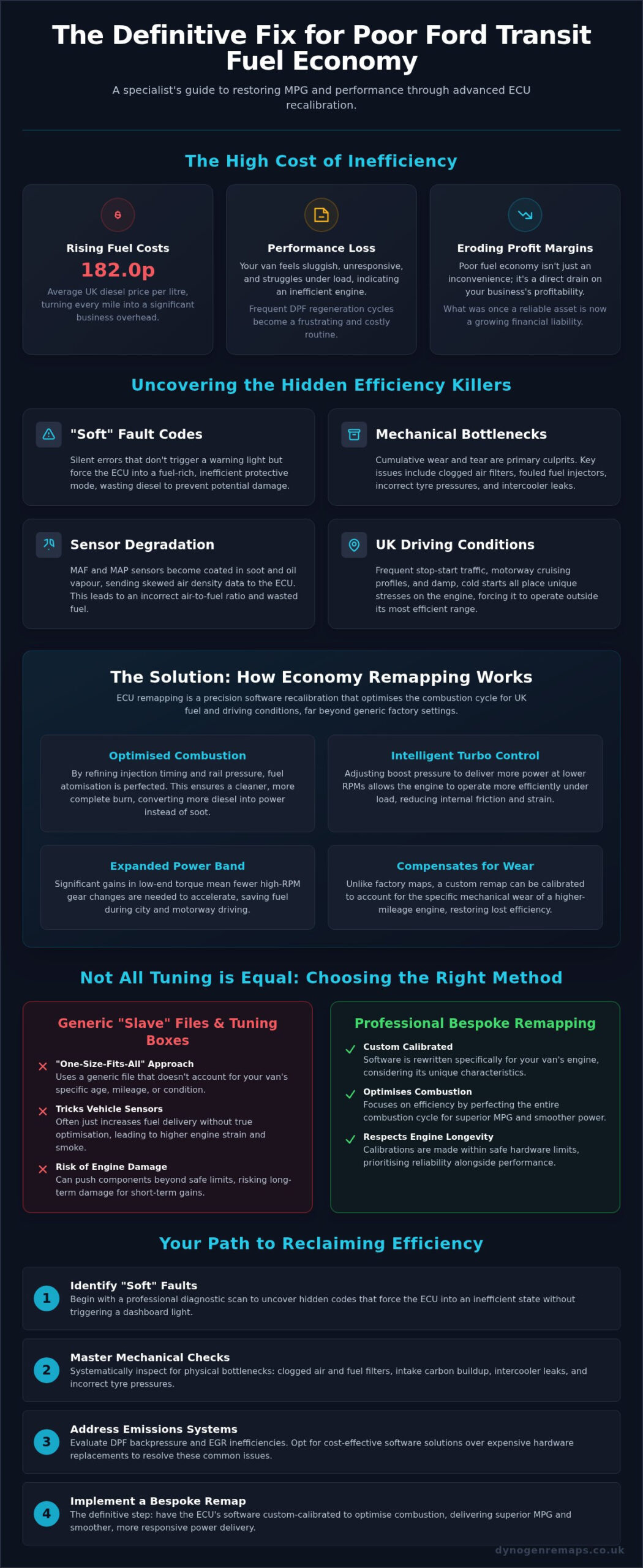
Achieving a definitive Ford Transit poor fuel economy fix begins with a methodical diagnostic approach. Efficiency loss is rarely the result of a single catastrophic failure; it is typically a cumulative effect of mechanical wear and software limitations. We frequently observe that even well-maintained vans suffer from “soft” fault codes. These are errors that don’t trigger a dashboard warning light but still force the ECU into a protective state, often increasing fuel delivery to prevent engine damage at the cost of your MPG.
Mechanical bottlenecks remain a primary concern for high-mileage Transits. Clogged air filters restrict the oxygen required for efficient combustion, whilst leaking or carbon-fouled injectors result in poor fuel atomisation. Even seemingly minor issues like incorrect tyre pressures can significantly increase rolling resistance. Understanding the various factors that influence fuel economy is essential for any fleet operator or sole trader looking to protect their margins. Beyond these physical checks, sensor degradation is a silent efficiency killer. The Mass Air Flow (MAF) and Manifold Absolute Pressure (MAP) sensors provide the ECU with critical data regarding air density and volume. When these sensors become coated in oil vapour or soot, they provide skewed readings, leading to an incorrect fuel-to-air ratio that wastes diesel without providing additional power.
Mechanical vs. Software Faults
Distinguishing between a physical component failure and a software-based limitation is a core skill of the seasoned specialist. If your Transit is over-fuelling, you might notice dark exhaust smoke or a distinct lack of low-end torque. Whilst a mechanical repair like replacing a faulty sensor is sometimes necessary, software optimisation often provides a more significant return on investment. Many factory-standard ECU maps are designed as a “one size fits all” solution. They don’t account for the specific hardware wear of an older engine, whereas custom-calibrated software can compensate for these variances to restore lost efficiency.
The Impact of UK Driving Conditions
British driving environments place unique stresses on the Ford Transit. Frequent stop-start traffic in major urban hubs forces the engine to operate in its least efficient range, often leading to rapid carbon buildup in the EGR system. Motorway cruising requires a specific torque profile that many factory maps fail to provide, forcing the driver to use more throttle to maintain speed. Additionally, the British climate plays a role; frequent cold starts in damp conditions prevent the engine from reaching its optimal operating temperature quickly, which significantly increases fuel consumption during the first few miles of every journey.
The Science of Economy Remapping: How Software Fixes MPG
Economy remapping is the precision recalibration of the Engine Control Unit (ECU) to enhance the efficiency of the combustion cycle. While factory settings are designed to accommodate poor fuel quality and varying global climates, a professional Ford Transit poor fuel economy fix focuses on the specific requirements of UK diesel and local operating environments. By refining the injection timing and increasing rail pressure, we achieve superior fuel atomisation. This ensures that every drop of diesel is converted into kinetic energy rather than wasted as heat or soot, resulting in a cleaner, more efficient burn that directly translates to more miles per gallon.
Adjusting turbo boost pressure allows the engine to breathe more effectively at cruising speeds. When the ECU is calibrated to deliver higher boost at lower RPMs, the engine operates more efficiently under load, effectively reducing the internal friction losses associated with higher engine speeds. This technical advancement unlocks significant low-end torque, which fundamentally changes how the van handles heavy payloads. By expanding the “sweet spot” of the engine’s power band, we reduce the need for high-RPM gear changes that traditionally drain the fuel tank during acceleration.
Optimising Fuel Maps for Commercial Use
A generic “tuning box” simply tricks sensors into providing more fuel, often leading to engine strain and poor results. In contrast, a bespoke Ford Transit economy remap involves a deep-level rewrite of the engine’s software. We can tailor the maps based on whether your van is consistently laden with heavy equipment or running unladen for multi-drop deliveries. By removing the conservative factory-imposed safety buffers designed for global markets, we reclaim the efficiency that Ford engineers left on the table during the initial production phase. Drivers often find that choosing a professional Economy Remap pays for itself within months through significantly reduced weekly fuel spend.
Torque and Drivability Improvements
A smoother, more linear torque curve is the key to preventing unnecessary downshifting on inclines. When the engine has ample torque available at 1,500 to 2,000 RPM, the driver no longer needs to floor the accelerator to maintain momentum on motorways. This creates a calmer driving experience, reducing the aggressive throttle inputs that typically ruin MPG in high-pressure commercial environments. Torque optimisation reduces fuel waste at 70mph by allowing the vehicle to maintain cruising speed with minimal throttle opening. Combining this software upgrade with a practical checklist for improving fuel economy can lead to substantial long-term savings for any fleet operator or independent tradesperson.
Addressing Emissions Systems: DPF and EGR Software Solutions
Emissions systems are often the primary culprits behind a sudden drop in MPG. While they are designed to reduce pollutants, their failure or sub-optimal operation transforms them into parasitic drains on your engine’s efficiency. A clogged Diesel Particulate Filter (DPF) creates significant backpressure within the exhaust system. This restriction forces the engine to work harder to expel waste gases, which directly increases fuel consumption. For many owners, a professional Ford Transit poor fuel economy fix must address these hardware restrictions through intelligent software management.
Active Regeneration cycles represent a significant hidden fuel cost. During this process, the vehicle’s computer injects additional diesel into the exhaust stroke to incinerate soot within the filter. If your van is frequently stuck in these cycles due to stop-start UK traffic, you are essentially burning excess fuel without gaining any mileage. Understanding how an Engine Control Unit works is essential to solving this problem; the ECU dictates when and how these regenerations occur. By recalibrating this logic, we can ensure the system operates only when necessary, preserving your fuel for the road rather than the filter.
The DPF Fuel Economy Trap
DPF health is intrinsically linked to engine load and driving style. When the filter becomes restricted, you’ll notice symptoms such as a sluggish throttle response and a noticeable drop in MPG. Implementing software solutions for DPF issues allows the engine to breathe more freely by optimising the soot-loading parameters. This prevents the van from entering “Limp Mode” and eliminates the constant, fuel-heavy regeneration cycles that plague high-mileage commercial vehicles.
EGR Valve Calibration
Exhaust Gas Recirculation (EGR) valves are notorious for ruining combustion efficiency by introducing inert exhaust gases back into the intake. Whilst this reduces nitrogen oxide emissions, it often leads to heavy carbon buildup that chokes the engine over time. Software-based EGR Solution ensures the valve operates with precision, preventing the intake manifold from becoming restricted. It’s important to ensure any software adjustments remain MOT compliant. Reputable specialists focus on optimising these systems to maintain a balance between environmental responsibility and the operational efficiency required for a profitable business.
A Practical Checklist for Improving Your Transit’s Fuel Economy
Immediate gains are often found in the technical details of your service schedule. Using the correct grade of low-ash engine oil is non-negotiable for Euro 6 engines, as it prevents premature DPF clogging and reduces internal friction. We frequently encounter Transits with sticking brake calipers, a fault that creates constant drag and ruins efficiency whilst often going unnoticed by the driver during normal operation. Cleaning the Mass Air Flow (MAF) sensor every 20,000 miles ensures the ECU receives precise data for fuel-air mixing, effectively preventing the over-fuelling that leads to high weekly costs.
Long-Term Strategic Upgrades
Beyond software-based improvements, physical modifications can also play a vital role in fleet efficiency. For businesses exploring bespoke vehicle builds or conversions, the specialists at Auto Industries Factory LLC offer professional fabrication services tailored to specific commercial requirements.
Investing in your van’s software is a strategic move that yields significant dividends over time. Calculating the ROI of an economy tuning service typically reveals that the initial cost is recouped within months for high-mileage operators. Speed limiters also play a vital role in fleet management, as aerodynamic drag increases exponentially once you exceed 60mph. Beyond the pump, the ECU remapping benefits include reduced component wear and smoother power delivery, which protects your vehicle’s long-term resale value. To secure these professional results for your fleet, book an economy remap with our specialist team today.
Professional Economy Tuning: The Dynogen Remapping Approach
Dynogen Remapping Solutions specialises in delivering a bespoke Ford Transit poor fuel economy fix that prioritises technical precision over generic speed. Unlike many tuning shops that rely on “slave” files, which are unrefined copies of software applied to every vehicle regardless of its history, we develop custom-calibrated solutions tailored to your van’s specific condition. With over 15 years of technical expertise, we understand that an engine with 100,000 miles requires a different calibration approach than a brand-new vehicle. Our seasoned specialists focus on optimising the delicate balance between injection timing, boost pressure, and torque delivery to ensure your vehicle achieves its maximum efficiency potential.
The process begins with a comprehensive vehicle health check to ensure all mechanical components are fit for the upgrade. We then read the original software from your ECU and modify it within safe engine parameters, ensuring that longevity is never sacrificed for short-term gains. Every remap concludes with a thorough road test and data logging session, allowing us to verify that the real-world performance matches our technical projections. This methodical, logical flow ensures that when you leave our centre, your Transit is operating at the absolute peak of its efficiency.
The Dynogen Difference
Our commitment to workmanship means we place as much emphasis on engine longevity as we do on performance and economy. For those seeking a blend of power and efficiency, our Stage 1 performance remaps provide a sophisticated solution that transforms the driving experience whilst maintaining reliability. We also support fleet managers with national software solutions, providing a consistent standard of excellence across multiple vehicles to ensure operational costs remain low across the entire business.
Getting Started with Your Fix
Booking a technical consultation is the first step toward a definitive Ford Transit poor fuel economy fix. When you visit our specialised centre, you can expect a professional, business-like environment where technical excellence is the priority. We guide you through the entire remapping process, explaining the specific adjustments made to your vehicle’s software. Our post-remap support is a core part of the Dynogen commitment; we remain available to ensure you’re completely satisfied with the results. If you’re ready to lower your fuel spend and restore your van’s performance, our team is prepared to deliver a superior, personalised alternative to standard dealership options.
Maximising Your Transit’s Efficiency for the Road Ahead
Restoring your van’s performance in 2026 requires a shift from basic maintenance to sophisticated software management. By identifying the cumulative effects of mechanical wear and emissions system restrictions, you can implement a definitive Ford Transit poor fuel economy fix that protects your bottom line. We’ve demonstrated that custom-calibrated software offers a superior alternative to generic files, allowing for precision adjustments that respect engine longevity whilst significantly lowering operational costs. Addressing the root causes of inefficiency ensures your vehicle remains a reliable asset rather than a financial drain.
Dynogen Remapping Solutions brings over 15 years of technical expertise to every project, providing expert software solutions for complex DPF, EGR, and AdBlue faults. Our focus on pride in workmanship ensures that your vehicle receives a bespoke recalibration tailored to your specific driving requirements. Don’t let rising diesel prices and sluggish performance dictate your business’s success. Take the professional step towards a more responsive and efficient vehicle today. Contact Dynogen Remapping Solutions for your professional Transit economy fix and reclaim the driving experience you deserve. We look forward to helping you achieve peak efficiency.
Frequently Asked Questions
How much extra MPG can I expect from a Ford Transit economy remap?
A Stage 1 economy remap on a Ford Transit typically results in a fuel economy improvement of 4-8 mpg. This gain is achieved by precisely optimising the injection timing and turbo boost parameters to ensure more complete combustion. While individual results vary based on your specific payload and driving style, most commercial operators notice a significant reduction in their weekly fuel spend. This technical enhancement allows the engine to produce more torque at lower RPMs, reducing fuel waste.
Will remapping my Transit for fuel economy affect my MOT result?
A professional economy remap won’t negatively affect your MOT result as it’s designed to operate within legal emissions frameworks. Our software recalibrations focus on improving the efficiency of the combustion cycle, which often leads to a cleaner-running engine with reduced soot output. While we provide technical solutions for DPF and EGR systems, we ensure the vehicle remains compliant with UK smoke opacity tests. It’s essential to use a specialist who understands Euro 6 standards to maintain legality.
Can a faulty EGR valve really cause poor fuel economy?
A faulty Exhaust Gas Recirculation (EGR) valve is a frequent culprit behind a Ford Transit poor fuel economy fix. When the valve sticks or becomes clogged with carbon, it can recirculate too much exhaust gas or leak boost pressure, forcing the engine to over-fuel to compensate for the lack of oxygen. This inefficiency leads to a sluggish throttle response and increased soot production. Our EGR software solutions recalibrate the valve’s behaviour to ensure optimal air intake and combustion efficiency.
Is remapping safe for high-mileage Ford Transit engines?
Remapping is safe for high-mileage Transits provided a comprehensive health check is performed before the software is modified. Unlike generic “slave” files, our custom-calibrated software respects the specific wear and tear of an older engine by maintaining safe thermal and mechanical limits. We adjust the torque delivery to protect the drivetrain whilst still unlocking the efficiency gains. With over 15 years of technical expertise, we ensure that the recalibration enhances the vehicle’s reliability rather than compromising its longevity.
How long does it take to perform a fuel economy software fix?
A professional economy remap typically takes between 90 minutes and three hours to complete. This duration allows our specialists to perform an initial diagnostic scan, read the original ECU software, and apply a bespoke calibration tailored to your vehicle’s needs. The process concludes with a road test to verify the improvements in throttle response and power delivery. It is a methodical process that ensures every software modification is perfectly integrated with your Transit’s existing hardware and sensors.
Will an economy remap reduce the power of my van?
An economy remap doesn’t reduce the power of your van; it actually increases low-end torque to improve drivability. By widening the engine’s power band, the vehicle can maintain cruising speeds with less throttle input, which is the key to saving fuel. You’ll find the van feels more responsive and capable when carrying heavy loads. The goal is to provide smoother power delivery that reduces the need for frequent gear changes, resulting in a more relaxed driving experience.
Why doesn’t Ford set the Transit to the most efficient map from the factory?
Ford must calibrate the Transit to operate in diverse global markets with varying fuel qualities and extreme climates. These factory maps are conservative compromises designed to ensure the engine survives sub-standard diesel or neglected service intervals in any country. By applying a professional Ford Transit poor fuel economy fix, we can remove these generic safety buffers. This allows us to optimise the software specifically for high-quality UK diesel and local driving conditions, reclaiming the efficiency lost to global standardisation.
Can I reverse an economy remap if I sell the vehicle?
An economy remap is entirely reversible should you decide to return the vehicle to its factory settings before a sale. We always retain a secure backup of your original ECU software, allowing us to flash the factory map back onto the vehicle at any time. However, most buyers view a professional economy calibration as a value-added feature, especially given the rising costs of commercial operation. The process is non-invasive and leaves no physical footprint on the engine’s external components.