

What if the sudden loss of throttle response and those dreaded dashboard warning lights aren’t signs of a mechanical catastrophe, but rather a software misunderstanding? It’s a scenario we see frequently: a vehicle enters a restricted performance state, leaving the driver to wonder, will a remap fix limp mode, or am I facing an eye-watering repair bill from a main dealer? You likely feel the frustration of intermittent faults that your local garage can’t seem to pin down, especially when the car feels perfectly healthy one moment and completely powerless the next whilst joining a motorway.
We understand that you want a permanent fix for these power losses without replacing expensive hardware unnecessarily. This technical guide will help you distinguish between genuine mechanical failure and software-induced restrictions. We’ll examine how professional ECU recalibration addresses issues with components like the DPF or EGR valve, providing a sophisticated alternative to standard repairs. By the end of this article, you’ll understand exactly why your ECU is restricting performance and how a precision Stage 1 or emissions-specific remap can restore your driving experience to its peak potential.
Key Takeaways
- Identify the specific triggers that cause your ECU to activate a restricted performance state and how these protective measures safeguard your engine from further damage.
- Discover the precise technical circumstances under which a professional remap will fix limp mode by recalibrating software thresholds for emissions-related components.
- Learn how to distinguish between physical hardware failures and software-based errors to avoid expensive and unnecessary component replacements at a main dealership.
- Explore how specialised DPF and EGR software solutions can permanently resolve persistent dashboard warnings whilst restoring your vehicle’s lost power and throttle response.
- Understand the vital role of expert diagnostics and custom-calibrated software in successfully identifying and rectifying complex, intermittent vehicle faults that generic tools often miss.
Understanding Limp Mode: Why Your Car Has Lost Power
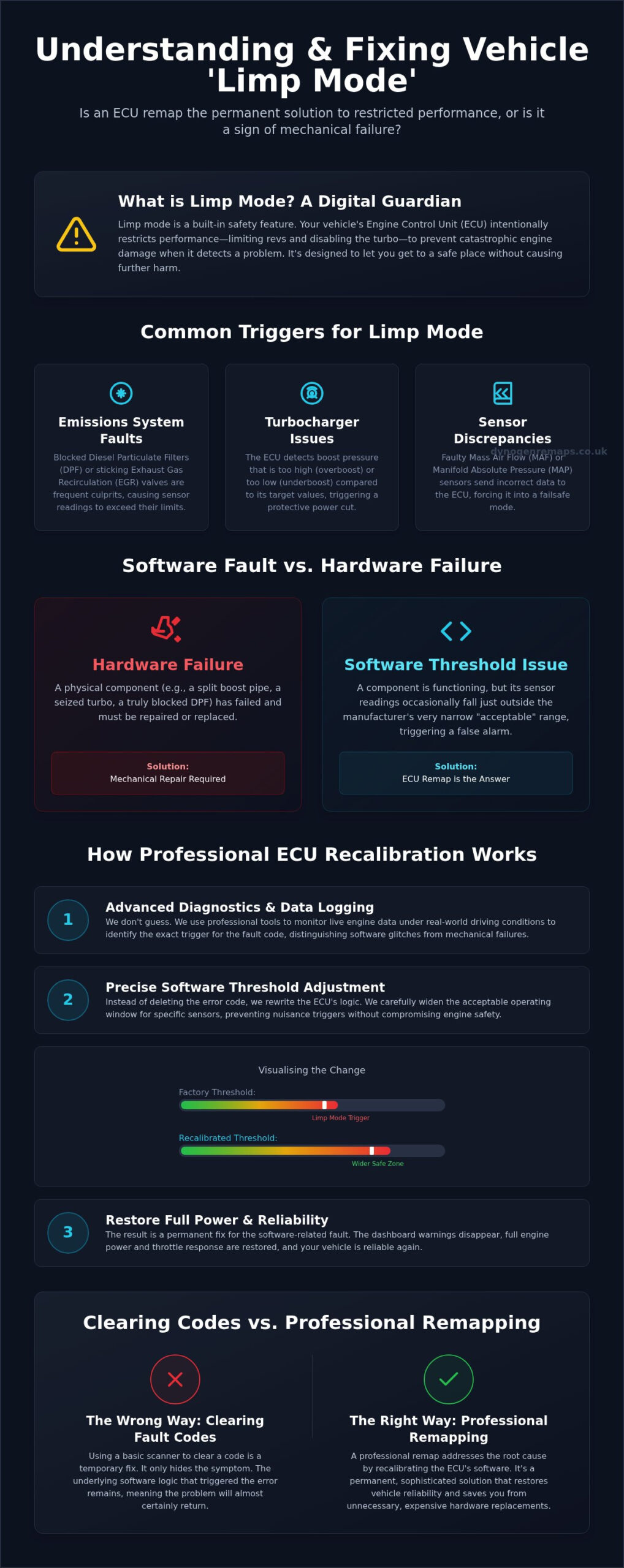
Limp mode is the automotive equivalent of a forced safety shutdown. It’s a protective state programmed into the vehicle’s software to mitigate the risk of severe mechanical damage. When your car enters this reduced power mode, the experience is often jarring. You’ll likely find the engine refuses to rev past a certain point, the turbocharger boost is completely disabled, and the dashboard illuminates with warning symbols. While these symptoms are frustrating, they are entirely intentional. The system is designed to allow you to limp home or to a specialist workshop without causing a total engine meltdown.
The ECUs Role as a Digital Guardian
The sophisticated Engine Control Unit (ECU) acts as the central intelligence of your vehicle, processing thousands of data points every second. It monitors live telemetry from various sensors to ensure the engine operates within strict, factory-defined safe operating parameters. If a sensor reports a reading that deviates from these pre-set limits, such as excessive exhaust gas temperature or a spike in boost pressure, the software immediately intervenes. It overrides your throttle inputs and limits fuel delivery to protect the hardware. This logic is the foundation of modern vehicle safety, yet it leads many drivers to ask: will a remap fix limp mode? The answer depends on whether the trigger is a physical component failure or a software-based threshold issue.
Common Triggers for Limp Mode
Modern diesel and petrol engines rely on complex systems that frequently trigger these safety protocols. Identifying the specific cause is vital before attempting a software solution. The most common culprits include:
- Turbocharger Issues: Overboost or underboost conditions occur when the ECU detects pressure levels that don’t match its target maps.
- Emissions System Faults: Blockages in the Diesel Particulate Filter (DPF) or a sticking Exhaust Gas Recirculation (EGR) valve are notorious for causing persistent power loss.
- Sensor Discrepancies: Failures in the Mass Air Flow (MAF) or Manifold Absolute Pressure (MAP) sensors provide the ECU with corrupted data, forcing it into a failsafe state.
Whilst mechanical components can fail, many of these triggers are actually software-governed boundaries. Our technical approach focuses on identifying if these limits are being triggered prematurely or if the hardware truly requires replacement. In many scenarios, a precision remap can recalibrate these boundaries to resolve the issue permanently.
For owners of Japanese vehicles, consulting a specialist repair facility such as Speedy Roo Motorsports & Repair Inc provides an excellent example of how expert mechanical diagnostics can pinpoint hardware issues before considering software recalibration.
How ECU Remapping Interacts with Engine Fault Codes
Many drivers believe that using a basic OBD-II scanner to clear a fault code is a permanent solution. It isn’t. Clearing a code merely hides the symptom; it doesn’t change the logic that caused the ECU to flag the error in the first place. This is where the question, will a remap fix limp mode, becomes nuanced. Unlike a simple reset, a professional remap involves rewriting the software logic to handle specific data inputs more effectively. We don’t just delete the warning; we address why the software decided to trigger it.
Adjusting Software Thresholds
Software recalibration allows us to adjust the “acceptable” ranges for various engine sensors. Every component has a tolerance level set by the manufacturer during development. Over time, or due to slight variations in hardware performance, a sensor might report data that sits just outside this narrow factory window, triggering a failsafe state. By identifying the exact map responsible for this trigger, we can widen these thresholds slightly. This ensures that nuisance triggers don’t interrupt your drive whilst still maintaining the core safety protections that prevent actual engine damage. Understanding how car computers and sensors interact is key to appreciating why these precise software adjustments are so effective at maintaining vehicle uptime.
Diagnosing Before Calibrating
We never apply a software solution without a thorough diagnostic phase. Professional-grade equipment allows us to distinguish between “ghost” codes, which are often software glitches, and genuine mechanical failures. Data logging is our most powerful tool in this process; it lets us observe real-time engine behaviour under actual load conditions. If we see a turbocharger struggling to meet its target because of a split hose, we won’t suggest a software change. We’ll recommend a mechanical repair. However, if the hardware is healthy but the factory software is overly sensitive to a specific emissions cycle, a custom calibration is the superior choice. If you’re wondering, will a remap fix limp mode for your specific vehicle, a proper diagnostic session is the only way to get a definitive answer.
This methodology forms the backbone of our safe engine tuning UK philosophy. We focus on longevity and reliability, ensuring that every modification enhances the vehicle’s performance without compromising its mechanical integrity. If you’re tired of seeing the same warning lights return every week, our expert technical software solutions can provide the permanent resolution you’ve been searching for.
Software Fix vs Hardware Repair: When a Remap is the Answer
Distinguishing between a physical component failure and a software-induced restriction is the most critical step in your diagnostic journey. Whilst many mechanics default to replacing expensive sensors or mechanical parts, the reality is often found within the code. To determine if a remap will fix limp mode, we must evaluate whether the vehicle’s Onboard Diagnostics (OBD) system is reporting a genuine mechanical catastrophe or merely a data discrepancy that exceeds factory-set tolerances. Choosing software calibration over hardware replacement can save you hundreds of pounds in unnecessary parts and labour.
When Remapping is the Correct Solution
Software recalibration is the superior choice when the hardware is fundamentally sound but the ECU logic is too restrictive. Manufacturers often program extremely narrow operating windows to account for poor fuel quality or extreme climates that we simply don’t experience in the UK. If your vehicle suffers from limp mode due to an overly sensitive sensor or a software glitch following a previous low-quality stage 1 remap, a custom software correction is the only way to achieve a permanent fix. This approach is also essential when resolving faults related to bypassed emissions components, where the software must be taught to ignore missing data from sensors that are no longer active.
When Hardware Repair is Essential
Precision software cannot mend a broken physical component. If your vehicle has a snapped boost hose, a seized turbocharger vane, or a failing high-pressure fuel pump, remapping is neither safe nor effective. Attempting to tune out a genuine mechanical fault is dangerous; it bypasses the safety protocols that prevent engine failure. Our 15 years of technical expertise allows us to identify these physical limitations during the initial data logging phase. If we detect electrical wiring loom damage or corroded connectors, we’ll always prioritise the mechanical integrity of your vehicle over a software-only approach.
Once the mechanical foundation is verified, the ECU remapping benefits extend far beyond simply extinguishing a warning light. A professional calibration restores lost throttle response and often improves fuel efficiency by optimising the combustion cycle. We provide a sophisticated, data-driven alternative to the “parts-darts” approach often found at standard dealerships, ensuring your car returns to the road with improved performance and total reliability.
Common Faults Resolved via Technical Software Calibration
Modern vehicles are increasingly reliant on complex emissions and pressure-management systems that, whilst beneficial for the environment, are often the primary cause of sudden power loss. When considering if a remap will fix limp mode, it is essential to look at the specific emissions-related triggers that frequently plague modern diesel engines. Our technical approach focuses on recalibrating the software logic governing these components, providing a permanent resolution to faults that standard mechanical cleaning often fails to address.
Emissions System Software Solutions
Emissions components like the Diesel Particulate Filter (DPF) and Exhaust Gas Recirculation (EGR) valve are notorious for triggering restricted performance modes. A DPF Solution involves modifying the ECU software to stop the system from requesting active regenerations, which is particularly effective if the filter has become chronically blocked. Similarly, an EGR Solution allows us to command the valve to remain in a closed position via software. This prevents carbon-heavy exhaust gases from entering the intake manifold, stopping the buildup that typically causes the valve to stick and trigger a fault code. For those facing the dreaded non-start countdown, an AdBlue Solution can resolve sensor communication errors that would otherwise leave the vehicle immobilised on the driveway.
Turbo and Boost Pressure Management
Turbocharger “overboost” is another frequent cause of limp mode, particularly in vehicles equipped with Variable Nozzle Turbine (VNT) technology. If the ECU detects that boost pressure has exceeded its target for even a fraction of a second, it will immediately cut power to protect the engine. Professional software calibration allows us to smooth out the boost delivery and adjust the MAP sensor linearisation to match the vehicle’s actual performance. This is especially vital when hardware upgrades have been installed, as the factory software will not understand the increased airflow without a precision recalibration. By refining the throttle response and boost curves, we eliminate the sudden torque spikes that often lead the ECU to initiate a safety shutdown.
Beyond simply resolving faults, many drivers opt for diesel economy tuning UK to improve the overall reliability and efficiency of their vehicles. These calibrations optimise the combustion cycle, reducing the strain on emissions components and preventing future blockages. If your vehicle is currently restricted by emissions-related errors or boost discrepancies, our bespoke software solutions offer a permanent, technical resolution that restores your car’s true potential. We pride ourselves on delivering results that exceed the limitations of factory-standard software.
Professional Diagnostics and Custom Software at Dynogen
Choosing the right specialist is the most critical decision you’ll make when your vehicle is trapped in a restricted performance state. With over 15 years of technical expertise, Dynogen Remapping Solutions has evolved alongside automotive technology, positioning us at the leading edge of ECU software solutions. We understand that a generic approach often fails to address the underlying complexities of modern engine management. When you ask, will a remap fix limp mode, our answer is rooted in a methodical, data-driven process that prioritises your vehicle’s long-term health over a quick, temporary fix.
The Dynogen Diagnostic Process
Precision begins with identifying the exact cause of a fault rather than simply treating the symptoms. We utilise advanced, dealer-level diagnostic equipment to interface with your vehicle’s control systems, ensuring every error code is interpreted with clinical accuracy. Our specialists perform comprehensive data logging whilst the engine is under various driving conditions, allowing us to analyse live parameters amongst real-world scenarios. This meticulous approach ensures we identify the root cause of the power loss, whether it’s a software threshold issue or a genuine mechanical failure. Before we commit to any calibration, we provide a clear technical report so you can make an informed decision about your vehicle’s repair path.
Bespoke Software for Lasting Results
Generic “off-the-shelf” maps are often the culprit behind persistent dashboard errors because they fail to account for individual vehicle wear or UK-specific environmental factors. We develop custom calibrations that are written specifically for your engine, turbocharger, and emissions system. This level of precision is why a remap will fix limp mode when generic tuning centres fail; we adjust the software to work in harmony with your car’s unique mechanical state. By choosing a seasoned specialist, you avoid the risks associated with poor-quality software that can exacerbate existing faults or trigger new failsafe protocols. Our commitment to technical excellence ensures that your vehicle returns to the road more powerful, more efficient, and entirely reliable.
Don’t settle for standard corporate or dealership options that default to expensive hardware replacements. Resolve your limp mode issues today with Dynogen’s expert vehicle tuning services and experience the difference that 15 years of specialist knowledge makes to your driving experience.
Restore Your Vehicle’s Performance with Technical Precision
Identifying the true cause of restricted engine power is the first step toward reclaiming your car’s potential. This guide has detailed how professional calibrations address the root causes of power loss by refining software thresholds that factory settings often leave too narrow. Whether you’re battling a stubborn DPF error or an intermittent boost fault, the question of will a remap fix limp mode is best answered through elite-level diagnostics and bespoke software that standard garages simply cannot provide.
Our team brings over 15 years of technical experience to every vehicle, ensuring that our custom software calibrations provide a permanent resolution rather than a temporary mask. By choosing a seasoned specialist over a standard dealership, you protect your engine’s longevity whilst avoiding unnecessary hardware costs. It’s time to move past the frustration of restricted power and regain the driving experience you deserve. We’re here to ensure your vehicle operates at its peak with total reliability and refined performance.
Get a Professional Diagnostic and Remap Quote from Dynogen
Frequently Asked Questions
Can a remap fix limp mode caused by a DPF fault?
A professional DPF Solution can resolve limp mode by recalibrating the ECU to stop requesting regenerations or monitoring specific soot thresholds. This software-based modification is highly effective when the hardware is sound but the factory parameters are too restrictive. It provides a permanent fix for the power loss associated with chronic blockages. However, we always perform a full diagnostic check first to ensure no other underlying engine faults are contributing to the issue.
Is it safe to remap a car that is currently in limp mode?
It is safe and often necessary to remap a car in limp mode when the software is the intended solution for the fault. Our process involves identifying the root cause through dealer-level diagnostics before applying any changes. If the limp mode is triggered by a software threshold or an emissions component that requires a technical solution, remapping is the correct path. We never apply performance files to a vehicle with unresolved mechanical damage.
Will a remap permanently delete the engine management light?
A remap will permanently resolve the engine management light if the light is triggered by a component we are specifically addressing with a technical solution. For example, an EGR Solution or DPF Solution recalibrates the ECU to ignore specific data that usually triggers the warning. Simply “deleting” the light without addressing the logic is a temporary fix; our custom-written software ensures the fault does not return by modifying the underlying software boundaries.
How much does it cost to fix limp mode with a remap?
The cost of resolving limp mode through software varies depending on the vehicle’s make, model, and the complexity of the required solution. Every vehicle has a different ECU type that may require specific access methods or custom coding. Because we provide bespoke calibrations rather than generic files, we recommend contacting us for a direct quote. This ensures you receive a price tailored to your specific technical needs and performance goals whilst maintaining elite standards.
Can a bad remap actually cause limp mode?
Yes, a poor-quality or generic “off-the-shelf” map is a common cause of restricted performance. If a file requests too much boost pressure or creates sudden torque spikes, the ECU will trigger a safety shutdown to protect the engine. This is why the question, will a remap fix limp mode, often leads back to replacing a bad map with a custom-calibrated one. Our precision tuning ensures all parameters remain within safe mechanical limits at all times.
What happens if I drive my car whilst it is in limp mode?
Driving in limp mode is designed for short, emergency journeys only. Whilst the ECU reduces power to protect the engine, the underlying fault could still cause damage if ignored. For instance, a turbocharger overboost issue or a fuel delivery fault could lead to catastrophic failure if the vehicle is driven under heavy load. You’ll also experience a significant lack of throttle response, which can be dangerous when merging into fast-moving traffic or climbing hills.
Will a remap fix a turbocharger failure?
No, software cannot repair physical hardware damage such as a snapped turbo shaft or seized vanes. If a turbocharger has failed mechanically, it must be replaced or refurbished before any remapping takes place. However, if the “failure” is actually a software-triggered overboost fault caused by overly sensitive factory parameters, a custom remap can often resolve the issue without the need for expensive new hardware. Proper technical diagnostics are vital to making this distinction accurately.
Do I need to fix mechanical issues before getting a performance remap?
Yes, your vehicle must be in good mechanical health before we apply a Stage 1 Performance Remap. Tuning an engine that already has underlying issues, such as leaking injectors or a worn clutch, will only accelerate those problems. We always start with a comprehensive diagnostic check to verify the health of your engine. If we find mechanical faults, we’ll advise you to resolve them before we proceed with any performance enhancements to ensure total reliability.