

What if the frustratingly sluggish throttle response and capped performance of your vehicle aren’t mechanical flaws, but intentional software restrictions? You’ve likely noticed your car feels restrained, as if it’s holding back despite your foot being firmly down. It’s a common grievance amongst modern drivers who feel disconnected from their vehicle’s true potential. When you choose to unlock engine power software through professional calibration, you aren’t forcing the engine beyond its physical limits; you’re simply restoring the optimal settings that manufacturers often dial back to meet broad commercial requirements.
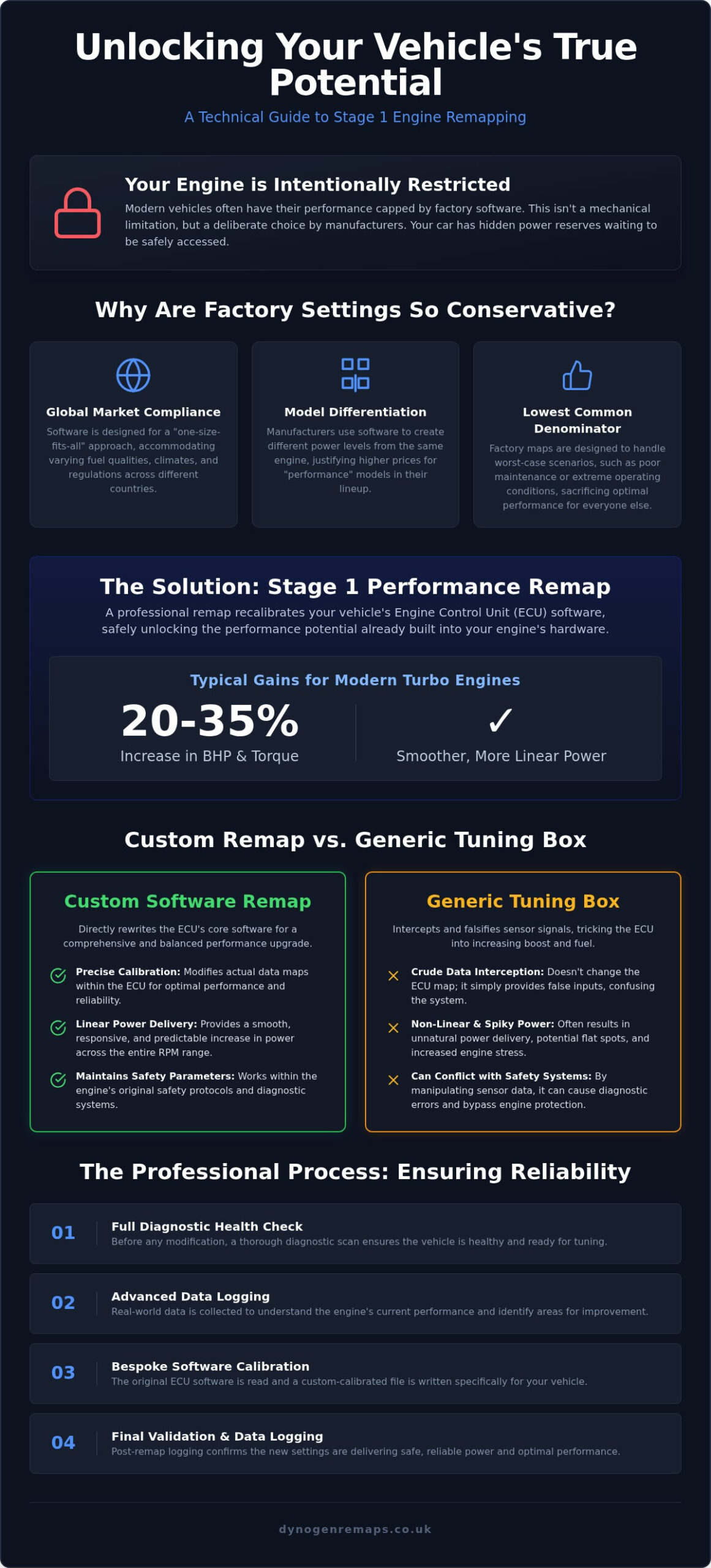
We understand the hesitation that comes with modifying your engine’s electronic control unit, especially whilst facing conflicting information regarding generic tuning boxes versus custom remaps. This guide provides a clear, technical look at how a Stage 1 Performance Remap safely releases hidden reserves, typically offering gains of 20 to 35 per cent on modern turbo engines. You’ll discover the meticulous science behind ECU remapping, giving you the confidence to move beyond factory constraints. We’ll examine the specific mechanics of software adjustment, the vital importance of bespoke files over generic alternatives, and the tangible BHP and torque improvements you can expect from a specialist service.
Key Takeaways
- Learn how the Engine Control Unit acts as the vehicle’s central command, where bespoke software maps dictate the precise behaviour and performance output of your motor.
- Discover the commercial reasons why manufacturers intentionally restrict performance and how to safely unlock engine power software to access your vehicle’s true potential.
- Understand why direct data modification via a custom remap provides a superior, more linear power curve compared to the crude data interception of a generic tuning box.
- Gain insight into the specific technical adjustments of boost pressure and fuel timing that result in typical Stage 1 performance gains of 20 to 35 per cent.
- Recognise the vital importance of professional diagnostic health checks and advanced data logging to ensure long-term engine reliability whilst pursuing peak performance.
What is Engine Power Software and How Does it Work?
Modern vehicles are no longer purely mechanical machines; they are sophisticated computers on wheels. At the heart of this technology sits the Engine Control Unit (ECU), a high-speed microprocessor that serves as the vehicle’s central nervous system. By learning how to unlock engine power software, drivers can bypass factory-set limitations that were never meant to protect the engine, but rather to simplify global production logistics. Historically, performance enthusiasts would physically desolder and replace internal microchips to gain performance, a practice detailed in this overview of What is Chip Tuning?. Today, we utilise non-invasive OBDII or bench remapping techniques to refine the digital instructions that govern your engine’s every move. This digital-first approach remains the most efficient and cost-effective method to increase engine torque and power without the expense or complexity of heavy hardware upgrades.
The Role of the Engine Control Unit (ECU)
The ECU works by processing vast amounts of data from sensors located throughout the powertrain. MAF (Mass Air Flow), MAP (Manifold Absolute Pressure), and O2 sensors provide a constant stream of information, allowing the ECU to execute millions of calculations every second to manage combustion. However, factory software is typically designed for the lowest common denominator, prioritising generic global conditions such as poor fuel quality or extreme temperature variations. A specialist Stage 1 Performance Remap replaces these broad, conservative settings with precise instructions tailored for your specific environment and driving needs. This ensures the engine operates at its peak efficiency whilst maintaining all original safety parameters.
Software Calibration vs. Physical Modification
Engineers build modern powerplants with significant mechanical headroom, meaning the physical components like pistons and bearings can handle far more stress than the factory software allows. Instead of replacing turbochargers or exhaust manifolds, we focus on refining the digital maps that control boost pressure and fuelling. Remapping is the process of replacing factory software with custom-calibrated files. This shift from hardware to software allows for a smoother, more linear and responsive driving experience whilst maintaining the inherent reliability of the engine’s original design. When you choose to unlock engine power software, you are simply accessing the performance potential that was already built into the motor from day one.
How Software Remapping Modifies Engine Parameters
Professional software calibration works by rewriting the specific data tables that govern mechanical hardware. To unlock engine power software effectively, we address several core parameters simultaneously to ensure a balanced, reliable result. This process isn’t about pushing parts to their breaking point; it’s about eliminating the inefficiencies found in conservative factory settings. By refining fuel injection timing, we allow for a more complete burn within the cylinder, extracting maximum energy from every drop of fuel. Advancing ignition timing ensures the spark occurs at the precise millisecond required to capitalise on the piston’s position, resulting in a cleaner and more powerful stroke.
Torque limiters represent another significant area of modification. Many manufacturers apply an electronic leash in the form of software-based caps that restrict output in lower gears or at specific RPM ranges. These limits often exist to differentiate between vehicle models in a manufacturer’s lineup rather than to protect the drivetrain. Removing these restrictions provides a transformative shift in how the car pulls through the gears, providing a sense of urgency that was previously absent.
Optimising the Air-Fuel Ratio (AFR)
Achieving the perfect balance between air and fuel is critical for both performance and engine longevity. Whilst factory maps often run intentionally rich to cool the cylinders, professional remapping identifies a more efficient middle ground. This refinement improves throttle response by removing the artificial delays often programmed into fly-by-wire throttle systems. Even whilst pursuing peak power, we ensure the vehicle remains compliant with relevant emissions regulations, maintaining a responsible and professional approach to technical tuning.
Managing Boost and Turbocharger Behaviour
For turbocharged vehicles, software provides direct control over the wastegate and boost pressure. We can significantly reduce turbo lag by commanding the turbo to spool faster at lower RPMs, providing immediate power when you request it. This adjustment stays strictly within the manufacturer’s mechanical safety margins to prevent over-stressing the turbine or cooling system. Understanding these technical nuances is just one of the many ECU remapping benefits that result in a more linear, predictable power delivery across the entire rev range. If you’re curious about how these specific adjustments could transform your drive, explore our Stage 1 Performance Remap options to see the hidden potential within your engine.
Why Manufacturers Restrict Engine Output
Engineers don’t usually decide to limit an engine’s potential because of mechanical weakness. Instead, these decisions are made in boardroom meetings to satisfy global marketing strategies and production logistics. When you choose to unlock engine power software, you’re essentially reclaiming the performance that was sacrificed for the sake of the manufacturer’s bottom line. This isn’t a case of “overclocking” a fragile component; it’s about removing artificial barriers that were never meant to protect the enthusiast driver.
A primary driver for these restrictions is the “One Engine, Multiple Outputs” strategy. Major automotive groups, such as BMW and the VW Group, frequently use an identical 2.0-litre turbocharged unit across multiple models. By simply changing the software maps, they can sell the same physical engine in various states of tune, perhaps offering 150 BHP in a base model and 230 BHP in a premium variant. This creates artificial price gaps between model tiers, allowing companies to charge thousands of pounds more for “performance” that is already physically present in the entry-level vehicle.
Commercial Tiering and Product Differentiation
This strategic detuning is why Stage 1 performance upgrades are so transformative for modern cars. You aren’t forcing the hardware to perform an impossible task. You’re simply enabling the high-output settings that the manufacturer reserved for their top-tier badges. It’s a logical way to bypass commercial tiering and enjoy the full capabilities of your powertrain. For many owners, it’s the most effective way to gain the performance of a higher-spec model without the associated insurance premiums or initial purchase costs of a flagship variant.
Global Standardisation and Environmental Factors
Global standardisation also plays a significant role in factory detuning. A car leaves the factory with a “one-size-fits-all” map designed to work in every corner of the globe. This means a vehicle in the UK, where high-quality 95 or 98 octane fuel is readily available, is running software designed to tolerate the low-quality 91 octane fuel found in developing markets. These maps must also account for extreme Saharan heat and high-altitude Alpine passes, even if the car never leaves a temperate, sea-level environment. Manufacturers must also account for poor maintenance habits amongst the general public, such as delayed oil changes and the use of inferior filters, by leaving a substantial safety margin in the factory software. By choosing to unlock engine power software, you can optimise your vehicle for the specific fuels and conditions found in your local region, safely utilising that wasted safety margin.
Software Remapping vs. Tuning Boxes: Which is Best?
When looking to unlock engine power software, you’ll inevitably encounter two distinct paths: external tuning boxes and internal ECU remapping. Whilst both aim to increase performance, their methods and results couldn’t be more different. A tuning box is a physical device that intercepts sensor signals, whereas a remap is a sophisticated software overhaul that modifies the engine’s fundamental operating instructions. Understanding these differences is vital for any owner concerned with the long-term health and drivability of their vehicle.
The Limitations of Signal Interception
External tuning boxes operate by “tricking” the ECU. They sit between the engine sensors and the computer, altering the data before it reaches the “brain”. For example, a box might tell the ECU that fuel rail pressure is lower than it actually is, forcing the ECU to compensate by pumping in more fuel. This crude method often results in the ECU fighting the external device as it detects anomalies in the combustion cycle, leading to jerky power delivery or the dreaded “limp mode”. Because these boxes only see a handful of signals, they cannot adjust critical parameters like ignition timing, turbo wastegate behaviour, or speed limiters.
The Superiority of Custom ECU Software
In contrast, a custom remap provides a holistic solution by accessing thousands of individual data tables within the ECU. This allows for a smooth, linear power curve that feels like it came from the factory, only better. Choosing high-quality performance software for cars ensures that all factory engine protections, such as Exhaust Gas Temperature (EGT) monitoring, remain fully active. If the engine gets too hot, the software knows how to dial back the power safely; a tuning box, being blind to these internal protections, might keep pushing until damage occurs.
Professional calibration is the only way to truly unlock engine power software whilst maintaining full diagnostic visibility for your mechanic. We prioritise safe engine tuning in the UK, ensuring that every modification respects the mechanical limits of your specific drivetrain. If you want the most reliable and sophisticated performance upgrade available, book your custom Stage 1 Performance Remap today to experience the difference that expert software calibration makes.
Professional Performance Tuning: Ensuring Reliability and Results
Professional software calibration is a meticulous process that begins long before the first line of code is written. To successfully unlock engine power software, a specialist must first establish a baseline of mechanical health. Unlike amateur “flash-and-go” services, a seasoned specialist treats every vehicle as a unique project, ensuring that the hardware is capable of supporting the digital enhancements. This methodical approach guarantees that the resulting performance gains are both impressive and sustainable over the lifetime of the vehicle.
The core of a high-quality service lies in the distinction between generic, off-the-shelf files and bespoke calibrations. We utilise specialist equipment to perform advanced data logging, monitoring vital parameters like boost pressure, fuel rail pressure, and exhaust gas temperatures in real-time. This data allows us to refine the software precisely for your engine’s specific condition and mileage. By maintaining a steadfast commitment to this level of detail, we ensure that every adjustment remains within safe mechanical tolerances whilst delivering the pursuit of perfection in vehicle performance.
The Importance of a Pre-Remap Diagnostic
A comprehensive pre-remap diagnostic is non-negotiable for any reputable tuner. This involves interrogating the ECU for stored fault codes and physically inspecting critical components such as the turbocharger, DPF, and EGR systems. We also assess the condition of the clutch and drivetrain to ensure they can manage the significant torque increase provided by a Stage 1 Performance Remap. If an engine shows signs of excessive wear or underlying faults, a professional will refuse to proceed until the mechanical issues are resolved. This protective stance ensures the end-user’s experience remains positive and prevents the risk of premature component failure.
What to Expect After Unlocking Engine Power
Once the calibration is complete, the transformation in the driving experience is immediate and profound. You’ll notice substantial improvements in car drivability and throttle response, making the vehicle feel significantly more agile during overtaking and daily commutes. For those driving modern diesel engines, the optimised torque curve often leads to improved fuel economy under normal driving conditions, as the engine requires less effort to maintain cruising speeds. Choosing an expert to unlock engine power software provides the ultimate peace of mind, knowing that your vehicle’s hidden reserves have been released through precise, professional workmanship rather than crude guesswork.
Transform Your Driving Experience Today
Your vehicle’s true capabilities extend far beyond the conservative limits imposed by the factory. By understanding the mechanics of professional calibration, it’s clear that remapping is a sophisticated digital refinement rather than a crude hardware strain. When you choose to unlock engine power software, you are reclaiming the performance and efficiency that was sacrificed for global production logistics. This process ensures a smoother, more responsive drive whilst maintaining the vital safety parameters of your engine’s original design.
Dynogen Remapping Solutions brings over 15 years of specialist tuning experience to every project, utilising advanced diagnostic and remapping equipment to ensure flawless results. We pride ourselves on delivering bespoke software tailored to your specific vehicle, moving beyond generic files to provide a truly personalised upgrade. It’s time to stop settling for a restricted driving experience and start enjoying the precision engineering your car was built for. Discover the true potential of your vehicle with a Dynogen Stage 1 Remap and feel the difference that professional expertise makes on every journey.
Frequently Asked Questions
Is it legal to use software to unlock engine power in the UK?
It is entirely legal to use software to enhance your vehicle’s performance in the UK, provided the modifications don’t cause the car to breach environmental or safety regulations. You must inform your insurance provider of any changes to ensure your policy remains valid. Whilst performance tuning is permitted, the vehicle must still comply with the Road Vehicles (Construction and Use) Regulations regarding emissions levels during road use.
Will unlocking engine power with software void my car warranty?
Modifying your ECU software can potentially void the manufacturer’s warranty on the engine and drivetrain components. If a mechanical failure occurs, the manufacturer may check the software and deny a claim if they find unauthorised changes. However, a remap does not void the warranty on unrelated parts, such as the suspension or electronics. Many owners choose to unlock engine power software after their initial three-year warranty period has expired to mitigate this risk.
Can I revert my car back to the original factory software?
You can absolutely revert your vehicle to its original factory settings at any time. A professional specialist will always take a complete backup of your original ECU file before applying any modifications. This process is non-destructive and allows the vehicle to be returned to stock condition if you decide to sell the car or if it needs to visit a main dealership for a critical manufacturer software update.
How much extra BHP can I expect from a Stage 1 remap?
Typical gains for a Stage 1 Performance Remap on modern turbocharged engines range between 20 and 35 per cent. The exact increase depends on the specific make and model of your vehicle and its current mechanical condition. For example, a standard turbo-diesel or petrol engine often sees a significant leap in both horsepower and torque, providing a much more responsive and linear power delivery without needing hardware changes.
Does remapping software work on both petrol and diesel engines?
Professional remapping software is highly effective for both petrol and diesel engines. Whilst naturally aspirated engines see modest improvements in throttle response and mid-range pull, turbocharged powerplants offer the most dramatic transformations. By choosing to unlock engine power software, you can optimise the boost pressure and fuelling for either fuel type, resulting in a more refined and capable vehicle regardless of the displacement or fuel source.
Will software tuning affect my vehicle’s MOT emissions test?
A high-quality Stage 1 remap should not negatively affect your vehicle’s MOT emissions test. Professional calibration focuses on improving the efficiency of the combustion process, which often keeps emissions within the legal limits. As long as the physical emissions hardware, such as the catalytic converter or DPF, remains intact and functioning correctly, the vehicle will pass the smoke or gas analyser test just as it did with factory software.
Is a custom remap better than a generic tuning chip?
A custom remap is vastly superior to a generic tuning chip or “plug-and-play” box. Whilst chips simply trick a few sensors into providing more fuel, a custom calibration modifies thousands of parameters within the ECU for a holistic result. This ensures all engine safety protections remain active and the power delivery is smooth and predictable, whereas generic chips can cause jerky performance and increased long-term mechanical stress.
How long does the software remapping process usually take?
The professional remapping process typically takes between one and three hours to complete. This duration allows for a thorough pre-installation health check, the reading of the original ECU data, and the careful application of the bespoke calibration. Some modern vehicles with advanced ECU architecture may require slightly longer if the unit needs to be accessed directly on a bench rather than through the standard OBDII port.